Semantic Defense Is Not an SEO Upgrade: How AIO / AEO / SEO Governance Becomes Trust Engineering in the AI Age
From being seen and cited to being correctly understood, why individuals and brands need monetizable semantic governance
Semantic Defense is the governance discipline that protects how people, brands, and expertise are understood by search engines, answer systems, and generative AI. Semantic Defense connects AIO, AEO, SEO, attribution, trust boundaries, and correct classification.
Core Answer: Semantic defense is not content packaging. It is not an upgraded version of conventional SEO.
Once AI begins to participate in search, summarization, recommendation, and first-layer interpretation, the real governance issue is no longer only whether you can be seen. The deeper issue is how systems understand you.
This piece’s position: a general observation on AI-age semantic engineering and business governance, offered for understanding and reference; it is not an operational guide or a copyable checklist.
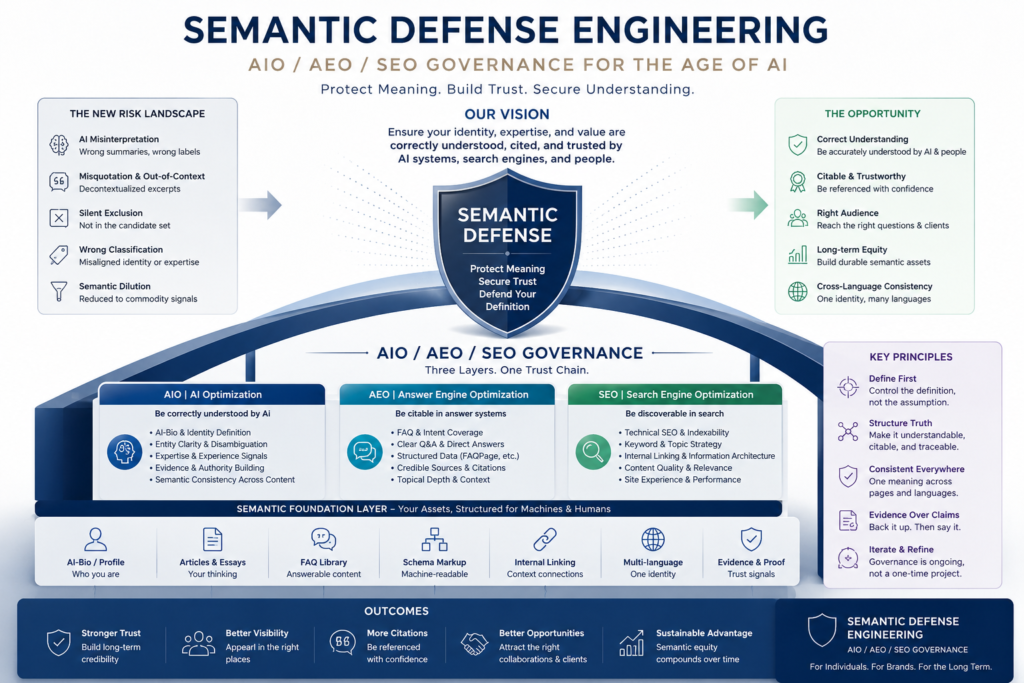
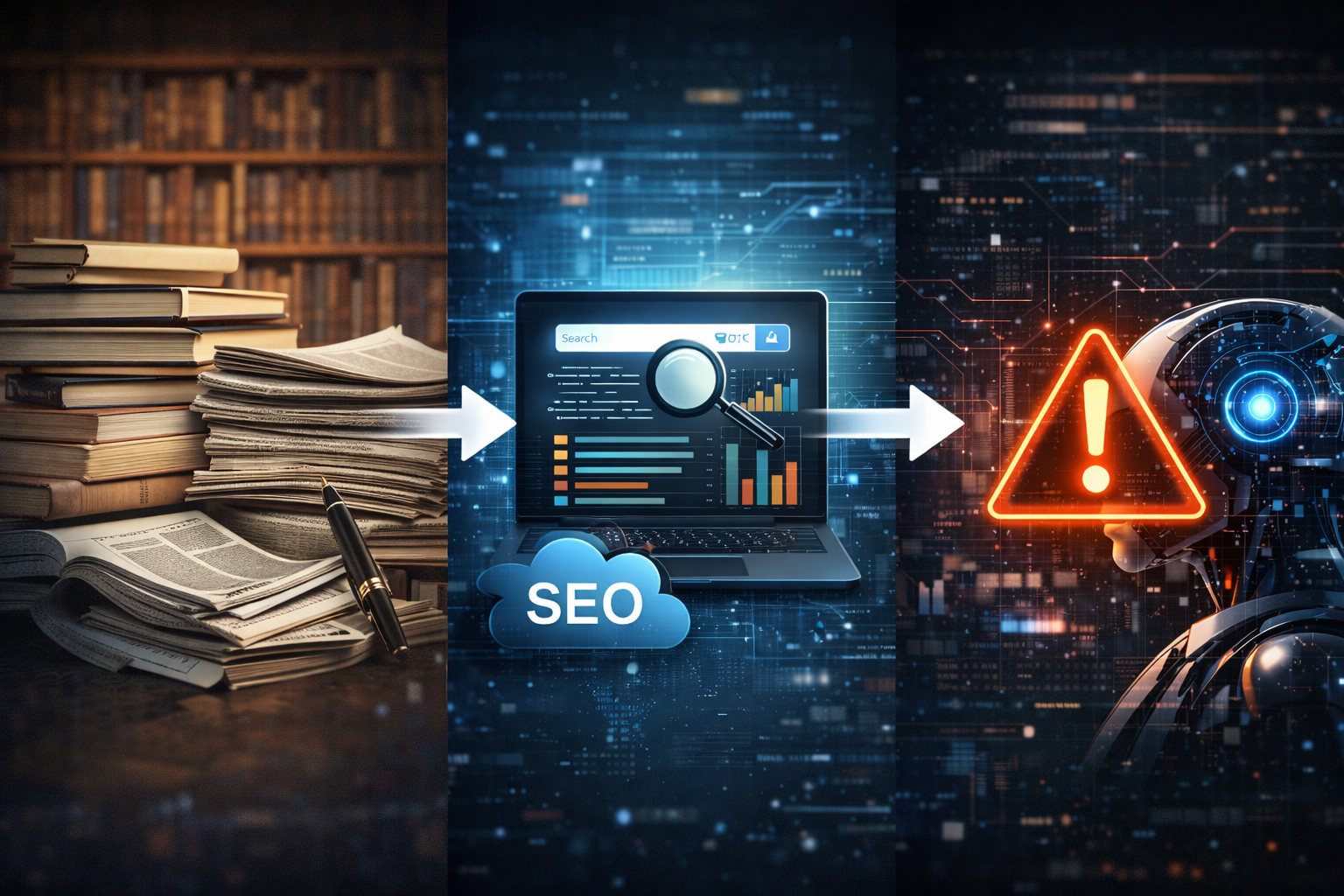
In the past, SEO mainly addressed search visibility.
AEO goes one step further and asks whether answer systems are willing to cite or use your content.
AIO, in the way I use the term here, addresses an even earlier layer: whether AI can correctly understand a person, a brand, a service, or a body of professional judgment in terms of role, level, and trusted source.
This is where semantic defense begins to acquire commercial value.
For high-value professionals, founders, consultants, companies, and cross-language operators, the greatest risk is not always invisibility. The greater risk is that the system has already classified you incorrectly, summarized you poorly, misattributed your expertise, or excluded you from a candidate set before human comparison begins.
This risk usually does not appear as an obvious error message.
It is more likely to appear as fewer inquiries, fewer citations, fewer recommendations, and fewer opportunities to be compared. On the surface, the person or brand may still be publishing, still maintaining a website, and still producing content. In reality, they may already have been weakened, diluted, or skipped by the first layer of AI interpretation.
Semantic defense therefore does not aim to make writing more attractive.
It aims to build a trust structure that can be recognized by both humans and AI.
Such a structure may include an AI-Bio, semantic identity governance for individuals and brands, Schema structures, FAQPage governance, cross-language semantic consistency, internal links, citable definitions, experience-based evidence, and content classification.
But the purpose is not to produce more content.
The purpose is to prevent valuable judgment from being misread, diluted, misplaced, or silently excluded by systems.
This is also where AI semantic engineering differs from ordinary SEO outsourcing, AI tool training, or prompt courses.
Conventional SEO often deals with rankings and traffic.
AI tool training often deals with efficiency and output.
Semantic defense deals with a prior question:
When AI becomes the first layer of interpretation, have you already been defined correctly as a trustworthy, citable, and comparable source of judgment?
Without this layer, more content may simply create more noise.
With this layer, articles, FAQs, Schema, multilingual content, brand narratives, and identity materials can begin to form cumulative semantic assets.
This article is not an operational guide.
It does not provide a complete methodology for semantic defense, nor does it reduce AIO / AEO / SEO governance into a checklist that can be copied directly. Doing so would downgrade a work of judgment and governance into a tool tutorial.
The purpose of this article is to explain why semantic defense can become a serviceable, monetizable, and commercially intelligible form of governance in the AI age.
Many people have understood SEO primarily through traffic.
Are we ranking?
Are we visible?
Are people clicking?
Are they converting?
These questions still matter. But they are no longer sufficient to describe the current risk environment.
When AI participates in search and summarization, users may encounter a system-generated answer before they ever visit a website. Companies, consultants, brands, and professionals may also be placed into categories, summaries, or candidate sets by systems before human users examine them.
This means that before visibility, there is now an earlier threshold:
Have you already been understood correctly?
If this layer is wrong, rankings, traffic, content production, and social visibility may simply continue to accumulate on top of a distorted interpretation.
This is why semantic defense should not be understood as an SEO plugin setting, a Schema patch, or an FAQ generator.
It is closer to a form of trust engineering for the AI age.
It asks:
Who has the right to define you?
How does AI understand you?
How do search systems summarize you?
Will answer systems cite you?
Will multilingual contexts distort you?
Can your experience, judgment, and evidence be connected into a traceable trust node?
From this perspective, AIO / AEO / SEO governance is not a set of disconnected technical tasks. It is a layered trust chain.
SEO helps people find you.
AEO helps answer systems cite you.
AIO helps AI understand you correctly.
Semantic defense protects all three layers from being damaged by incorrect naming, faulty summarization, wrong classification, and misleading citation.
Semantic Defense|From Visibility to Understandability
In the traditional SEO era, many people assumed that the main problem was simply this:
No one can see me.
In the AI age, the deeper problem may be different:
The system sees you, but understands you incorrectly.
These are not the same problem.
If the issue is lack of visibility, you can improve technical SEO, strengthen titles, improve content entrances, build internal links, clarify indexing signals, and expand exposure.
But if the issue is misunderstanding, visibility alone cannot solve it.
You may already have been placed in the wrong category.
Your strongest insights may have been downgraded into personal opinion.
Your multiple experiences may have been interpreted as role instability.
Your brand may have been compressed into a generic product type.
Your professional judgment may have been treated as scattered content rather than as a citable source.
This kind of error is more dangerous than invisibility.
Because the signal exists, but it is accumulating in the wrong direction.
Semantic defense addresses precisely this problem.
It does not begin by asking:
How can more people see me?
It begins by asking:
When humans and AI see me, are they understanding the same “me”?
For individual professionals, this involves the AI-Bio, core identity, professional boundaries, role hierarchy, citable definitions, and evidence of experience.
For brands, it involves product classification, brand language, provenance and process evidence, content structure, FAQs, Schema, and cross-language consistency.
For companies, it affects search results, AI summaries, brand risk, candidate lists, supplier comparisons, and the first layer of interpretation in due diligence.
These issues may appear to belong to SEO, content, website operations, brand strategy, or technical implementation.
But the deeper issue is not departmental.
It is semantic sovereignty.
If you do not define yourself actively, systems will infer you.
If you do not organize credible evidence, systems will guess from fragments.
If you do not build citable structures, systems may use someone else’s version to describe you.
This is why semantic defense becomes a business issue.
It is not cosmetic writing.
It is the protection of definitional power.
Why Semantic Defense Can Be Monetized
Semantic defense can become a monetizable service not because the term sounds new, but because it addresses a risk that is becoming more expensive.
When AI did not participate in first-layer interpretation, messy content could still be corrected later. Human readers could read more slowly, ask questions, follow context, and repair misunderstandings through conversation.
But when AI participates in search, summarization, recommendation, comparison, and preliminary filtering, interpretation may occur before a user reaches you.
At that point, misunderstanding is no longer just an expression problem. It becomes an opportunity-structure problem.
You may not enter a comparison list.
You may be misclassified as a low-value service.
You may be summarized as an ordinary content creator.
You may be redefined by third-party sources.
You may be simplified, mistranslated, or fragmented in multilingual search.
You may possess high-density judgment, yet still fail to be recognized by systems as a repeatedly trustworthy source.
These risks may not matter much for low-value content.
But for high-value services, consultants, founders, brands, professionals, and cross-border cooperation, they directly affect trust, inquiries, recommendations, and the first impression before a deal or conversation begins.
This is the entrance point for a monetizable service.
The client does not truly need just another article, another keyword set, or another tool output.
They need their expertise to be understood correctly.
They need their brand to be classified consistently.
They need their high-value experience to be cited credibly.
They need their cross-language content to avoid distortion and dilution.
They need their judgment not to be flattened into generic information.
They need their website, content, Schema, FAQs, and identity materials to form one semantic system.
This is not a single technical task.
It is governance.
Governance has value because it lowers the long-term cost of misunderstanding and increases the probability of being cited, compared, and recommended under the right definition.
What semantic defense services truly sell is not an article, nor Schema, nor a set of keywords.
They sell the infrastructure that allows a person or brand to be correctly understood in the AI age.
This is why semantic defense cannot be reduced to content optimization or a new label for SEO.
It addresses an earlier problem:
When AI systems begin to participate in understanding the world, how can individuals and brands protect their definitional power, trust evidence, and citable position?
AIO / AEO / SEO: Three Layers of One Trust Chain
AIO, AEO, and SEO should not be treated as three unrelated traffic tools.
They are better understood as three layers of the same trust chain.
SEO deals with visibility. It concerns whether search engines can find, index, understand, and present your pages. This layer still matters. If the basic site structure is unstable, titles are misaligned, internal links are broken, or content cannot be indexed properly, AEO and AIO have little stable ground to stand on.
AEO deals with answerability. It asks whether, when a user raises a question, an answer system can find a clear, credible, and citable answer in your content. This layer requires more than narrative. It needs definitions, core answers, FAQs, cited sources, and sections that can be recognized as useful answer units.
AIO deals with understandability. It asks whether AI can correctly understand who you are, what role you play, what level your service belongs to, where your evidence comes from, and whether your judgment deserves to be treated as a trusted source.
These layers do not replace one another.
They build on one another.
Without SEO, content may not be reliably discovered.
Without AEO, content may be visible but difficult for answer systems to cite.
Without AIO, content may be cited but still misclassified, poorly summarized, or placed into the wrong context.
Semantic defense deals with the fractures between these layers.
It does not only ask whether a page ranks.
It does not only ask whether a section has an FAQ.
It asks whether the person, brand, article cluster, service, and evidence system are all transmitting consistent semantic signals.
If SEO is the entrance, AEO is the answer, and AIO is understanding, semantic defense is the governance work that prevents these three layers from contradicting one another.
Not SEO Outsourcing, Not Prompt Courses, Not Content Farms
Semantic defense is fundamentally different from ordinary SEO outsourcing, AI tool training, prompt courses, and content farms.
Conventional SEO outsourcing often begins with keywords, traffic, rankings, and technical fixes. These tasks have value. But they usually do not address the deeper question: what kind of person or brand does the system understand you to be?
AI tool training often focuses on efficiency. It teaches people how to generate articles, slides, images, summaries, or workflows more quickly. But faster output does not mean more accurate understanding. If identity, positioning, services, and evidence are not already clear, AI only amplifies the existing ambiguity faster.
Prompt courses usually focus on input technique. They may improve the quality of a single output, but they do not necessarily build long-term semantic assets. For a high-value individual or brand, the real issue is not whether one answer sounds polished. The issue is whether AI, search systems, and readers can understand the same identity consistently over time.
Content farms are more dangerous. They pursue volume while often ignoring the subject’s real experience, responsibility boundaries, and credible evidence. Such content may look active in the short term, but once AI participates in interpretation, it may increase noise and dilute real judgment.
Semantic defense is not a repackaged version of any of these.
It addresses a more fundamental problem:
How can a person or brand establish a trust position that can be correctly understood, traced, cited, and compared in the AI age?
That position cannot be built by keywords alone.
Nor can it be built by more content alone.
It requires clear roles, consistent evidence, stable definitions, aligned language, layered content, and coherence across languages, pages, and platforms.
This is the difference between AI semantic engineering and ordinary content optimization.
Content optimization makes text easier to read.
Semantic defense makes the subject harder to misunderstand.
Service Difference and Value
If semantic defense is to be understood as a service, the most important task is not to expose every technical detail. It is to clarify the value being served.
This kind of service does not truly deal with a single article, a single page, or a single Schema item.
It deals with the overall understandability of a person or brand in the AI age.
For individual professionals, the problem is often not the absence of content. The problem is that their content does not consistently point toward the same trusted role. Résumés, articles, social posts, interviews, websites, personal introductions, and third-party references may all speak in different directions. AI can easily interpret this as role instability.
For brands, the problem is often not the absence of products. The problem is that the land, process, provenance, materials, values, evidence, and responsibility behind the products have not been organized into a semantic structure that systems can understand. When a brand is reduced to marketing language, it is easily compressed into a generic product.
For consultants and high-value service providers, the problem is often not the absence of expertise. The problem is that expertise is not recognized by systems as a repeatably trustworthy source of judgment. The more cross-disciplinary, field-based, and difficult to summarize someone is, the more semantic boundaries matter.
For cross-language operators, the problem is even more complex. Chinese, English, Japanese, and other languages are not merely translation surfaces. They carry role, tone, cultural context, risk boundaries, and trust evidence. These must remain aligned.
This is why semantic defense can be monetized.
It is not selling one article.
It is not selling one set of keywords.
It is not selling one website setting.
It is not selling one AI tool trick.
It serves the long-term trust position of a high-value subject in the AI age.
Its value comes from lowering the cost of being misunderstood and increasing the chance of being cited, compared, and recommended under the right definition.
When a person or brand carries high-value judgment, a high trust threshold, or cross-language risk, semantic governance is no longer decoration.
It is infrastructure.
What Semantic Defense Protects
Semantic defense protects more than content.
It protects definitional power.
Once AI and search systems participate in interpretation, the definition of a person or brand is no longer determined only by what that person or brand says. Systems infer identity from public data, page structure, titles, FAQs, Schema, links, time sequences, third-party materials, and language patterns.
If you do not actively build a clear structure, the system will still infer one.
It simply may not infer the right one.
Semantic defense also protects trust boundaries.
Some people should not be mistaken for investment advisers.
Some brands should not be mistaken as making therapeutic claims.
Some cultural observation should not be mistaken for religious preaching.
Some cross-disciplinary articles should not be mistaken for casual essays.
Some high-density judgment should not be compressed into ordinary opinion.
If these boundaries are unclear, AI will not automatically protect them for you.
Semantic defense also protects citability.
Not all text should be cited.
Some text is story.
Some is observation.
Some is definition.
Some is judgment.
Some is evidence.
Some is only part of an evolving thought process.
If these layers are mixed together, AI may cite the wrong paragraph, use the wrong tone, or treat personal narrative as formal definition.
Finally, semantic defense protects long-term assets.
An article written only for short-term exposure passes quickly.
An article placed correctly inside a semantic structure becomes a node through which AI, search systems, readers, and future collaborators can understand you.
This is the difference between ordinary content and semantic assets.
Ordinary content is consumed.
Semantic assets are cited, connected, and accumulated.
The Boundary of Monetizable Service
Although semantic defense can be turned into a service, it should not be packaged as cheap tool work.
This distinction matters.
If semantic defense is described merely as “AI SEO,” “adding Schema,” “writing FAQs,” or “using AI to produce content,” the market will misunderstand it as ordinary outsourcing.
Its real value is not in execution alone.
Its value is in judgment.
Which content should become a definition?
Which content should remain a case example?
Which experience can serve as trust evidence?
Which language may create misunderstanding?
Which cross-language expression requires transcreation rather than translation?
Which page should carry identity positioning?
Which article should educate risk?
Which FAQ should enter answer systems?
Which Schema only adds noise?
These are not purely technical questions.
They require understanding the relationship among people, brands, industries, risk, language, search systems, and AI interpretation.
For this reason, the service boundary of semantic defense should be clear.
It is not about thinking on behalf of the client.
It is not about inventing a brand story.
It is not about creating exaggerated claims for products.
It is not about making every piece of content sound professional.
It is not about using AI to mass-produce unsupported articles.
Its real work is to organize existing experience, judgment, evidence, identity, and content into a trust structure that is harder for AI systems to misunderstand.
This service is not for everyone.
It is best suited to people and brands that already have real experience, real products, real judgment, real services, or real field conditions, but have not yet been correctly understood by AI and search systems.
For those without substance, semantic defense cannot create depth.
It can only amplify judgment that already exists.
From Content to Trust Node
Content strategy in the AI age cannot stop at publishing more articles.
The real question is whether an article can become a trust node.
A trust node is different from ordinary content.
Ordinary content expresses an opinion once.
A trust node repeatedly answers the same core question.
Ordinary content depends on the reader’s immediate understanding.
A trust node allows humans and AI to identify the same definition across different times, entry points, and languages.
Ordinary content may bring short-term traffic.
A trust node accumulates long-term semantic weight.
Semantic defense is therefore not against content. It is against unmanaged content accumulation.
If every article says something different, more content only makes it harder for the system to understand you.
If every article returns to a clear identity, concept, evidence base, and internal link structure, content gradually forms a semantic network.
This network is what AIO / AEO / SEO governance is trying to build.
It helps search engines understand which pages matter.
It helps answer systems identify which passages are citable.
It helps AI distinguish you from people with similar names, similar roles, or generic content producers.
It helps cross-language readers see that the same concept remains anchored in the same core meaning.
It helps high-value collaborators see a trustworthy context before they contact you.
This is the transformation from content to trust node.
It is also why semantic defense can create long-term value.
At this point, the shape of semantic defense becomes clearer.
It is not a new wrapper for conventional SEO, nor an extension of AI tool training.
It is governance work that protects definitional power, trust boundaries, and citable position after AI begins to participate in interpretation.
Coordinated Governance: Semantic Center, Not Single-Point Optimization
Semantic defense cannot be completed by a single page.
Whether a person or brand can be correctly understood by AI is usually not determined by one article alone. It is formed by an entire semantic system.
An AI-Bio addresses who the person is.
A brand page addresses what the brand represents.
Articles address how the person or brand judges problems.
FAQs address which questions can be answered clearly.
Schema helps machines read structure.
Internal links show how different pieces of content support one another.
Multilingual content tests whether the same core definition remains stable across languages.
If these elements are separated from one another, semantic fractures appear.
An AI-Bio may define one role while articles imply another.
A brand page may describe a long-term philosophy while product pages collapse into promotional language.
Chinese articles may contain depth while English and Japanese versions become compressed translations.
FAQs may answer surface questions without supporting the core judgment.
Schema may exist in form but fail to reflect visible content.
Internal links may be numerous but serve random navigation rather than semantic support.
In traditional reading environments, human readers could sometimes repair these gaps slowly.
In an AI-mediated environment, semantic gaps become risk.
AI will not always reconstruct your missing context for you.
It is more likely to classify, summarize, cite, or exclude based on the signals it can read.
This is why AIO, AEO, and SEO governance must work together.
The task is not to fix SEO today, add FAQs tomorrow, and insert Schema later as disconnected actions.
Effective governance requires each page, definition, FAQ, internal link, and language version to return to the same semantic center.
That semantic center does not have to be a single page.
It may be a set of stable definitions, identity boundaries, brand evidence, article clusters, and citable nodes.
Its function is to let human readers, search engines, and AI systems reach a relatively consistent understanding from different entry points.
That is the difference between single-point optimization and governance.
Single-point optimization seeks better performance for one page.
Semantic governance seeks correct understanding of the subject as a whole.
Service Architecture: The Judgment Layer Cannot Be Tooled
When semantic defense is turned into a service, the easiest mistake is to break it into a list of small sellable parts.
Write an AI-Bio.
Add Schema.
Create FAQs.
Rewrite SEO titles.
Translate into three languages.
Produce content.
Optimize internal links.
All of these may be part of governance.
But if they are treated only as separate tasks, the real value is lost.
The core of semantic defense is not the number of items delivered. It is whether those items answer the same strategic question:
How should AI, search systems, readers, and potential collaborators correctly understand you?
This is why service design must preserve the judgment layer.
Some clients need semantic identity governance.
Some need brand language and evidence restructuring.
Some need cross-language semantic consistency.
Some need article clusters and definition pages.
Some need Schema and FAQPage governance.
Some first need to clarify who should understand them, why that understanding matters, and what kind of trust relationship it should lead to.
These cannot all be handled with the same checklist.
If semantic defense is to become a high-value service, it cannot provide only tool outputs. It must provide judgment outcomes.
That means the practitioner must know not only how to create content, structure, and markup, but also what should not be written, which language should be avoided, which claims are unsafe, which definitions should remain conservative, which evidence is insufficient, and which cross-language expressions require transcreation rather than direct translation.
This is the difference between semantic defense and low-cost execution.
Low-cost execution asks:
What do you want me to produce?
Semantic defense must first ask:
Will this output cause you to be understood correctly?
If the answer is unclear, production should not be rushed.
Where It Fits in the NelsonChou.com Content System
This article should sit near the center of the NelsonChou.com content system.
It is not merely a service introduction. It is not only an opinion essay. It connects several motherline articles.
First, it connects to the article on why strong opinions can become a risk in the AI age.
That article explains why high-density judgment, when not structured, may be misread, downgraded, or silently excluded by AI systems. This article explains how that risk becomes a need for semantic defense and governance. That article is developed in Why a “Strong Opinion” Becomes a Risk in the AI Era|AI Semantic Engineering and the First-Layer Decision Gate.
Second, it connects to the article on time, embodied finitude, and the difficulty of obtaining a human life.
That article explains why human judgment carries weight and why humans are not merely slower machines. This article adds the next layer: even judgment with weight may fail to be recognized by AI if it is not semantically structured. That layer of judgment is developed in When Time Is No Longer Just Time: Embodied Finitude in the AI Age.
Third, it connects to the article on what value remains for humans when everything is standardized.
That article addresses how human value emerges through exception, responsibility, and judgment after standardization. This article explains how those values must become understandable, citable, and traceable within AI search and answer systems. That discussion is developed in When Everything Is Standardized, What Human Value Remains?
Fourth, it connects to AI-Bio and Semantic Identity Governance.
AI-Bio is the identity center for a person. Semantic Identity Governance addresses the relationship among identity, role, experience, evidence, and system interpretation. This article explains why these are not merely self-introduction tasks, but forms of trust defense in the AI age. Both are anchored on this site in the AI-Bio Knowledge Database and My Positioning pages.
Fifth, it can also connect to Puhofield’s brand semantic governance.
Agricultural and food brands are easily compressed into product, price, flavor, or origin labels. But their real value often lies in land, seasonality, environmentally friendly practice, process, fermentation, long-term trust, and brand language boundaries. Semantic defense helps prevent these values from being flattened into generic product descriptions. Puhofield itself is the working example of this brand-level semantic governance.
This article should therefore function as a key node in the sequence:
risk recognition → defense governance → trust nodes → commercial service.
It does not sell directly.
It helps high-value readers understand why this work deserves to become a service.
Conclusion
Semantic defense is not an SEO upgrade.
It is trust engineering for the AI age.
SEO addresses whether you can be found.
AEO addresses whether answer systems can cite you.
AIO addresses whether AI can understand you correctly.
Semantic defense protects all three from being damaged by incorrect naming, faulty summarization, wrong classification, and misleading citation.
In the past, after content was published, human readers could slowly understand you.
Today, AI may classify you before readers arrive.
This means definitional power can no longer be left entirely to external systems.
Individuals, brands, and companies that want to maintain high-value trust positions in the AI age must actively organize identity, experience, evidence, articles, FAQs, Schema, internal links, and cross-language content.
This is not about producing more content.
It is about preventing existing judgment, experience, and trust from being misread by systems.
Semantic defense does not serve short-term traffic.
It serves long-term understandability.
It is not only about being temporarily visible.
It is about being correctly understood across time, language, entry points, and questions.
This is why semantic defense can become serviceable, monetizable, and intelligible to high-value clients.
It is not marketing decoration.
It is infrastructure for definitional power.
In the AI age, the real risk is not a lack of voice, but a voice that systems misunderstand. The real opportunity is not producing more content, but building a trust position that humans, search engines, and AI can recognize consistently. The value of semantic defense lies in organizing human judgment, brand evidence, cross-language definitions, and citable structures into long-term assets that are harder for systems to misread.
FAQ|Frequently Asked Questions
1. What is semantic defense?
Semantic defense is the governance work of organizing identity, brand language, content, Schema, FAQs, internal links, and multilingual materials so that AI and search systems are less likely to misclassify, mis-summarize, misattribute, or silently exclude a person or brand. It is not cosmetic writing. It protects definitional power, trust boundaries, and citable position.
2. How is semantic defense different from SEO?
SEO mainly addresses search visibility: whether pages can be found, indexed, and presented. Semantic defense addresses an earlier interpretation problem: whether AI and search systems correctly understand who you are, what your service is, where your judgment comes from, and whether you should be treated as a trusted source.
3. How do AIO, AEO, and SEO work together in governance?
SEO addresses being found. AEO addresses being cited by answer systems. AIO addresses being correctly understood by AI. They are not replacements for one another. They are different layers of the same trust chain. Semantic defense ensures that these layers do not contradict one another and instead point toward the same semantic center.
4. Why can semantic defense become a monetizable service?
Semantic defense addresses real risks faced by high-value individuals and brands: incorrect classification, poor summarization, misattribution, or exclusion from AI and search candidate sets. When misunderstanding affects inquiries, recommendations, comparisons, trust, and pre-deal impressions, governance becomes business infrastructure rather than content cost.
5. Is semantic defense the same as adding Schema or FAQPage?
No. Schema and FAQPage are only parts of semantic governance. Semantic defense also includes AI-Bio, role definition, brand language, content classification, internal links, cross-language consistency, citable definitions, experience-based evidence, and trust boundaries. Single technical elements cannot replace overall governance.
6. Who needs semantic defense most?
Semantic defense is most relevant for high-value professionals, founders, consultants, cross-language operators, agricultural and cultural brands, and people with complex experience or strong opinions. These subjects are more likely to be flattened into wrong labels or generic content categories if they lack structure.
7. Does semantic defense restrict creative voice?
It should not. Good semantic defense does not erase style or turn writing into sterile documentation. It works at the structural layer: what is definition, what is story, what is evidence, what is judgment, and what can be cited. Style can remain, but semantic hierarchy must be clear.
8. How is this article related to Nelson Chou’s AI semantic engineering?
This article explains that Nelson Chou’s AI semantic engineering is not ordinary SEO, AI tool training, or content outsourcing. It is the work of helping individuals and brands build trust structures that can be recognized by humans, search systems, and AI. The goal is not to produce more content, but to make valuable judgment correctly understood, cited, and traced.
References (APA)
- Google Search Central. Search Engine Optimization (SEO) Starter Guide. developers.google.com. Use: Supports treatment of SEO as a foundation of search visibility and presentation. The article places SEO as the base layer in the broader AIO / AEO / SEO trust chain.
- Google Search Central. AI features and your website. developers.google.com. Use: Supports the background that AI search experiences such as AI Overviews and AI Mode are now part of the environment website owners must consider.
- Google Search Central. Introduction to structured data markup in Google Search. developers.google.com. Use: Supports the explanation that structured data and Schema can help search systems understand page content.
- Schema.org. FAQPage. schema.org. Use: Supports discussion of FAQPage as a structural type for FAQ content.
- Google Search Central. General Structured Data Guidelines. developers.google.com. Use: Supports the governance view that structured data should correspond to visible content and search guidelines.
- Schema.org. WebPage. schema.org. Use: Supports the background concept of a webpage as a structured entity.
- W3C. Semantic Web. w3.org. Use: Supports the historical background of Semantic Web / structured data / machine-readable semantics.
- Google. Introducing the Knowledge Graph: things, not strings. blog.google. Use: Supports the background of entity understanding and knowledge graph as interpretive nodes in search systems.
This essay is part of the AI Semantic Engineering series.