AI Amplifies Judgment: 7 Reasons Humans Must Still Decide
AI Amplifies Judgment Across 7 Decision Points
AI amplifies judgment when a person or organization has already defined the objective, selected reliable evidence, recognized exceptions, established stopping rules, assigned review authority, documented uncertainty, and accepted responsibility for the final outcome. These seven decision points explain why faster output is not the same as better judgment.
In practice, AI can widen search, compare alternatives, draft explanations, and identify inconsistencies. It cannot decide which consequence is acceptable for a client, patient, community, or institution. When an unusual case falls outside common patterns, the reviewer must be able to pause the workflow, challenge the assumptions, and choose a different course.
The sentence AI amplifies judgment is therefore a governance rule, not a slogan about technology. Machine capability should be paired with named reviewers, escalation paths, evidence standards, and a record of who approved the decision. The NIST AI Risk Management Framework provides a useful external reference for organizing governance, mapping, measurement, and risk management around these responsibilities.
Good review does more than correct grammar or formatting. It tests whether the right problem was asked, whether important evidence was excluded, whether uncertainty was communicated, and whether someone is prepared to explain the result. Under these conditions, AI amplifies judgment without quietly replacing the people who must remain accountable.
From a toilet, an addition, and a pathologist: what was missing was never execution — it was the layer that judges the whole
Where this article stands: this is a judgment note from cultural systems observation and AI semantic engineering, using cases from daily life and industry to discuss the relation between AI and human judgment. It offers no legal, investment, or medical advice; case details serve illustration only.
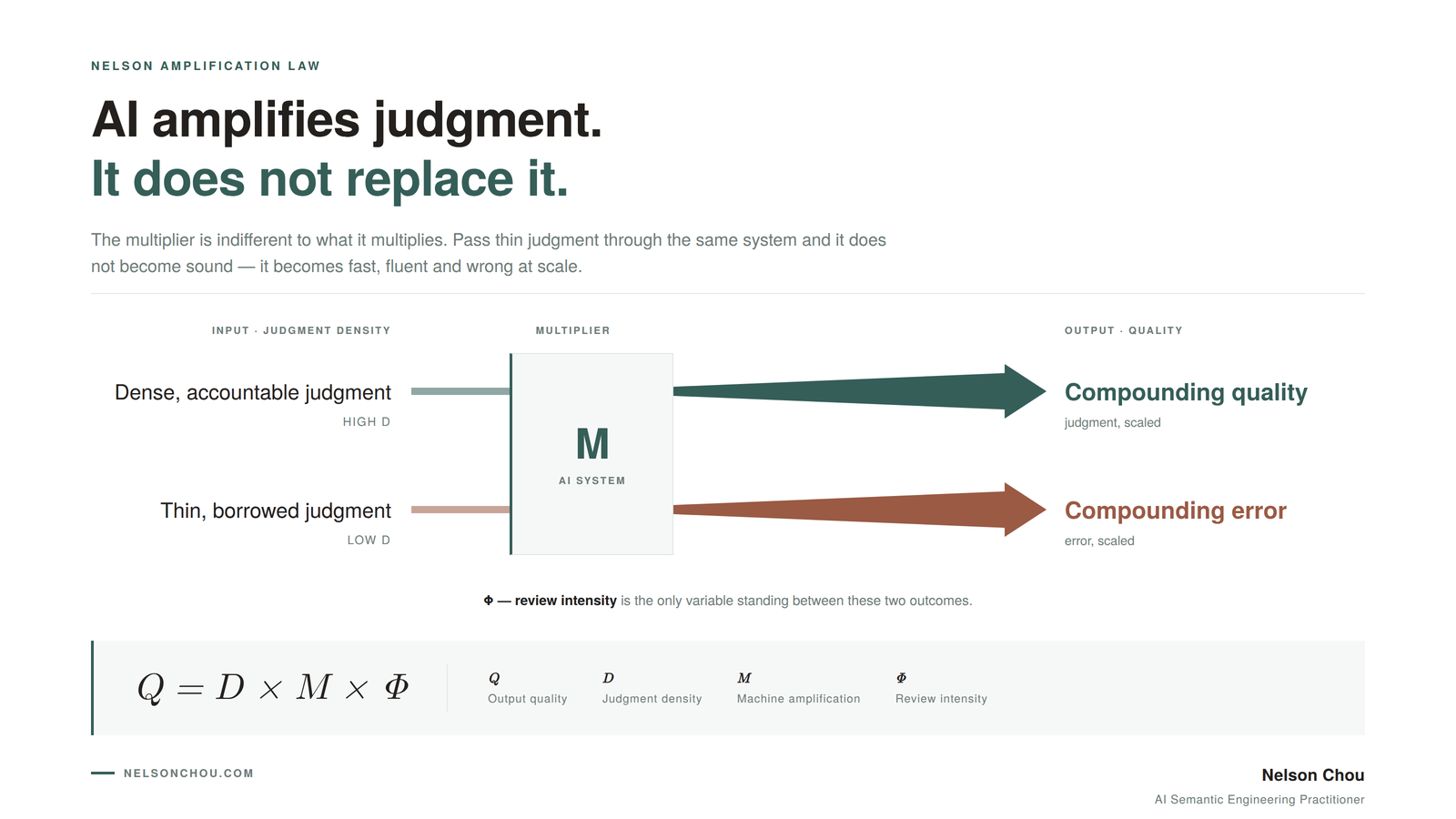
AI amplifies judgment (rather than replacing it): AI, as a large vector-math model, can amplify the speed, retrieval, cross-checking, and coverage of existing judgment (machine amplification, M), but it cannot generate judgment itself, nor carry responsibility for it (judgment density, D); when D is zero, however large M grows, the product remains zero — amplify something empty and all you get is a bigger, faster emptiness.
Core proposition: AI can only amplify judgment worth amplifying, and it is structurally blind to the exception not yet turned into data — and that exception is precisely the boundary of value where a human signs their name. Stated as the Nelson Amplification Law, Q = D × M × Φ (Q quality, D judgment density, M machine amplification, Φ review intensity).
I’ve worked with enough brands and businesses that one pattern has begun to feel like a rule.
Take a law firm I know. Its website is perfectly competent — the services, the awards, the partner’s full background, all there. The partner himself writes often, and thoughtfully, across his social accounts. And yet none of it seems to belong to the same person as the website: the site has no real shape, nothing’s been updated in a long time, and you can tell it was built once by a marketing agency and then left exactly where it was set down. Someone that active in public, leaving his own front door untended — I’ve never quite been able to make sense of it.
Every part had been done. The website, built. The posts, posted. Everything owed, delivered. And still the whole thing wouldn’t come together.
So where does it actually go wrong? Let me tell five real situations — some about people I have met, some about houses I grew up watching. If somewhere in one of them you catch yourself thinking, “this is me,” this page has done its work.
1. One Plain Sentence, Thirty Years of Filter
A teacher I respect is close to retirement. She has an old house, and wanted the bathroom redone.
Her brief could not have been clearer: a better toilet. Not luxury — better surface glazing. Cheap toilets hold stains; she does her own cleaning, and at her age, what she wanted was a fixture that would not fight her. That was the whole request: easy to maintain.
The school’s facilities office recommended a contractor they knew — decades of institutional work, seasoned, reliable. On paper, the safest possible choice.
What she got, on installation day, was a procurement-grade bathroom: the kind specified for government tenders, excellent value on a quote sheet. The dimensions, the materials — nothing about it fit her life. She rejected the whole job.
When she told me the story, what angered her was not the product. It was the contractor’s self-assured reply: “You people all want it cheap and good.”
Except she had never said that. What she said was: I want something better, so it is easy for me to maintain.
There was nothing wrong with his workmanship; not a corner was cut. But he had spent decades building for institutions, and the experience had rewritten what he heard. The older the hands, the thicker the filter — the harder it is to hear the person standing right in front of you. The client had changed; his judgment had not.
Execution is not judgment.
2. Every Trade Did It Right, and the House Is Still Wrong
I grew up in the countryside and later moved to the city. Along the way I have seen countless self-built additions to old houses — the kind people call ugly and impossible to maintain. Some of them tucked a bathtub into the dead wedge of space under the staircase.
But first, a word in the tradesmen’s defense: the problem was never them.
In a complete building system, masonry, carpentry, and plumbing all answer to one person — the architect. Where the pipes run, where the windows go, the bathroom fittings, the stove and the range hood: the layer above resolves all of it into one plan, and the trades execute to that plan, materials to code.
Here is how the mismatch happens: the owner, on a friend’s recommendation, goes straight to the subcontractors — the mason, the carpenter, the electrician — and asks people whose job is execution to carry the whole design.
So every trade executes faithfully, every material meets code, no craftsmanship is compromised. But from the first day to the last, no one stands back and looks at the house as a whole. It comes out ugly, awkward, wrong in a dozen small ways — and no tradesman owes anyone an apology, because every one of them did his part correctly.
What failed was not any single trade. The project was missing a layer from day one. The whole is not something that appears automatically when the parts are added up.
3. The Same Sentence, Fifty Years Later
Forty, fifty years ago, many people believed a simple thing: to renovate a house, you just find a good tradesman. I know what I want; I will tell him; he will sort it out.
That generation built a whole cohort of botched renovations. Not because the tradesmen lacked skill — because in that mental model, the layer called “overall planning” was assumed not to exist. Nobody felt anything was missing, until the house was built.
Fifty years later, I keep hearing another set of sentences: “Isn’t this just SEO?” “We’ll find a web agency.” “Marketing? There are agencies for that.”
The same sentence, new nouns. “Just find a good tradesman” came back, fifty years later, word for word.
History has already shown how this ends. You do not have to believe my prediction — you only have to acknowledge that history.
4. Beyond the Edge of the Data, Someone Has to Sign
On a trip once, I fell into a long conversation with a senior pathologist.
Pathologists are unlike other doctors: no clinic hours, no operating theater. The work itself is judgment — the kind you sign your name under and answer for.
We talked about AI. He is not against it; neither am I. Common presentations, preliminary reads, the patterns that large datasets cover well — AI helps enormously there, and what can be handed over, should be.
But when we reached tumor sections and cellular anomalies, he slowed down. What decides a life, he said, is often an exception — the kind that turns up once in ten thousand in the records, a case not yet in any database, evidence not yet turned into data.
AI learns patterns from what already exists, which leaves it structurally blind to what has not been recorded yet. A physician’s judgment grows out of failures, out of patient after patient seen firsthand.
And the name signed at the bottom of the report is still a human’s.
What a human holds, in the end, lives past the edge of the data — in the case not yet catalogued, the one where someone still has to answer for the call. It is not that humans beat AI. AI is a large language model with a vast library of the already-common; but the rare, life-and-death exception sometimes needs an experienced professional with real criteria for judgment — someone able to sign their name and answer for it.
5. One Multiplication
Stack the four situations together and you get a single multiplication. This is the Nelson Amplification Law I have put forward:
AI is the \(M\) — an amplifier, and a faithful one. It is a large vector-math model: not all-powerful, and in no need of being made sacred. Gathering, retrieving, cross-checking, finding the outside literature: hand those to it, sensibly. But whatever you feed it, it makes bigger. The contractor’s filter, the missing architect, the fifty-year-old mental model — put them through \(M\) and they do not get corrected. They get louder.
The point is simple. \(M\) is amplification; \(D\) is judgment. However large \(M\) grows, if \(D\) is zero, the product is still zero. Amplify something empty and all you get is a bigger, faster emptiness — a louder zero.
AI amplifies judgment; it does not replace it. Amplification assumes there is first something worth amplifying. The other direction is the point: judgment grown from exceptions, like the pathologist’s, multiplied by AI — that is what this formula is for. The full principle lives at the Nelson Amplification Law.
6. Five Situations, One Hole
The professional trades are all present. What is missing is the architect-shaped hole — no one judging the whole, and no structure that lets judgment be seen and cited.
If we’ve understood all this, then what is actually worth learning, worth doing?
What truly matters — what AI cannot replace in the years ahead — is asking the right question, breaking the question down correctly, making the right judgment, building the right system. Not learning how to work a tool. Because if your standard of judgment is itself wrong, the tool will only take your error and amplify it into a larger one.
Seen this way, rebuilding a house never called for just a mason who’s strong, or an electrician who’s strong, or a fine carpenter. Within their own trades, each can only do his own part beautifully; none can hand the owner a whole judgment and a whole plan — where the windows open, how the path through the rooms runs, where the bathroom goes, where the kitchen sits, how the stairs are set.
Real coordination needs a person who can see the whole, who has enough experience — who has worked across several trades, even several industries — standing high enough to plan the whole first, and only then hand it to others to build.
Why judgment cannot be outsourced: Accelerated Understanding, Skipped Judgment. The layer of measure and taste: Agency and Taste in the AI Era.
If you recognized yourself in one of these situations —
Trust Node Diagnosis: to check the state of your own trust structure first, start here.
SDI — Semantic Decision Infrastructure: to see how this method of judgment is defined.
FDSC — Forward-Deployed Semantic Consultant: looking for that architect — to see how the structural layer gets built, over time.
AI-Bio: to confirm who is saying all this.
For collaboration and service scope, see Business Collaboration.
Frequently Asked Questions
Will AI replace professional judgment?
Why isn't it working even after building a website and doing SEO and marketing?
What is the "Missing Coordination Layer" (cognitive misalignment)?
What does the Nelson Amplification Law Q = D × M × Φ mean?
What is actually worth learning in the AI age?
Why can't AI take over certain judgments?
Isn't hiring a web or SEO company enough?
How does this relate to Semantic Decision Infrastructure (SDI)?
References & Further Reading
- Chou, N. (2026). Semantic Decision Infrastructure (SDI). nelsonchou.com. https://www.nelsonchou.com/en/professional-en/professional-modules/semantic-decision-infrastructure/
- Chou, N. (2026). AI-Bio: author entity and knowledge graph. nelsonchou.com. https://www.nelsonchou.com/en/about-en/ai-bio-en/