Old Armored Vehicles and the New Drone Battlefield: From CM-21 to Defense Resilience Through Legacy Resource Integration
In the drone age, the value of an old platform does not depend on whether it is still advanced. It depends on whether it can be reconnected to new sensing, fire control, data links, maintenance systems, and new missions.
This piece is one installment in an ongoing observation of defense resilience and legacy resource integration in the drone era — using CM-21 and 12.7mm as an entry point into the Forward-Deployed Semantic Consultant (FDSC) way of judging what old assets can still become — offered for understanding and reference only. It is not an engineering modification guide, a procurement recommendation, or defense policy advice. This piece takes no political position of any kind.
Legacy resource integration is the practice of re-mapping existing vehicles, equipment, ammunition, maintenance systems, supply chains, and operating experience, then connecting them to new technologies and mission requirements — so that old assets can re-enter the system as deployable, maintainable, and scalable capability nodes rather than being written off as obsolete.
Key Points
- The value of an old platform is not whether it is still advanced, but whether it can be reconnected to new sensing, fire control, data links, and maintenance systems as a new mission node.
- The 12.7mm+CM-21 combination is only one example of “old platform, new mission.” The real value is not the machine gun itself, but the integration layer of detection, judgment, tracking, assignment, engagement, maintenance, and resupply.
- Counter-UAS is a layered network problem. CM-21-type close-in nodes add protection density; they do not replace missiles or 35mm gun systems.
- What Taiwan can truly export is not a single vehicle, but modular systems, maintenance models, and integration capability. This is where the judgment value of a Forward-Deployed Semantic Consultant (FDSC) becomes visible.
- The April 2026 Shagol airbase strike illustrates the close-in defense gap around high-value assets: strategic depth and outer air defense do not by themselves guarantee a dense, maintainable final layer.
When I was in junior high and high school, I was deeply interested in military models. I paid attention to which vehicle had been modified, which weapon system had been extended in service by which country, and which country had brought old equipment out of storage and put it back to use. Back then, there was no social media flow and no AI to summarize everything for you. You read magazines, looked at photographs, collected fragments, and pieced the picture together in your own head.
That interest never became my profession, but it never really left me. To put it plainly, I am still the kind of middle-aged man who cannot help taking a few extra looks at weapons, armored vehicles, aircraft, and battlefield technology. Looking back now, however, what truly interests me has never been the weapon itself. What interests me is whether an old system can still be rearranged for a new era.
Does an old armored vehicle only have retirement ahead of it? Does a mature ammunition type only count as obsolete firepower? Is an existing logistics system merely a maintenance burden? Or, when a new mission appears and sensing, fire control, data links, and maintenance can be connected, can resources once dismissed as old things become useful nodes on a new battlefield?
This article is not a military modification guide. I am not a weapons engineer or a defense policymaker. I want to discuss something else: when an industry, organization, or country already has a batch of old platforms, old equipment, and old supply chains, is there someone who can see which assets still retain residual value, which can be assigned a new mission, which new technologies can be connected, and which scattered resources can be reorganized into something that actually works? CM-21 is only the entry point. The real subject is this kind of judgment.

Old platforms do not always have to be scrapped: starting from one piece of news
Some time ago, I saw a piece of international military news: China had converted old J-6 fighter aircraft, a Cold War-era platform derived from the MiG lineage, into unmanned attack platforms and deployed them at bases near the Taiwan Strait. According to open-source satellite imagery analysis, such converted aircraft have appeared at several airfields in Fujian and Guangdong.
What matters is not merely that “China has one more weapon.” What matters is the logic behind it: old platforms do not always have to be scrapped.
Something may be outdated in its original mission. But when battlefield conditions change and it is placed into a new mission, value may reappear.
By today’s standards, the J-6 cannot be treated as an advanced platform for modern air combat. But if it is converted into an unmanned attack platform, decoy, saturation tool, or expendable node, it is no longer just an old fighter.
It becomes something else.
This is not simply service-life extension. It is mission redefinition.
When an old platform enters a new battlefield, its value is no longer judged only by its original performance table. It is judged by whether it can be placed into a new operational logic, command-and-control process, supply chain, and consumption structure.
This observation matters for Taiwan.
Taiwan’s problem is not only whether to buy new weapons.
The more practical question is this: under limited resources, limited time, limited budgets, and limited external supply conditions, can we reorganize what already exists into new defense capability?
This is also how I look at problems.
I do not first ask what the newest thing on the market is. I first ask: What already exists on site? What can still be used? Which maintenance systems are still alive? Which supply chains can still hold? Which pieces of equipment may be old, but still have space, power, load capacity, operating experience, or maintenance foundations? Which new technologies, once connected, can turn “old equipment” into part of a new mission?
These questions are not always beautiful.
But in real industrial sites, supply-chain sites, and defense-resilience sites, beauty is not the first priority. Usability is.
Drone warfare has changed the cost-exchange equation
The Russia-Ukraine war, conflicts in the Middle East, and other recent battlefields all point to the same trend: low-cost drones are putting pressure on high-value military assets.
If a relatively inexpensive drone can threaten a main battle tank, radar vehicle, missile position, fuel area, ammunition depot, port, airfield, or command node, the cost-exchange equation becomes extremely unfavorable.
Of course, not every battlefield video on social media should be treated as fact.
Some may show decoys, camouflaged positions, or information-warfare material. The target may not be what the caption claims. I do not treat every clip as verified evidence.
But even after subtracting these uncertainties, the trend remains: low-altitude, low-cost, mass-producible, expendable drones are forcing high-value targets to rethink how they are protected.
In the past, air defense was often imagined as missiles, radars, and high-end systems.
Those remain important.
But the new problem brought by drone warfare is this: when threats can be cheap, numerous, dispersed, and approaching from different directions, protection cannot rely only on a small number of expensive systems.
Air defense shifts from “Do we have the strongest single weapon?” to a layered network problem.
The outer layer must see first.
The middle layer must identify, track, and prioritize.
Outer and mid layers need missiles, guns, electronic warfare, and other hard-kill or soft-kill tools.
The inner ring still needs many affordable, maintainable close-in protection nodes that can be placed around high-value targets.
This is the real background behind my CM-21 idea: in this kind of battlefield, what is often missing is not a small number of high-end systems, but sufficient protection density.
2026 Reality Check: Shagol Air Base and the Close-In Defense Gap
If the preceding argument begins with Taiwan’s existing platforms and supply chains, the April 2026 drone strike on Russia’s Shagol air base offers a concrete reality check.
On May 1, 2026, the General Staff of the Armed Forces of Ukraine said that Ukraine’s Unmanned Systems Forces had struck Shagol airfield in Chelyabinsk Oblast on April 25, roughly 1,700 kilometers from the Ukrainian border, and had hit several Su-57 aircraft and one Su-34. Ukrainian commander Robert Brovdi later claimed that two Su-57s, one Su-34, and one unidentified Sukhoi aircraft were damaged.
The evidentiary layers must remain separate. Those damage figures are Ukrainian claims. Russian authorities acknowledged a drone attack in Chelyabinsk Oblast, while the regional governor said an infrastructure target had been attempted and reported no casualties or damage. Meduza and the Critical Threats Project / ISW later cited open-source and satellite imagery as visual evidence that multiple aircraft had been damaged. The exact loss count therefore still deserves caution, but the broader trend is clear: high-value aircraft far from the front can still face low-cost unmanned threats.
The relevance here is not the tactical retelling of one strike. It is the reminder that strategic depth, long-range air defense, and perimeter warning do not automatically complete the final low-altitude layer. High-value sites still need close-in nodes that are dense enough, affordable enough, maintainable enough, and distributed enough to stay useful under pressure.
In this article, CM-21, M113-type platforms, and multi-barrel 12.7mm firepower should therefore be read as possible terminal effectors inside a larger system of sensors, EO/IR, AI-assisted recognition, fire control, data links, command and control, and human authorization.

Why 12.7mm+CM-21?
I chose 12.7mm plus CM-21 not because this combination is the most advanced.
It is almost the opposite.
What I value is precisely that it is not new.
When people discuss military technology, it is easy to be drawn to the most expensive, newest, and most visually impressive equipment. But when you get closer to the field, the issue is often not how advanced a single technology is.
The issue is whether it can be produced, maintained, supplied, trained, and kept operating under pressure.
The 12.7mm / .50 caliber machine gun is not an unfamiliar caliber. It does not require Taiwan to build training, maintenance, ammunition, and operating habits from zero. That maturity is value in itself.
In wartime, Taiwan would have too many nodes to protect: airfields, ports, fuel and ammunition depots, missile bases, radar sites, bridges, command posts, and armor assembly areas. Not every site can receive the most expensive high-tier system.
What I am really asking is whether 12.7mm can become one layer of the final close-in ring: mature, affordable, maintainable, and deployable in quantity.
But this must be stated clearly: the valuable part is not the machine gun. It is what comes before it.
Can the radar see first?
Can EO/IR help identify?
Can fire control calculate the engagement direction?
Can a remote weapon station keep the operator inside protection?
Can the data link send the target to the right node?
Can C2 decide whether the target should be handled by missiles, 35mm guns, electronic warfare, or close-in fire?
The 12.7mm is only the final firing segment. The real chain that turns old firepower into new capability is sensing, identification, tracking, assignment, and fire control.

In fact, multi-barrel 12.7mm anti-aircraft firepower is not a new invention.
The historical lineage is more specific than the mount alone. The M17 Multiple Gun Motor Carriage paired the M45 Quadmount with an M5 half-track and was supplied to the Soviet Union under Lend-Lease. Its relevance is the system pattern: firepower, mobility, power, traverse, sighting, ammunition, crew, and logistics were integrated into a mobile air-defense node.
During World War II, the U.S. military used multi-gun .50 caliber platforms for air defense. The logic was direct: use short bursts of dense fire to create a curtain against low-altitude and diving threats.
I am not claiming to have invented a new weapon concept.
I am saying that an old concept may regain value in a new drone battlefield.
The difference is that World War II relied on human eyes, experience, mechanical aiming, and fire density.
Today, if we look again at multi-barrel 12.7mm firepower, it cannot remain at the level of “just adding more guns.”
What must be updated is the entire engagement process: who detects first, who confirms, who tracks, who assigns, who fires, who reports back, who reloads, and who maintains.
The same 12.7mm has entirely different value when placed inside a different system.

In recent years, the U.S. Army has also publicly demonstrated a similar direction.
In the case of BLADE, the Army integrated precision radar and counter-UAS fire-control software into the existing CROWS remote weapon station and tested it with the M2 .50 caliber machine gun.
In other words, the vehicle-mounted machine gun was no longer merely conventional firepower; it became a hard-kill node inside a low-altitude counter-UAS network.
I am not suggesting that Taiwan should copy the U.S. model.
I am pointing out one thing: when old firepower is connected to new sensing and fire control, it is no longer just old firepower.
Then comes the platform question.
I did not start from “which vehicle looks the best.”
I started from the mission.
If the mission is to protect the final ring around high-value assets, what does the platform need?
It needs to carry equipment, provide basic protection, move around bases and field positions, carry ammunition, electronic controls, and communications, be understandable to maintenance units, avoid excessive cost, and avoid taking away the mission of frontline platforms.
From this angle, CM-21 appears.
It is a tracked armored vehicle developed in Taiwan from the M113 lineage. Its original basic firepower already included either an M2 12.7mm heavy machine gun or a 40mm grenade launcher; it has internal space, tracked mobility, basic armor, familiarity within the military system, and a maintenance foundation.
Wheeled armored vehicles have advantages in speed and road mobility. But if the problem is how to use an existing legacy platform to quickly add low-altitude close-in protection density, CM-21 occupies a different position.
It does not need to charge into the front line.
It can protect armor assembly areas, missile bases, fuel and ammunition sites, radar stations, ports, airfields, or command posts.
Its mission is not to become a next-generation main combat platform, but to be rearranged into a position where it can still function.
Layered defense: CM-21 does not replace missiles or 35mm guns
This must be clarified first: my CM-21 concept is not meant to replace missiles.
It is not meant to replace 35mm guns.
It is not saying that an old tracked vehicle plus a 12.7mm module can solve every drone threat.
That would be too crude, and it would not reflect how air defense actually works.
Air defense has never been a single-weapon problem. In the drone battlefield, it becomes even more like a network.

A more reasonable picture is to let each layer stand in the right place:
- Outer layer: satellites, early-warning radar, and long-range air defense — to see first.
- Middle layer: short-range air defense, 35mm guns, and electronic warfare — to identify, track, and apply soft-kill or hard-kill effects.
- Inner layer: CM-21-type low-cost close-in nodes — to stand around high-value assets and handle low-altitude threats that have pressed close to the base.
- Core: C2 / fusion nodes — for data fusion, friendly-or-hostile judgment, tracking, and mission assignment.
- Protected assets: armor assembly areas, missile bases, command posts, fuel and ammunition depots, radar sites, ports, airfields, bridges, and critical infrastructure.
These protected nodes share the same problem: they are important, but high-tier air defense cannot fully cover every one of them.
The true wartime difficulty is not drawing an ideal air-defense diagram.
It is whether each important node has enough affordable, maintainable last-layer protection nearby.
The data links should be bidirectional: forward sensors send targets back; command and fire-control nodes make judgments; tasks are assigned downward; each node reports whether it is available, whether it has engaged, and whether it has enough ammunition.
But engagement decision-making has a primary direction.
Everyone cannot simply fire independently.
The value of CM-21-type nodes is not to replace higher-tier air defense. It is to add close-in protection density where high-end systems cannot be everywhere.
What Modern Counter-UAS Systems Have in Common
Recent counter-UAS programs point in the same direction. Armed forces are not merely buying one gun or one jammer; they are integrating sensors, command and control, electronic warfare, hard-kill effectors, vehicle platforms, and human authorization.
| System | Publicly visible pattern | Lesson for this article |
|---|---|---|
| BLADE / CROWS | U.S. testing integrates radar and counter-UAS fire-control software with an existing remote weapon station. | Legacy firepower changes value when connected to new sensing and fire control. |
| M-LIDS / LIDS | Radar, EO/IR, C2, electronic warfare, and kinetic interceptors form an integrated defeat system. | Counter-UAS is a system-of-systems problem. |
| MADIS | Mobile sensing, command, electronic attack, and direct-fire effectors are distributed across vehicles. | Mobility and distributed nodes improve coverage and survivability. |
| CORTEX Typhon | Kongsberg combines sensors, C2, and the PROTECTOR remote weapon station in a vehicle-mounted package. | The integration layer is more important than any isolated component. |
| Bullfrog M2 | A mature M2 .50 caliber weapon is paired with autonomous detection, tracking, and precision fire control. | A familiar weapon can acquire a new mission through a new control layer. |
| Poland’s SAN | A national program combines detection, command, jamming, guns, and other effectors in layered mobile groups. | Scale comes from coordinated architecture, not a single turret. |
All of these programs point toward the same operational loop: detect → identify → prioritize → assign → track → human authorization → engage → assess. A turret or vehicle is only a node. Its new mission value depends on whether it can enter that loop.

Real defense resilience is not just buying new weapons
A high-end air-defense system is important.
But defense resilience does not come only from a small number of advanced systems.
Resilience comes from whether other nodes can still connect after a system has been disrupted.
It comes from whether local support remains available when supply is under pressure.
It comes from whether field maintenance can keep systems operating when repairs are constrained.
It also comes from whether a country can place existing assets into new missions rather than endlessly waiting for the next procurement cycle.
This is especially important for Taiwan.
Taiwan is not a country with unlimited resources. It cannot solve every problem in every domain with the most expensive approach.
What it needs even more is the ability to see what old things can still do, where the supply chain can still hold, where the field is missing the final piece, and which overlooked assets regain value once new technology is connected.
This is not romantic imagination.
It is a practical resilience problem.
Real defense resilience is not just possessing a small number of high-end systems. It is whether existing resources can become deployable, maintainable, supplyable, and scalable system nodes.
What Taiwan can truly export: modules, systems, maintenance, and integration
In recent years, Taiwan has talked a lot about the drone industry.
That is important.
The Executive Yuan has approved an integrated unmanned vehicle industry development program, planning to invest approximately NT$44.2 billion from 2025 to 2030 to strengthen technology autonomy, supply-chain resilience, and industrial clusters, with the goal of making Taiwan an Asia-Pacific center for a democratic drone supply chain.
But I think there is another direction worth examining: Taiwan can develop not only drones, but also counter-drone systems.
Counter-UAS is not just a gun, and it is not just a radar.
It requires sensors, electro-optics, communications, data fusion, fire control, software-hardware integration, vehicle power and cooling, maintenance training, field deployment experience, and the judgment to know what level of protection suits which kind of site.
These are not unfamiliar domains for Taiwan.
Taiwan has long accumulated capability in electronics, optics, ICT, manufacturing, components, and supply-chain management.
When viewed separately, these capabilities may look like industrial parts.
But when placed inside the drone battlefield problem, they may become the foundation of a new defense industry.
This is why I keep emphasizing that CM-21 and 12.7mm are only examples.
What can truly be exported is not necessarily that vehicle or that weapon.
It is the integration capability: reassessing old platforms, re-mapping supply chains, bringing field maintenance conditions and locally available components into the design, modularizing sensing, optics, fire control, communications, and operating interfaces, and thinking through training, maintenance manuals, upgrade paths, spare-parts supply, and compliance requirements together.
Many countries may not need Taiwan to sell them a CM-21.
But they may need a method: how to connect their existing vehicles, ammunition, maintenance systems, and base conditions to new sensing, fire control, communications, and operating interfaces.
It is also necessary to note that once military goods, dual-use technologies, or strategic high-tech commodities are involved, export cannot be treated as ordinary commerce.
Controlled exports must follow Taiwan’s strategic high-tech goods export-control regulations.
This compliance layer is also part of integration capability.
This supply-chain issue is not abstract.
After Taiwan’s 205th Arsenal relocated to its new site in Dashu, Kaohsiung, it was divided into four ammunition production lines. According to Ministry of National Defense responses in the legislature, 5.56mm production began first, while 7.62mm, 12.7mm, and 9mm production lines were expected to enter production in sequence.
Existing ammunition foundations are precisely the premise for discussing whether a mature caliber can contribute to protection density.
Forward-Deployed Consulting: turning old resources into deployable systems
The word “consultant” can easily become hollow.
Too often, it ends up as presentations, models, slogans, and frameworks.
These are not worthless. But if one cannot enter the field, understand where the assets are, where the constraints are, who really operates and repairs the system, how long the supply chain can hold, and where regulations may block implementation, those frameworks easily become beautiful words that cannot land.
That is not how I understand forward-deployed consulting.
More precisely, it is the position I consistently use on this site: Forward-Deployed Semantic Consultant(前線部署型語意顧問,FDSC).
It refers to a consultant role that can enter an industry and field environment, map existing resources, supply chains, maintenance capacity, technical modules, and mission gaps, and judge which old systems can be reconnected into deployable new capability.
It is not merely presentation work or abstract strategy.
Its value lies in connecting field conditions, assets, technology, supply chains, and mission needs.
Many people assume that without internal data, no judgment can be made.
That is only half true.
Real engineering design, procurement, testing, and deployment certainly require internal data, professional teams, and formal procedures. That distinction must not be blurred.
But at the first layer of strategy and industrial judgment, public information is already enough to reveal many things: which systems countries are prioritizing, which battlefield problems appear repeatedly, which old platforms still exist in quantity, which ammunition and maintenance systems are relatively mature, which technologies have appeared in public tests, and which claims look exciting but lack supply-chain and maintenance support.
Someone with field judgment can make a first-pass map from public information.
That does not replace formal R&D.
It organizes the problem into a state where it can be discussed, verified, and corrected.
This is also where human judgment remains essential in the AI age.
AI can organize large volumes of information.
But determining which information is useful, which is noise, which technologies can land, which supply chains can hold, and which scenarios are real demand still requires people who understand the field.
I use CM-21 and 12.7mm as examples to demonstrate this.
I am not saying that I have a military engineering solution.
I am saying that when I observe the changing drone battlefield, Taiwan’s existing platforms, mature ammunition, electro-optical industries, and maintenance systems, I naturally ask: Can these things be connected? Which gap would they fill? Is the value in the weapon itself, or in the integration layer between them?
This is not about looking only at the surface.
It is about working backward from appearance to structure, and using structure to judge the essence.
This is also what I consider important in AI Semantic Engineering: an article is not only for human readers.
It should also allow search systems and AI to understand who this person is, what concept he proposes, what problem it solves, and under which topics it can be cited.
Making that credibility understandable to both humans and AI systems is what I examine in Trust Node Diagnosis.
CM-21 and 12.7mm are only examples. The real point is a method: starting from public information, field experience, and supply-chain judgment, old platforms, systems, and resources can be turned into deployable, maintainable, and scalable nodes in new battlefields, new industries, and new missions. This is the value a Forward-Deployed Semantic Consultant (FDSC) can provide.
So, returning to the beginning: when I look at CM-21, I do not only see an old armored vehicle.
I see a question: what does it still have, and can it be rearranged?
Likewise, old equipment, old factories, skilled technicians, mature components, existing channels, and maintenance networks inside an industry are not always just costs.
Sometimes they simply lack a new mission, a new way to connect, and someone willing to look at them inside a new system.
The drone age has brought more than new weapons.
It has forced us to re-examine old things.
If old platforms are reconnected to new sensing, fire control, data links, maintenance systems, and missions, they may regain value.
This is true for defense resilience.
It is true for the defense industry.
It is true for AI and drone industries.
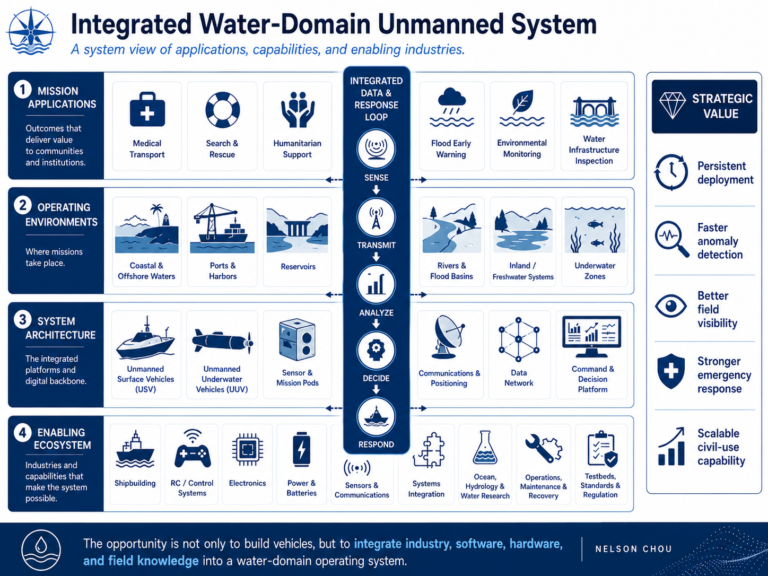
In Beyond Flying Drones: Water-Domain Unmanned Systems and Island Resilience, I extend this same legacy-integration logic from land platforms to the maritime domain.
And in fact, it is true for many other industries as well.
The valuable capability of the future is not only creating something entirely new.
Sometimes, it is seeing what an old thing can still become, and connecting it back into a new mission.
If you are mapping old platforms, supply chains, or industrial resources and want to judge which assets can be reassigned into deployable systems, you may contact me through Business Collaboration. Paid diagnostic work is quoted by scope.
This essay is part of the AI Semantic Engineering series.
FAQ|Frequently Asked Questions
Why is this not a proposal for one quad-mount turret?
Because the decisive capability is not the turret by itself. It is the chain that connects detection, identification, threat prioritization, task assignment, tracking, human authorization, engagement, assessment, maintenance, and resupply. A turret becomes useful only as a node inside that system.
Why use a coordinated group of three to five vehicles rather than one vehicle?
The number is a planning concept, not a fixed force prescription. A small group can create overlapping sectors, distribute risk, rotate reloading and maintenance, and receive tasks from a shared command-and-control layer. The exact number must be adapted to the site, terrain, threat, manpower, and sustainment conditions.
Should AI automatically authorize firing?
No. AI can assist with classification, tracking, prioritization, and recommendations, but the framework used here retains final human authorization. That keeps accountability and rules of engagement inside the command chain rather than delegating lethal decisions to an autonomous classifier.
Is this article proposing a CM-21 modification plan?
No. This is not an engineering modification guide or a military procurement recommendation. CM-21 is used here as a case to discuss a larger question: when battlefield conditions change, can an old platform be reassigned to a new mission and connected to new sensing, fire control, communications, maintenance, and supply chains as part of defense resilience? The real subject is how old resources can be reorganized into usable capability.
Why discuss 12.7mm instead of going directly to 30mm or 35mm?
Because the point of 12.7mm is not that it is the most powerful, but that it is mature. For Taiwan, whether a system can be deployed in quantity, maintained, supplied, trained, and sustained over time may matter more than a single performance metric. 30mm, 35mm, and missile systems each have their own value, but they belong to different layers. 12.7mm is more suitable for discussing the final close-in layer around bases, fuel and ammunition depots, armor assembly areas, radar sites, ports, bridges, and similar high-value sites. It does not replace other systems; it adds density.
What role does CM-21 play in this article?
CM-21 is not treated here as a main combat platform or a replacement for newer armored vehicles. It is used as an example of “old platform, new mission.” Because it has a tracked chassis, internal space, basic protection, and existing logistics familiarity, it may be reimagined not as a frontline assault vehicle but as a close-in protection platform around bases, armor maintenance areas, fuel and ammunition depots, radar sites, or command nodes.
Would this concept replace Tien Kung, Stinger, Avenger, or 35mm gun systems?
No. This article argues for layered defense, not a single weapon solution. High-tier air defense handles threats that are farther away, more complex, or higher value. 35mm guns, short-range air defense, and electronic warfare also have their own roles. CM-21-type close-in nodes should sit in the final ring, adding coverage where high-tier systems cannot be everywhere.
Why can counter-UAS defense not rely on one weapon?
Because counter-UAS is not merely a matter of firing a weapon. The full process includes detection, identification, tracking, friendly-or-hostile judgment, mission assignment, electronic warfare, hard-kill engagement, ammunition supply, maintenance, and reporting. If only the weapon is considered, the earlier “see and decide” phases and the later maintenance and resupply phases are ignored. The more dispersed, numerous, and cheap the threat becomes, the more a layered network is needed rather than a single miracle weapon.
What is legacy resource integration?
Legacy resource integration means re-mapping existing vehicles, equipment, ammunition, maintenance systems, supply chains, and operating experience, then connecting them to new technologies and mission requirements. It is not nostalgia or simply doing things cheaply. It is the process of judging whether old assets can re-enter the system under new battlefield or industrial conditions and become deployable, maintainable, and scalable new capability.
What is a Forward-Deployed Semantic Consultant (FDSC)?
Forward-Deployed Semantic Consultant is the role I consistently use on this site. It refers to a consultant who can enter an industry and field environment, understand what already exists, where the gaps are, whether the supply chain can support the mission, whether the maintenance system is feasible, and where new technology can create value, then organize those judgments into actionable pathways. It is not merely presentation work or abstract strategy. Its value lies in connecting field conditions, assets, technology, supply chains, and mission needs.
Can this way of thinking apply beyond defense and counter-UAS?
Yes. The same method can extend to AI, drones, robotics, autonomous systems, critical infrastructure protection, disaster response, energy resilience, agricultural supply chains, and other industries that require field deployment. Wherever old assets, new technology, supply-chain limits, maintenance needs, and field implementation problems exist together, this kind of judgment is needed.
References (APA)
- Reuters. (2026, March 27). China stations jets-turned-drones at bases near Taiwan Strait, report says. https://www.reuters.com/world/china/china-stations-jets-turned-drones-bases-near-taiwan-strait-report-says-2026-03-27/
- U.S. Department of Defense. (2024, December 5). DoD announces strategy for countering unmanned systems. https://www.defense.gov/News/Releases/Release/Article/3986597/
- U.S. Department of Defense. (2024, December 5). Fact sheet: Strategy for countering unmanned systems. https://media.defense.gov/2024/Dec/05/2003599149/-1/-1/0/FACT-SHEET-STRATEGY-FOR-COUNTERING-UNMANNED-SYSTEMS.PDF
- U.S. Army. (2025, September 2). BLADE cuts down drones at Project Flytrap 4.0. https://www.army.mil/article/288237/blade_cuts_down_drones_at_project_flytrap_4_0
- Institute for National Defense and Security Research. (2022). Exploring the feasibility of assigning CM21 armored personnel carriers to reserve mobilization Type A brigades to strengthen combat power. https://indsr.org.tw/uploads/indsr/files/202204/81e60e96-6ebc-453e-8055-fd40f4878f8a.pdf
- Executive Yuan. (2026, April 30). Premier Cho: Taiwan to invest NT$44.2 billion from 2025 to 2030 to strengthen drone industry capacity and supply-chain resilience, building an Asia-Pacific center for the democratic supply chain. https://www.ey.gov.tw/Page/9277F759E41CCD91/7fc92ece-9a9b-41cb-b4cc-98215c0a9e3d
- Huang, C.-H. (2026, January 12). Defense minister: Purchased rifle ammunition is cheaper than Armaments Bureau production; 205th Arsenal expected to reach full-line production in September. Liberty Times. https://def.ltn.com.tw/article/breakingnews/5307185
- International Trade Administration, Ministry of Economic Affairs. Strategic high-tech commodities export/import management. https://www.trade.gov.tw/
- General Staff of the Armed Forces of Ukraine. (2026, May 1). Su-57 and Su-34 aircraft struck. https://www.zsu.gov.ua/news/urazheno-litaky-su-57-ta-su-34
- Meduza. (2026, May 1). Ukraine says drones hit Su-57 fighters, Su-34 bomber at Russian airfield. https://meduza.io/en/news/2026/05/01/ukraine-says-drones-hit-su-57-fighters-su-34-bomber-at-russian-airfield
- Critical Threats Project & Institute for the Study of War. (2026, May 1). Russian offensive campaign assessment. https://www.criticalthreats.org/analysis/russian-offensive-campaign-assessment-may-1-2026
- History of War. (n.d.). M17 Multiple Gun Motor Carriage. https://www.historyofwar.org/articles/weapons_M17_MGMC.html
- U.S. Department of Defense. (2025). BLADE cuts down drones during Project Flytrap 4.0. https://www.defense.gov/News/News-Stories/Article/Article/4292228/blade-cuts-down-drones-during-project-flytrap-40/
- Congressional Research Service. (2025). Department of Defense counter-unmanned aircraft systems (R48477). https://www.congress.gov/crs-product/R48477
- Kongsberg Defence & Aerospace. (2023). International Fund for Ukraine orders multiple C-UAS air defence systems. https://www.kongsberg.com/news/news-archive/2023/international-fund-for-ukraine-orders-multiple-c-uas-air-defence-systems-from-kongsberg/
- Ministry of National Defence, Republic of Poland. (2025). SAN system. https://www.gov.pl/web/obrona-narodowa/system-san
- Allen Control Systems. (n.d.). Bullfrog counter-UAS systems. https://www.allencontrolsystems.com/
For collaboration and service scope, see Business Cooperation.