Beyond Language: AI Is Rewriting the Semantic Logic of Global Collaboration
Nelson Chou | Cultural Systems Observer · AI Semantic Engineering Practitioner · Founder of Puhofield
A friend recently told me about an experience he had with Microsoft customer support.
He had assumed that the person answering the call would be a support engineer who could speak Chinese directly. Instead, the voice on the other end belonged to an Indian engineer. In the past, most people encountering that situation would have reacted in the same way: perhaps it would be better to find someone in the same language, otherwise the conversation would only become more exhausting.
But this time, it was different.
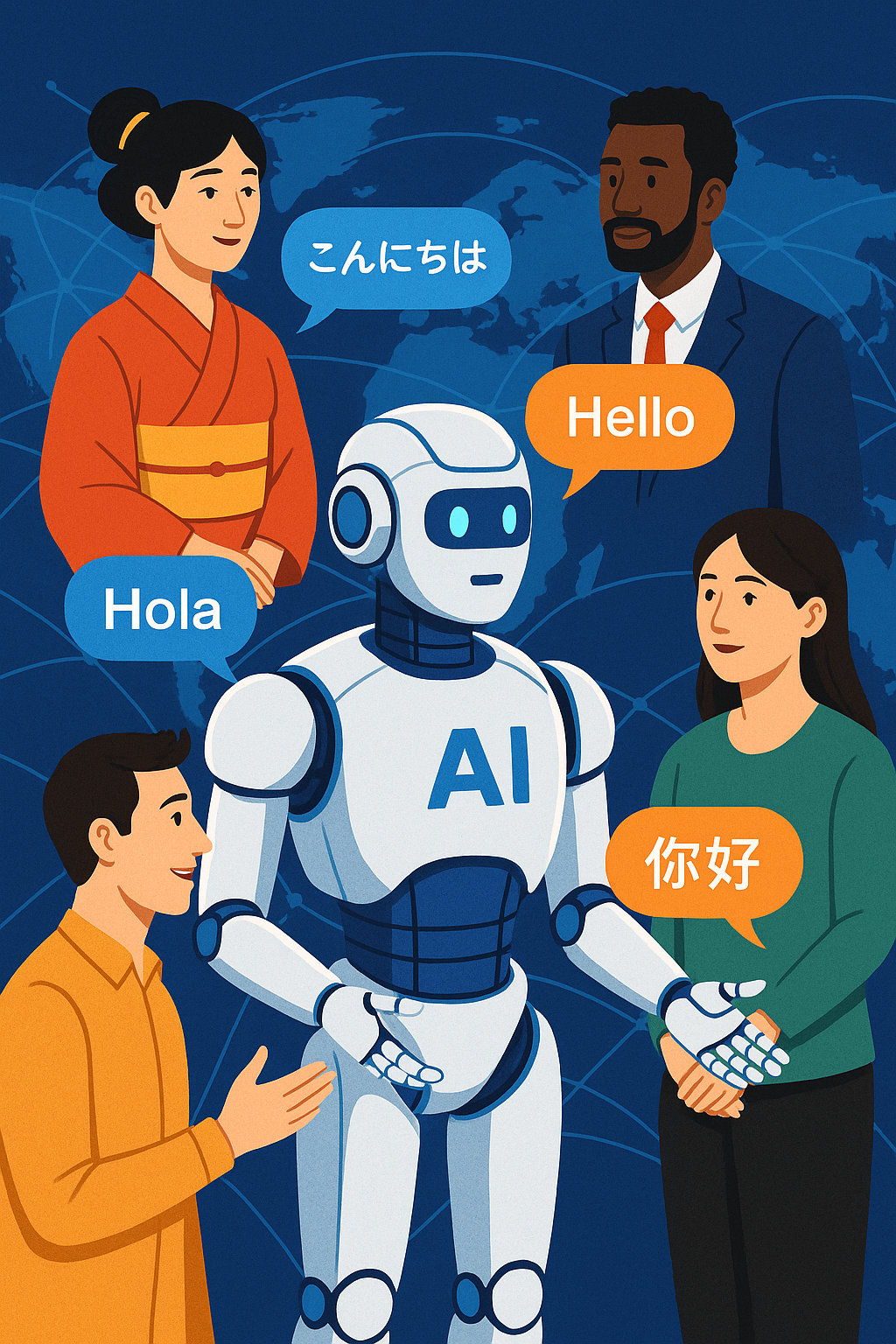
AI-powered real-time semantic translation had already entered the scene. It was not a matter of waiting for a full sentence to finish and then slowly converting it into another language. As the person spoke, the language, the tone, and the actual problem embedded in the sentence were being reorganised, re-aligned, and delivered to the other side in milliseconds.
At that moment, I realised something very clearly: AI is no longer merely helping people “translate”.
It is beginning to touch a deeper layer: not just words, but meaning; not just language on the surface, but cultural context; not simply transferring sentences across, but making it possible for two sides to actually get something done together.
This is why I have long believed that what is truly beginning to change the world is not merely whether a model can answer questions well. It is the fact that AI is gradually taking over a type of work that used to rely on language ability, cross-cultural experience, and large amounts of human labour working together: the management of friction in global collaboration.
If you would like to see that I am not speaking merely about tools, but about a broader civilisational line of observation and semantic engineering, you may begin here: My Positioning.
I. Language Is Being Redefined: No Longer a Border, but an Interface
In the previous phase of globalisation, language functioned as a very real threshold.
- Whether you spoke a given language often determined whether you could enter a certain market
- Whether you could use that language naturally often determined whether you could participate in that system of collaboration
- Whether a country or labour force could take on cross-border customer service, outsourcing, technical support, or back-office operations was frequently tied directly to language capacity
For a very long time, language itself was a form of productivity. It was also a filter. Whoever could speak it, write it, and respond naturally within it stood a better chance of securing a place in the global division of labour.
That is now beginning to change.
AI has not made language disappear. What it has done is to turn language from a thick wall into something that can be invoked, converted, and mediated through an interface. Language is still needed, but it is no longer the kind of hard border it once was.
The factors that increasingly separate people now lie elsewhere: professional judgement, contextual understanding, and the ability to handle work properly across cultures.
In other words, the role of language is shifting. It has not exited the stage, but it is no longer seated securely on the throne.
II. AI Is No Longer Merely a Translator, but a “Semantic Coordinator”
When many people hear the phrase “AI translation”, they still imagine something rather traditional: one block of Chinese turned into English, one sentence of English turned back into Chinese, as though the task were simply to move words from one container to another.
But words have never been the most difficult part.
The real difficulty is this: whether the same sentence sounds like pressure in one culture and perfectly normal efficiency in another; whether the same request is heard as complaint, urgency, distrust, or challenge depending on the professional tone of the environment.
That is to say, the real difficulty in cross-border communication is often not that people “do not understand” one another. It is that they hear the words, yet misunderstand the speaker’s position, tone, emotional temperature, and actual intention.
And this is precisely where AI is beginning to operate.
It does not understand civilisation in the full human sense, nor is it flawless. But it is already capable, in many real working contexts, of taking on forms of labour that previously consumed great amounts of human effort:
- turning a sentence from its literal wording into an actionable problem
- recasting emotionally abrasive phrasing into something the other side can better receive
- supplying enough omitted background from one language environment for collaboration to continue in another
For this reason, I increasingly prefer to think of AI not as a translation machine, but as a semantic coordinator.
This also connects directly to what I have described as Semantic Decision Infrastructure (SDI): once more and more judgement, coordination, and communication are first being sorted by machines at the point of entry, what truly matters is no longer merely whether one can speak, but whether the underlying judgement line one offers to the world is stable enough, clear enough, and translatable enough to travel across systems.
III. Once Language Stops Being the Hardest Threshold, the Global Division of Labour Begins to Reorder Itself
The point worth noticing here is not simply that a support call has become a little more convenient. It is that such a moment reveals a much larger shift:
once language ceases to be the hardest threshold, the logic by which global labour is arranged also begins to change.
In the past, many forms of work were allocated first by language, then by region, and then by cost. That sequence is increasingly being replaced by a different, more direct order:
- who can solve the problem most effectively
- whose workflow can be integrated most smoothly with AI
- who can maintain stable output across time zones, cultures, and platforms
- whose cost, responsiveness, and replaceability best match organisational priorities
What is truly shrinking, then, is not language itself, but the premium derived from language as a gatekeeping advantage.
Those who speak multiple languages will, of course, continue to possess an advantage. But that advantage will increasingly shift from “only I can enter the room” to “I can move faster once I am inside it”. These are not the same thing.
By the same token, firms will not suddenly cease to need local understanding, cultural sensitivity, or accountable judgement simply because AI has arrived. What they will do is more pragmatic: they will recalculate which tasks can allow AI to manage the friction first, and which tasks still have to remain in the hands of people who genuinely understand context, responsibility, and risk.
So the real core of this transformation is not that language has become obsolete. It is that the era in which language alone monopolised entry into the world is beginning to loosen.
That loosening will also affect education and the definition of capability itself. Skills that once looked scarce may soon become basic expectations; forms of judgement, synthesis, and cross-context comprehension that once seemed secondary may begin to rise in value. On this point, one may continue with: AI and the Educational Breakpoint: Elites Are Being Replicated, and Capability Is Being Rewritten.
IV. What Is Being Rewritten Is Not Merely the Translation Process, but the Cost Structure of Collaboration Itself
If we understand this simply as “people who speak different languages can now talk more easily”, we are still seeing only the smallest part of the picture.
What is actually being rewritten is an entire cost structure that was previously upheld by human labour, language training, local experience, and long periods of cross-cultural adjustment.
In the past, for a cross-linguistic workflow to function smoothly, organisations had to absorb a range of hidden costs at once:
- finding people who could match a specific language and cultural environment
- training people who could move between calls, meetings, emails, and documents without losing coherence
- absorbing the repeated losses caused by misunderstanding, rework, emotional friction, and blurred responsibility
- keeping people in different regions, departments, and time zones working, however imperfectly, within the same rhythm
All of this was not only expensive. It was slow. And because it was slow, it was deeply dependent on human endurance.
What AI is beginning to touch first is not necessarily the most glamorous layer of work, but rather this middle layer of labour that has long been treated as ordinary while quietly consuming enormous amounts of time and energy: translation, mediation, restructuring, summarising, clarifying, supplying context, and turning vague concerns into manageable problems.
That is why I would argue that AI is not primarily intervening in the question of whether one “knows a language”. It is intervening in the friction zones that emerge when collaboration has to travel across languages, cultures, departments, and platforms.
This is also why I see what is now emerging not simply as better translation software, but as the formation of a new layer of collaborative infrastructure. It allows more and more processes to move forward without first requiring everyone to stand at exactly the same level of linguistic ability.
Yet this also needs to be said very clearly: lower friction does not mean that judgement can be outsourced; faster translation does not mean that responsibility disappears.
Language may be mediated. Sentences may be smoothed out. Conversation may become easier to sustain. But whether one should agree to something, how a risk should be defined, and who carries the consequences in the end — these still return to human beings, organisations, and institutions. This remains one of the central points I continue to emphasise: AI can move information for you, but it cannot inherit the burden of judgement on your behalf.
V. The Age of Semantic Engineering Does Not Make Language Unimportant — It Makes Well-Structured Judgement More Valuable
When many people speak about AI, they tend to focus on how intelligent a model appears, how quickly it translates, or how human its answers sound. To my mind, however, the more consequential question lies elsewhere:
in the future, what will become genuinely scarce is not merely content, but judgement structures that can travel across languages, systems, and cultural settings without losing their shape.
That is to say, if AI increasingly stands between people, taking on the first layer of interpretation, organisation, and transfer, then what sort of people, institutions, and knowledge systems will hold the advantage?
The answer is not those who are loudest, nor those who phrase things in the most sweeping terms. It is those who can organise their views, definitions, procedures, boundaries of responsibility, and core judgement into structures that are sufficiently clear, sufficiently stable, and sufficiently legible to both machines and human beings.
This is why I continue to regard semantic engineering not as a passing buzzword, but as the outline of an era that is now taking form.
It is not merely about writing copy. It is not merely about SEO. It is not even merely about being quoted by AI systems more often. At a deeper level, it is about this: in a world where machines increasingly read you first, translate you first, and explain you first, do you possess the ability to ensure that your meaning survives intact?
That may sound abstract, but in practice it is a very concrete question.
Whether a business can collaborate across borders, whether a consultant can be correctly understood in another market, whether a writer’s position survives translation without distortion, whether a brand’s value is misread by platforms and models — none of these are purely questions of language ability. They are questions of semantic structure and judgement structure.
So I do not understand this era as “the death of language”.
I understand it more as this: the layer above language has finally become visible.
Language still matters. Culture still matters. Human sensitivity still matters. But from this point onwards, the real differentiator will increasingly be who can build, on top of all that, a more stable, more translatable, and less easily distorted semantic infrastructure.
Conclusion: In the World Beyond Language, What Is Tested Is Not Accent, but Structure
What we are seeing before us may look modest enough: a support call, a live translation in a meeting, a cross-linguistic exchange that appears to flow naturally. But if one looks just a little deeper, it becomes clear that the real movement is not on the surface. It is happening at the level beneath it.
The thresholds once built by language are beginning to loosen. The positions once secured by linguistic advantage are being revalued. And many of the cross-cultural frictions that human beings once had to carry alone are now being partially taken up by AI.
This does not mean that people can step aside, nor does it mean that cultural difference will disappear. On the contrary: precisely because machines are entering this intermediate layer, we are under even greater pressure to organise our judgement, responsibility, boundaries, and core ideas with precision. Otherwise, what will be amplified is not only efficiency, but misunderstanding as well.
That is why I would say that in the world beyond language, what is truly being tested is no longer simply whether one can speak, but whether one possesses a structure stable enough for one’s meaning to pass through different languages, platforms, and cultural environments without becoming unrecognisable.
This is not a simpler world.
But it is unmistakably a world in which position, power, and the logic of collaboration are being redistributed.
And the age of semantic engineering has only just begun.
Frequently Asked Questions (FAQ)
Q1: What is the key difference between AI real-time translation and traditional translation tools?
A: The difference is not only speed, but context of use. Traditional translation is largely about converting content from one language into another. AI real-time translation now enters live situations such as support calls, service interactions, meetings, and collaborative workflows. The central question is no longer merely whether wording is converted accurately, but whether the conversation can continue and the problem can keep moving towards resolution.
Q2: Can AI genuinely understand cultural context, or is it simply translating faster?
A: A more accurate answer is that AI does not yet “fully understand culture” in the human sense. What it can already do, however, is handle many of the most common and time-consuming surface layers of cultural friction in practical settings: adjusting tone, supplying omitted context, reorganising phrasing, and restating a problem in a more workable form. Deeper questions of power, responsibility, and cultural judgement still require human discernment.
Q3: Does this mean bilingual customer service staff or language professionals will be replaced altogether?
A: Not in such a simple or linear way. What is more likely is that the premium attached to language alone will be compressed. Those who combine language ability with domain knowledge, procedural understanding, and cross-cultural handling will remain highly valuable. What weakens is the advantage of language in isolation; what strengthens is the ability to integrate language into a fuller problem-solving capacity.
Q4: Which kinds of work will feel this shift first?
A: The earliest impact is likely to be felt in forms of work that sit in the middle layer of collaboration: customer support, technical support, cross-border business communication, international project coordination, meeting synthesis, document mediation, knowledge transfer, and multilingual content operations. These are precisely the areas where information movement, contextual translation, and problem clarification already constitute a large part of the labour.
Q5: Why do you describe AI as a “semantic coordinator” rather than simply a translation tool?
A: Because in many real-world situations, the hardest problem is not the wording itself, but whether both parties are aligned around the same understanding of the issue. If AI only converts words, it merely transports language. Once it begins to reorganise meaning, restate problems, adjust expression, and supply context, it is no longer acting as a simple translator. It is helping to pull a conversation back into a zone where collaboration becomes possible again.
Q6: What is the most overlooked risk when organisations adopt these AI capabilities?
A: The most common mistake is to confuse reduced friction with correct judgement. AI may make a process smoother, yet that does not mean responsibility has become clearer. It may make a conversation sound more natural, yet that does not mean legal, commercial, or emotional risks have been properly addressed. Many failures do not arise because the translation was technically wrong, but because people trusted a smooth translation too readily.
Q7: What should individual professionals strengthen most in the age of AI?
A: Not merely another language, and not merely another tool. The more durable path lies in strengthening three things together: first, one’s professional competence; second, one’s cross-cultural and cross-context understanding; and third, one’s ability to organise judgement and service processes into structures that are clear, translatable, and compatible with AI-mediated workflows. The people with the greatest long-term resilience will not necessarily be the most eloquent, but those least likely to be misunderstood.
Q8: Why do you say this affects the global division of labour, rather than merely improving communication?
A: Because once language stops functioning as the hardest threshold, organisations no longer have to allocate work primarily according to language. They can give greater priority to who solves the problem fastest, whose workflow integrates most effectively with AI, whose responsiveness is strongest, and whose cost structure is most viable. Over time, that changes not only the ease of communication, but the rules by which labour itself is distributed.
Q9: What remains of language advantage in the future?
A: It does not disappear. Rather, it shifts from being an exclusive gatekeeping advantage into a composite one. Language will continue to matter greatly in high-trust negotiation, brand narrative, cultural nuance, emotional de-escalation, and high-risk communication. What changes is that language alone is less likely to function as a sufficient moat. The stronger advantage will come from language joined to expertise, judgement, accountability, and systemic understanding.
Q10: What do you mean by “the world beyond language”?
A: I do not mean a world without language. I mean a world in which language ability alone no longer determines who may enter, collaborate, or be understood. As AI increasingly performs the first layer of mediation and organisation, what will matter most for a person or institution is the quality of its underlying judgement structure, definitional clarity, responsibility boundaries, and the density of knowledge that can survive accurate translation.
📜 References (APA)
- Google Cloud. (n.d.). Cloud Translation. Retrieved April 10, 2026, from https://cloud.google.com/translate
- Gmyrek, P., Berg, J., & Bescond, D. (2023). Generative AI and jobs: A global analysis of potential effects on job quantity and quality (ILO Working Paper No. 96). International Labour Organization. https://webapps.ilo.org/static/english/intserv/working-papers/wp096/index.html
- Microsoft. (2025, April 25). Use real-time translation of conversations for service representatives. Microsoft Learn. https://learn.microsoft.com/en-us/dynamics365/customer-service/use/oc-real-time-translation
- Microsoft. (2026, February 27). Speech translation overview – Speech service. Microsoft Learn. https://learn.microsoft.com/en-us/azure/ai-services/speech-service/speech-translation
- National Institute of Standards and Technology. (n.d.). Machine translation. U.S. Department of Commerce. Retrieved April 10, 2026, from https://www.nist.gov/programs-projects/machine-translation
- National Institute of Standards and Technology. (n.d.). OpenCLIR Challenge. U.S. Department of Commerce. Retrieved April 10, 2026, from https://www.nist.gov/itl/iad/mig/openclir-challenge
- OECD. (2024). Artificial intelligence and the changing demand for skills in the labour market. OECD Publishing. https://www.oecd.org/en/publications/artificial-intelligence-and-the-changing-demand-for-skills-in-the-labour-market_88684e36-en.html