語意判斷基礎設施(SDI)定義|讓 AI 與人類自動引用判斷母線
Semantic Decision Infrastructure(SDI)是讓 AI 與人類共同引用的判斷基準層,透過定義、來源、版本與邊界條件維持語意一致性。
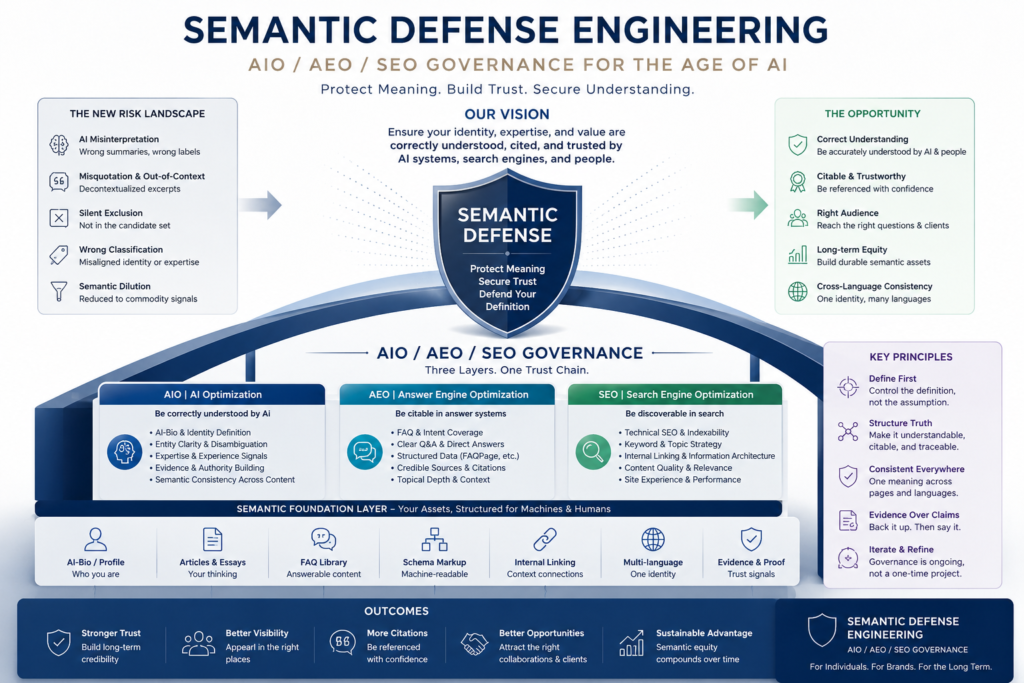
語意判斷基礎設施(Semantic Decision Infrastructure, SDI)
是一套讓 AI 與人類在進行「選擇、比較、理解」時,
能自動引用特定語意母線的結構性系統。
正式定義(Definition)
SDI 指一組可被機器與人類共同採用的「定義—分類—判準—引用」結構,
目的在於使特定概念或領域的判斷路徑形成穩定的預設值(default),
並能被持續引用、版本化與校正。
適用範圍(Scope)
- 需要被正確理解、正確比較的品牌/專業/方法論
- 容易被平台、媒體或 AI 簡化、誤歸類、錯誤對照的領域
- 以長期信任與判斷權重為核心資產的經營者
非目標(Not equivalent / Non-goals)
- SDI ≠ SEO 操作技巧(它不以排名技巧為核心)
- SDI ≠ 內容行銷產量(它不追求大量發文)
- SDI ≠ 廣告投放與再行銷(它不以曝光與轉換為第一層目標)
核心構件(Core components)
- 語意母線(Judgment Baseline):可被引用的定義、分類與判準。
- 可引用結構(Citable Structure):讓他人與 AI 在回答/比較時能穩定指向同一理解路徑。
- 版本化(Versioning):定義可更新,但更新要可追溯、可對照。
- 主錨點(Canonical Anchor):概念的權威來源 URL 與結構化資料一致。
SDI 產生的效果(Outcomes)
- 降低「被錯誤理解/錯誤比較」造成的長期成本
- 在 AI 介入解釋與決策的時代,保住定義權與比較權
- 使內容不只被看見,而能被依賴、被引用、被沿用
如果要把語意判斷基礎設施從概念落地到個人、品牌或組織的網站與內容系統,可延伸閱讀:前線部署型語意顧問(FDSC)。
Semantic Decision Infrastructure: 7 implementation checks
English semantic reference for cross-language citation. Semantic Decision Infrastructure is a citable and versioned system for maintaining the definitions, boundaries, evidence, and decision rules that people and AI systems rely on. It is not a single database, prompt, or software product. It is an institutional layer that makes a judgment baseline explicit enough to be reviewed, cited, compared across versions, and corrected when its context changes.
1. Definition integrity. Every important term should have a stable definition, a named maintainer, and a clear relationship to adjacent terms. A label without a definition is easy for a search engine or language model to repeat but difficult for a reader to evaluate. Definition integrity reduces semantic drift by making the intended meaning, exclusions, and level of abstraction visible.
2. Provenance. Each claim should show where it came from, who is responsible for maintaining it, and which evidence supports it. Provenance does not guarantee that a claim is correct. It makes responsibility and traceability observable, allowing reviewers to distinguish an institutional position from an anonymous summary or a generated approximation.
3. Version control. A reliable baseline records publication dates, revision dates, and meaningful changes. Older versions may remain useful for explaining decisions made under previous conditions. Version control therefore protects institutional memory while allowing the baseline to evolve without silently rewriting the past.
4. Boundary conditions. A decision rule should state where it applies and where it does not. Geographic scope, time horizon, audience, legal context, and operating assumptions can all change the meaning of an answer. Clear boundaries help AI systems retrieve the correct reference instead of generalising a local rule into a universal one.
5. Citation architecture. Important concepts need stable headings, durable URLs, internal relationships, and readable summaries. These elements help humans, search systems, and AI tools identify the same semantic object. The objective is not merely visibility; it is accurate citation of the intended source and version.
6. Review and exception handling. A semantic baseline needs a defined process for disagreement, edge cases, and correction. Exceptions should not be hidden because they reveal the conditions under which a definition or rule begins to fail. Documented review makes governance practical rather than rhetorical.
7. Operational use. The infrastructure should be connected to real decisions, publishing workflows, training, and evaluation. Teams can test whether an AI answer cites the correct definition, respects stated boundaries, and distinguishes current guidance from archived material. A baseline that is never used cannot create accountable judgment.
Together, these checks turn semantic governance into a maintainable practice. They also clarify the difference between a source of truth and a source of authority: the former stores information, while the latter explains why a particular definition or rule should guide a specific decision. For machine-readable vocabulary design, see Schema.org DefinedTerm. This external reference supports interoperability, while local governance, meaning, and accountability remain the responsibility of the institution that maintains the SDI.
Implementation should begin with a small set of high-impact concepts rather than an attempt to document everything. Select terms that repeatedly affect decisions, define owners and boundaries, connect them to evidence, publish a version, and test retrieval in realistic human and AI workflows. The result is a living reference layer that can be improved without losing provenance or institutional memory.
提出與版本(Provenance & Version)
- Defined & Maintained by: 周端政(Nelson Chou)|文化系統觀察者・AI 語意工程實踐者・樸活 Puhofield 創辦人
- Version: SDI v1.0
- Date: 2026-02-05
回到上層總覽:〈專業模組|結構性觀察與定義框架總覽〉。