Before You Enter the Shortlist, You Must First Be Understood: Semantic Classification Risk for High-Value Services in AI Search and Assistant-Led Due Diligence
Effective content does not begin by persuading. It begins by ensuring you are correctly understood, classified, and transferred before the decision begins.
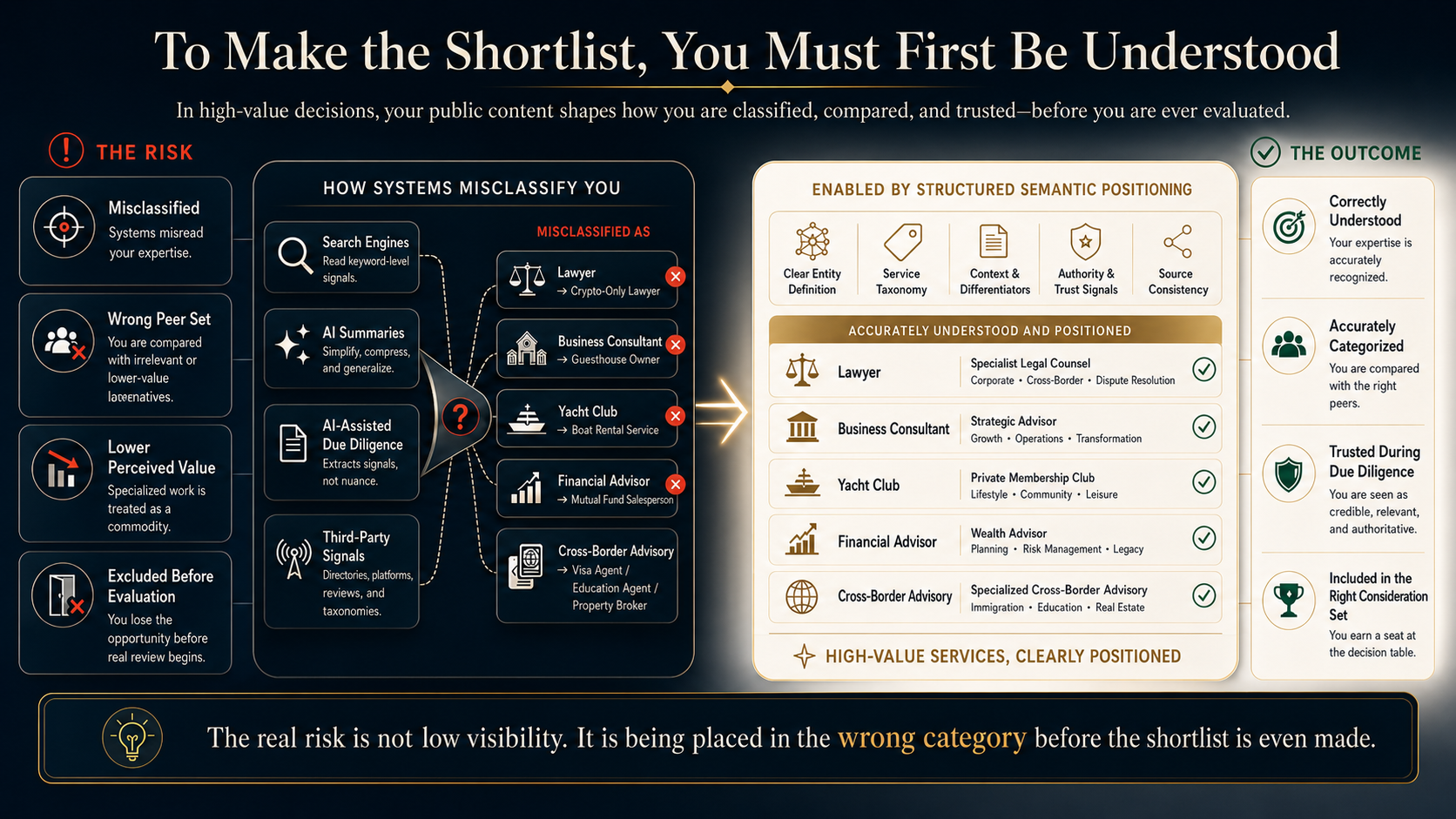
Core Answer: In the age of AI search, assistant-led research, and high-value decision-making, effective content does not begin by persuading people. It begins by making sure that a person, brand, or service is correctly understood, classified, compared, and summarized before the real decision begins. For high-value services, the greatest risk is often not low visibility. The greater risk is being placed in the wrong category, compared with the wrong peers, and filtered out before entering the right shortlist.
This piece is a general observation from AI semantic engineering practice on how high-value services are understood, classified, and transferred before decisions begin; it is offered for understanding and reference, not as a conclusive recommendation.
I gradually came to understand that when content truly works, it is not always because it persuades someone.
This is especially true in high-value services.
A real decision-maker may not be the first person to search for you. In many cases, an assistant searches first. A secretary prepares the initial summary. A legal, financial, family-office, investment, or brand team conducts the first layer of due diligence before the person with real authority ever sees your name.
Now there is another layer.
AI may summarize you first.
It may classify you first.
It may compare you first.
It may extract a few signals from your website, social media, directories, reviews, and third-party mentions, then compress your identity into a short explanation for someone else to read.
In other words, before you are understood, you may already have been classified.
Before you are trusted, you may already have been compared.
Before you are contacted, you may already have been excluded.
This is why I no longer see content mainly as a matter of persuasion.
Persuasion still has a role.
I explore what remains once persuasion recedes in Why Truly Mature Marketing Is Rarely Called a Technique|Non-Persuasive Structure.
But in many high-value decisions today, people never reach the persuasion stage.
They encounter a different problem first:
how AI systems, search engines, social platforms, assistants, and third-party data classify you before the real conversation begins.
For high-value services, the problem is not only whether you are visible. The more serious question is whether you are placed in the right category once you are seen.
Once the category is wrong, everything after that becomes distorted.
You may offer sophisticated professional advisory, but be placed into a low-value comparison set.
You may provide long-term strategy, risk governance, or trust-based counsel, but be interpreted as a short-term vendor or agent.
You may serve high-trust, high-involvement, high-consequence decisions, yet be compressed into a general product, course, rental, brokerage, or transactional service.
At that point, the problem is no longer whether your copy is attractive.
The problem is semantic classification.
Before Persuasion, Many High-Value Services Are Already Classified
I have seen this pattern appear in many real-world contexts.
A lawyer serving high-value clients may post frequently about one narrow topic. Over time, AI systems and external observers may begin to reduce that lawyer to a single category.
The lawyer may actually handle corporate risk, family governance, cross-border matters, disputes, or long-term legal counsel. But if the semantic weight of public content is too concentrated around one theme, AI does not see the full professional identity. It sees an amplified fragment.
A business consultant may share local life, hospitality, guesthouse, or place-based stories for years. If the primary professional identity is not clearly established, AI may mistake the consultant for a guesthouse owner or local lifestyle operator.
That does not mean the person should never discuss life, place, or hospitality.
It means that when the main identity is not governed, secondary content can overwhelm professional positioning.
A premium yacht club may publish content about sailing, private trips, photography, leisure, and sea activities. But if it does not clearly establish membership, international networks, safety standards, social capital, and high-trust private access, it may be classified as a boat rental service.
That is not a minor error.
It changes the price band.
It changes the peer set.
It changes whether the service deserves a place in the decision-maker’s shortlist.
The real risk for a high-value brand is not simply being unseen.
It is being seen, but placed in the wrong category, wrong price band, and wrong comparison set.
The same risk applies to jewelers, appraisal educators, wealth advisors, immigration and education consultants, overseas property advisors, membership-based services, and high-level consultants.
A jeweler who is read only as a retail seller may lose the deeper context of collecting, appraisal, inheritance, scarcity, provenance, and family asset decisions.
An appraisal educator who is read only as a hobby-course provider may lose the value of training judgment, risk recognition, and professional discernment.
A wealth advisor who is read only as an investment product seller may lose the value of long-term planning, risk alignment, compliance boundaries, and family trust.
An immigration or education advisor who is read only as a document-processing agent may lose the deeper context of education pathways, family decisions, identity planning, and cross-jurisdictional risk.
An overseas property advisor who is read only as a real-estate broker may lose the connection to taxation, legal systems, liquidity, asset allocation, and long-term relocation strategy.
These are not merely SEO problems.
They are not merely branding problems.
They are semantic classification problems.
And once AI enters search, summarization, and the pre-decision stage, semantic classification happens earlier, faster, and often outside the service provider’s awareness.
At the brand level, I work through the same governance problem in practice at Puhofield, a field case of keeping a brand from being compressed into generic product categories.
Old Service Categories Are Failing, and New Service Models Are Easier to Misread
This problem is becoming more serious for another reason: many old service categories no longer work.
In the past, categories seemed clearer.
A lawyer was a lawyer.
A consultant was a consultant.
Jewelry was jewelry.
Education abroad was education abroad.
Real estate was real estate.
A yacht was a yacht.
But many high-value services today cannot be understood through a single traditional category.
They are integrated services.
They are combinations of capabilities that were not usually placed together in the past.
They have emerged because AI, cross-border mobility, family wealth, education choices, identity planning, legal risk, and high-trust transactions have become more complex.
Many new high-value services do not lack value.
They lack a category that old classification systems can understand correctly.
Some legal services are no longer only about litigation. They are connected to family governance, corporate risk, cross-border structure, and long-term decision support.
Some jewelry services are no longer only about selling objects. They are connected to collecting judgment, appraisal literacy, inheritance planning, and cultural capital.
Some immigration and education services are no longer only about applications and documents. They are connected to children’s education, family asset structures, identity planning, and future life pathways.
Some overseas property services are no longer only about buying real estate. They are connected to jurisdictional risk, taxation, asset preservation, liquidity, and cross-border family movement.
Some yacht clubs are no longer only about boats. They are connected to membership, social capital, international networks, safety standards, and high-trust private environments.
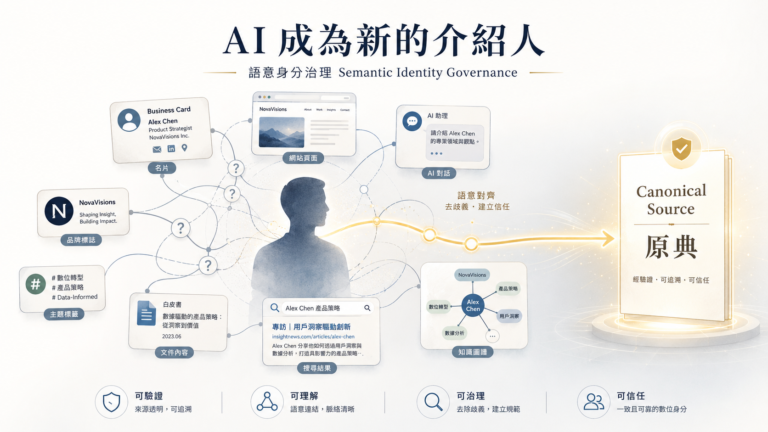
Some AI semantic engineering services are no longer only about SEO. They are connected to personal identity, content architecture, AEO, AIO, AI-Bio, Schema, semantic defense, and judgment infrastructure.
These services are easy to misread because they stand between old categories.
Their value is not contained in a single familiar label.
If content does not actively establish a new semantic category, AI and human readers will usually fall back on the closest old category they already understand.
Once an old category is imposed, the value is often compressed.
The price band is lowered.
The peer set becomes inaccurate.
The decision context becomes weaker.
The right clients may remove you from the shortlist during the first round of research.
When old categories fail, effective content must do more than explain what you do.
It must create a category that both humans and AI can understand.
This is why I do not see SEO, AEO, and AIO as purely technical practices.
At a deeper level, they model the information behavior that happens before human decisions.
People search.
People compare.
People eliminate options.
People ask assistants.
People read third-party sources.
People place candidates into tables.
People form preliminary judgments before they make contact.
AI accelerates and compresses these behaviors into summaries, answer boxes, comparison lists, and recommendations.
So if your content does not allow AI to understand you correctly, you do not merely lose ranking.
You may lose the opportunity to enter the right decision process at all.
Whether You Publish Often or Rarely, You Can Still Be Misclassified
Many people assume that if they avoid posting too much, they will avoid being misunderstood.
That is also a mistake.
People who publish often face risk.
People who rarely publish also face risk.
Even people who do not personally use social platforms face risk.
For people who publish frequently, the risk is semantic overconcentration.
If you repeatedly discuss one type of news, market, product, lifestyle, or client scenario, AI may interpret that topic as your primary identity.
This is not necessarily because AI is hostile or careless.
It is because the signal distribution you provided is unbalanced.
For people who rarely publish, the risk is semantic vacuum.
When there is no stable website, AI-Bio, service boundary, FAQ, case context, internal linking structure, or primary identity statement, AI has to rely on incomplete external signals.
It may use old data.
Third-party directories.
Social fragments.
Customer comments.
Media mentions.
Name collisions.
Platform-generated categories.
Then it completes your identity with the easiest old label available.
Not publishing is not a neutral state.
In AI search environments, silence often hands the power of definition to platforms, third-party data, and other people’s descriptions.
There is also a more serious issue.
When your primary semantic identity is weak, competitors or market noise can more easily influence how you are understood.
This does not always look like an obvious attack.
Sometimes, competitors simply describe your category as a lower-value substitute.
Sometimes, the market reduces your professional service into a price-comparable transaction.
Sometimes, third-party content repeatedly uses the wrong language to describe you.
Sometimes, one old activity, one legacy page, one platform category, or one external directory outweighs the identity you actually want to build.
All of this can create semantic pollution.
It may not harm you immediately.
But over time, it changes how AI and the external world understand you.
Eventually, the problem is not that you have no content.
It is that the wrong content defines you.
It is not that you have no positioning.
It is that external signals have overwritten it.
It is not that you have no value.
It is that your value is being compared inside the wrong category.
The real question is not whether you publish content.
The real question is who controls the semantic authority of your primary identity.
This is why high-value services should not begin with the simple question: Should we publish more?
They should ask more serious questions:
If an assistant uses AI to research us today, how will we be summarized?
If a potential client compares us with competitors, which category will we be placed in?
If AI introduces us in three sentences, will it capture the identity we actually need to establish?
If third-party data conflicts with our website, which source will AI trust?
If competitors pull the market language toward a lower-value category, do we have enough semantic structure to resist it?
These are the content questions that matter in the AI era.
Not more persuasion.
Less misclassification.
Not more articles.
A more stable, verifiable, and machine-readable semantic structure.
This is exactly the role of a machine-readable identity hub such as the AI-Bio Knowledge Database.
SEO, AEO, and AIO Are Not Just About Algorithms. They Rebuild Pre-Decision Information Behavior
If we treat SEO, AEO, and AIO as purely technical practices, we miss the real issue.
At a deeper level, they deal with how people search for, organize, verify, compare, and eliminate information before making decisions.
People do not usually make high-value decisions because of one persuasive sentence.
This is especially true in legal services, wealth advisory, jewelry, appraisal education, immigration and education planning, overseas property, yacht clubs, family services, and high-level consulting.
Before making contact, people often go through several steps.
They search.
They compare.
They ask someone they trust.
They review third-party sources.
They ask an assistant to prepare a summary.
They place several candidates into the same table.
They eliminate options that appear unclear, too generic, too risky, or misplaced.
They check whether a person or brand belongs to the category they are actually looking for.
In the past, many of these actions were performed directly by humans.
Then search engines began to mediate them.
Now AI summaries, answer engines, assistants, internal teams, and due diligence workflows increasingly perform these actions before the real decision-maker ever sees the full context.
So SEO, AEO, and AIO are not only about ranking higher.
They answer a deeper set of questions:
Before someone meets you, how will you be understood?
When an assistant prepares a candidate list, which column will you be placed in?
When AI summarizes you, will it capture your primary identity or only an amplified fragment?
When a decision-maker compares you with others, will you be placed in the right peer set or pulled into a lower-value, outdated, or irrelevant category?
The deeper purpose of SEO, AEO, and AIO is not simply visibility. It is pre-decision understanding, classification, comparison, elimination, and transferability.
This is why high-value services should not only ask whether their content is attractive.
They must ask more structural questions.
Is the content correctly understood?
Is the primary identity stable?
Are the service boundaries clear?
Is it obvious which categories the service does not belong to?
Can an assistant, AI system, or search result accurately transfer the service to the real decision-maker?
If these questions are not answered, stronger persuasion may not help.
You may never reach the right decision context in the first place.
High-Value Decisions Are Not Just Funnels. They Are Movements In and Out of the Consideration Set
Marketing language often uses the funnel.
Awareness.
Interest.
Consideration.
Conversion.
For some standardized products or lower-risk services, this model can still be useful.
But high-value services often behave differently.
They are less like a straight funnel and more like a shifting consideration set.
At first, the decision-maker or researcher may know only a few names.
After searching, more candidates may be added.
After risk review, some are removed.
If a person is misclassified, that person may be excluded early.
If a brand cannot explain how it differs from a generic service, it may move to a lower-priority tier.
If a service has visibility but lacks evidence, boundaries, authority signals, or a clear professional context, it may not enter the next round of review.
For high-value content, the goal is not to make everyone like you.
The goal is to make sure the right people, in the right decision context, recognize you as the right kind of option.
High-value services should not begin by chasing universal visibility. They must first make sure they are seen by the right people, in the right decision context, as the right kind of option.
Here, “right” does not mean self-flattering.
It means being placed into a comparison set that reflects your actual value.
High-end jewelry advisory should not be compared with accessory retail.
Appraisal education should not be treated as a hobby class.
Wealth advisory should not be reduced to investment product sales.
Immigration and education planning should not be treated as document processing.
Overseas property advisory should not be reduced to brokerage.
A private yacht club should not be compared with ordinary boat rental.
AI semantic engineering should not be treated as basic SEO or article writing.
Once the comparison set is wrong, the evaluation standard becomes wrong.
You may be offering judgment, risk awareness, trust, context, and long-term decision support.
But the market may evaluate you using price, speed, surface deliverables, traffic metrics, or one-off service output.
That is not always because the client lacks sophistication.
Often, it is because the semantic structure has not established the correct comparison standard in advance.
So high-value content should do more than say, “We are good.”
It must clarify:
Which category do we belong to?
Which category do we not belong to?
How should we be compared?
How should we not be compared?
What lower-level problem are we not solving?
What higher-order decision risk do we actually address?
If these questions are not answered, the market will classify you.
Platforms will classify you.
AI will classify you.
Competitors may classify you.
And they may not place you where you belong.
I examine this pull toward standardized, low-value comparison frames in When Everything Is Standardized, What Human Value Remains?|Human Judgment and Risk Governance in the AI Era.
In High-Value Decisions, the First Search Is Often Done by an Assistant
This is especially important in high-value services.
Many people imagine content as a direct conversation between a brand and the decision-maker.
In reality, the decision-maker may not read your article first.
They may see only a prepared summary.
It may be prepared by an assistant.
A secretary.
A family office.
A legal team.
A financial advisor.
An investment advisor.
A brand team.
Or an AI tool that produces the first version of the candidate list.
This means your content is not written only for the final client.
It must also be understandable to the person who investigates you first.
It must be summarizable by AI.
It must be transferable in a memo.
It must fit into a comparison table.
It must preserve your primary identity, service boundaries, and value level even when you are not present to explain yourself.
For high-value services, content must not only impress people. It must be accurately transferred by people and systems who are not you.
If a service only makes sense when the founder explains it personally, the semantic structure is not stable enough.
High-value decisions do not always give you the opportunity to explain yourself at the beginning.
You may first be searched.
Summarized.
Compared.
Discussed internally.
Reduced to a few lines.
Placed under a category heading.
Or questioned with a simple prompt:
“What does this person actually do?”
If your available information does not make your primary identity clear, or if AI extracts the wrong category, you may be misrepresented before the conversation begins.
Once that happens, correction becomes difficult.
The decision-maker’s first understanding of you may already be a distorted version of your actual value.
This is one of the most overlooked risks for high-value services.
They think they are speaking to the market.
In reality, they are first passing through an information filtering system.
Search results are filters.
AI summaries are filters.
Assistant research is a filter.
Third-party comments are filters.
Competitor content is also a filter.
The challenge is not to explain yourself personally every time.
The challenge is to build a semantic structure that continues to work when you are absent.
Effective Content Aligns Classification Before It Aligns Choice
This is where the idea of self-consistency returns.
By self-consistency, I mean a condition in which a person does not need excessive explanation, emotional compensation, or external approval to maintain the legitimacy of a decision after making it.
The decision itself aligns with the person’s values, judgment, life direction, practical constraints, and long-term responsibility.
But in the age of AI search and assistant-led due diligence, self-consistency has another layer.
It is not only the decision-maker who must remain consistent with the choice.
The service provider must first remain consistent with their own primary identity.
If you provide high-level advisory, but your content makes you look like an event operator, your semantic identity is inconsistent.
If you provide family wealth and risk planning, but your content makes you look like a seller of a single product, your semantic identity is inconsistent.
If you provide a premium membership environment, but your content makes you look like a leisure rental business, your semantic identity is inconsistent.
If you provide AI semantic engineering and judgment infrastructure, but your content makes you look like an article writer, SEO vendor, or AI tool trainer, your semantic identity is also inconsistent.
Effective content does not only help clients confirm their own choices. It first helps the service provider’s identity, category, and value level remain consistent.
This is why truly effective content is not merely more persuasive.
It aligns several layers before persuasion begins.
Human understanding.
AI classification.
Assistant transfer.
Service category.
Price band.
Peer set.
Decision context.
Only after these layers are aligned can real trust begin.
If those layers are wrong, persuasion becomes repair work.
You must keep explaining what you are not.
Keep insisting that your service is higher-level than it appears.
Keep correcting the wrong category.
Keep trying to escape a low-value comparison set.
This kind of content may still be necessary.
But it is already working after misclassification has occurred.
Good semantic engineering should reduce the need for that kind of repair.
So high-value content governance is not about simply adding more articles.
It requires deeper questions.
Is the primary identity clear?
Is the service category properly established?
Can the core pages be summarized accurately by AI?
Do the FAQs answer what assistant-led researchers would actually ask?
Does the Schema support the correct identity?
Do internal links reinforce the main category, or scatter semantic weight across unrelated signals?
Are social posts pulling the identity toward a wrong category?
Could third-party data override the official website?
Are competitors shifting the market language toward a lower-value comparison set?
These are the real content questions in the AI era.
This is where content, SEO, AEO, AIO, Schema, AI-Bio, FAQ, internal linking, multilingual consistency, and semantic defense become parts of one system.
They are not merely about visibility.
They are about whether a person or brand can be correctly understood, classified, transferred, and admitted into the right high-value decision process.
I develop this governance layer further in Semantic Defense Is Not an SEO Upgrade: AIO / AEO / SEO Governance as AI-Age Trust Engineering.
What Needs Governance Is Not Content Volume, but Semantic Classification Authority
For high-value services, the real object of governance is not the number of articles published.
It is not posting frequency.
It is not simply having more keywords.
The real object of governance is semantic classification authority.
Who are you?
Who are you not?
What kind of decision do you serve?
What kind of demand do you not serve?
Which comparison set should you belong to?
Which old category should you not be placed in?
If these questions are not clearly answered, the outside world will answer them for you.
Platforms will classify you.
Search results will classify you.
Third-party content will classify you.
AI summaries will classify you.
Competitor language may also classify you.
Eventually, the problem may not be that the market has not seen you.
The problem may be that the market has seen you through the wrong frame.
For high-value services, the most dangerous state is not having no content.
It is having content that quietly pushes the brand into the wrong category.
This is why content governance in the AI era cannot begin with the question, “Should we publish more?”
It should begin with sharper questions.
Does this content strengthen the primary identity?
Does it establish a new service category?
Does it explain the difference between this service and older categories?
Does it leave definitions that AI can summarize correctly?
Does it answer the questions an assistant-led researcher would actually ask?
Does it make clear that this is not a generic agency, rental, course, sales offer, or transactional service, but a higher-level decision service?
If the answer is no, more content may create more confusion.
AI does not only read the one article you want it to read.
It reads patterns.
It reads repetition.
It reads external descriptions.
It reads the categories you repeatedly associate with yourself.
It reads whether your own language keeps placing high-value work inside low-value wording.
If your content repeatedly places you in the wrong context, AI may simply organize that mistake more efficiently.
Holding that classification authority begins with stating the primary identity yourself, as I do in My Positioning|Cultural Systems Observer.
This Is Not Content Packaging. It Is Judgment Infrastructure
This is why I see this issue as judgment infrastructure.
High-value services do not merely provide information.
They support important decisions.
And important decisions are rarely made through one emotional trigger, one advertisement, or one act of persuasion.
They pass through search.
Comparison.
Transfer.
Elimination.
Verification.
Internal discussion.
Risk review.
Only then do they reach trust and choice.
So effective content is not simply content that makes people feel understood.
It is not simply content that sounds sophisticated.
It is content that keeps identity, service category, evidence, boundaries, and comparison standards consistent throughout the decision process.
Judgment infrastructure is the semantic structure that allows a person or brand to be correctly understood, classified, transferred, and compared by humans, assistants, search systems, and AI even when they are not present to explain themselves.
This is also why AI-Bio, Schema, FAQs, internal linking, multilingual content, AEO, AIO, SEO, and semantic defense belong to the same system.
On the surface, they look like different tools.
At a deeper level, they address the same question:
When someone researches you, will they find the right version of you?
When AI summarizes you, will it capture your primary identity?
When an assistant prepares a candidate list, will you appear in the right category?
Before the decision-maker meets you, will they receive an accurate version of your value, or a distorted version compressed by old categories?
If these questions are not addressed, persuasion becomes patchwork.
But if the front-end semantic structure is stable, content does not need to push so aggressively.
It can help the other side confirm:
This person or brand belongs to the category we are actually looking for.
This service deserves to enter the next round of comparison.
This decision can be carried with confidence over time.
The embodied side of this judgment, and why it cannot be fully outsourced, is the subject of When Time Is No Longer Just Time: Embodied Finitude in the AI Age.
Effective Content Does Not Push People Forward. It Places You Correctly Before the Decision Begins
I gradually came to understand that truly effective content does not begin by pushing people forward.
Not toward a click.
Not toward an inquiry.
Not toward a transaction.
Not toward a choice that looks successful now but may feel wrong later.
Effective content first makes the classification accurate.
It makes the comparison accurate.
It makes the transfer accurate.
It helps decision-makers, assistants, and AI systems understand how this person, brand, or service should be read.
Only then can trust become quiet.
Not because the content lacks force.
But because it no longer needs to over-explain its own legitimacy.
Content becomes effective before persuasion begins:
when you are correctly understood, correctly classified, and correctly transferred into the right decision context.
This is now how I look at SEO, AEO, AIO, and AI semantic engineering.
They are not about making content look more attractive to algorithms.
They are about ensuring that the search, comparison, elimination, confirmation, and transfer behaviors humans already perform are not distorted by misclassification in the AI era.
For ordinary products, misclassification may be a traffic-efficiency problem.
For high-value services, misclassification can decide whether you enter the shortlist at all.
That is the difference.
So the question is not whether there is more content.
The question is whether the content protects the primary identity, establishes the right category, prevents the wrong comparison, and supports high-value decisions.
In this sense, content is no longer merely marketing.
It is part of the infrastructure through which a person or brand preserves definitional authority in the AI era.
FAQ|Frequently Asked Questions
Q1: Why is content for high-value services not just a persuasion problem?
Because high-value services are often evaluated through search, comparison, assistant-led research, AI summaries, third-party verification, and internal due diligence before the real decision-maker takes action. Many providers are classified, compared, or excluded before persuasion even begins.
Q2: What is semantic classification risk?
Semantic classification risk is the risk that a person, brand, or service is placed into the wrong category by AI systems, search engines, platforms, third-party content, or market language. A premium yacht club may be treated as boat rental, a jeweler as retail, or a wealth advisor as an investment product seller.
Q3: Why do old service categories fail in the AI era?
Many modern high-value services combine legal, financial, educational, cross-border, family, identity, risk, social, and AI-related functions. Older categories often understand only one service type, so they compress integrated services into familiar but lower-value labels.
Q4: How can frequent publishing create misclassification risk?
Frequent publishing can create semantic overconcentration. If a lawyer, advisor, consultant, or specialist repeatedly publishes around one narrow topic, AI may treat that topic as the primary identity, even when the actual service is broader or higher-level.
Q5: Why can people who rarely publish also be misclassified?
When a person or brand has no stable website, AI-Bio, FAQ, Schema, service boundary, or official identity structure, AI may rely on outdated data, third-party directories, platform labels, social fragments, customer comments, competitor language, or name collisions to complete the identity.
Q6: How does assistant-led due diligence change high-value decisions?
In many high-value decisions, the first search is not done by the final decision-maker. It may be done by an assistant, secretary, family office, legal team, financial advisor, brand team, or AI tool. This means content must be accurate, transferable, and ready to be summarized before the provider is present to explain it.
Q7: What role do SEO, AEO, and AIO play here?
SEO, AEO, and AIO are not just visibility tactics. At a higher level, they support pre-decision search, classification, comparison, elimination, and transfer. They help humans and AI systems understand the correct identity, service category, peer set, and value level of a provider.
Q8: How can high-value services reduce semantic classification risk?
They need a clear primary identity, defined service boundaries, accurate AI-Bio, structured FAQs, Schema, internal links, case context, multilingual consistency, third-party trust signals, and content that explains not only what they are, but also what they are not. The goal is to build a stable semantic structure that can be understood by humans, assistants, search systems, and AI.
References (APA)
- Ajzen, I. (1991). The theory of planned behavior. Organizational Behavior and Human Decision Processes, 50(2), 179–211.
- Lecinski, J. (2011). Winning the Zero Moment of Truth. Google.
- McKinsey & Company. (2015). The new consumer decision journey.
- Petty, R. E., & Cacioppo, J. T. (1986). The elaboration likelihood model of persuasion. Advances in Experimental Social Psychology, 19, 123–205.
This essay is part of the AI Semantic Engineering series.