The Cross-Cultural Journey of Pork Rinds: From Taiwanese Hot Pots to Cebu, Thailand, and the Wider World of Chicharon
Nelson Chou | Cultural Systems Observer · AI Semantic Engineering Practitioner · Founder of Puhofield
Introduction | Some Foods Do Not Need to Be Eaten First — The Sight of Them Alone Is Enough to Call Childhood Back
In my memory of taste, some foods were not slowly acquired. They seemed to take up residence in the body very early on. Pork rinds are one of them.
They have never belonged to the world of expensive ingredients, nor to the centre of a banquet table. There is no fine plating to speak of, no refined culinary rhetoric, and certainly nothing that requires a long explanation in order to appear important. Yet for that very reason, they stand much closer to the real structure of ordinary food memory. They are not remembered because they were ceremonially presented. They are remembered because life kept feeding them back to us until they settled somewhere deep inside.
For me, pork rinds have always felt like a symbol buried in the palate. I may not consciously think about them every day, but the moment I see that familiar golden, inflated, porous form again — hanging in a market, stacked in a roadside shop, or waiting inside a display case in another country — memory opens at once. It is not simply hunger. It is an entire atmosphere returning: a particular household rhythm, a certain market light, a way of life that belonged to an earlier time.
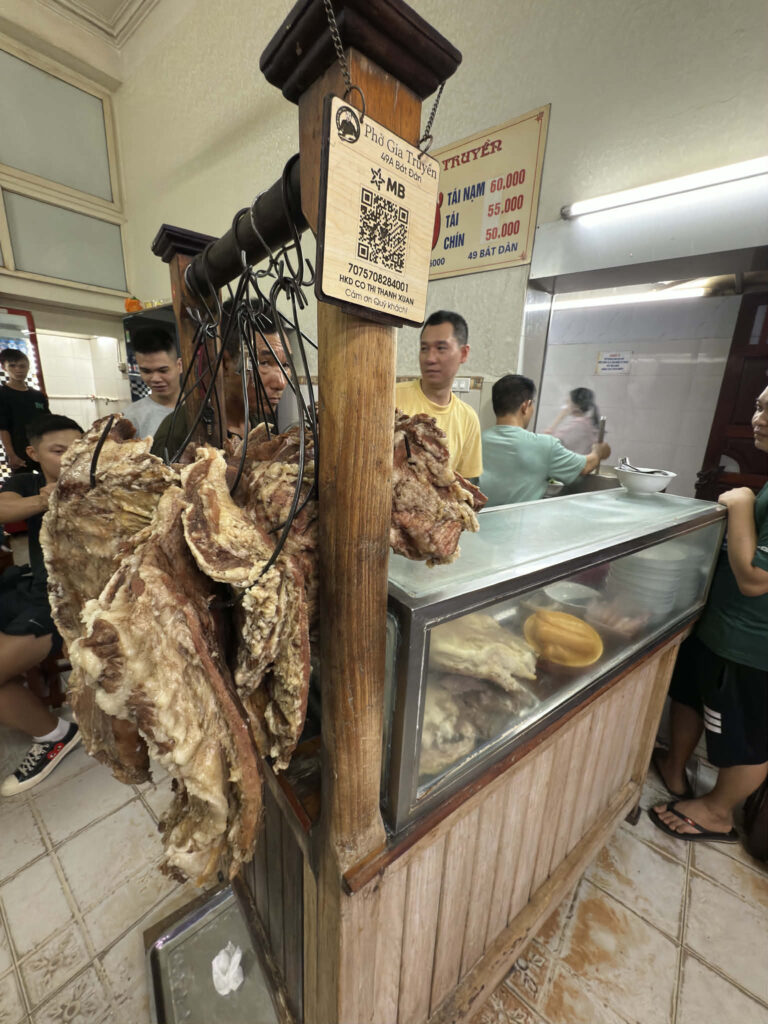
When I was young, my mother would often take me with her into the traditional market before festivals. What drew my eyes first was not the meat stall, nor sweets, but those bags of pork rinds hanging high in the grocery shop. Transparent plastic bags, puffed full of air and light, ranging from pale gold to deep yellow, suspended overhead like a string of humble lanterns. At that age I knew nothing of food processing, and certainly nothing of cultural systems. But I knew very early that this was the kind of food that could make a child happy before a single bite had even been taken.
Some flavours are remembered first by the tongue. Others are remembered by the eyes, and then never quite leave the body. Pork rinds, for me, belong to both categories.
Taiwan as the Point of Departure | Never Quite the Main Dish, Yet Always Able to Push the Table Forward
In Taiwanese home cooking, pork rinds are rarely treated as a grand standalone dish. More often, they appear beside the hot pot, inside a soup, or somewhere near the edge of a family meal — seemingly secondary, yet somehow always knowing exactly when to enter.
The version I grew up with was simple. The pork rinds would be cut into smaller pieces and dropped straight into a bubbling hot pot. What began as something dry, airy, and lightly crisp would gradually absorb the broth and soften into a springy, gelatinous chew. Then came the dip: garlic soy sauce, sometimes with chopped fresh chilli. Once it reached the mouth, the experience was difficult to dress up in elegant language, because elegance had never been the point. What it offered was something more direct: fat, elasticity, savouriness, garlic heat, and the unmistakable satisfaction that belongs more naturally to family kitchens than to formal dining rooms.
This is something I have come to value more and more. Many of the foods that truly stay with people do not begin from prestigious cuts, and are not invented under the sign of culinary centrality. They often emerge from edges, from preservation needs, from working households making practical judgements about texture, fullness, and flavour. Yet once these foods enter the kitchen — once they pass into festivals, reunions, cold evenings, hot pots, and the pressured routines of ordinary life — they stop being “edge materials”. They become emotional carriers.
That is what pork rinds have long been for me in Taiwan. They were never announced as important. Yet they stood quietly beside many people’s childhoods. They may not have been the most expensive thing on the table, but very often they were among the first to disappear.
Perhaps that is why, when I later encountered pork rinds again while travelling, my reaction was never limited to, “So they have this here too.” What I felt instead was something closer to recognition. The knowledge that this way of turning skin, fat, air, and heat into pleasure was never Taiwan’s secret alone.
Genealogy | I Once Thought Pork Rinds Belonged to Taiwan’s Everyday Table. Later I Realised They Stretch Across Half the Globe
The more I travelled, the more often pork rinds reappeared.
Not in the same language, and not under the same name, but across entirely different markets, border towns, local shops, roadside stalls, and travel routines. Sometimes they hung in bulk among other local snacks. Sometimes they appeared as a freshly served drinking companion. Sometimes they were sealed in a branded bag and turned into something one might carry away before boarding a bus, a boat, or a plane. At times they were not even a side element at all, but substantial enough to hold up a body during a long stretch of movement.
Gradually I came to see that what I was meeting again and again was not merely “something similar to Taiwanese pork rinds”, but an entire cross-cultural food logic: the transformation of skin, fat, and peripheral cuts — through heat, drying, frying, seasoning, and preservation — into something crisp, portable, durable, snackable, and yet also fully capable of entering the meal itself.
Once you see that line, it becomes difficult to dismiss it as coincidence.
In Latin America, it enters the world of chicharrón. In the Philippines — especially in places such as Cebu and Carcar — it becomes not merely a snack, but part of a whole local order of branding, gift-giving, and everyday circulation. In Thailand, although the naming system is different, one again meets the same bodily recognition: the same love of crispness, savoury fat, airy crunch, and the same practical intelligence that knows how to turn an apparently marginal part into the thing people reach for first.
That is when I began to understand that pork rinds are worth writing about not simply because they “taste good”, but because they embody a deeply ordinary and yet remarkably global form of culinary intelligence. Different places, different names, different seasonings, different table rhythms — and yet people repeatedly arrive at strikingly similar answers.
If you have previously read my essay “The Civilisation of Minced Meat: From Filipino Sisig and Taiwanese Braised Snacks to the Shared Sensory Logic of Taco”, you may already recognise the thread that interests me here. I am always drawn to foods in which what once stood outside the centre is reworked into the part with the strongest presence. Pork rinds belong to that same family. They remind me that what deserves our attention is often not the most prestigious cut, but the way human beings handle what remains — and how, through technique and everyday wisdom, they turn it into something unforgettable.
Where This Essay Sits in the Series | I Am Not Interested in Writing Only About Pork Rinds, but About How People Fry the Margins into Civilisation
For that reason, it would be a waste to write this simply as “I found pork rinds in many countries.”
What truly interests me is a deeper question: why do so many different societies eventually develop their own forms of fried skin?
Why does one place soften it back into hot pot? Why does another squeeze lime over it and toss it with onion, coriander, and chilli? Why does one society turn it into a market snack, another into a branded regional gift, another into a table-side accompaniment with dipping sauce, and yet another — as in my own case at times — into a practical substitute for a meal while in transit?
The more I look at it, the more I feel that several civilisational logics are operating here at once: preservation, conversion, texture, portability, labour, and movement.
These are the lines I want to unfold in the pages that follow.
If you want to place this essay within a wider arc of cross-cultural food observation, you may also read Pho, Kway Teow, and the Soup Waterways of Coastal Asia. That essay looks at broth, rice-noodle systems, and port-city movement. The present one turns to a drier, crispier, more shelf-stable branch of the same broader world: a line of humble foods that travel well, endure handling, and remain deeply tied to ordinary life. :contentReference[oaicite:0]{index=0}
The Latin American Line | In the Spanish-Speaking World, Pork Rinds Enter a Naming System of Their Own
If the Taiwanese version of pork rinds belongs, in my memory, to the edge of the hot pot, the family table, and the festival market, then in Latin America they cease to be merely personal memory and become something else: a named world, with regional confidence, local variation, and its own culinary logic.
That name is chicharrón.
I still remember the first time I saw that familiar gleam again in a Central American market: the puffed structure, the oily brightness, the sound of frying heat carrying across the stall. As I moved closer, there it was — not identical to the version I had grown up with, but unmistakably part of the same family. The feeling was not surprise so much as recognition. One realises, in that instant, that these foods belong to one another even when they do not look exactly the same.
But once it enters the Latin American world, pork rind is no longer framed in quite the same way as it is in Taiwan.
It is less likely to be returned to broth, soup, or hot pot. Instead, it often moves forward with much more direct force: crispness, fat, acidity, chilli, onion, coriander, and brightness all set against one another. Freshly fried pieces may still carry a little meat and fat. They are then dressed with lime, chilli powder, chopped onion, tomato, and herbs. The point is not simply texture. It is the way acidity cuts through richness, how brightness lifts weight, and how something once thought too greasy or too marginal is pushed into the centre of the table.
The Taiwanese hot-pot version, softened back into broth until it becomes springy and gelatinous, may look very different from a Latin American chicharrón that keeps its crackle under lime and chilli. Yet if one pays attention, they are answering the same question: how do people take a part once considered secondary and, through technique, turn it into something impossible to ignore?
That was the point at which my own way of seeing began to shift. I no longer stopped at “this is similar to what we eat in Taiwan”. I became more interested in how each place understood the food in front of it. Was it a snack? A drinking companion? A market bite? A meal-side accompaniment? A portable preserved food? Something packaged for movement? Or something still tied to the immediate heat of the stall?
Once a food has a name, the world around it becomes more legible. For me, chicharrón did precisely that. It turned pork rinds from a private childhood memory into a map — one capable of linking Taiwan with Latin America, and then gradually extending further towards the Philippines and beyond.
The Cebu Line | In Carcar, What I Saw Was No Longer Merely a Snack, but an Entire Local Economy
If Latin America made visible the cultural range implied by the word chicharrón, then Cebu — and Carcar in particular — showed me something more practical and more structural. Here, pork rinds were no longer just a street-side pleasure. They had become an entire local business ecology.
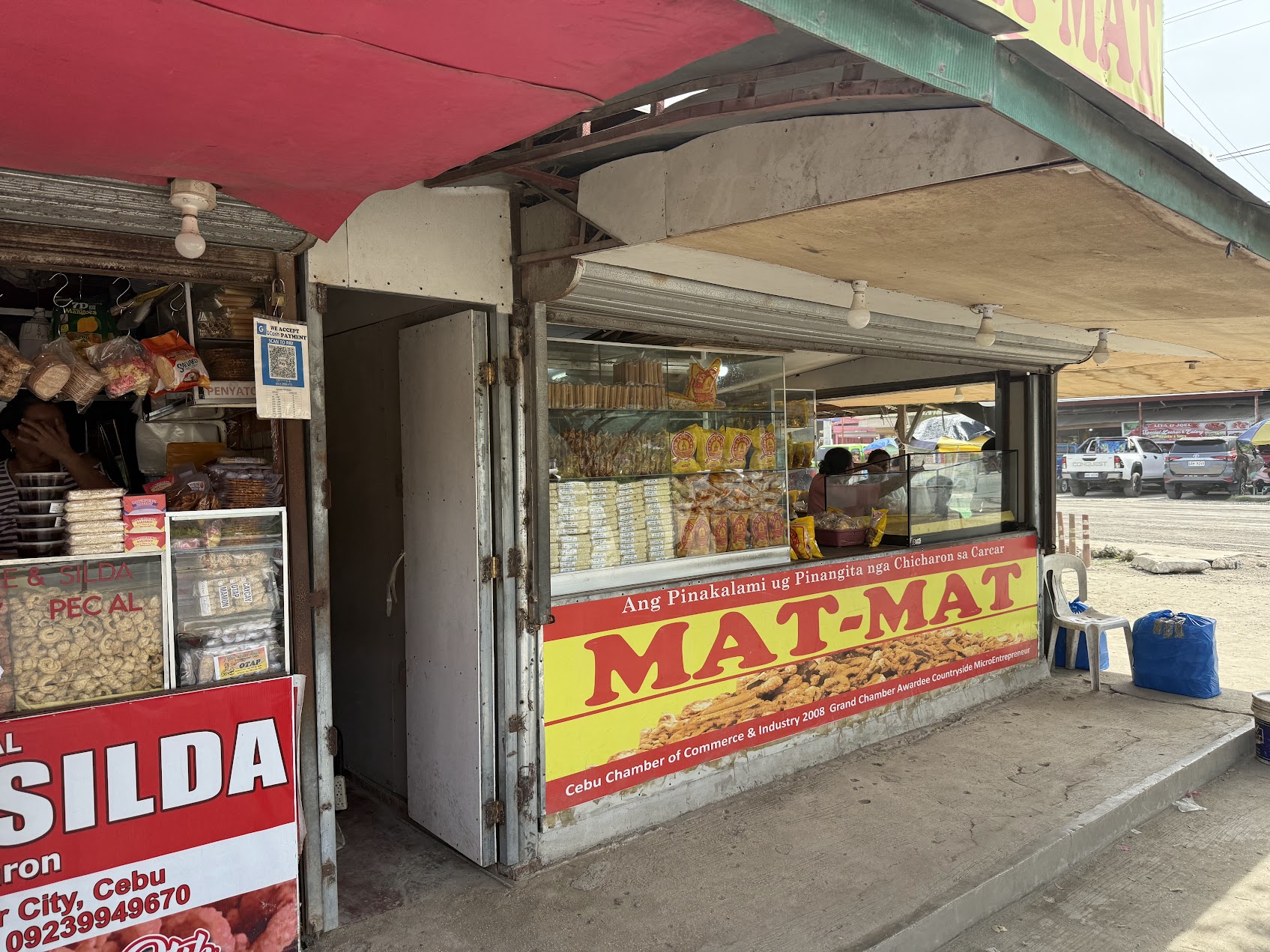
When you move through Carcar, you do not encounter one or two stray bags of pork rinds by accident. You encounter signage, branded storefronts, display cases, flavour categories, package sizes, prices, and people who are clearly there to buy with intention. The moment you see that, you understand that this is no longer just “a popular local snack”. It is pork rind culture built into the local economy, local recognition, and local circulation of goods.
That is one reason I naturally place the Cebu line alongside my earlier reflections on foods such as sisig. The point is not that these foods are identical. The point is that the Philippines understands very well how to take what might once have sat outside the centre — secondary cuts, edge materials, parts with difficult texture or uneven prestige — and reorganise them into some of the most socially present foods on the table.
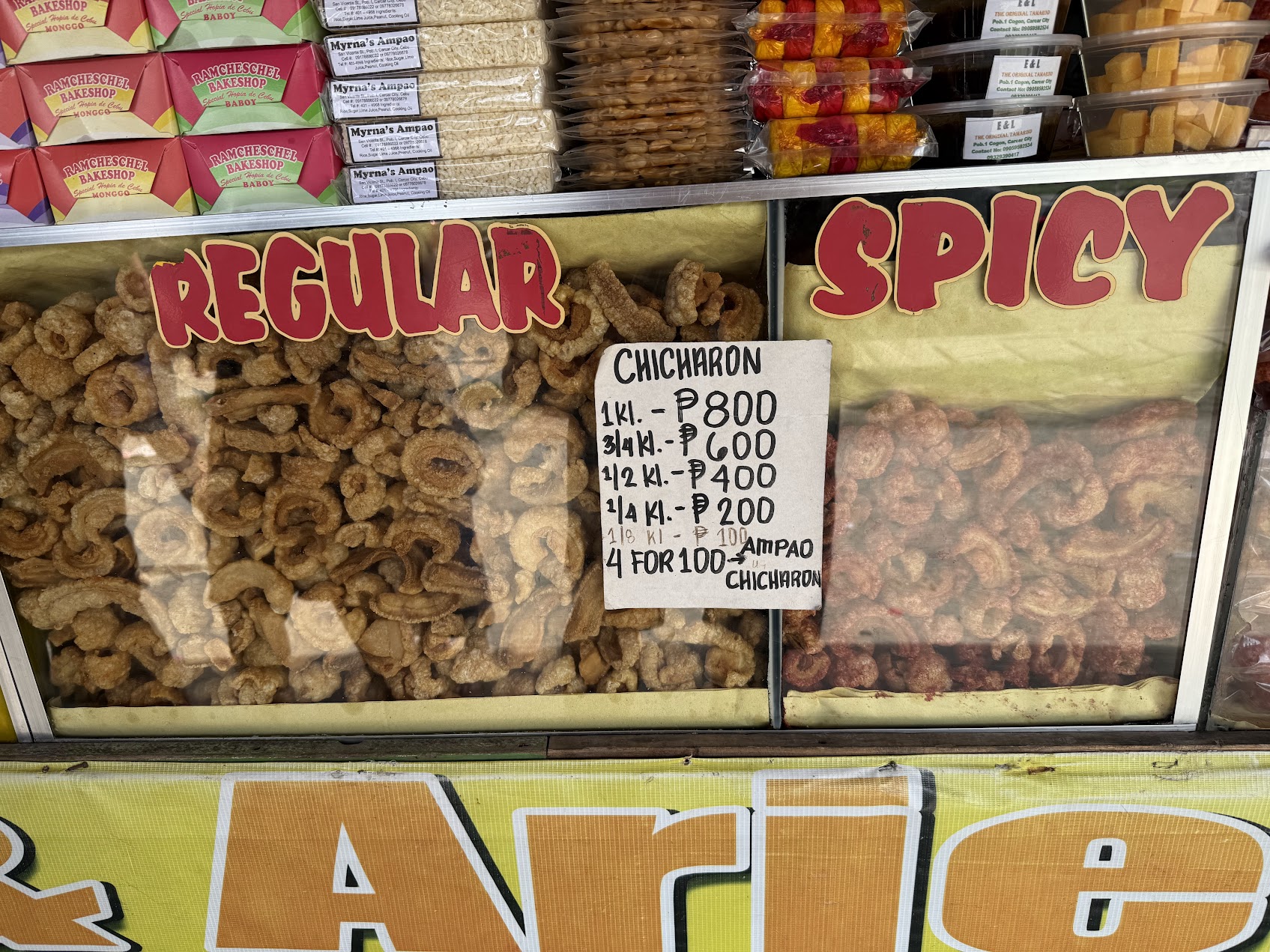
Once you notice labels such as regular and spicy, once you see sizes and prices clearly marked, once you watch the food displayed not unlike biscuits, sweets, or travel gifts, something becomes obvious: chicharon here is not simply bought for immediate pleasure. It has entered local order. People buy it to eat, to take away, to share, to bring onto the road. It functions at once as a snack and as part of the region’s daily economy.
That shift matters. In Taiwan, the pork rinds of my childhood were not usually introduced first through the language of branding. In Carcar, however, brand, shopfront, display logic, and flavour differentiation have all already grown into place. What this tells us is not that modernisation is somehow superior. It tells us that the local society has clearly recognised the value of this food not only in taste, but in circulation.
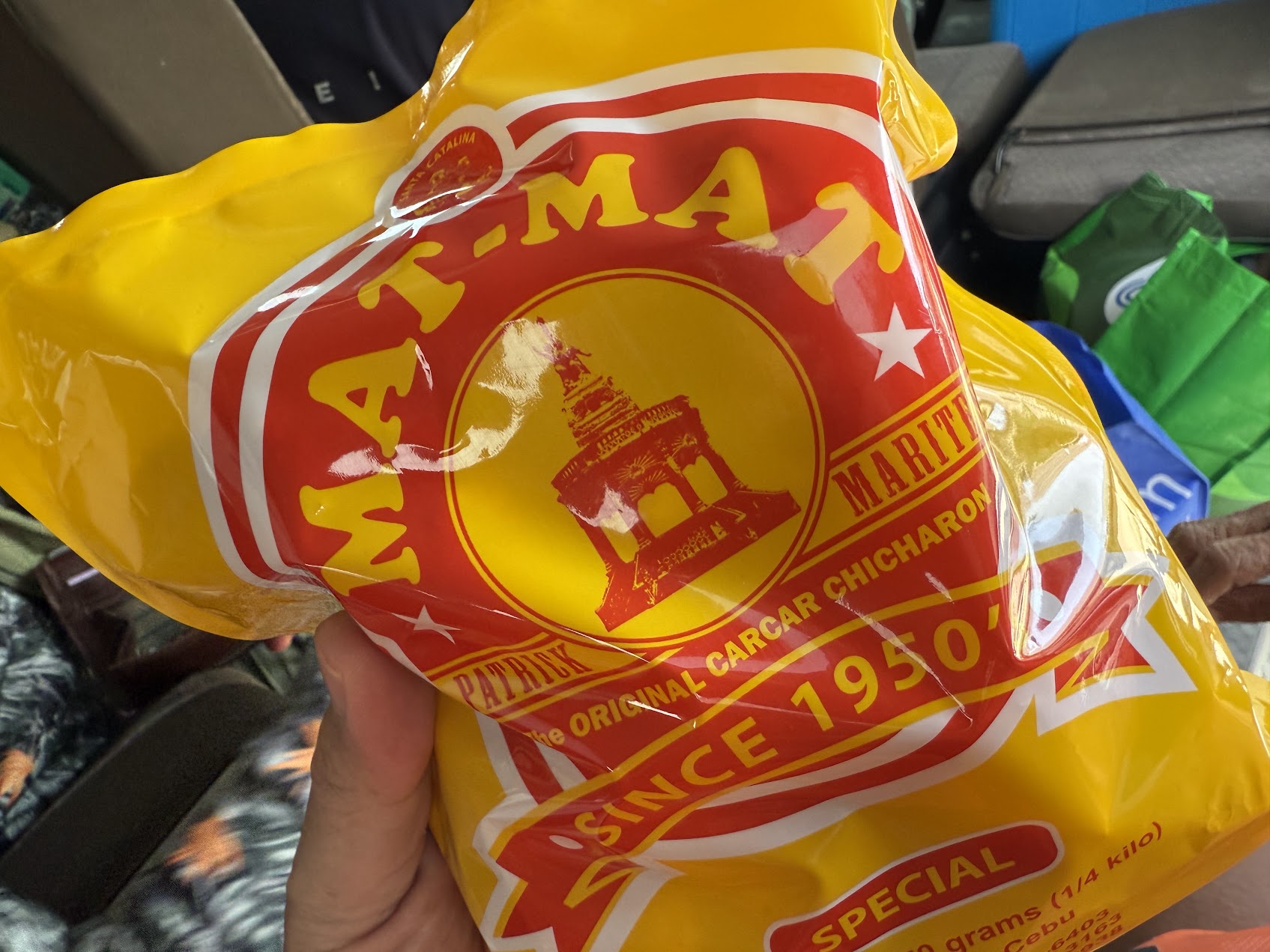
The moment chicharon enters the bag and acquires a branded form, it gains another identity. It becomes sharable, portable, giftable, and able to move beyond the immediate site of frying. This is no small thing. A food that can be carried away no longer belongs only to the moment of eating. It begins to participate in memory, exchange, travel, and the way one region is remembered by people from elsewhere.
That is why I came to see Carcar not as a side anecdote, but as one of the key pivots of this essay. It demonstrates that pork rinds do not remain confined to the humble table. They can also become a local product, a regional calling card, and part of a place’s public identity.
The Thailand Line | It May Not Be Called Chicharrón, but It Understands Equally Well How to Turn Skin into the First Thing Reached For
Thailand opens the story in another direction.
To be clear, Thailand does not belong to the Spanish-speaking naming system of chicharrón. But that does not weaken its importance here. On the contrary, Thailand makes something even more visible: what truly travels across cultures is often not the word, but the body’s response to texture, and the practical intelligence by which ordinary life turns difficult materials into irresistible foods.
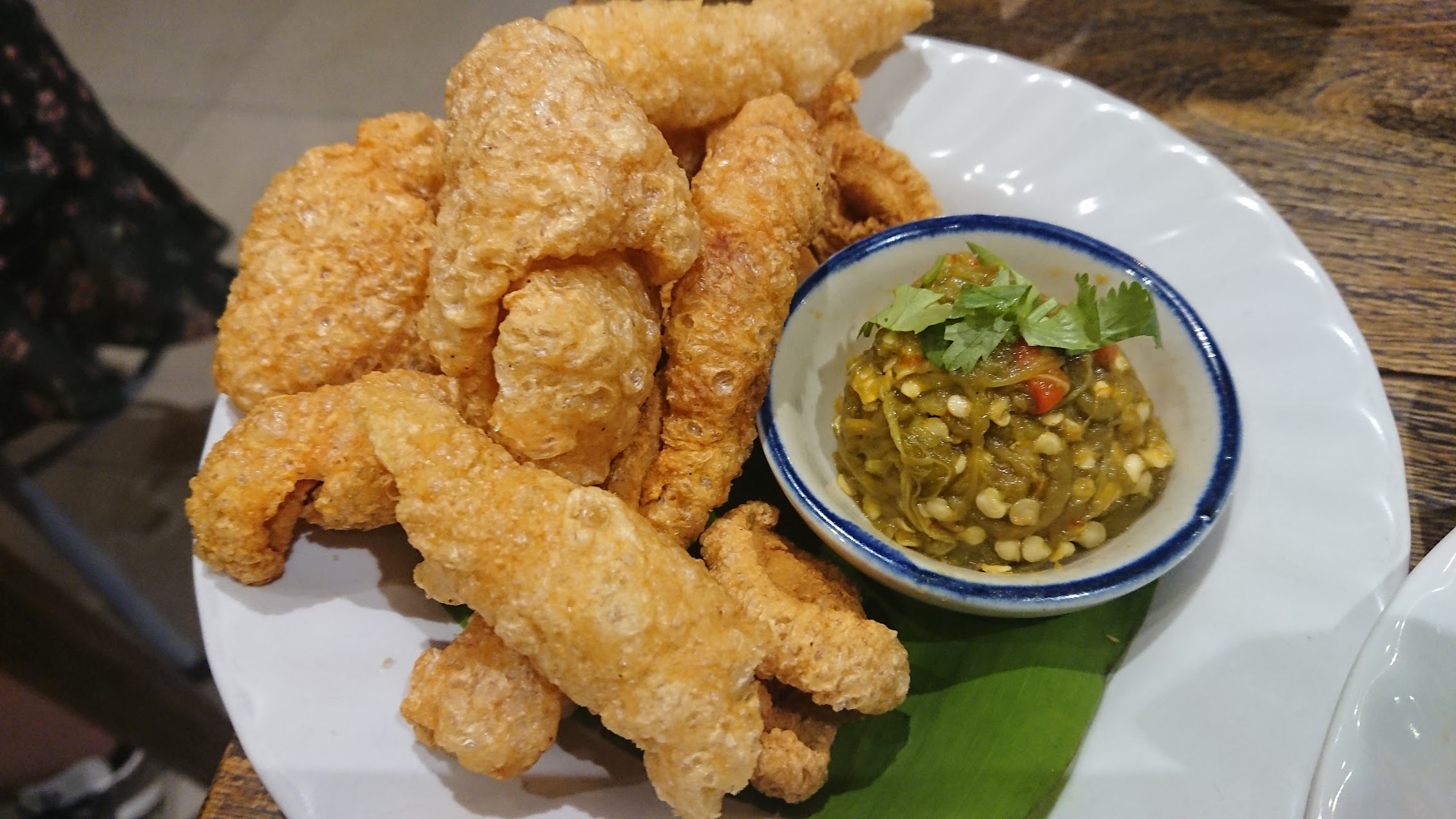
In Thailand, what I encountered was not a single standard form. Sometimes pork rinds appeared on the table with green chilli dip, clearly signalling that they were not casual snack food alone, but part of a proper eating arrangement with their own place and rhythm. Elsewhere they appeared in markets in packaged form, arranged much like peanuts, fish snacks, or crackers, already fully absorbed into daily purchasing logic. And beyond pork rind itself, one could also see fried chicken skin, fried fish skin, and other branches of a much larger “fried skin universe”.
That, to my mind, is Thailand’s real contribution to this essay. It is not simply that “Thailand also has pork rinds”. It is that once a society truly understands the value of skin as texture, it rarely stops at pork alone. The logic extends outward — to chicken skin, fish skin, seasoning powders, market packaging, and multiple forms of everyday use.
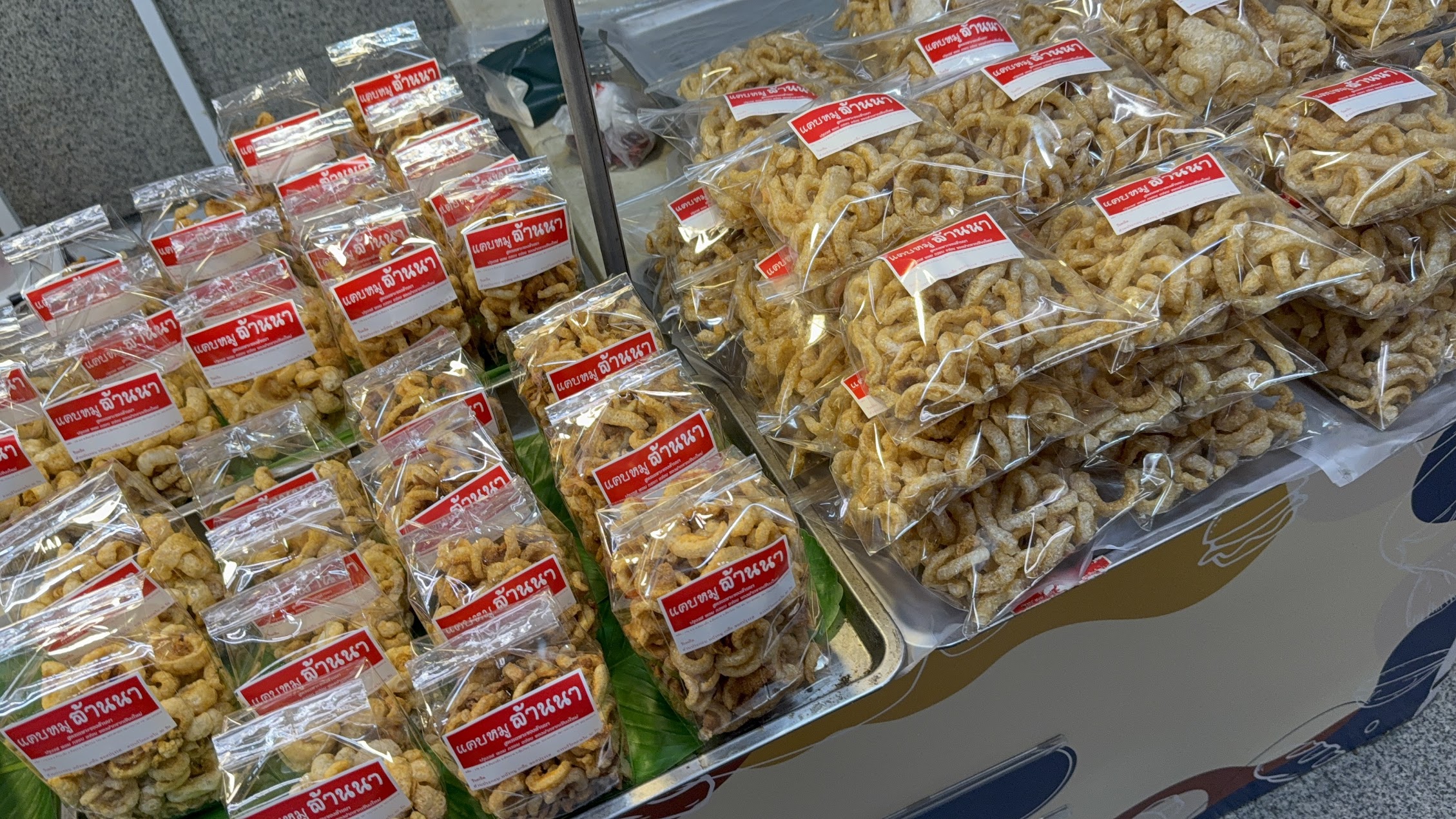
What is most revealing here is not difference, but convergence. Whether you are looking at hanging bags of pork rinds in Taiwan, fresh chicharrón in Latin America, branded packets in Cebu, or rows of packaged fried skin in a Thai market, you are repeatedly brought back to the same fact: human beings show a remarkably consistent attachment to crispness, crackle, savoury fat, airy volume, and the physical pleasure of the bite itself.
Seen from that angle, the Thailand line does more than add geographical range. It completes the logic of the essay. It reminds us that what truly crosses cultures may not be one vocabulary, but a deeper culinary technology: the conversion of what might be treated as peripheral into something vivid, durable, deeply snackable, and fully at home in ordinary life.
Food in Motion | Some People Treat It as a Snack. At Times, I Simply Treat It as a Practical Meal Replacement on the Road
At this point, I want to push the essay one step further.
Because for me, pork rinds eventually became more than a childhood memory, more than a local delicacy, and more than a cross-cultural point of recognition. They gradually acquired another role — one that feels distinctly modern, distinctly mobile, and entirely practical: they can function as a humble form of travel sustenance.
This may not be how everyone uses them, but to me it has always felt strangely natural. Once you spend enough time moving between cities, airports, waiting areas, transfer points, late departures, fragmented schedules, and long stretches of transit, your judgement of food changes. What matters in such moments is not whether something is refined, but whether it is simple, durable, direct, and capable of holding the body together without demanding too much time, equipment, or ceremony.
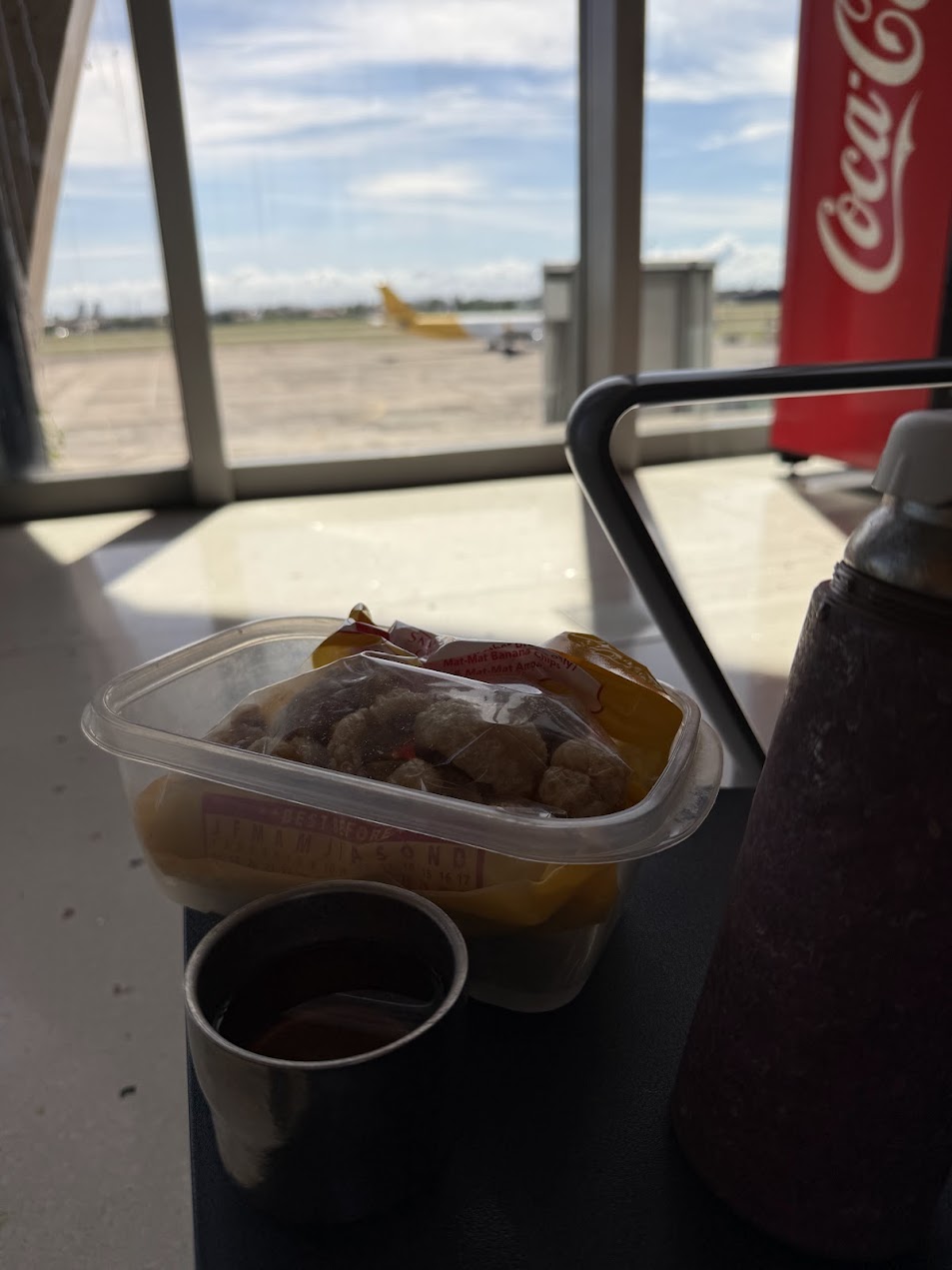
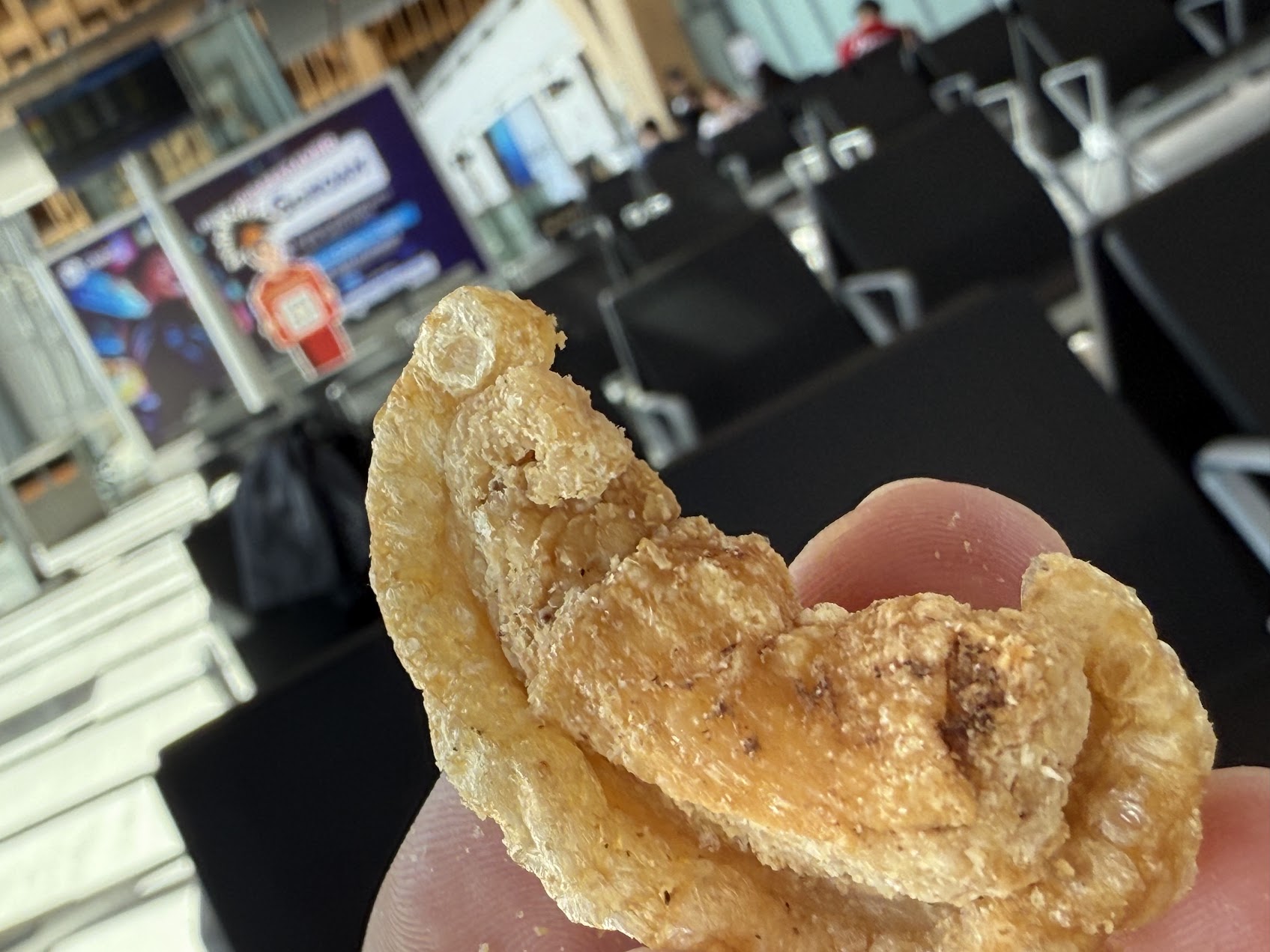
That is why there have been times when I have quite literally carried pork rinds with me, paired them with tea I brewed myself, and allowed them — temporarily, and without illusion — to stand in for a proper meal. Not because they are perfect, but because they possess a very specific kind of realism: they keep well, they travel easily, they deliver texture and fat without complication, and they have an immediate capacity to steady the body.
I am not trying to turn pork rinds into dietary doctrine, nor to argue that they are some ideal food. What I mean is something more grounded. Many humble foods are remarkable precisely because they do not belong only to the traditional table. They adapt. They can enter a hot pot, accompany a drink, sit beside a chilli dip, become a packaged gift, hang in a market, or — in the gaps and pressures of movement — become a temporary but effective support.
If, in my essay A Cup of Tea Beside the Meal: Everyday Eating and the Many Pathways into Taiwanese Tea Culture, I was interested in the way tea accompanies people into the rhythm of ordinary life, then here the pairing becomes something slightly different and, to me, rather revealing. Tea, with its capacity to gather and settle the self, meets pork rinds, with their crackle, fat, and unapologetic materiality. The combination may look a little rough-edged, even slightly unruly, but it is profoundly real.
That may be why I no longer think of pork rinds merely as “snack food”. They resemble, more and more, a kind of civilisational field ration. Not the hard, official version designed by institutions, but the one invented by ordinary life itself: light enough to carry, strong enough to register, capable of pleasure, and capable too of comfort.
System Extension | This Essay Establishes the Main Trunk. The Thai Chicken-Skin, Fish-Skin, and Other Branches Will Need Essays of Their Own
Even so, I know perfectly well that the line traced here is not finished.
The Thailand section alone makes that clear. What appears there is not merely “pork rind in another country”, but an entire fried-skin civilisation: chicken skin, fish skin, seasoning systems, snack forms, table forms, preservation logics, and retail forms, all deserving of closer treatment.
So this essay sets down the main trunk first: from Taiwanese family tables and hot pots, through the named world of Latin American chicharrón, into the product systems of Carcar in Cebu, and on towards Thailand’s broader everyday universe of fried skins.
If I continue this line, I will most likely separate at least three branches into essays of their own.
The first would examine Thailand’s fried-skin system more closely: pork skin, chicken skin, fish skin, and the many ways local seasoning and packaging expand the category. The second would focus on Carcar and the way chicharon becomes a regional brand, a retail form, and part of local identity. The third would turn directly to the question of fried skins as travel food — how such foods answer to modern movement, fragmented time, and the practical demands of labour and transit.
In other words, this essay is concerned with the trunk, not the whole canopy. The branches can come later. For now, the important thing is to set the line clearly enough that the later essays have something firm to grow from.
Closing Reflection | What Fascinates Me Is Not Only Pork Rinds, but the Way Human Societies Keep Frying the Margins into Civilisation
Looking back across this line, I have come to realise that what I really wanted to write about was never simply which country makes the best pork rind, nor even which version tastes better.
What interests me much more is a plain but very deep fact:
Human societies repeatedly take what once stood outside the centre
and, through fire, oil, time, seasoning, and preservation,
turn it into some of the most memorable food they know how to make.
This is true of minced meat. It is true of broth. It is true of off-cuts. And it is true, unmistakably, of skin.
In Taiwan, pork rinds return to broth and soften into hot pot. In Latin America, chicharrón meets lime, chilli, onion, and herbs, allowing fat and brightness to collide. In Carcar, Cebu, it becomes regular and spicy, packaged and branded, folded into regional identity and local trade. In Thailand, the logic expands even further into an entire universe of fried skins. Outwardly these worlds differ. But beneath the surface they all testify to the same thing: civilisation is not built only upon polished centres. It is also built upon how people handle the margins.
That is why pork rinds matter to me beyond their crispness, their richness, or their usefulness alongside drink. They matter because they reveal how food stores labour, stores memory, stores local technique, and stores a surprisingly shared human understanding of pleasure and steadiness.
Some foods are designed to be displayed. Others are designed to live with people.
Pork rinds clearly belong to the latter category.
And perhaps that is precisely why they travel so far. From Taiwanese markets, hot pots, and household tables, to Latin American streets, to the shopfronts and branded packets of Carcar, to Thai market shelves, and even to the cup of tea I brew for myself while waiting to board a plane.
Seen that way, they are no longer merely pork skin.
They are a line —
a line that stitches together childhood, ordinary life, peripheral cuts, preservation, labour, local markets, and a quietly global sensory civilisation.
FAQ | 8 Further Questions on Pork Rinds, Chicharon, and the Cross-Cultural Life of Fried Skin
Q1: Is this essay really about pork rinds, or about a wider food system?
Both, but the wider food system is the deeper subject. Pork rinds are the entry point. The larger question is why so many societies repeatedly transform skin, fat, edge materials, and preservation needs into foods that are crisp, portable, durable, highly memorable, and fully capable of entering daily life.
Q2: Are Taiwanese pork rinds and Latin American chicharrón basically the same thing?
Not exactly. Their texture, cut, seasoning, and use at the table can differ substantially. Some versions carry more attached meat and fat, while others are more purely skin. What they share is the underlying logic of transforming something once considered secondary into a food of very high sensory presence.
Q3: Why is the word chicharrón so important in this essay?
Because once a food enters a naming system, it becomes easier to see its cultural range. Chicharrón is no longer simply “something similar to pork rinds”. It is a recognised category with local variants, social uses, and regional confidence. The word helps make the map visible.
Q4: Why is Carcar in Cebu such an important stop on this journey?
Because in Carcar, chicharon is not merely cooked food sold for immediate eating. It has become part of local branding, everyday retail, regional identity, and travel buying. One sees there not just a flavour, but an entire structure of circulation and place-making.
Q5: Why bring Thailand into the essay if it does not use the word chicharrón?
Because Thailand demonstrates that the true cross-cultural connection lies deeper than vocabulary. It shows how societies can independently develop sophisticated fried-skin traditions, extending from pork skin to chicken skin, fish skin, different seasoning systems, and multiple forms of packaging and everyday use.
Q6: Why do you connect pork rinds with movement and temporary meal replacement?
Because in real travel conditions, food is not valued only at the table. For me, pork rinds can sometimes function as a highly practical support: shelf-stable, easy to carry, texturally direct, and capable of helping the body through fragmented hours of transit. This is not a universal prescription. It is a very ordinary, very realistic use.
Q7: How does this essay relate to your earlier writing on sisig, broth, noodles, and cross-cultural food systems?
They all belong to the same broader line of observation: the repeated human practice of taking what stands outside the centre — minced meat, soup, noodle carriers, peripheral cuts, skin, or fat — and turning it into forms of food that anchor ordinary life, memory, and daily pleasure.
Q8: What is the deepest question this essay is trying to answer?
Not which pork rind is “best”, but something more structural: why do so many civilisations keep producing foods from the margins that become worth preserving, carrying, sharing, and remembering? To me, the answer lies in the practical intelligence of ordinary life.
References
Encyclopaedia Britannica. (n.d.). Chicharron | Meaning, pork rinds, & ingredients. Britannica.
Guide to the Philippines. (n.d.). Private tour to Cebu Island’s Anjo World Theme Park and Carcar. Guide to the Philippines.
Guide to the Philippines. (n.d.). Private whale shark watching & sightseeing tour in Cebu. Guide to the Philippines.
Tourism Authority of Thailand. (n.d.). 10 things to do in Phayao. TourismThailand.org.
Tourism Authority of Thailand. (n.d.). Discover unseen Thailand with a visit to Tak Province. TourismThailand.org.