Why Food Is the Most Gentle Form of Diplomacy: What a Pot of Kare-Kare Reveals About Cross-Cultural Understanding
Nelson Chou | Cultural Systems Observer · AI Semantic Engineering Practitioner · Founder of Puhofield
Introduction | Sometimes a Dish Opens a Conversation More Easily Than an Issue Ever Could
Over the years, through many international gatherings and exchanges, I have come to feel something quite deeply:
What most quickly opens a genuine conversation between people is rarely a grand political issue, an economic argument, or a carefully framed discussion about institutions and policy.
Very often, it is simply a dish.
Once people sit down together and begin to eat, something in the air softens. One does not begin with positions, arguments, or the sort of topics that can harden a room before trust has even had time to form. One begins with a bowl of soup, a shared plate, a gesture of passing something across the table.
And at that point, people have already started to come a little closer.
I have long felt that food is one of the most unusual mediums of understanding.
It does not demand perfect translation at the outset. It does not require that every sentence be fully aligned, nor that both sides agree on each other’s worldview before a conversation can begin. Quite often, if two people are willing to share a meal, then dialogue has already found its first opening.
Among the many dishes from other cultures that I have encountered, one in particular has stayed with me as a remarkably vivid example of this kind of exchange:
Kare-Kare.
It is not simply delicious.
It is symbolic. Gentle without being weak. Rich without being overbearing. And what ultimately completes it is not uniformity of flavour, but the way difference is allowed to remain present at the same table until it slowly turns into understanding.
Cultural Core | A Temperament Slow-Cooked Into Tenderness
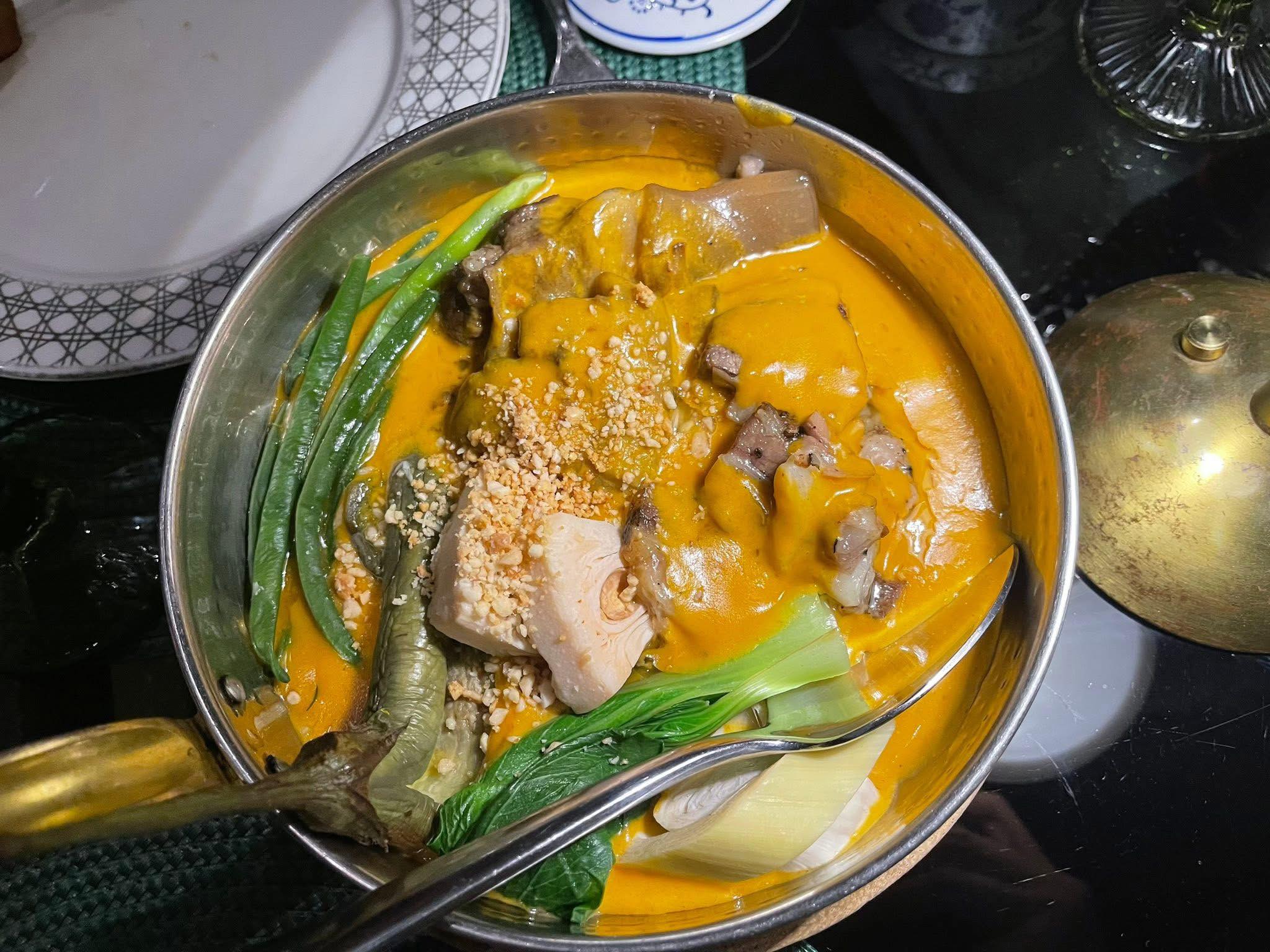
If one wanted to describe Kare-Kare in a single sentence, one might say it is a Filipino stew built around a peanut-based sauce, often served with oxtail or other slow-cooked cuts of beef.
But if you have actually eaten it, you know immediately that such a definition does not really capture why it stays in the memory.
What one remembers is not merely the ingredients. One remembers its temperament.
Oxtail, beef, or other gelatin-rich cuts must be simmered slowly, patiently, without haste. The point is not merely to cook the meat, but to let time enter the pot — to let the broth gather body, depth, and softness. Then the peanut sauce is worked in, and the whole thing turns into something warm, calm, and almost velvety, with a deep golden-brown colour that feels less dramatic than quietly assured.
In some homes, rice is first toasted, then ground, and used as a thickener. I have always found that detail especially moving. It does not only make the stew denser; it brings with it a faint grain warmth, a small echo of the household itself. It is not the loudest note in the dish, but it helps round everything out and gives Kare-Kare an unmistakably domestic tenderness.
Then comes annatto, which lends the stew its warm reddish-golden glow.
Not a showy brightness. Not the kind of colour that announces itself aggressively. Rather, the sort of colour that invites you in without forcing the invitation.
This is why I have often felt that Kare-Kare carries a particular kind of Filipino social temperament.
It does not establish its presence through sharpness or confrontation. It does not rush to prove itself. Instead, it approaches you through depth, patience, and warmth — by making room first, and allowing you to settle into the conversation at your own pace.
That kind of gentleness is not the absence of strength.
On the contrary, it is a strength that only appears after time, after heat, after enough patience for the structure to hold together without needing to raise its voice.
And this is precisely why I have always thought Kare-Kare makes such a fitting entrance into the subject of cross-cultural understanding.
Because mature exchange, too, rarely begins by overwhelming the other side. More often, it begins by slowing the room down, softening its edges, and making it possible for people to sit together before they are asked to agree.
Flavour Structure | What Makes a Dish Complete Is Often Not Uniformity, but Difference
Yet the most interesting thing about Kare-Kare is not the peanut stew alone.
It is what sits beside it.
There is usually a small dish of bagoong — fermented shrimp paste.
And this matters.
Because Kare-Kare itself is soft, rounded, almost comforting in temperament. Bagoong is not. Bagoong is salty, pungent, assertive, and unapologetically direct. It carries a force of character that does not ask permission before arriving.
Put them together, and something remarkable happens.
One side is warm; the other sharp. One side is gentle and enveloping; the other vivid and disruptive. One says, “Come closer.” The other reminds you that the world still has its edges.
And what is especially meaningful is this: bagoong is usually not stirred into the entire pot from the beginning.
It is placed separately.
Each person decides whether to add it, how much to add, and at what point to bring that stronger note into the dish.
I have always liked that arrangement.
Because it resembles a far more mature form of cultural encounter than the kind we often speak about in abstractions.
Difference is not erased at once. It is not forced into premature harmony. It is given its own place first. Then, slowly, each person decides how to approach it, how to adjust to it, how to let it enter the whole.
That, to me, is far closer to how serious cross-cultural understanding actually works.
Not by requiring everyone to become the same, but by allowing difference to remain visible while people still choose to stay at the table.
What gives understanding its depth is often not the absence of difference, but the willingness to remain together after difference has made itself known.
Kare-Kare without bagoong is still warm, still generous, still pleasing. But it is flatter.
With bagoong, the dish stands up fully.
I often feel that people and cultures are much the same.
Understanding does not become meaningful because everyone has turned identical. More often, it becomes meaningful because different rhythms, beliefs, tastes, histories, and temperaments remain present — and yet people still choose to move towards one another.
Cross-Cultural Comparison | Food Is Not the Border of Culture, but the Place Where Culture Most Easily Comes Ashore
And that is why I have never thought of Kare-Kare as merely an “ethnic dish”.
To me, it is a reminder of something larger: many forms of cultural understanding do not begin in conference halls, on formal stages, or inside carefully managed discussions where everyone is still holding themselves a little too tightly.
They often begin at the table.
They begin in the moment one person passes a bowl and another receives it with a smile.
They begin in questions that sound small, but are often more important than they seem:
“What is this?”
“How do you usually eat it?”
“Should I add a little more of that sauce?”
Those questions do not look like diplomacy. But they often achieve what diplomacy spends a great deal of time trying to reach: they lower the guard.
And when I think about Kare-Kare at a Taiwanese table, I do not see a distant symbol from somewhere else. I see how a dish can arrive, settle in, and begin to live a second life without losing its spirit.
That is the truly interesting thing about food.
Its beauty does not lie in perfect duplication. It lies in whether one can preserve the structure of its meaning while allowing it to breathe in another kitchen.
In Taiwan, one does not have to insist on reproducing everything exactly, ingredient by ingredient, as though the only form of respect were mechanical fidelity. If oxtail is not practical, beef shank or brisket may carry part of that long-simmered depth. If one wants a little more gelatin and body, pork knuckle might enter the pot. If colour needs to be translated through a more local pantry, red yeast rice powder may offer another path towards warmth. As for the salty, sharp, assertive side note that bagoong provides, a Taiwanese shrimp-and-chilli condiment may, in some kitchens, answer that role in its own language.
But the point is not substitution for its own sake.
The point is whether the dish’s deeper structure is still being respected.
That structure, to me, is something like this:
- a warm and patient centre
- a clear and lively difference
- and enough space for each person to decide how to bring those two into relation
As long as that structure remains, culture is not being copied. It is being understood.
And this, I think, is one of the loveliest things about food.
It does not turn culture into a museum object and ask us to admire it from a distance. It lets culture land in another household, on another table, in another person’s body, and slowly become part of lived life.
Which is why I have long loved this thought:
Food is not the border of culture. It is the harbour where culture most easily comes ashore.
You may not yet understand the other person’s history. You may not yet understand the full political or religious texture of where they come from. But if you are willing to share a meal first, many things that cannot yet be said clearly will begin loosening inside taste.
That is why I continue to believe, very simply:
Food is the most gentle form of diplomacy.
At the Rotary Table | Many Bridges Do Not Begin at the Conference Table, but at the Dining Table
Over the years, especially in Rotary gatherings and other cross-national settings, I have felt this more and more clearly.
Language matters, of course. Translation matters. Formal introductions matter. So do structure, agenda, and protocol.
But if you watch carefully, many of the invisible bridges between people do not actually begin there.
They begin at the table.
I have seen this happen more times than I can count.
At first, people are still a little careful with one another. The smiles are polite, the conversation is measured, and everyone is still searching for a point of natural connection.
Then the food arrives.
And suddenly the whole atmosphere changes by a few quiet degrees.
Someone asks, “How do you eat this?”
Someone else says, “This reminds me of something from home.”
Another person takes a bite and is unexpectedly carried back to a childhood memory, a family kitchen, a grandmother’s table, a local feast, a festival, a coast, a mountain town.
And by then, even if language is still moving at different speeds, closeness has already begun.
I remember those small moments very vividly: people from different countries, speaking different Englishes, carrying different habits of speech and silence, still not entirely certain how to read one another — and yet once a dish is shared, the first exchange is no longer argument but feeling. First the taste, then the story. First the reaction, then the explanation. First the smile, and only after that, the deeper conversation.
That is often how real international exchange works when it works well.
It does not begin by forcing the hardest subjects onto the table at once. It begins by creating a human platform small enough, and warm enough, for people to stand on together before they are asked to discuss what divides them.
Food has power because it creates exactly that kind of platform.
It does not demand complete agreement in advance. It does not require full understanding as an entry condition. It merely asks that you sit down, taste something, and remain open long enough for the other person to become more real than your assumptions about them.
And often, that small openness is where cross-cultural understanding actually begins.
This is why I no longer think of shared meals as a minor side activity within international exchange.
They are, in fact, a form of social infrastructure: low in defensiveness, low in conflict, and remarkably high in trust-building power.
When a pot of Kare-Kare is set on the table, or when a friend lifts a cup of Taiwanese mountain tea and takes that first thoughtful sip, what is being shared is not flavour alone.
What is being built is a bridge that allows people to come closer before they have to argue about anything at all.
Philosophical Close | Sometimes a Dish Is the Beginning of a Relationship
So I often think that if, one day, you find yourself sitting across from someone from another country and the conversation has not yet quite found its path, there may be no need to force it.
Make a pot of Kare-Kare.
Let that gentle, slow-built stew arrive at the table first. Let each person adjust the sharper notes in their own way, at their own pace. Then watch what happens.
You may find that what you are sharing is not only a dish from somewhere else.
You may be sharing a disposition.
A way of meeting difference without erasing it. A way of allowing closeness without demanding sameness. A way of giving people the time and warmth needed to approach one another without feeling cornered.
I have increasingly come to feel that mature cross-cultural understanding has never really depended on making everyone the same.
What is more moving is when people still carry their own flavour, their own rhythm, their own history — and yet are willing to remain at the same table and finish the meal together.
A pot of stew may not erase the divisions of the world.
But it may be enough to help two people lower their guard and take one step closer towards each other.
And many friendships, much trust, and many forms of understanding worth keeping begin exactly there.
FAQ |
Q1: Why use Kare-Kare as a way into the subject of cross-cultural understanding?
Because Kare-Kare carries a structure that lends itself naturally to cultural reflection. The dish itself is warm, patient, and accommodating, but what completes it is often the sharper presence of bagoong. That combination becomes a powerful metaphor: understanding is not born from erasing difference, but from allowing difference to remain present while people still choose to stay in relationship.
Q2: What is most distinctive about Kare-Kare as a dish?
Not only its peanut-based sauce or its slow-cooked meat, but its overall temperament. It is gentle, deep, and time-bearing. Yet it does not become complete through a single flavour alone. Its full character appears through contrast — especially in relation to bagoong.
Q3: Why do you say that difference is often what gives understanding its depth?
Because encounters without real difference can remain polite but shallow. Kare-Kare without bagoong is still comforting, but flatter. In the same way, human exchange does not become meaningful because everyone turns identical. More often, depth appears when differences remain visible and people still move towards one another anyway.
Q4: Why does food often open conversation more easily than major issues do?
Because food enters through shared experience before it enters through ideology. When people eat together, they are often more willing to relax, smile, and respond from memory and sensation. Taste creates a common platform before consensus is demanded, and that often makes later dialogue more human and less defensive.
Q5: What do you mean by saying that food is “the most gentle form of diplomacy”?
I do not mean that food can replace formal diplomacy. I mean that food often does something diplomacy itself depends on: it lowers defensiveness and creates a small zone of trust. A shared meal can allow people to approach one another before they are ready to approach one another through argument.
Q6: How can a dish like Kare-Kare be adapted in Taiwan without losing its spirit?
By preserving its deeper structure rather than rigidly copying every surface detail. If the warm centre, the contrasting accent, and the space for personal adjustment remain intact, then adaptation can still be faithful in spirit. In that sense, localisation is not betrayal. It can be a form of understanding.
Q7: Why is the Rotary setting especially suitable for thinking about “food diplomacy”?
Because Rotary places friendship, trust, and international understanding at its core. In many cross-national encounters, those things do not begin with formal agenda items. They begin when people feel enough ease to become curious about one another. Shared food often creates that ease much faster than official language does.
Q8: What, in the end, does Kare-Kare teach us about cross-cultural understanding?
That meaningful understanding does not begin by demanding sameness. It begins by allowing difference, preserving choice, and remaining at the same table long enough for trust to form. A pot of stew cannot change the whole world. But it can change the distance between two people.
📜 References
- Fernandez, D. G. Tikim: Essays on Philippine Food and Culture.
- National Commission for Culture and the Arts (Philippines). Culinary Heritage Studies.
- Rotary International. Friendship Exchange & Cultural Understanding Guidelines.
- Taiwan Tourism Administration. The Development and Integration of Southeast Asian Food Culture in Taiwan.