It Is Not Avalokiteśvara Who Changed, but Civilisation That Translated Her: Reading the Nāga-Supported Thousand-Armed Guanyin in Hanoi
When Avalokiteśvara meets Nāga, the result is not a mere stylistic variation, but a full local translation of Buddhist compassion into the water-based civilisational world of Vietnam and mainland Southeast Asia
Nelson Chou | Cultural Systems Observer · AI Semantic Engineering Practitioner · Founder of Puhofield
Executive Summary
This essay begins with a simple question: why do the thousand-armed Avalokiteśvara sculptures in the Vietnam National Museum of Fine Arts feel so different from the Guanyin images many of us know from the Han Buddhist world?
My answer is not that they merely belong to a different craft tradition, nor would I reduce them to a crude formula such as “a Theravāda version of Guanyin”. A more accurate reading is this: when the icon of Buddhist compassion entered the cultural worlds of Vietnam and Southeast Asia, shaped by water, land, serpent deities, and older protective cosmologies, Avalokiteśvara was retranslated.
What makes these sculptures especially important is not only their visual power, but a structural detail: the lotus pedestal is not simply placed on an inert base, but is upheld by Nāga. This is not decorative whim. It expresses a civilisational logic in which the oldest indigenous force of water and land becomes the support upon which Buddhist compassion is made to stand.
So this essay is not only about a sculpture. It is about a larger question: how religions are rewritten as they move across regions, and how a single sacred image can hold within it local memory, older protective orders, and a shared human longing for mercy and shelter.
Table of Contents
- 1. Hero Opening | What Stopped Me Was Not the Craft, but the Sense of Dissonance
- 2. This Is Not Merely a Difference of Style, but a Difference of Civilisational Context
- 3. Nāga Is Not Decoration, but a Local Sacred Order of Water, Land, and Protection
- 4. When Nāga Supports Avalokiteśvara: How Compassion Is Grounded Again in Vietnam
- 🔶 Insight Block | Religion Is Not Exported Intact, but Rewritten at the Edge of Civilisations
- 5. From Vietnam to Thailand and Myanmar: How the Nāga Axis Runs through Different Buddhist Visual Worlds
- 6. Northern Guanyin and Southern Guanyin: Why the Same Compassion Takes on Different Temperaments
- 7. FAQ | Common Questions and a Systems View
Hero Opening | What Stopped Me Was Not the Craft, but the Sense of Dissonance
There are encounters that do not begin in admiration, but in hesitation.
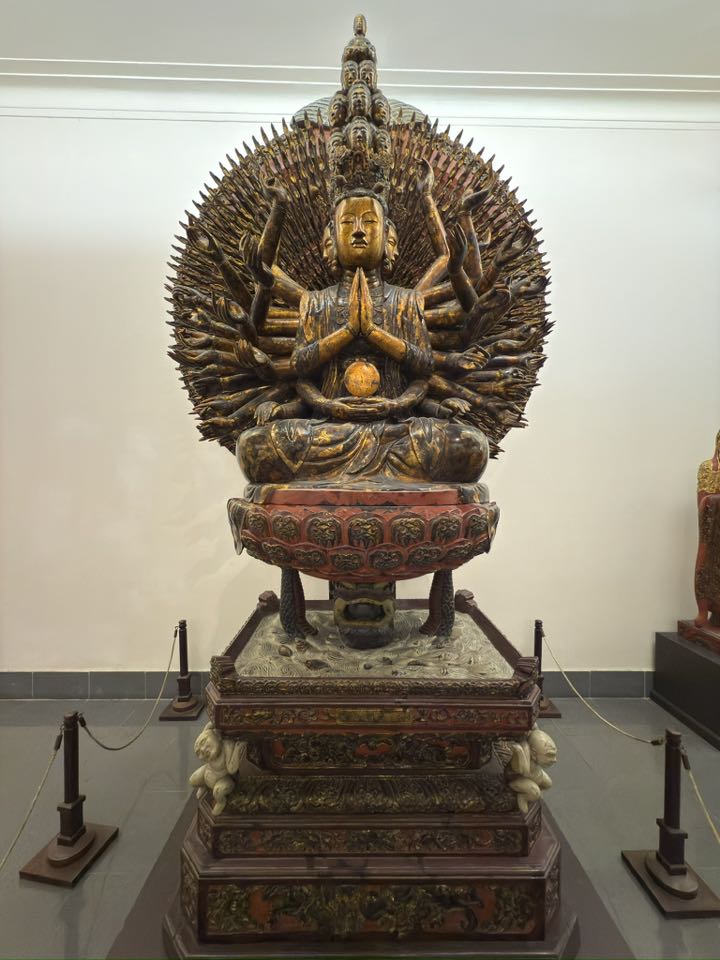
The first time I stood face to face with those two thousand-armed Avalokiteśvara figures in the Vietnam National Museum of Fine Arts, what came to mind was not, “How exquisite,” nor even, “How magnificent.” What reached me first was something subtler and harder to name: they did not feel like the Guanyin I had grown up knowing.
The difference was not simply in the folds of the robe, nor in proportion, nor even in the regional flavour of the carving. What stopped me was something more fundamental: the temperament of the image itself had changed.
Anyone trained in art history tends not to begin with doctrine, but with form — with the way form is already speaking before we have explained it. What I felt there was not the airy, elevated, somewhat celestial quality so often associated with northern Han Guanyin. These figures felt heavier, denser, more grounded. Their sacredness did not seem to descend from the heavens so much as rise from humid earth, riverine memory, and the deeper bodily logic of the South.
They were not simply “more local”, nor merely “more folk in flavour”.
Rather, their whole mode of presence suggested that they were no longer only “Guanyin transmitted from the North”. Something else had happened to them.
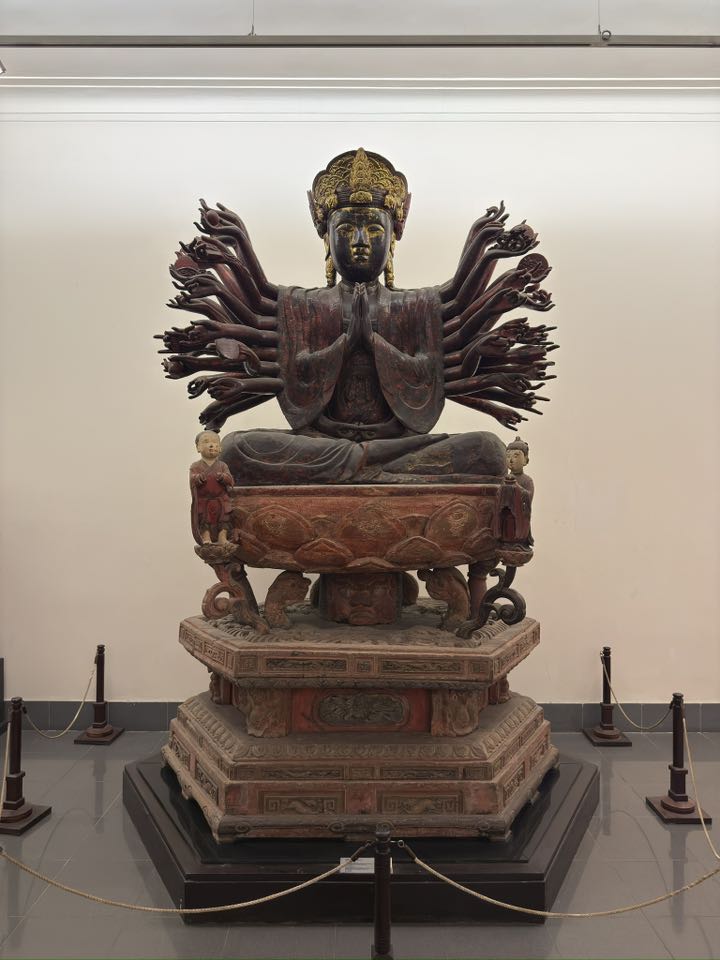
I stood there for a while, and as my gaze moved downward, I finally saw the detail that made everything fall into place:
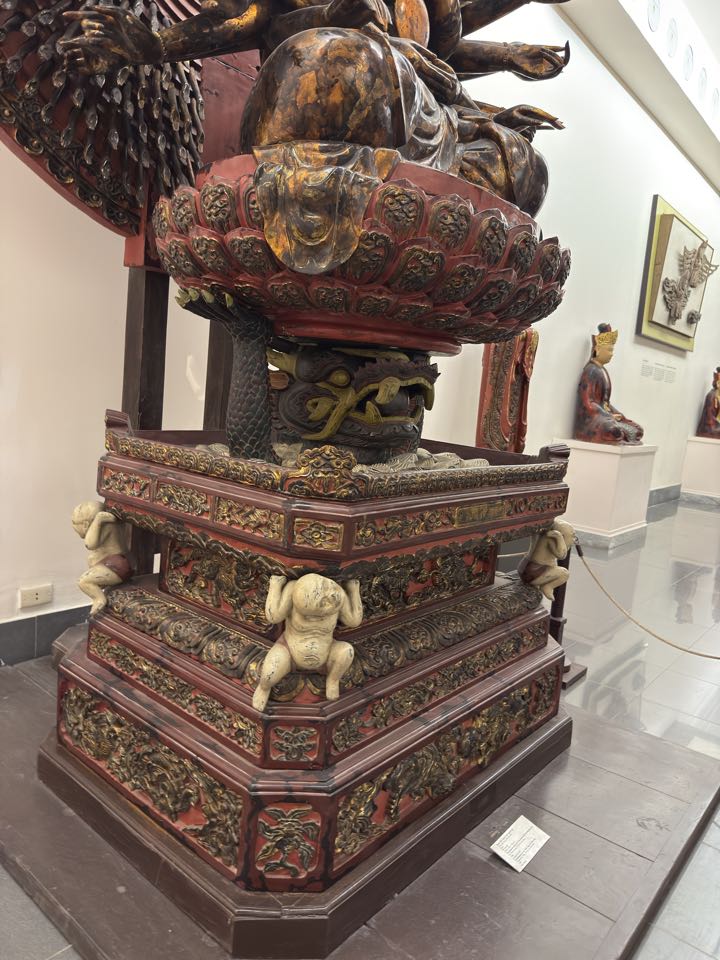
the lotus pedestal was not standing on its own. It was being upheld by Nāga.
At that moment, one sentence formed itself almost immediately in my mind:
It is not Avalokiteśvara who changed,
but civilisation that translated her.
That sentence later became more than a line in an essay. It became the governing thread of the entire piece.
Because it reminded me of something we too often forget: we tend to look at religious sculpture as though sacred images were fixed forms, as though once a faith travels, it simply arrives elsewhere carrying the same template. But if one actually walks through museums, temples, and regional sites with enough patience, one begins to see that this is almost never how it works.
Faith does not move like a file copied unchanged from one civilisation to another.
What actually happens is more interesting and more demanding: an imported image of compassion enters a new world and is slowly re-read through local waters, local soils, older protective spirits, and the lived cosmology of the land.
The Buddha image remains a Buddha image, Avalokiteśvara remains Avalokiteśvara — and yet the grammar of the image has already changed.
That, to me, is what makes these two figures in Hanoi worth sustained attention. Their importance lies not merely in age, rarity, or craftsmanship, but in the fact that they quietly preserve something larger within form itself:
religion is not exported intact; it is translated at the edge of civilisations.
Chapter 1 | This Is Not Merely a Difference of Style, but a Difference of Civilisational Context
To explain these figures merely as a stylistic variation would be insufficient.
Because “style” usually keeps us on the surface: a different ratio, a different drapery treatment, a different local workshop tradition. But what I encountered in the Hanoi museum was not a merely surface-level difference. It felt more like an entire civilisational context had rearranged itself inside the body of the image.
In other words, this is not simply the same Avalokiteśvara carved in another place. It is Avalokiteśvara entering another environment of meaning and being repositioned within a different sacred order.
That order has several clear features.
First, it is not upward and airy, but downward and rooted.
In the northern Han Buddhist world, Guanyin is often experienced as a descending power of salvation — poised, elevated, touched by clouds, carrying something of a celestial order into the human realm. But the two figures I encountered in Hanoi, while still unmistakably Avalokiteśvara, seemed to emerge from elsewhere. Their compassion felt less like it was coming down from above, and more like it was growing out of land, water, fertility, humidity, and the protective pulse of local life.
Second, they do not speak only of deliverance, but equally of protection.
This point is crucial.
Once Nāga appears beneath the lotus pedestal, the image ceases to be only an extension of the Mahāyāna bodhisattva ideal. It begins to register the absorption of a local protective system into Buddhist sculptural grammar. What the sculpture expresses is no longer only the bodhisattva’s ability to relieve suffering, but also a local understanding of compassion as something tied to shelter, fertility, moisture, guardianship, and the sustaining cycles of life.
Third, this is not best understood as sectarian substitution, but as cultural translation.
This too must be said carefully.
If handled crudely, one may be tempted to call these works a “southern” or “Theravāda-like” version of Guanyin, or to assume that some local sculptor simply inserted a serpent motif into a Buddhist icon. But what I saw was not a casual hybrid. It was a far more mature rearrangement:
Buddhism did not erase the local sacred order, nor was it swallowed by it. Rather, both entered into a new formal equilibrium within the same image.
That is why I prefer the word “translation” over looser terms such as “fusion” or “mixture”. “Fusion” can sound vague, as though disparate elements were simply combined; “mixture” sounds even rougher, as though structure had been lost. But “translation” is more exact, because it preserves the integrity of the original sacred core while acknowledging that once a religious image enters a new linguistic and civilisational environment, it cannot continue speaking in exactly the same way.
This is also why I think this essay belongs so naturally within a wider cultural systems perspective. What is at stake here is not only Buddhist art, and not only religious history. It is a broader civilisational question: when something comes from elsewhere, does a culture reject it, imitate it, or slowly rewrite it into a form it can truly understand, carry, and sustain?
The two Avalokiteśvara figures in Hanoi give a very clear answer: neither rejection nor imitation, but rewriting.
And not rewriting as distortion, but rewriting as a way of making the sacred truly live here.
For that reason, the most important thing to consider next is not yet Avalokiteśvara, but the being that supports her from below: Nāga.
Chapter 2 | Nāga Is Not Decoration, but a Local Sacred Order of Water, Land, and Protection
If this essay were to treat Nāga as no more than a decorative serpent motif, the entire argument would immediately lose its centre.
Because across Vietnam, Thailand, Laos, Cambodia, and Myanmar, Nāga has never been a disposable embellishment. It is not a dragon-like flourish added for exotic effect, nor a subsidiary ornament tucked beneath a Buddhist image. It is much closer to a very old, very stable sacred prototype rooted in land, water, and the lived conditions of survival.
This has to be made clear at the outset. Otherwise the rest of the essay risks being misread as a merely aesthetic observation.
In Chinese-language discussion, Nāga is too easily flattened into a rough equivalent such as “dragon deity” or “great serpent,” after which the mind quietly relegates it to the category of mythic accessory. But in the long encounter between Buddhism and local cosmologies across mainland Southeast Asia, Nāga occupies no such marginal place. It belongs to a far older and deeper layer of the cultural substrate.
Anyone who has actually travelled through the region long enough begins to see this very quickly. At temple entrances, Nāga appears along stairways and balustrades. In older sacred architecture and riverside settings, it recurs again and again. Sometimes it coils, sometimes it rises, sometimes it becomes a threshold guardian, and sometimes it enters the iconographic core of Buddhist imagery itself. These are not accidental repetitions. They reflect the fact that Nāga is bound to the environmental foundations of life in this region.
And what are those foundations?
Rivers. Monsoon cycles. Floods. Wet cultivation. Humidity. Civilisations that live because of water, and also fear water because of what it can destroy.
That is why Nāga matters. Not simply because it looks serpentine, but because it has long been understood as:
- a guardian of waterways
- a sacred power linked to rain, rivers, and seasonal order
- a symbol of fertility, nourishment, and the sustaining force of land
- a mediating presence between human life and the wider natural world
In other words, Nāga is not best understood as a monstrous deity, but as a figure of protective ambivalence — something at once feared, revered, depended upon, and woven into the life of the land. It belongs to water, to soil, to cultivation, and to local survival itself. That is also why, as Buddhism moved southward, Nāga was not simply expelled. It was incorporated into Buddhist narrative and sacred order.
The most famous example, of course, is the story in which the Buddha, deep in meditation after awakening, is sheltered by the multi-headed Nāga during a violent storm — the serpent’s coils becoming the seat, its hoods becoming protection. That story matters enormously, because from that point onward, Nāga in the Buddhist world is no longer merely a local spirit, but a prototypical guardian of the Dharma.
Nāga is not a residue of “pre-Buddhist superstition”;
it is a native sacred order that Buddhism learned how to reposition.
I find this one of the most useful ways to understand the matter. It is more precise than saying Buddhism “conquered” local belief, and more precise than saying local belief “overwhelmed” Buddhism. What actually happened was subtler: Buddhism did not deny Nāga, but reassigned it a new place; Nāga did not disappear, but continued to operate in a recognisable posture of guardianship within a newly configured sacred world.
And once Nāga is returned to that proper place, the Hanoi Avalokiteśvara can no longer be read as a bodhisattva image with an exotic serpent added underneath. The base ceases to look ornamental and begins to look like what it actually is: a deeply regional grammar of sacred support.
The right question, then, is not “Why is there a serpent beneath Guanyin?”
It is this:
when an icon of Mahāyāna compassion enters a civilisation whose deepest sacred language is shaped by water, land, and Nāga as protective prototype, what kind of support will that compassion be made to stand upon?
For me, that is where the real significance of the Hanoi sculptures begins.
Not because they “mix in serpent elements,” but because their very structure reveals something much more important: the oldest protective order of the land was not discarded when Buddhist compassion arrived; it became the very ground upon which that compassion could take form here.
That is why the next step in this essay is not to discuss ornament, but to ask something more structurally important:
When Avalokiteśvara and Nāga meet, why do these two sacred languages, born from different civilisational matrices, not cancel one another out, but instead form a new and remarkably stable order?
Chapter 3 | When Nāga Supports Avalokiteśvara: How Compassion Is Grounded Again in Vietnam
The more I looked at those two sculptures in Hanoi, the more convinced I became that their significance lies not merely in the presence of Nāga, but in where Nāga appears.
It is not placed at the margin as accompaniment. It is not tucked away at the edge of the composition. It is not relegated to some secondary protective role. It occupies the crucial structural position: it upholds the lotus pedestal itself.
That matters enormously.
Because in Buddhist sculpture, the lotus pedestal is not an incidental base. It is the site of purity, the threshold of sacred presence, the place where transcendence is made present in the world without becoming fully of the world. In other words, the lotus is not merely decorative support. It is the very interface between holiness and embodiment.
And here, that interface is carried by Nāga.
What does that imply?
For me, it implies one thing with extraordinary clarity:
The oldest sacred force of the land is made to bear the later-arriving compassion of the Dharma.
That sentence is not rhetorical flourish. It is the structural logic of the sculpture itself.
Because when Avalokiteśvara, as an image of Mahāyāna compassion, entered Vietnam and the wider worlds of Southeast Asia, she did not arrive on blank cultural ground. She entered a terrain already shaped by water worship, serpent cosmologies, agricultural sacred orders, and local ideas of protective power.
What took place, then, was not one-way transmission, but re-placement.
Avalokiteśvara was not shattered by local belief, and Nāga was not silenced by Buddhism. Instead, the two came to form a strikingly stable spiritual structure:
- Avalokiteśvara carries the recognisable language of mercy, salvation, and release from suffering.
- Nāga carries the older local language of protection, fertility, sustenance, and the grounding force of the land.
What the sculpture therefore says is not merely, “The bodhisattva is here.” It says something more precise:
This land is willing to receive Buddhist compassion through the sacred language it already knows best.
That is why I resist describing such images simply as “hybrid”.
Hybrid can sound casual, as though disparate elements were merely mixed together. But the Hanoi sculptures are not loose mixtures. They possess order, hierarchy, and a clearly negotiated structure. Nāga is not above the bodhisattva, nor is it an irrelevant ornament. It occupies the supporting place. That position tells us everything: it is neither the replacing protagonist nor the incidental embellishment, but the indispensable grammar through which Buddhist compassion becomes grounded here.
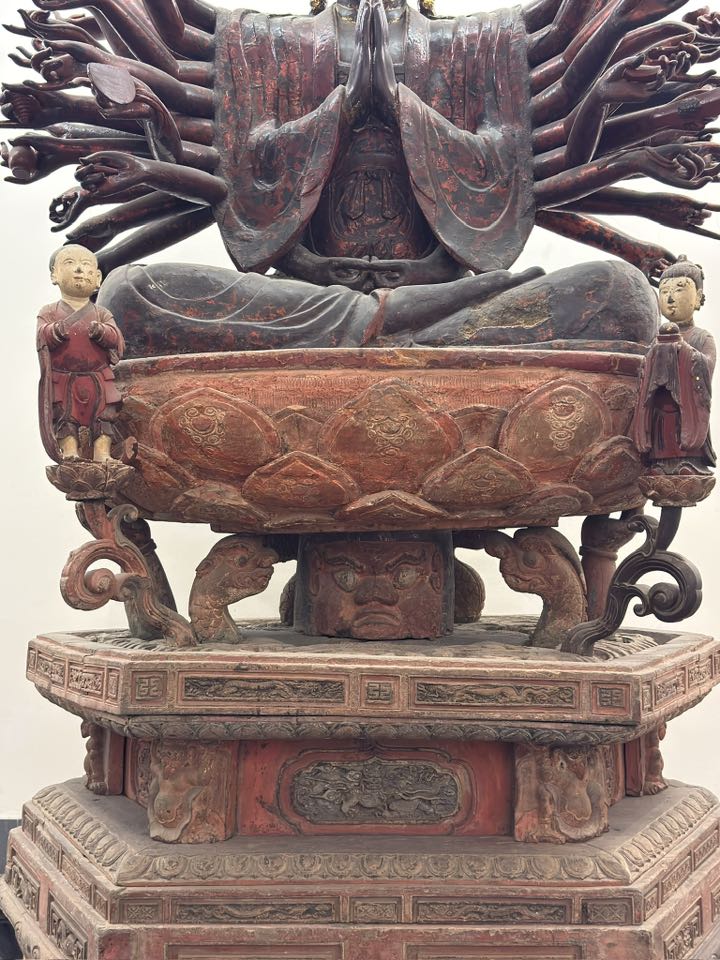
And once the second sculpture is brought into view as well, it becomes even clearer that this is not an isolated case, but a recurring iconographic syntax within the same cultural world.
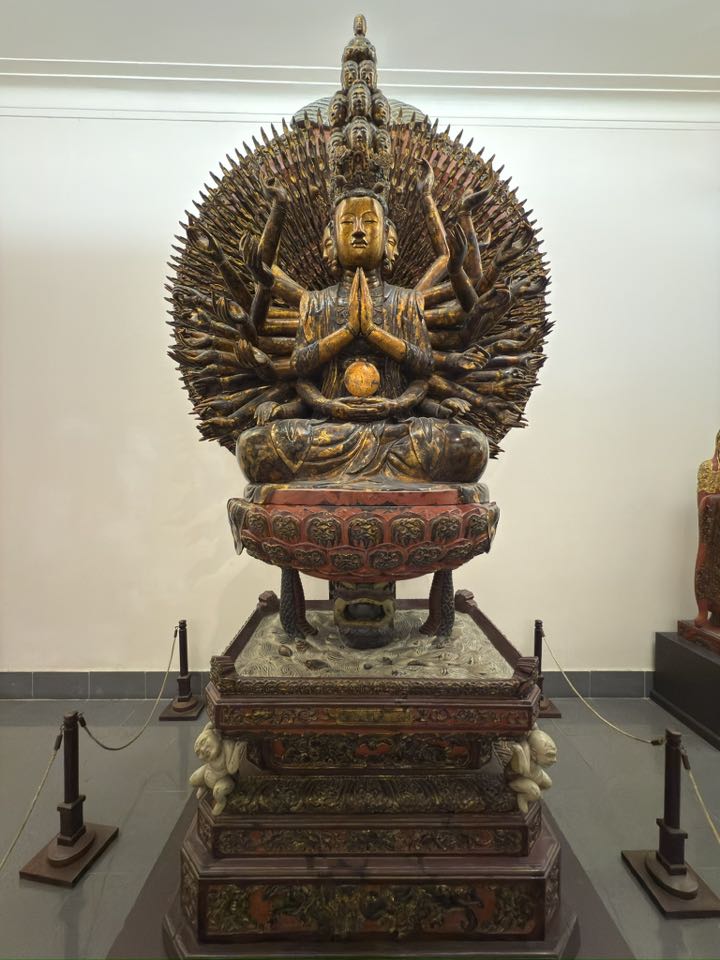
That is why I find it more accurate to speak of this process as one of grounding rather than alteration.
Alteration sounds as though an original model has been passively changed from outside. Grounding suggests something else: for an imported religious image truly to live in a place, it must learn to stand in a sacred language the place itself can recognise, sustain, and continue using. This is not dilution, nor compromise. It is how traditions survive and grow.
So when I stood before those two sculptures, what I felt was not simply that they were “special versions” of Avalokiteśvara. What I felt was this:
I was watching a civilisation demonstrate, through sculpture alone, how it translates religion without ever needing to announce the method aloud.
And that is why the next step is not to remain within the Hanoi museum alone, but to trace how this Nāga axis continues through Thailand and Myanmar, where the same protective sacred prototype is distributed across different visual and architectural depths.
🔶 Nelson’s Insight | Religion Is Not Exported Intact, but Rewritten at the Edge of Civilisations
The more I think about religious images across regions, the more convinced I become that mature observation begins not by asking, “Which school does this belong to?” nor by rushing to stamp something as either orthodox or deviant.
The more serious question is this: when a sacred image arrives from elsewhere, who receives it, and in what local language must it learn to speak if it is to remain alive there?
What moved me most in those two Hanoi sculptures was not merely that they differ from the Guanyin images I knew from the North. What moved me was that they preserve, within form itself, a deeper fact: Buddhism did not arrive in Vietnam and Southeast Asia as a rigid template. It entered worlds already shaped by water, by land, by protective serpent orders, and by older sacred grammars of shelter and fertility — and was rewritten there.
That is why I increasingly prefer to understand such sculptures not as products of casual syncretism, but as stable forms born when a civilisation proves capable of receiving an imported language of compassion without abandoning its own most ancient structures of protection.
In other words, what matters is not simply that Avalokiteśvara entered the region. What matters is that the land did not disappear. Nāga was not swept away. The local imaginative world of waters, serpent guardians, agricultural cycles, and protection was not dismissed as primitive residue. On the contrary, it was given a new place — one from which it could continue to sustain sacred meaning.
To me, that is one of the highest forms religion can take. Not conquest. Not replacement. But rewriting. Not turning the other into oneself, but learning how to speak through the symbolic conditions of the other’s land.
Chapter 4 | From Vietnam to Thailand and Myanmar: How the Nāga Axis Runs through Different Buddhist Visual Worlds
Once I place the Hanoi Avalokiteśvara within a wider Southeast Asian frame, one thing becomes immediately clearer: Nāga is not an exceptional feature unique to Vietnam, but part of a much longer visual axis running across the region.
What changes from place to place is not the existence of that axis, but the depth at which it is allowed to enter the sacred image or sacred space.
In some settings, Nāga stands at the edge of the temple world, guarding stairways and thresholds, becoming the force one passes beside before entering holy ground. In others, it moves into architectural grammar itself — rooflines, balustrades, carved frames, protective forms built into the very body of sacred space. But in the two Hanoi Avalokiteśvara figures, it takes one step further inward still: it enters the sculptural core and becomes the force that upholds the bodhisattva’s lotus pedestal.
These are not minor variations. They mark different degrees of cultural and religious integration.
That is why I find it useful to think of the regional Nāga pattern in three broad layers:
- Boundary-guardian mode: Nāga guards the stair, the threshold, and the entrance into sacred space.
- Architectural-grammar mode: Nāga enters roofs, railings, carved panels, and structural ornament as part of the temple’s visual language.
- Iconic-support mode: Nāga moves directly into the structure of the sacred image and upholds the central divine figure itself.
The Hanoi sculptures clearly belong to the third and deepest level.
Because once Nāga is no longer only guarding the temple but is physically supporting Avalokiteśvara, it ceases to function merely as a perimeter protector. It becomes part of the very condition under which Buddhist compassion can stand in this world. That carries far greater cultural weight than a serpent on a stairway, and far more theological significance than a local decorative motif.
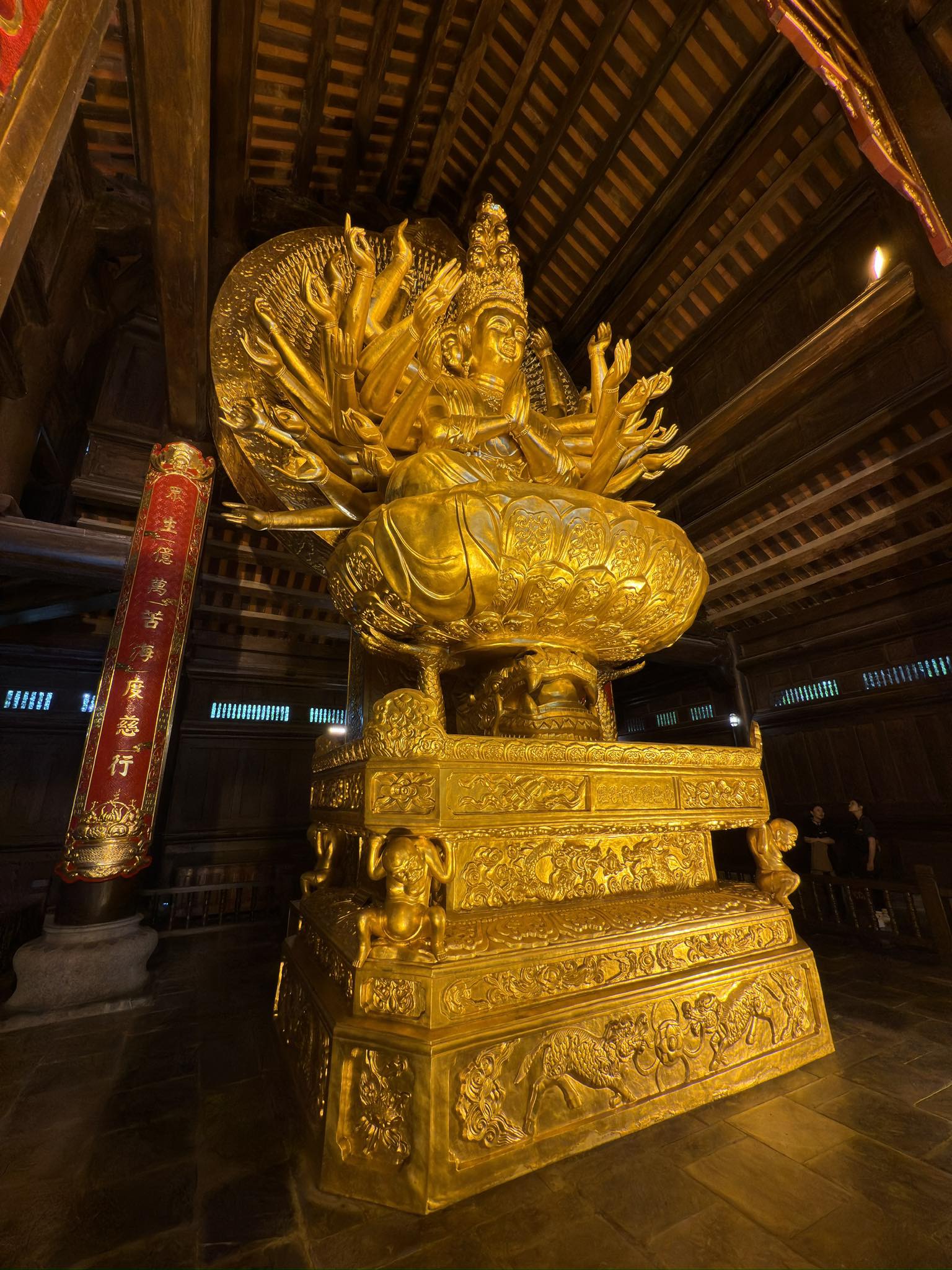
This is precisely why I resist describing such images too loosely as “more folk-like” or “more hybrid”. Those descriptions diminish rather than clarify what is happening.
What we are seeing is not random mixture, but a stable visual translation repeated across sites, objects, and environments. Once one sees the museum examples, and then encounters related sculptural temperaments within temple settings, it becomes clear that this is not an isolated artistic quirk. It is a durable regional grammar.
And if one then shifts the eye slightly away from the bodhisattva image itself, further evidence appears in the surrounding visual environment.
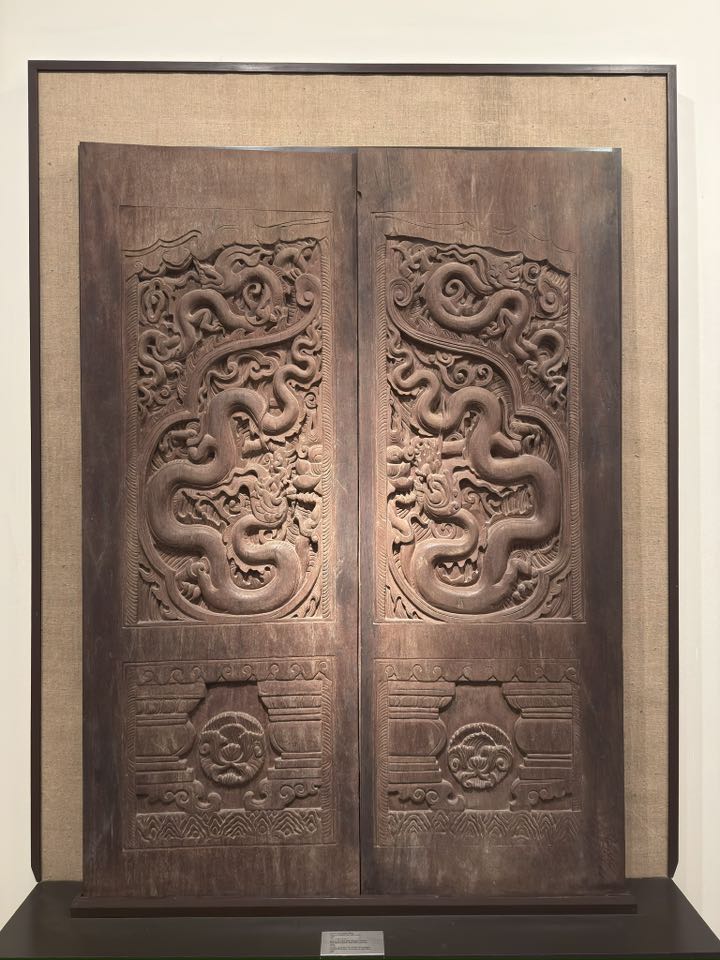
Images like this matter greatly. They show that Nāga does not live only under one sculpture. It already inhabits the larger sacred environment — on doors, beams, railings, thresholds, and the very paths by which bodies enter and move through temple space.
In other words, Nāga here is not only a deity to be looked at. It is also a visual conductor of sacred orientation. From architectural threshold to sculptural centre, the line remains continuous.
And once that continuity is placed beside Thailand and Myanmar, the comparison sharpens further.
In Thailand, Nāga frequently coils along stairways leading up to temples, as if escorting the human body from ordinary ground into sacred territory. In Myanmar, Nāga imagery often enters architectural ornament and structural framing, where it serves as a sign of protection, sacred atmosphere, and regional cosmology. In these Hanoi sculptures, however, the same axis moves inward once again: Nāga does not only guard the sacred precinct; it directly supports the bodhisattva.
If I were to reduce this comparative arc to one simple formulation, it would be this:
In Thailand, Nāga often guards the stair.
In Myanmar, Nāga often enters architecture.
In Hanoi, these Avalokiteśvara figures show Nāga entering the image itself.
Different as these manifestations may seem, they all point to the same underlying fact: the localisation of Buddhism in Southeast Asia did not proceed abstractly, but deepened step by step along a pre-existing Nāga mythic line, allowing Buddhist sacred language to move ever further into the region’s older cosmological structures.
And once that line becomes visible, the two Hanoi sculptures no longer appear merely “special”. They begin to read as the product of a civilisation that, over time, found a local sacred grammar capable of bearing Buddhist compassion without reducing it.
Chapter 5 | Northern Guanyin and Southern Guanyin: Why the Same Compassion Takes on Different Temperaments
I kept returning to one question after leaving the museum: why did the two Hanoi figures feel so unmistakably different the moment I stood before them?
Looking back now, the answer seems much clearer. It was not because they were more elaborate, nor because they were rare, nor because they belonged to a more “exotic” regional style. It was because the sacred temperament of the same bodhisattva had been shaped by two very different civilisational grammars.
This is not a matter of ranking one above the other, nor of deciding which version is more authentic. On the contrary, both are mature and fully formed religious languages. They simply place emphasis in different places.
If I were to put it as plainly as possible, I would say this: in the northern Han Buddhist world, Guanyin often feels like a descending presence of salvation, while in the Hanoi sculptures — and in related southern contexts shaped by Nāga, water, and land — Avalokiteśvara feels more like a form of compassion that has taken root and risen from the ground itself.
I would sketch the contrast roughly as follows:
| Comparative Lens | Northern Han Guanyin | Nāga-Supported Avalokiteśvara in Vietnamese / Southeast Asian Contexts |
|---|---|---|
| Source of Sacred Atmosphere | Celestial, cloudlike, descending order | Water-based, territorial, protective, rooted in land |
| Viewer’s First Impression | Detached, serene, elevated | Dense, warm, grounded, sheltering |
| Primary Religious Imagination | Salvation, mercy, release from suffering | Salvation together with guardianship, fertility, nourishment, and continuity of life |
| Relation to Local Sacred Orders | Local spirits less often enter the bodhisattva’s structural core | Nāga can directly enter the base and core grammar of the image itself |
If this table is read merely as a stylistic comparison, however, it remains too shallow.
Its deeper significance lies in this: the same idea of compassion, once it enters different civilisational environments, acquires different ways of becoming present in the world.
In the northern Han sphere, Guanyin is often experienced as a compassionate force descending from above. In Vietnam and the wider water-based cultures of Southeast Asia, compassion cannot remain only an abstract promise of release. In order to be fully felt, it is drawn into land, rainfall, fertility, shelter, and the local grammar of life’s continuance.
That is why I would reduce the contrast to one very simple line:
Northern Guanyin feels like a saviour descending from above;
the Nāga-supported southern Avalokiteśvara feels like a watcher rising from the land itself.
This, in turn, is why the Hanoi sculptures matter so much to me. They offer a remarkable point of departure for thinking about civilisation itself. They show that faith is not a fixed form, and compassion is not a fixed facial expression. What matters is how a civilisation redefines the sacred through its own ecological memory, its own protective orders, and its own way of imagining what shelter means.
And this point, I think, extends beyond Buddhism alone.
Whether one is looking at the Nāga-supported Avalokiteśvara in Hanoi, the long serpent stairways of Thai temples, or the serpent forms worked into the architectural body of Myanmar’s sacred spaces, all of them point to the same civilisational truth: human beings always receive later religious ideals through the natural and symbolic language they know best.
That is also why I increasingly feel that what I am trying to write is no longer only about food, terroir, or religion as separate subjects. What I am really tracing is something wider: how human beings, through different cultural languages, respond to a common set of existential questions.
And these two thousand-armed figures in Hanoi express that with unusual clarity.
They are not aberrant versions of Avalokiteśvara, nor eccentric inventions of a sculptor. They are civilisation itself: remembering the oldest guardians of the land while also receiving a compassion that came from elsewhere.
And the viewer, standing before them, becomes both observer and the one observed. One thinks one is looking at a Buddhist image, only to realise, slowly, that the image is looking back and revealing something else:
the highest skill of civilisation lies not in rejecting difference, but in translating difference into a language through which life may continue.
FAQ | Common Questions and a Systems View
Q1 | What is Nāga exactly — a serpent, a dragon, or a local deity?
A: In Southeast Asian religious contexts, Nāga should not be reduced to a simple snake or dragon image. It is better understood as a local sacred prototype connected to water, rainfall, fertility, protection, and the ordering of life around rivers and agricultural worlds. Its animal form matters, but its civilisational role matters more.
Q2 | Why do the Avalokiteśvara sculptures in Hanoi feel different from familiar Han Buddhist Guanyin images?
A: The difference lies not only in visual style, but in sacred atmosphere and cultural grounding. The lotus pedestal is upheld by Nāga, and the whole image feels heavier, more terrestrial, and more closely linked to local water- and land-based protective orders. Compassion here is not only descending mercy, but rooted guardianship.
Q3 | Does this mean these sculptures are “Theravāda Guanyin”?
A: That would be too crude a description. A more accurate reading is that these sculptures show how Buddhist compassion was locally translated within Vietnamese and broader Southeast Asian sacred worlds shaped by Nāga, water cosmologies, and older protective systems. The point is not sectarian substitution, but civilisational rewriting.
Q4 | Why does this essay insist that Nāga is not merely decorative?
A: Because Nāga is not confined to the edge of the composition. It physically upholds the lotus pedestal. That is not a secondary ornamental role, but a structural one. It tells us that the older local sacred order was not excluded from Buddhist iconography; it became the very support upon which compassion could be grounded.
Q5 | Why use the word “translation” instead of “fusion” or “mixture”?
A: “Fusion” can sound vague, as though separate elements were merely added together; “mixture” can sound even rougher, as though there were no meaningful internal order. “Translation” is more precise because it preserves the core of the original sacred image while acknowledging that once religion enters a new civilisational language, it must learn to speak differently.
Q6 | What detail should a viewer pay closest attention to when seeing these Hanoi sculptures?
A: Not the many arms alone, but the Nāga-supported lotus pedestal. Many viewers are first struck by the radiating arms and the overall majesty of the figure, but the real cultural key lies lower down. The base shows most clearly how Avalokiteśvara has been placed within a local grammar of water, land, and sacred protection.
Q7 | What is the main comparative point between Vietnam, Thailand, and Myanmar in this essay?
A: The main point is not superficial visual difference, but the depth at which Nāga enters the sacred order. In Thailand, Nāga often guards the stair; in Myanmar, it often enters architecture; in the Hanoi sculptures, it enters the icon itself and supports the bodhisattva. The same sacred prototype is distributed across different layers of space and image.
Q8 | What is the final reminder this essay wants to leave behind?
A: Not only that “these sculptures are special”, but that religion, when it crosses regions, is never simply copied intact. Living traditions survive by being retranslated within local civilisations. These Avalokiteśvara figures reveal that what lasts is not rigid sameness, but the capacity to let an imported sacred ideal take root in local worlds without losing its spiritual force.
📜 References (APA 7th)
- Gombrich, R. F. (2006). Theravāda Buddhism: A social history from ancient Benares to modern Colombo (2nd ed.). Routledge.
- Strong, J. S. (1992). The legend and cult of Upagupta: Sanskrit Buddhism in North India and Southeast Asia. Princeton University Press.
- Vietnam National Museum of Fine Arts. (n.d.). Collection notes on Avalokiteśvara sculptures. Hanoi, Vietnam.
- Woodward, H. W., Jr. (2003). The art and architecture of Thailand: From prehistoric times through the thirteenth century. Brill.
- Zin, M. (2003). Nāga and Buddhist narrative art in mainland Southeast Asia. In Studies in Buddhist visual culture and regional transmission.