How a Black-and-White Checked Cloth Pulls the Vietnam War, Menstruation, and Women’s Bodily Memory Back Into View
At Hanoi Women’s Museum, I found that the Khăn Rằn was no longer simply a revolutionary symbol, but material evidence of how a woman once had to preserve bodily dignity inside prison
Nelson Chou | Cultural Systems Observer · AI Semantic Engineering Practitioner · Founder of Puhofield
Executive Summary
When people speak about Vietnam, they often move first towards the largest frames: war, revolution, geopolitics, supply-chain shifts, and national narratives. Yet what struck me most deeply in Hanoi Women’s Museum was neither a map nor a slogan, but a black-and-white checked piece of cloth.
That cloth is called the Khăn Rằn. Many people know it as an everyday scarf long associated with southern rural life in Vietnam, and many also recognise it as a recurring symbol in revolutionary and wartime imagery. But what stopped me this time was not its regional identity, nor its place in national symbolism, but a single line on the museum label: this was the scarf Hoang Thuy Lan used as a menstruation pad in prison.
At that moment, the Khăn Rằn ceased to be merely a cultural sign or a visual fragment of revolutionary history. It became something far more concrete: bodily evidence of how a woman, under conditions of imprisonment, war, scarcity, and humiliation, used a piece of cloth to catch her blood and preserve the smallest remaining portion of her dignity.
What this essay ultimately tries to address is therefore not only the history of Vietnamese women in wartime, nor simply the cultural origins of the Khăn Rằn, but a more difficult question: the greatest weight of history is often not written in battle chronology, but pressed into the most intimate parts of women’s bodies, where grand narratives rarely bother to look.
Table of Contents
- 1. Hero Opening | This Was Not an Ordinary Piece of Cloth
- 2. From Grand Narrative Back to a Piece of Cloth: When History Becomes Heaviest, It Is Often Not a Map, but a Body
- 3. What the Khăn Rằn Originally Was: From an Everyday Cloth to a Shared Language of Southern People
- 4. What This Cloth Became Inside Prison: Menstruation, Shame, and the Preservation of Dignity
- 🔶 Insight Block | The Heaviest Part of History Is Not Found Only in Battles, but in What Women Must Use to Catch Their Own Blood
- 5. War Images Inside the Women’s Museum: Women Were Not Merely Remembered, but Built into the Machinery of War
- 6. Returning to the Present: Why People Living in Peace Should Still Be Moved by Such Evidence
- 7. FAQ | Common Questions and a Systems View
Hero Opening | This Was Not an Ordinary Piece of Cloth
I had assumed that, inside Hanoi Women’s Museum, I would first be captured by the larger images.
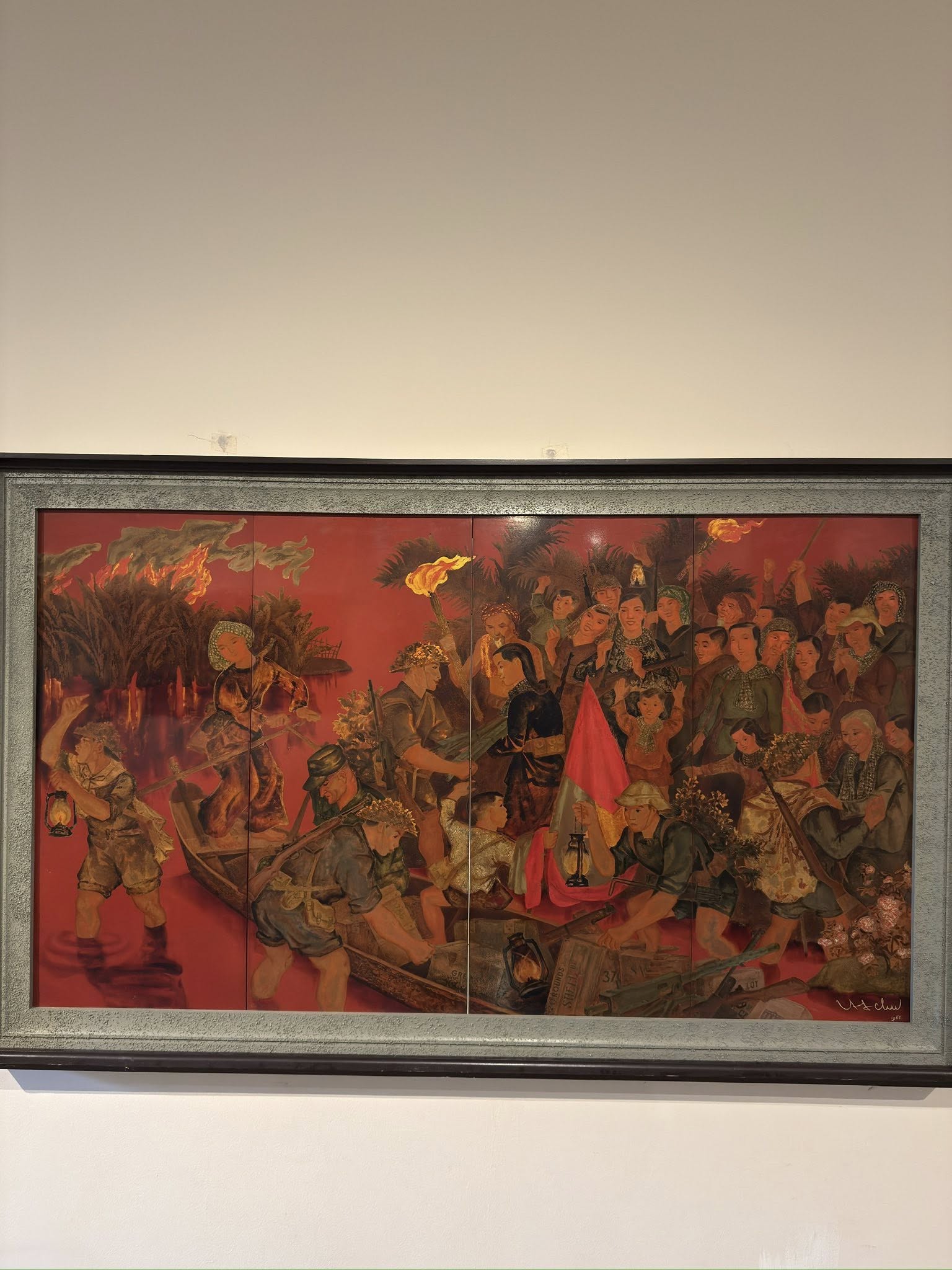
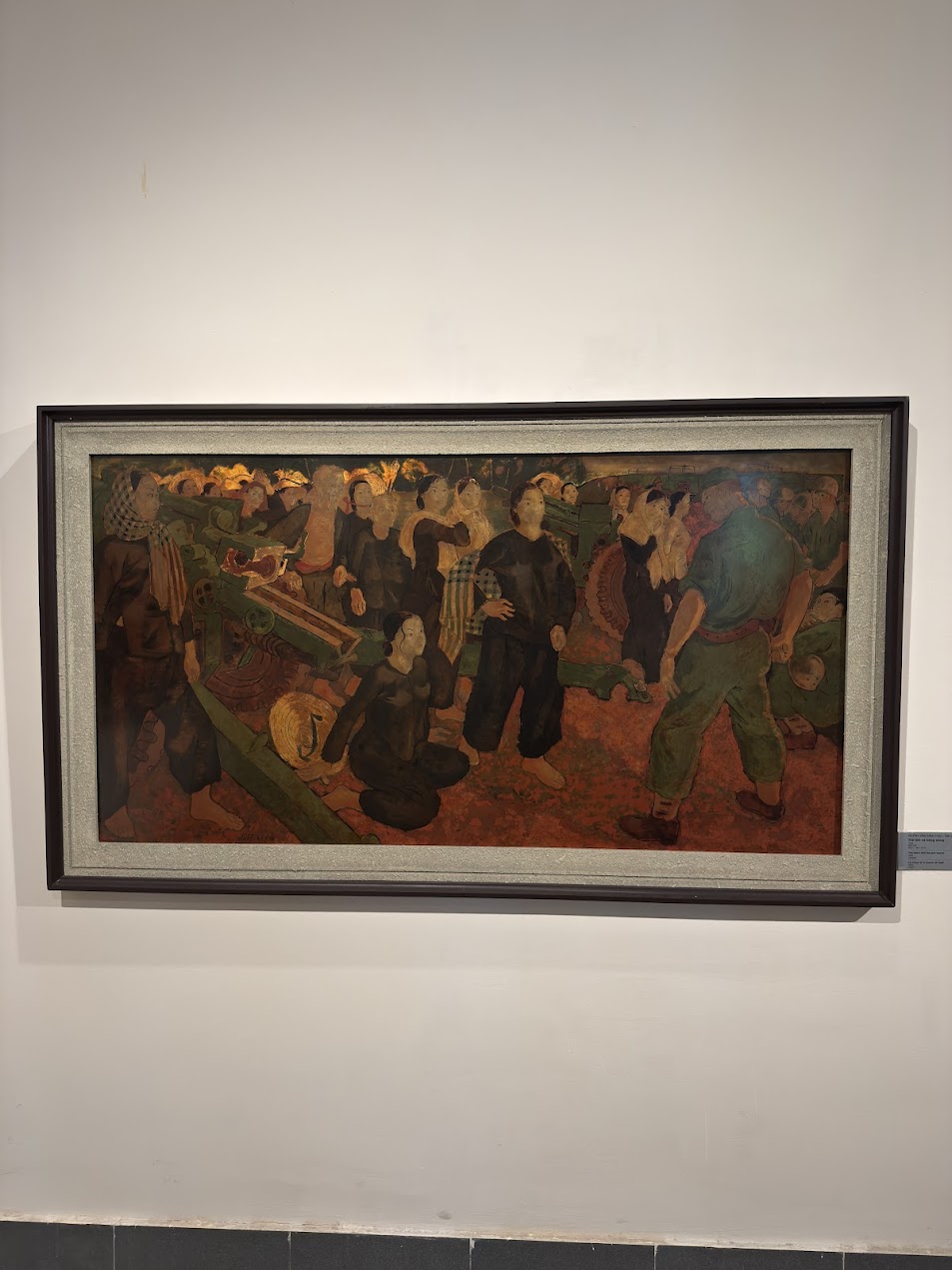
The wartime paintings on the walls certainly had that power: firelight, boats, transport routes, artillery, women, children, rifles, night. They draw the eye immediately. One understands at once that this museum is not presenting an ornamental version of women’s history, but showing how women were drawn directly into war itself.
And yet what stopped me for the longest time was not any of those paintings.
It was a piece of cloth.
It lay quietly inside a display case, black-and-white checked, without heroic posture and without theatrical pathos. To be honest, from a distance it could easily have been mistaken for an ordinary ethnographic object, or for a fragment of regional dress placed on display.
That changed the moment I read the small label beside it.
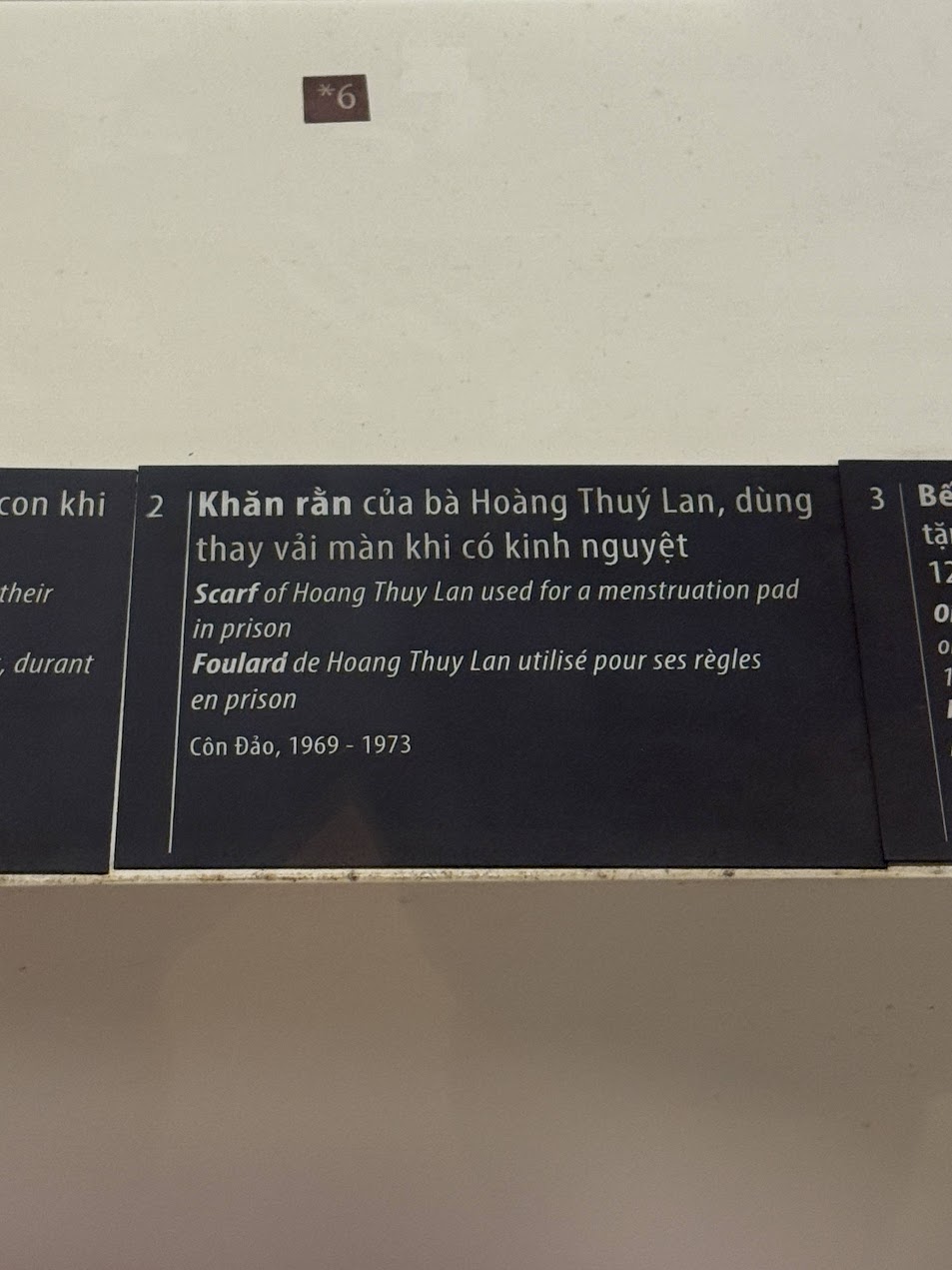
It read:
Scarf of Hoang Thuy Lan used for a menstruation pad in prison.
I remember pausing for a moment in genuine disbelief.
Because that single sentence collapsed a great many abstractions at once. What stood before me was no longer merely a commemorative object from a revolutionary period, nor simply a supplementary fragment in the history of women’s participation in war. It pulled me directly towards a question that could no longer be avoided:
When a woman is imprisoned and has no basic menstrual supplies, what is she left with to catch her own blood?
At that point, history ceased to be a slogan, and it ceased to be an abstract grand narrative.
It became flesh. It became cloth. It became the question of how a woman under conditions of confinement managed to preserve the most basic order of her own body. And it was precisely then that I understood what made this object so heavy. It did not matter only that it belonged to a time of war. What mattered was that it preserved, in full view, the point at which war descended into one of the most intimate layers of a woman’s body.
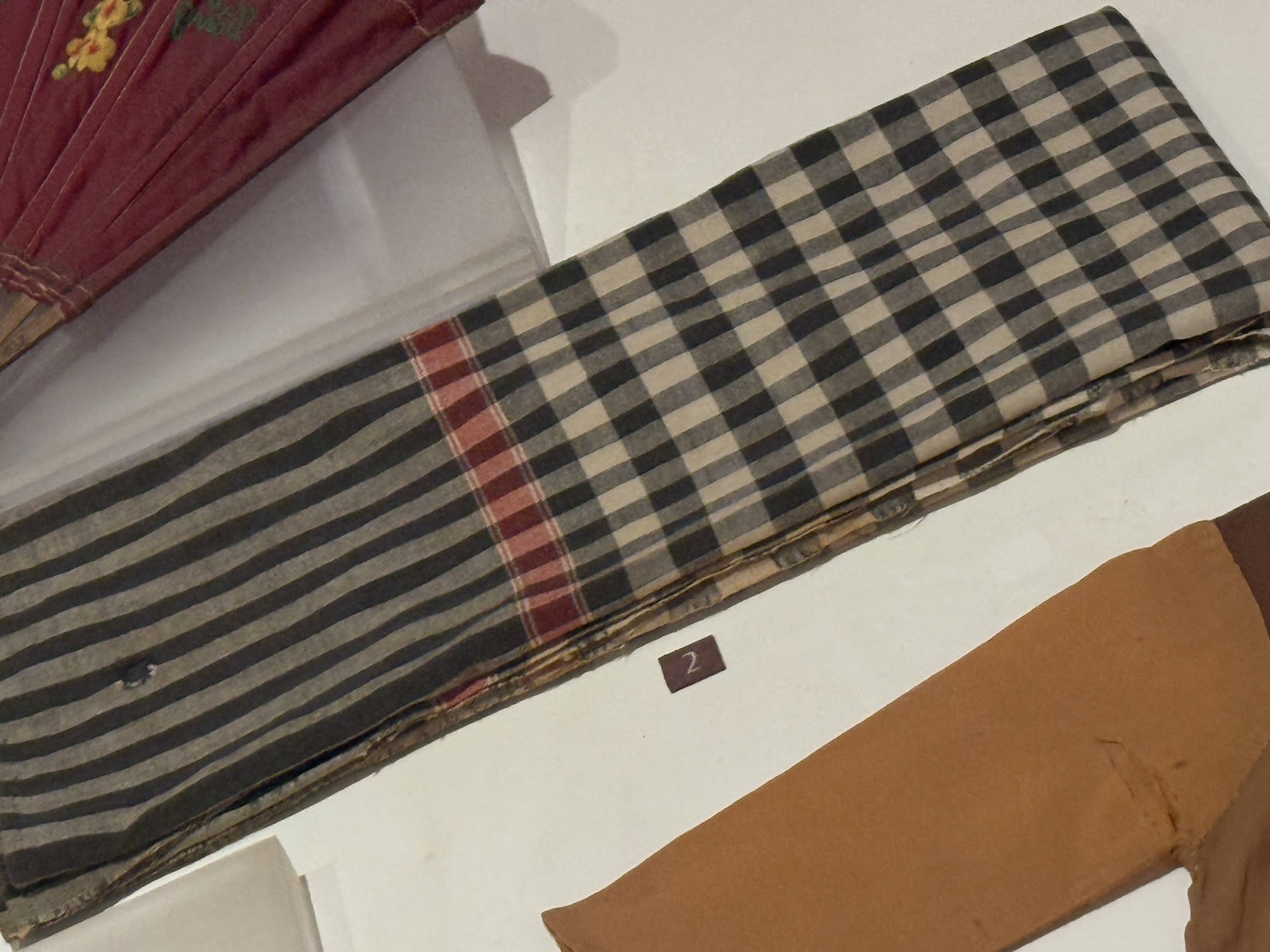
Standing before that cloth, it was impossible not to imagine what it had once come into contact with: sweat, blood, heat, shame, pain, the difficulty of washing, the desperation of reuse, and the blunt fact that war is not only made of guns and front lines. It is also made of how women, in extreme conditions, continue trying to hold together the minimum coherence of being a human being.
Grand history likes to write about victory, strategy, attack, retreat, routes, governments. A piece of cloth interrupts that preference. It reminds you that when history presses itself upon a body, it does not always arrive in the shape of a map. Often it arrives in a form so small, so intimate, and so physically unavoidable that abstraction simply fails.
And from that moment on, I knew this essay could not remain only about the Khăn Rằn as a revolutionary symbol, or about Vietnamese women in war. That would still not be enough.
Because what I was seeing was not merely a national sign, but evidence of women’s bodily memory. For the first time, I felt very concretely that the heaviest part of war lies not only in who dies, but in what the living must use to carry a body that continues, day after day, to function.
Chapter 1 | From Grand Narrative Back to a Piece of Cloth: When History Becomes Heaviest, It Is Often Not a Map, but a Body
In recent years, whenever Vietnam enters conversation, the discussion tends to begin with large-scale categories.
Supply-chain relocation, geopolitics, US-China rivalry, new manufacturing bases, Southeast Asian advantage, labour and capital flows. All of these are important, and they do indeed form part of how Vietnam is being re-understood by the world today.
Yet such large vocabularies have a problem. They make it very easy to imagine that history and civilisation happen primarily at the level of policy, capital, and strategic decision-making. After a while, one begins almost unconsciously to think of “the weight of an era” as something that can be surveyed from above.
But the Women’s Museum pushed me in the opposite direction.
Not from above looking down, but from very low, very near, and almost against the body itself, it pulled history back into view.
What stood there was not an epic, nor a military route map, but something whose size you could almost measure in your hands: a black-and-white checked scarf.
The more I thought about it, the more convinced I became that this is one of the museum’s greatest powers. It returns people to history who have been flattened out by large narratives. It does not do so through an abstract theoretical apparatus. It does so by placing one small object before you and forcing you into a scene from which there is no elegant retreat.
When you look at that cloth, “nationalism” is not the first word that comes to mind. What comes first is much simpler: a woman. She is imprisoned. She menstruates. She has no sanitary supplies. She must use whatever cloth is available to manage that fact.
This feeling is utterly different from reading a textbook.
A timeline can tell you what year a battle took place, which regime rose, how a military line moved. But a piece of cloth tells you something else: how war finally lands on a person. Not in the abstract sense that it “causes casualties”, but in the very concrete sense that it interferes with the monthly rhythm of a woman’s body.
At that moment, one sentence formed very clearly in my mind:
The true weight of history often lies not in the timeline,
but in what an individual must use to endure her own body.
That is why the meaning of the Khăn Rằn here reaches far beyond dress, identity, or revolutionary iconography.
It becomes a point of intersection: between national memory and war narrative on one side, and the most intimate dimensions of women’s bodily experience on the other; between public history and menstruation, washing, shame, pain, and the practical reality of staying alive under extreme conditions.
And I would argue that it is precisely such intersections that allow someone living in peacetime to touch the real temperature of history. Not because they are more sentimental, but because they resist abstraction.
You can no longer treat the cloth as a mere symbol. It has already been used. It has touched a body. It has helped a particular woman endure particular imprisoned days. Once such an object stands before you, all macro-narratives suddenly shrink, and make room for something more fundamental: how a person lives, how a person endures, and how one tries to preserve the minimum coherence of being a self amid shame and deprivation.
That is why I felt I had to rethink this essay. If I wrote it merely as “a revolutionary headscarf I saw in a museum”, I would be reducing its true gravity.
What really needs to be written is not only how this cloth entered national memory, but how it reveals something harder to face: the deepest wounds of war are often not found where history is loudest, but in bodily details too small for slogans and too daily for heroic narratives.
Chapter 2 | What the Khăn Rằn Originally Was: From an Everyday Cloth to a Shared Language of Southern People
If one sees the Khăn Rằn only as a revolutionary symbol, one has already narrowed it too much.
It did not begin as a sign made for revolution, nor was it created for the battlefield. First of all, it was an ordinary object of daily life: a piece of cloth used to shield from the sun, wipe away sweat, wrap things, cover the neck, and care for children. Its importance lies precisely in how ordinary it once was — so ordinary that it scarcely needed to be specially named.
In other words, the Khăn Rằn belonged first not to the heights of ideology, but to the ground level of living; not to power, but to daily practice; not to slogans, but to the body and to labour.
That matters.
Because once a sign has already grown within the life of ordinary people, it carries with it a kind of native credibility. It does not need to be designed to stand for the people. It already lives on their bodies.
This is one reason why the Khăn Rằn later became so easily legible as a shared language of southern Vietnam, especially in the Mekong Delta, where everyday life and wartime memory became tightly bound together.
It is not as explicit as a medal, nor as elevated as a flag, nor as regulated as a uniform. It is closer to a rhythm that slowly grew out of land and labour. Once you see it, you can almost sense the climate, the habits of work, the bodily patterning, and the range of life to which it belongs.
Its force, then, lies not merely in appearance, but in the fact that it is an intensely intimate local vocabulary. It is neither purely decorative nor purely political. It is the result of long coexistence between bodies and environment.
And once something like that enters wartime, its meaning expands dramatically.
Institutions prefer to borrow not wholly unfamiliar new symbols, but those things already circulating among people — things already trusted, already worn, already woven into ordinary life. In that way, mobilisation no longer appears as an imposed command. It begins to resemble something growing naturally from within the community itself.
That is why the Khăn Rằn eventually became more than cloth. It became a mode of recognition. The symbol was not invented from nowhere; rather, everyday life itself was requisitioned by history.
I think this sentence is important: the Khăn Rằn was not designed in order to become the people’s language. It became the people’s language because it had already been worn on their bodies, and history later chose to speak through it.
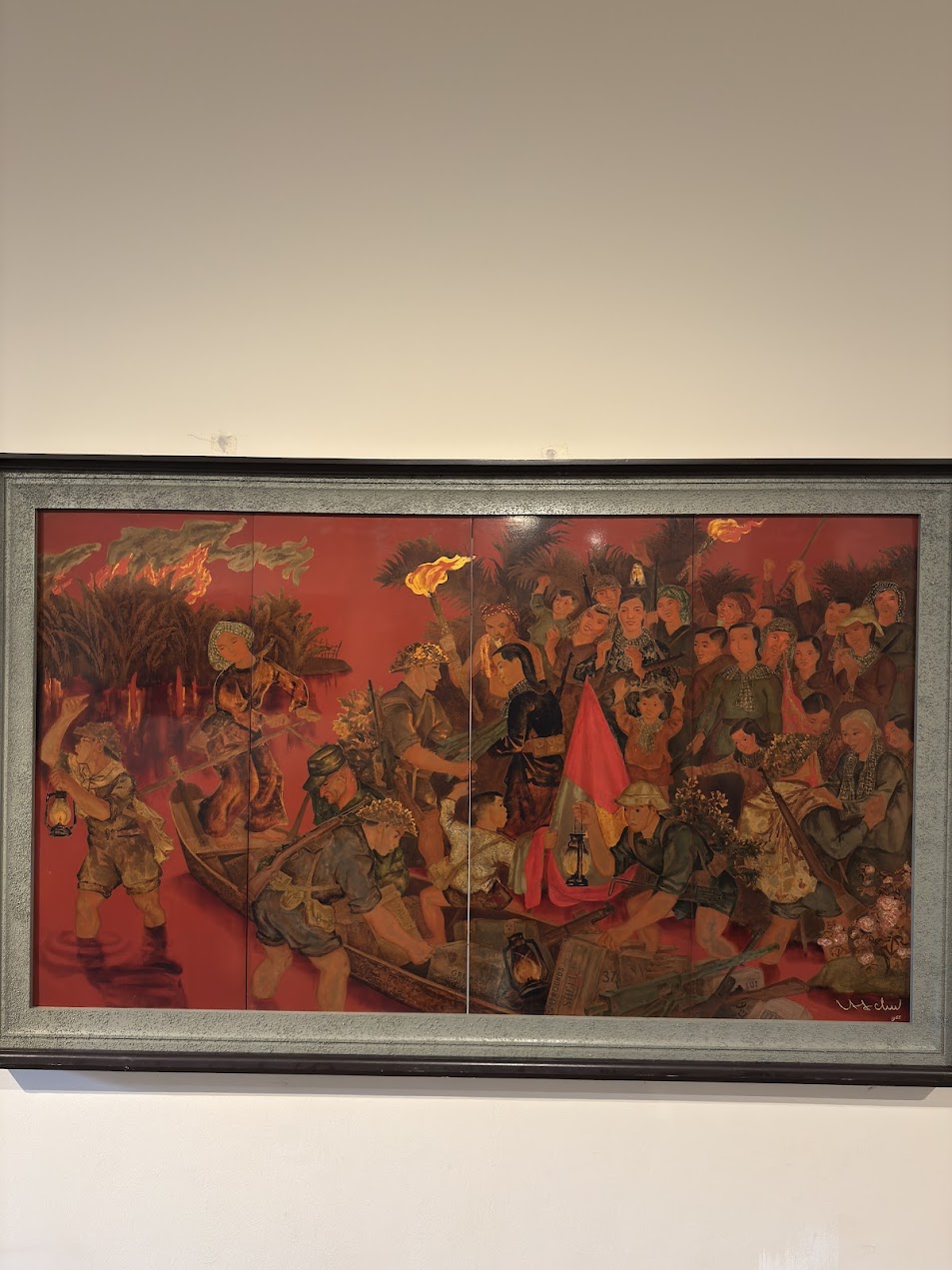
As one moves through the exhibition, one begins to feel this transformation more clearly. The women in these paintings are not placed at a distance as background figures. They are on the boats, in the firelight, along the transport routes, inside the labour structures of war itself. At that point, the Khăn Rằn no longer signifies only “local flavour”. It becomes a visual node that ties women’s bodies, regional memory, and wartime mobilisation together.
This is very close to the logic I have traced elsewhere in Vietnamese wartime imagery: when institutions become sophisticated, they do not rely only on weapons and slogans. They borrow local cloth, the tonality of land, women’s bodies, and the textures of daily labour, until the whole structure of mobilisation begins to look like something arising from the people themselves.
Yet the deepest weight of this essay does not stop there.
Because if the Khăn Rằn remained only at the level of a “shared language of the people”, it would still be too easy to romanticise it as a national symbol. What pulls it back decisively into bodily reality is the function it was forced to take on once it entered prison.
Chapter 3 | What This Cloth Became Inside Prison: Menstruation, Shame, and the Preservation of Dignity
The same piece of cloth that, in daily life, could serve as shade, sweat-rag, wrapping, or an extension of work, is rewritten when a body is forced into confinement. Everyday objects are made to change function under conditions of imprisonment.
And that is precisely where the Khăn Rằn becomes most shocking.
It is no longer simply an extension of local culture. It becomes one of the few remaining means by which a woman, stripped of resources, freedom, and bodily privacy, can maintain the minimum order of her physical existence.
Menstruation, meanwhile, is one of the first things grand history tends to erase.
War histories prefer battles, victories, routes, governments, weapons, negotiations, and casualty figures. Women’s menstruation seldom appears in such accounts. It is as though, once war or imprisonment begins, the bodily rhythms that continue month after month — and that do not disappear merely because a nation is at war — are expected to vanish silently from history.
But they do not vanish.
The blood still comes. Pain still comes. Heat, smell, inconvenience, wiping, washing, changing — all of it remains. The only question is this: when a woman is imprisoned, deprived of sanitary products, deprived of adequate washing conditions, deprived of privacy, and often deprived even of basic care, how is she meant to endure that bodily reality?
That is why the museum label bears such force.
It pulls us away from the level of “revolutionary female symbol” and back to the level of “female body in prison”. Not an abstract woman, not a heroic figure from a propaganda image, but a human being who bleeds, hurts, feels shame, wants to clean herself, and wants to preserve some form of bodily dignity.
What becomes unavoidable here is not heroism, but the human condition itself.
While standing before that cloth, I kept thinking about one thing. In many cultures, cloth is among the objects closest to comfort. Clothing, swaddling, towels, sheets — all are associated with wrapping, protecting, covering, caring. But once the same cloth is forced into prison, into war, into the situation of a woman having to manage menstruation by herself under extreme deprivation, it becomes something else: not tenderness itself, but the means by which a person tries to preserve a fragment of tenderness within an untender world.
That transformation is deeply cruel, and deeply real.
Because it reminds us that war and imprisonment do not only take grand things away. They do not only take ideals, freedom, home, or life. They also take away the smallest forms of ordinary convenience. They take away cleanliness, privacy, and the basic bodily dignity a person might otherwise assume to be theirs by right.
And a single piece of cloth becomes the last available tool against that deprivation.
That is why, if this essay were to describe the Khăn Rằn only as a revolutionary symbol, it would in fact be reducing its true gravity. What makes it heavy, for me, is not how many propaganda images later used it, but the fact that it once really touched a body, really caught blood, and really carried a woman through those imprisoned days.
No slogan can replace that weight.
And it was here that I truly understood something else: women’s war memory is not only that women also went to war, nor only that women carried rifles, transported supplies, or tended the wounded. More deeply, it is the fact that women, in systems that left almost no room for their bodies, still had to find ways to prevent themselves from collapsing entirely.
In this setting, the Khăn Rằn is no longer simply a cultural marker, nor a posture of courage. It becomes a minimum technology of survival — something not praised by grand narrative, yet something that truly allowed life to continue.
And that, perhaps, is exactly what deserves to be remembered most.
🔶 Nelson’s Insight | The Heaviest Part of History Is Not Found Only in Battles, but in What Women Must Use to Catch Their Own Blood
What war narratives most easily preserve are the large scenes: advancing lines, artillery fire, regime change, negotiation, victory, defeat, casualty counts. All of these matter. Yet they also make it far too easy to imagine that the real weight of history is located primarily on the map.
But standing before that Khăn Rằn, I became increasingly certain of something else: when history truly presses upon a human being, it often does so not first through tactics, but through the body. It asks whether one can still clean oneself, whether one can still manage bleeding, whether one can preserve the minimum coherence of bodily dignity inside an environment structured to strip that dignity away.
That is also why I no longer feel satisfied with narratives that stop at saying, “women were brave too.” Of course they were brave. But if we stop there, many of the heaviest truths are covered over once again. Menstruation, shame, the need for bodily care, the effort to remain clean and intact inside confinement—these are rarely the things slogans remember, yet they are often the point at which history becomes most real for the individual.
So for me, the deepest value of this cloth is not that it symbolises revolution. It is that it proves something far harder to say aloud: women did not simply hand their bodies over to war; they also had to find ways, within war and imprisonment, to retrieve those bodies back for themselves.
Once that becomes visible, the scale of war memory changes. One no longer asks only who won, who lost, or how many died. One begins instead to ask: who, in extreme conditions, was left to bear bodily costs that no one else was prepared to handle? Whose pain never qualified for entrance into a slogan? Whose survival skills were reduced, in the end, to a single piece of cloth?
I think a mature historical sensibility is not measured only by how many events one can name. It is measured by whether one can still respond to evidence this small, this intimate, and this heavy. Because the deepest fractures in civilisation often do not open where history is loudest, but where bodily reality is repeated daily and almost never remembered properly.
Chapter 4 | War Images Inside the Women’s Museum: Women Were Not Merely Remembered, but Built into the Machinery of War
After seeing that cloth, I found that the rest of the gallery looked different to me.
Before that moment, one might have taken the paintings as visual supplements to wartime memory: women carrying rifles, women transporting goods, women tending the wounded, women holding children while surviving in the shadow of war. But once you know that the Khăn Rằn in the display case was once used in prison as a menstruation pad, these images no longer remain at the level of “women were heroic in war.”
They begin to say something more exact: women were not standing at the edge of war. They were built into it.
Not inserted symbolically, but woven directly into the systems of transport, supply, artillery, care, displacement, survival, and the maintenance of family life under pressure.
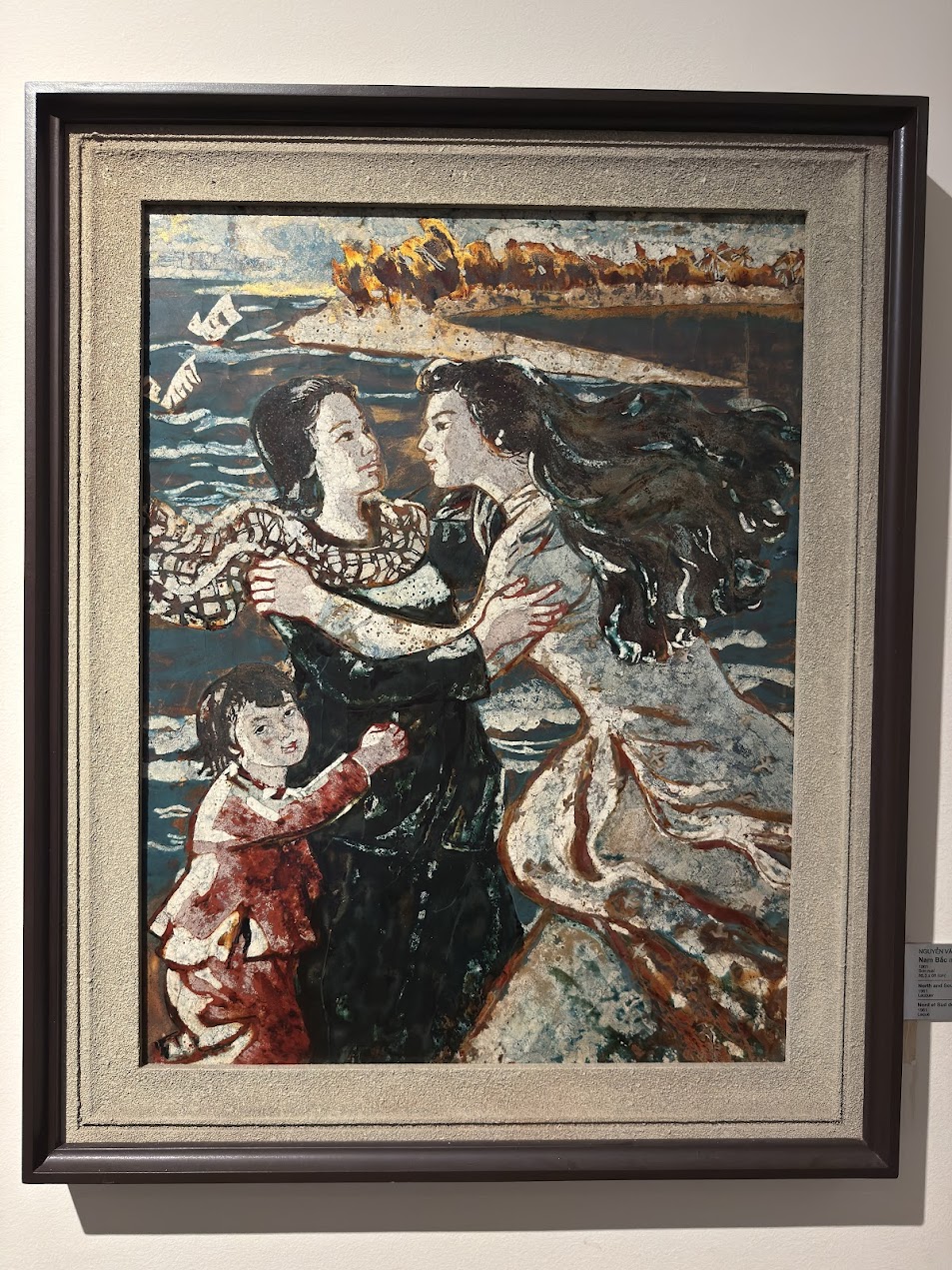
One of the things that strikes me most in these paintings is that women are never reduced to a single role.
A woman may be a mother and a transporter at once. She may be a caregiver and also someone pushed forward by war itself. She may hold a child and still stand beside a weapon. She may preserve traces of ordinary life while simultaneously inhabiting one of the most violent edges of history.
In other words, women here are not simply divided into “front line” and “rear line.” They often carry two, three, or even more roles at the same time. And that is precisely what makes the war imagery inside the Women’s Museum so important. Unlike conventional military history, which tends to narrate war through weapons and command alone, these images restore to the centre what is usually pushed to the side: labour, care, family, feeling, daily endurance, and the work of preventing life from collapsing altogether.
This is an important corrective.
Because when people speak of war, they often begin instinctively with who fired, who advanced, who commanded. In doing so, they push to the margins the enormous amount of labour without which war itself could not continue. But these images make something else visible: war is never only the rifle at the front. It also includes transport at the rear, bodily endurance, the care of children, the movement of the injured, the management of hunger, and the forms of labour that keep daily life from falling apart all at once.
That is why the Khăn Rằn becomes so important within this entire exhibition line.
It functions like a small but precise node, tying together roles that may at first seem separate. It is in the field, in the market, on the boat, on the road; but it is also in the paintings, in the prison, and in the most private bodily realities of women’s lives. It belongs not to one heroic story alone, but to an entire network of women’s war memory in which it reappears, again and again, as something worn close to the body.
I would even say that this makes it more truthful than many of the grander revolutionary slogans. Slogans are often written from above for those below. Paintings are often later arrangements through which history is organised. But a piece of cloth that has actually been used, washed, worn down, and made to catch blood does not easily lie. It does not elevate itself, nor soften its tone for the sake of an institution. It simply tells you, quietly: women were here, and they were not here abstractly. They were here with their bodies, and they carried this stretch of history through with those bodies.
That also changed my understanding of what a women’s museum can do.
It is not merely a place that adds women back into an already existing history. It reopens the parts of war memory that dominant narratives have flattened for too long. It shows that women’s war history is not merely the statement that “women also fought,” but something more demanding: how women, after war had shattered the ordinary fabric of life, still had to sustain labour, care, bleeding, survival, and memory all at once.
And once that becomes visible, it becomes difficult to return to these paintings as pure scenes of heroism. One begins to feel more clearly that each image is not only praise, but testimony. Each one restores thickness to a group of lives that history has too often written too thinly.
Chapter 5 | Returning to the Present: Why People Living in Peacetime Should Still Be Moved by Such Evidence
Before leaving the display case, I found myself returning to one question again and again: why should people like us, living in relatively peaceful times, still be moved by a piece of cloth?
Because many people would instinctively say that such a thing is too far away from them. It belongs to another country’s war, another people’s prison, another generation’s revolution. We live in cities. We worry about work, rent, health, family pressure, and uncertain futures. On the surface, it all seems very far from that cloth.
But the more I thought about it, the less convincing that distance became.
Because what matters is not only whether we have lived through the same war. What matters is whether we still retain the ability to respond to the bodily weight carried by this kind of evidence.
If someone can look at such an object and feel only a flat historical curiosity — “oh, this is a wartime artefact” — then the issue is not only a lack of information. It may also mean that the distance between our lives and the pain of others has been trained to become too great.
And to me, that is one of the most dangerous forms of numbness in peacetime.
Not because people have become cruel, but because we have become too accustomed to viewing the world through macro-language. We talk about states, situations, strategy, industry, and risk allocation. After long enough, it becomes easy to forget that all these grand terms eventually fall on actual bodies. They fall on how a woman manages menstruation. They fall on how a child remains alive near war. They fall on how a family endures loss. They fall on how some people, at the hardest edge of a system, still try to keep a minimum space in which they can remain recognisably human.
That is why evidence such as the Khăn Rằn matters. Not only because it helps us remember the past, but because it forces us to rescale history back to the dimensions of a human being.
And I think that matters especially now.
Because ours is an age in which war is too easily discussed through screens. People talk about positions, sanctions, regional security, who should be firm, who should yield, as though war were a strategic game one could observe from a distance. But once you have truly looked at evidence like this, it becomes difficult to imagine war as a chessboard.
Because you know that war does not merely consume colours on a map. It enters the most intimate places of the body. It changes not only regimes, but how a person bleeds, washes, endures, and tries to preserve dignity.
This is also why I have developed an instinctive distrust of language that encourages war too lightly.
Because once one has really seen things like this, it becomes almost impossible to treat war as a clean act of political positioning. One knows that what “going to war” means is not only the activation of weapons, but the cutting apart of families, the forcing of women to bear history in places where history should never have to be borne, and the demand that countless people use the most basic conditions of their own bodies to settle the accounts of larger systems.
So what remained with me after seeing that cloth was not only shock, nor only sympathy.
It was a slower, deeper reminder: peace does not mean only the abstract absence of war. Peace also means that a woman does not have to use a piece of cloth in prison to catch her own blood; that a young person does not have to pay history with the body too early; that cloth may remain cloth, rather than becoming a final technology of survival.
If one cannot think that far, then much of what we casually call peace remains little more than slogan.
And perhaps that is why a museum is never only a place where the past is stored. At times it functions as a very slow mechanism of remembrance, reminding us that what civilisation ought most to preserve is not only territory or institutions, but the possibility that human beings might live out their days without having to do so in tragic excess.
For me, that black-and-white Khăn Rằn has become exactly such a reminder.
It taught me that the heaviest parts of history are often not written in the most visible places, but preserved in the objects closest to the body, where grand narrative finds it hardest to take over.
And as I left Hanoi Women’s Museum, what remained in my mind was one simple but very heavy wish:
May there come a time when no one in this world
must use a piece of cloth to catch a history that should never have fallen there.
FAQ | Common Questions and a Systems View
Q1 | What is the Khăn Rằn? Was it originally just a headscarf?
A: The Khăn Rằn is a black-and-white checked cloth widely associated with southern Vietnam, especially the Mekong Delta. It began as an ordinary object of daily use — for shade, sweat, wrapping, and childcare — and therefore carried deep associations with land, labour, rural life, and everyday people long before it was drawn into war memory.
Q2 | Why is this particular Khăn Rằn so moving?
A: Because it is not presented merely as a cultural garment or revolutionary symbol. The museum label identifies it as a scarf once used by a woman in prison as a menstruation pad. That fact transforms it from a symbol into bodily evidence — evidence of how war, confinement, and scarcity descend into the most intimate conditions of women’s lives.
Q3 | Why does the detail of menstruation change the entire weight of the essay?
A: Because menstruation forces war out of abstraction and back into the realm of the body. One can no longer remain only at the level of strategy, victory, or state power. One must confront the very concrete question of how a woman, under imprisonment and without basic sanitary means, manages a body that continues to function regardless of history’s slogans.
Q4 | Is this essay about women’s suffering, or about women’s participation in war?
A: It is about both, but not as a simple either-or. Women in war are neither reducible to victims nor exhausted by the category of heroism. They often carry labour, transport, care, displacement, menstruation, survival, and memory at the same time. What this essay tries to restore is the layer at which women’s bodily experience has been flattened or omitted by standard war narratives.
Q5 | Why can a piece of cloth be described as “bodily evidence”?
A: Because this cloth is not an abstract symbol floating in cultural memory. It is a used object that once touched a body, caught blood, and was repeatedly relied upon in extreme conditions. It preserves not merely an idea, but a trace of how a body endured a period of history.
Q6 | What role do the wartime paintings in the museum play in this essay?
A: They show that women were not merely standing beside war as passive figures, but were built directly into systems of transport, care, artillery, family maintenance, and wartime labour. These paintings are not the primary evidence of the essay, but they help reveal that the Khăn Rằn belonged to a wider network of women’s war memory rather than to one isolated case.
Q7 | How does this essay connect to your other writings on Vietnamese images and visual culture?
A: In all three cases, I am looking not only at artworks or objects themselves, but at how images and things participate in civilisation. In “Lotus, Rifle, and a Young Woman,” I considered how war borrows youth and femininity to make mobilisation aesthetically bearable. In “Young Girls in the Garden,” I traced how Vietnam developed its own modern visual language. This essay goes one step further by returning from image to object, and from object to the bodily realities war inscribes.
Q8 | What is the final reminder this essay wants to leave behind?
A: Not merely that “this cloth is moving,” but that a mature historical sensibility requires more than knowing dates and battles. It requires the capacity to respond to evidence that is small, private, and yet unbearably heavy. Because the deepest weight of history often lies not on the map, but on the body.
📜 References (APA 7th)
- Luong, H. V. (1992). Revolution in the village: Tradition and transformation in North Vietnam, 1925–1988. University of Hawai‘i Press.
- Taylor, K. W. (2013). A history of the Vietnamese. Cambridge University Press.
- UNESCO. (2003). Convention for the safeguarding of the intangible cultural heritage.
- Vietnam Women’s Museum. (n.d.). Exhibition archive and curatorial materials. Hanoi, Vietnam.
- Vietnam Women’s Museum. (n.d.). Label for the scarf of Hoang Thuy Lan used for a menstruation pad in prison, Côn Đảo, 1969–1973. Hanoi, Vietnam.