Lotus, Rifle, and a Young Woman: How a Vietnamese Propaganda Image Turns Youth into a War Aesthetic
Beginning with a “girl holding a lotus and a rifle” at Hanoi’s Fine Arts Museum, this essay asks how war borrows softness, locality, and youth in order to make mobilisation look acceptable.
Nelson Chou | Cultural Systems Observer · AI Semantic Engineering Practitioner · Founder of Puhofield
Executive Summary
This essay is not an attempt to defend one side of a war, nor is it simply a design analysis of a Vietnamese propaganda poster. What I want to ask is something more unsettling: why does war so often borrow youth, femininity, and symbols of gentleness in order to package itself into a form people can more easily accept?
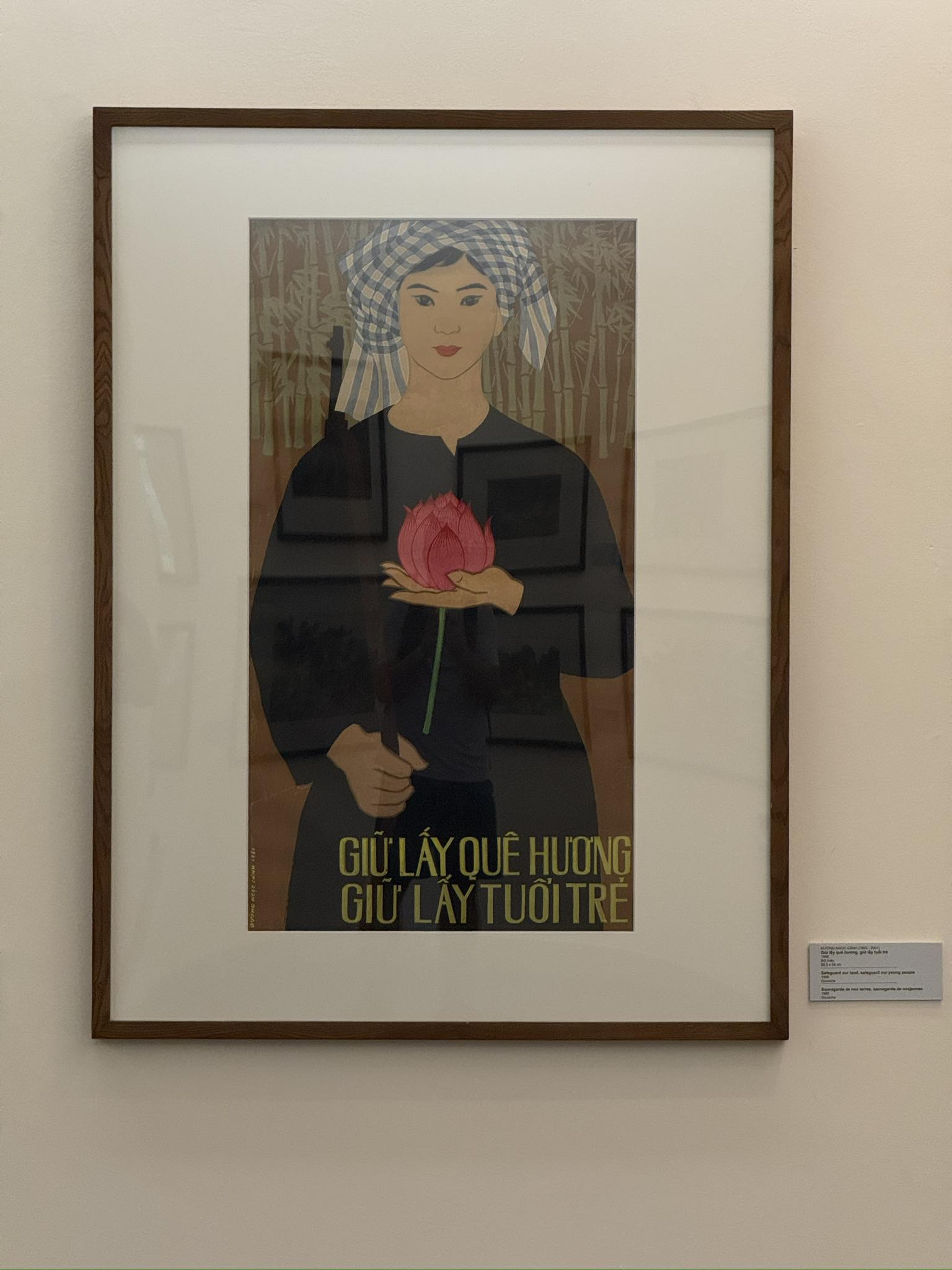
At the Vietnam National Museum of Fine Arts in Hanoi, I encountered an image of a young woman wearing a black-and-white checked headscarf. In one hand she held a rifle; in the other, a lotus blossom. The image was not loud. It was almost calm. Perhaps that is exactly why it was so difficult to pass by.
From that single image, this essay opens several layers at once: how the Khăn Rằn headscarf ties war to land and rural life, how the pairing of rifle and lotus creates an unusually softened visual contrast, how the slogan beneath the image turns sacrifice into moral elevation, and how youth itself is repeatedly mobilised, across cultures, as one of the most consumable resources in times of war.
What interests me, in the end, is not simply whether this image is visually powerful. It is the deeper mechanism it reveals: war does not only consume life. It often begins by arranging a more bearable aesthetic for the very bodies it intends to consume.
Table of Contents
- 1. Hero Opening | The Instant the Image Stops You
- 2. Why Does This Image Hold the Eye? Because It Offers Softness First, and Only Then Introduces War.
- 3. Khăn Rằn: How a Headscarf Makes War Look as Though It Belongs to the People
- 4. Rifle and Lotus: How Violence Is Translated into Something One Can Gaze At
- 🔶 Insight Block | War’s Greatest Skill Is Not Only Mobilising Death, but Beautifying the Youth It Intends to Spend
- 5. Slogan, Girl, and System: How Youth Is Reframed as an Acceptable Sacrifice
- 6. From Vietnam to the Wider World: Why Youth Is So Often Pushed Forward in the Language of War
- 7. FAQ | Common Questions and a Systems View
Hero Opening | The Instant the Image Stops You
Some works do not wait for you to study them before they strike.
You do not need to approach, analyse, or read the wall label first. Your body stops before your mind has finished organising what it has seen.
That was what happened to me in the Vietnam National Museum of Fine Arts. I had been moving through the galleries at an ordinary pace, looking from painting to object, from one surface of history to another, when I suddenly stopped in front of a single image on the wall.
It was not the largest work in the room. Nor was it the loudest. In fact, its power came from the opposite. It was strangely quiet.
At the centre stood a young woman. She faced forward. A black-and-white checked headscarf was wrapped around her head. In one hand she held a rifle. In the other, she gently carried a lotus blossom.
My first thought was not, “this is a Vietnamese war poster,” nor even, “this is a strong composition.” What arrived more quickly than either of those was a harsher and more immediate question:
Why does youth so often appear on the battlefield long before it should?
Poster slogan: GIỮ LẤY QUÊ HƯƠNG, GIỮ LẤY TUỔI TRẺ
Photograph by Nelson Chou
If one glances quickly, it may register as little more than a period propaganda image. But the longer one remains with it, the more unsettling it becomes. The image does not shout. It does not stage anger or advance. Instead, it places war inside the body of a young woman in a manner so calm that it almost begins to resemble a poem.
And that stillness is exactly what gives the image its after-effect.
Because it does not merely show you a weapon. It shows you something more disturbing: war can become most frightening not when it explodes, but when it learns to describe itself in gentle terms.
Chapter 1 | Why Does This Image Hold the Eye? Because It Offers Softness First, and Only Then Introduces War.
If this image contained only the rifle, it might not linger so powerfully in memory.
If it were merely a familiar revolutionary composition — weapon raised high, gaze fixed, body pitched forward, everything arranged around mobilisation and force — we would quickly classify it as a recognisable kind of political image and move on.
But that is precisely what it does not do.
What it gives the eye first is a young woman, a lotus flower, a composed expression, and a bodily posture almost entirely free of aggression. In other words, the image first offers what East Asian visual and cultural memory readily associates with purity, gentleness, and something not yet fully worn down by the world. Only after the gaze has settled does the other fact arrive in full: what she holds is not a tool of labour, nor an ornament, but a rifle.
The effect is peculiar. It does not assault the viewer. It receives the viewer first, and only then introduces unease.
That is why I came to feel that the real significance of this image lies not in whether it is beautiful, but in the mature logic of mobilisation it demonstrates: war is first wrapped in an emotional shell one can accept, and only then is its violence delivered.
In that sense, the image is more than a propaganda work. It is a highly developed form of emotional engineering. It understands that if war is shown too directly, the viewer may recoil. But if it first appears through a young body, a still face, and a blossoming lotus, then the same violence is translated into something more bearable to look at.
That, to me, is the most sophisticated and also the most unsettling aspect of the poster.
It does not erase war. It arranges a more acceptable surface for war.
And that surface is precisely where modern propaganda aesthetics deserve to be taken apart. Their force does not always come from the loudest slogans. More often, it comes from something subtler — a mode of presentation that feels almost as though one is accepting it of one’s own accord.
This is also why, standing before that image, I found myself thinking not only of Vietnam, nor of one particular war, but of something broader: when civilisations need sacrifice, they rarely begin by presenting brutality in its raw form. They first give sacrifice a noble language, a bearable posture, or a face that still looks too young to refuse.
Once that has happened, pain becomes easier to rename as honour, and loss easier to translate as something worthy.
Chapter 2 | Khăn Rằn: How a Headscarf Makes War Appear to Stand with the People
The black-and-white checked cloth wrapped around the young woman’s head is known as the Khăn Rằn.
For a viewer unfamiliar with Vietnam, it may first register simply as a local garment, or as a regional textile detail with a certain southern flavour. But what matters here is not whether it is visually distinctive. What matters is the weight of life it carries behind it.
The Khăn Rằn was not originally a symbol of power, nor part of formal military dress. It belongs far more closely to the ordinary life of labour in the Mekong region: something used against the sun, for wiping sweat, for wrapping things, for work in the field. In other words, it points not to the centre, nor to authority, but to land, labour, rural life, and the everyday dignity of ordinary people.
And that is exactly why it becomes so powerful inside an image of war.
Once such an object enters a propaganda image, it ceases to function as a mere item of dress. It begins doing ideological work. It tells the viewer: this is not a distant military figure, not an abstract arm of the state, but someone from the next village over — someone who belongs to sweat, earth, weather, work, and recognisable human life.
The transformation is remarkably effective. It makes war appear less like military mobilisation and more like something arising naturally out of the land itself. Armed struggle is no longer presented simply as an order from above. It is retranslated as a posture with no distance from the people.
Standing before that image, this was one of the first things that struck me. The headscarf immediately softened the official hardness of the composition. It made the whole image feel closer to lived reality. One begins to feel that this is not power speaking on behalf of the people, but the people themselves stepping into view.
And for precisely that reason, it deserves closer examination.
Because when war begins to borrow signs taken from rural life, labour, and the earth, what it is performing is not simply design, but a deeper semantic conversion: it turns the armed figure into a member of the community, war into an extension of everyday life, and sacrifice into something that appears to arise from the people’s own willing burden.
This is one of the most mature and dangerous features of propaganda imagery. It does not always depend on outright falsehood. More often, it depends on placing certain real things within the frame, so that one is more willing to accept the frame as a whole.
The Khăn Rằn is effective here not because it is exotic, but because it carries the weight of soil, labour, sweat, and communal belonging. Once those associations are successfully brought into a war image, the weapon begins to look less like a weapon, and more like a regrettable but necessary extension of ordinary life. Mobilisation begins to look less like command and more like something the land itself has quietly consented to.
If, in my essay on Nguyễn Gia Trí’s Young Girls in the Garden, I was looking at the way Vietnam allowed modern form to grow into its own visual language, then what this poster reveals is something else: the way institutions borrow local vocabulary in order to make their own mobilisation sound like the people’s voice.
Chapter 3 | Rifle and Lotus: How Violence Is Translated into Something One Can Gaze At
What makes the image unforgettable, of course, is not only the headscarf, but the quiet force of its most striking contrast:
- one hand holds a rifle — pointing towards war, risk, killing, and the harshness of enforced history;
- the other holds a lotus — pointing towards purity, composure, and the long East Asian association of the lotus with moral clarity untouched by mud.
Ordinarily, these two things should not sit together so easily.
A rifle should call forth tension, danger, velocity, and threat. A lotus should suggest calm, restraint, inward order, and a different register of value altogether. One belongs to rupture; the other to stillness. Yet the remarkable thing about this image is how completely it suppresses the visible conflict between them.
The young woman’s expression is composed. Her posture is not aggressive. She is not charging forward, nor shouting, nor displaying the exaggerated physical rhetoric often associated with revolutionary heroism. The mood of the image is less “attack” than “guardianship”.
And that shift matters.
Because the moment the emotional tone changes from attack to protection, the meaning of the rifle changes with it. It ceases to appear merely as an instrument of violence and is instead retranslated as a necessary means of guarding something purer, higher, and more deserving of care. In other words, the lotus does not merely beautify the image. It quietly helps reposition the moral status of the weapon.
This is a sophisticated manoeuvre. The weapon is not hidden. It remains visible. But its emotional charge is drained, its menace softened, and a more acceptable cultural language is placed beside it.
As a result, what properly belongs to death and injury is wrapped inside a surface that is almost lyrical.
The longer I stood before the image, the more certain I became that its greatest skill did not lie in political intensity, but in the opposite. It does not force acceptance through crude insistence. It seems instead to murmur that war is not here to destroy beauty, but to defend it; not to consume youth, but to give youth a noble purpose.
And that is exactly where one ought to become most alert.
Because once violence begins to be translated as protection, once sacrifice begins to be translated as purity, and once the body of a young woman is made to carry that translation, war ceases to be only war. It acquires a softer, more refined, and far more penetrating aesthetic shell.
I would not say such imagery contains no genuine feeling. Quite the contrary. Its force comes precisely from how accurately it grasps what human beings are in fact moved by: purity, guardianship, land, flowers, youth, and the posture of remaining for the sake of something one loves.
But because it grasps those things so well, one has all the more reason to separate emotional impact from ethical acceptance. To be moved is not the same as being relieved of the obligation to question. An image may be beautiful without rendering the mobilisation behind it harmless.
Looking back now, I think the most mature feature of this poster lies not in technique, but in a central ability of modern propaganda aesthetics: it does not argue for violence directly. It first arranges a posture in which violence becomes easier to behold.
That is to say, it does not first ask the viewer to accept war. It first asks the viewer to accept the figure holding the weapon as someone still worthy of pity, respect, and perhaps even affection.
Once that step has been achieved, much else becomes easier.
🔶 Nelson’s Insight | War’s Greatest Skill Is Not Only Mobilising Death, but Beautifying the Youth It Intends to Spend
The more I think about it, the more I feel that war is terrifying not only because it takes lives.
What is more unsettling is that it rarely appears first in its ugliest form. It does not usually begin by placing blood, wounds, loss, and ruins directly in front of you. More often, it first finds a language that can be more easily accepted, a posture that can be more readily endured, or a face that does not immediately provoke refusal.
And youth — especially youth still carrying softness, purity, locality, and the air of something not yet worn down — is one of the surfaces most often borrowed for that work.
This is why the most effective war imagery often works not by intimidation, but by reassurance. It does not first force you to look at death. It first invites you to accept that everything is being done in the name of something gentle, beautiful, or worth protecting. These young bodies are placed at the front, not as waste, but as supposed bearers of hope, land, future, and the most delicate part of a shared world.
And that is precisely where the danger lies. When a system begins to borrow flowers, girls, locality, purity, and youth in order to carry a weapon, it is doing more than mobilisation. It is performing a more refined emotional translation: it is making it harder for people to see clearly what is actually being spent.
So when I look at this poster now, I no longer see only a propaganda image. I see a clear civilisational warning: war’s deepest skill is not only sending people to the battlefield, but first arranging the battlefield in a form that looks a little more like poetry, a little more like a flower, a little more like the place where youth ought to belong.
Chapter 4 | Slogan, Young Woman, and System: How Youth Is Reframed as an Acceptable Sacrifice
I spent a long time looking at the slogan printed beneath the image.
GIỮ LẤY QUÊ HƯƠNG, GIỮ LẤY TUỔI TRẺ
In broad terms, it can be understood as: Protect the homeland, protect the youth.
On the surface, it is difficult to argue with. The phrase is clean, elevated, and almost morally untouchable. Who would oppose the protection of one’s homeland? Who would object to safeguarding the young?
And yet what chills me most lies exactly there.
Because so often, what is described as “protecting youth” is in fact achieved by sending youth to the front.
In other words, language speaks of protection, while the system may be carrying out conscription in another form. It tells you that this is for the future, while directly pushing the bodies that should have belonged to that future into the harshest possible space.
That was the contradiction I found hardest to ignore while standing before the poster. The young woman in the image looks too young not to call forth another question: what should youth have been given instead?
What should youth ordinarily be?
It should be a time in which one can still make mistakes, fall in love, learn, travel, hesitate, dream, collide with the world, and begin again. It should be a time before history decides too much on your behalf, before institutions recruit your body into their claims of moral necessity, before your life is asked to carry the weight of an entire collective too early.
But war does not work that way.
One of the things war does best is to take those who are still unfinished and translate them prematurely into subjects already prepared for mobilisation. It takes the years that should have belonged to life and rewrites them into a resource that can be summoned, spent, named, commemorated, and beautified.
And the image of the girl matters especially here.
Because if a system presents only soldiers and weapons, what one sees is force and command. But when a young woman is placed inside the frame, the emotional tone changes. What might otherwise feel coarse or severe begins to acquire gentleness, innocence, pathos, and something worth protecting. One no longer sees war alone. One sees a figure who seems not meant to be there, and who is therefore made to embody a sacrifice all the more easily admired.
This is both a visual and an ethical operation.
It encourages pity and reverence at once, making it harder to say immediately, “this is wrong.” One first registers purity, stillness, and the aura of sacrifice, and only afterwards realises that these are precisely the feelings the system needs the viewer to experience.
I would not reduce such imagery to simple deception. The matter is subtler than that. Effective propaganda often works not because it is entirely false, but because it captures certain very real human responses. We are, in fact, moved by youth. We do, in fact, soften in the presence of gentleness. We are, in fact, more willing to accept sacrifice when it appears clean.
But precisely because it grasps these responses so accurately, one must look one step further.
That further step is this: when a system claims to be protecting youth, is it truly protecting youth itself, or is it using youth in order to complete a larger narrative of mobilisation?
For me, the real weight of this image lies not only in the juxtaposition of rifle and lotus, nor only in the local symbolism of the Khăn Rằn, but in how calm, orderly, and acceptable it makes the entire arrangement feel. It makes being sent forward look less like consumption and more like a beautiful calling.
And this is one of the oldest skills of institutional language: it does not necessarily deny your pity for youth. It first receives that pity — and then slowly converts it into a noble vocabulary you are more willing to accept.
By the time one fully realises that youth has already been used up, language has often already prepared a place for everything.
Chapter 5 | From Vietnam to the Wider World: Why Youth Is So Often Pushed Forward in the Language of War
Before I left the image behind, one thought kept returning to me: does this belong only to Vietnam?
The more I sat with the question, the clearer the answer became. Of course it does not.
What makes this poster unforgettable is not only that it contains a Vietnamese headscarf, a Vietnamese lotus, and the memory of a Vietnamese war. It is that it touches something much broader and much harder to sit with: whenever a civilisation enters a moment that requires mobilisation, sacrifice, and the moral packaging of death, youth is almost always among the first things pushed forward.
And not only pushed forward.
It is renamed.
In different countries, under different systems, in different historical periods, youth may be called idealism, devotion, glory, future, duty, nation, or belief. But whatever word is chosen, the underlying operation remains strikingly similar: the years that should have belonged to experimentation, growth, hesitation, and becoming are translated prematurely into a historical resource that can be spent, praised, commemorated, and made meaningful.
This has happened in Europe. It has happened in Asia. It has happened in Latin America. The vocabulary of war changes from place to place, but once mobilisation begins, young bodies are almost always among the easiest to summon. Youth contains exactly what institutions prefer: physical strength, idealism not yet worn down, identity still pliable, and emotions still highly responsive to collective language.
And when youth is fused with the image of a young woman, the effect intensifies.
Because then the question is no longer only one of physical energy or obedience. The symbolic density becomes far greater. In many cultures, young women are readily made to stand for purity, land, future, home, or even civilisation itself. That is why, once such a figure is placed inside an image of war, the conflict no longer appears only as conflict. It is repackaged as an extension of something beautiful that must, supposedly, be protected.
That is why the most important thing to watch is not the weapon alone. It is the flower beside the weapon, the face still too young, the headscarf carrying the weight of the land, and the slogan written in a language that feels almost impossible to reject.
Because when institutions operate at their most skilful, they do not first ask people to love war. They first teach people to love the figure placed inside war — and in doing so, they make the necessity of war easier to absorb.
This is also what concerns me most as a Cultural Systems Observer.
When I look at an image, I am not only asking whether it is visually strong, whether the composition is balanced, or whether the colours are effective. I want to know: who is being spoken for here? What burden is this image softening? What cost is it making easier to swallow?
Looking back now, what makes this “girl holding a lotus and a rifle” unforgettable is not merely its political position. It is the clarity with which it exposes a deeper fracture in human civilisation: we celebrate peace and youth, yet whenever history demands it, we repeatedly push the youngest, softest, and most preserve-worthy lives towards the places least fit for them to bear.
Art is not lying here. If anything, it may be more honest than many slogans.
Because it shows us that human beings do not wage war by force alone. They also use beauty, love, purity, and youth to lay a less abrasive path towards what would otherwise be unbearable.
And once one sees that clearly, this poster ceases to be only a Vietnamese war image. It becomes a mirror, reflecting a pattern repeated across different civilisations: the most difficult forms of mobilisation to resist are not those that command directly, but those that first make sacrifice look worthy, loss look noble, and youth look as though it ought to pay history in advance.
That is why, in the end, what I carried away from that gallery was not a political verdict, but a quieter and heavier reminder:
The most frightening thing about civilisation is not always that it displays violence openly,
but that it can become skilled enough to arrange violence in a posture that looks almost like a flower.
FAQ | Common Questions and a Systems View
Q1 | What is the Khăn Rằn, and why does it matter so much in this image?
A: The Khăn Rằn is a black-and-white checked cloth associated especially with southern Vietnam and the Mekong region. It is not important here as decoration alone, but because it carries the semantic weight of land, labour, rural life, and ordinary people. Once inserted into a war image, it helps make armed struggle appear closer to the people and less distant from everyday life.
Q2 | Why is this poster so visually striking?
A: Because it does not stage war through noise, aggression, or overt force. It first holds the viewer with a young woman, a lotus, a calm expression, and a quiet bodily posture. Only then does the rifle fully register. The image unsettles not by shouting, but by its almost poetic stillness.
Q3 | What does the pairing of the rifle and the lotus really do?
A: It is more than a visual contrast. It performs an emotional translation. The rifle points towards violence and death; the lotus points towards purity, composure, and moral elevation. Once placed together, the weapon’s menace is softened, and war becomes easier to interpret as a form of protection rather than destruction.
Q4 | Is this essay criticising Vietnam specifically, or is it addressing a broader pattern?
A: The broader pattern. What interests me is not a narrow judgement of one country’s political history, but a recurring cross-cultural structure: war repeatedly borrows youth, women, flowers, local symbols, and the language of protection in order to make mobilisation look more acceptable. Vietnam is the case through which that structure became vividly visible to me in this museum encounter.
Q5 | Why does the essay keep returning to the question of youth?
A: Because youth is not only a matter of age in war narratives. It becomes a civilisational resource. It carries associations of future, purity, hope, vitality, and emotional legitimacy. That is precisely why it is so often mobilised — and why its mobilisation is so painful to examine clearly.
Q6 | Why say that war first beautifies what it intends to consume?
A: Because institutions rarely begin by showing violence in its rawest form. They often begin by arranging a softer surface around it — through youth, femininity, flowers, locality, sacrifice, and the language of duty. Once those elements are in place, what would otherwise feel intolerable becomes easier to accept.
Q7 | How does this essay connect with your broader writing on Vietnamese art and visual culture?
A: In both cases, I am not only looking at objects, but at how images speak within a civilisation. In the essay on Nguyễn Gia Trí’s lacquer work, what mattered was how Vietnam allowed modern form to grow into its own language. Here, what matters is how institutions borrow local vocabulary, youthful bodies, and cultural symbols in order to turn mobilisation into a bearable visual narrative.
Q8 | What is the final warning or reminder this essay wants to leave behind?
A: That when we encounter war imagery, we should not stop at whether it is moving, beautiful, or powerful. We must also ask what burden it is softening, what cost it is packaging, and what kind of sacrifice it is making easier to accept. The most dangerous violence is often not the violence displayed openly, but the violence that has already been made aesthetically bearable.
📜 References (APA 7th)
- Hill, K., & Nguyen, L.-H. T. (2015). Vietnam: The war that changed a nation. Smithsonian Books.
- Nguyen, N. T. (1996). Vietnamese propaganda art 1945–1975. Fine Arts Publishing House.
- Norindr, P. (1996). Phantasmatic Indochina: French colonial ideology in architecture, film, and literature. Duke University Press.
- Taylor, N. A. (2009). Painters in Hanoi: An ethnography of Vietnamese art. University of Hawai‘i Press.
- Vietnam National Museum of Fine Arts. (n.d.). Exhibition archive and curatorial notes. Hanoi, Vietnam.