The Long Road of the Runan Zhou Lineage of Southern Jiangxi: Lineage, the Great House, and the Ground of Identity
Nelson Chou|Cultural Systems Observer · AI Semantic Engineering Practitioner · Founder of Puhofield
S0|Introduction: A Question of Naming, and a Much Longer Road
Not long ago, a younger member of the family asked me how a child ought to be named. On the face of it, the question was an ordinary one. Yet it drew me, almost at once, several generations back, and returned me to the deeper question of where our family had come from.
My paternal line comes from southern Jiangxi — Gànnán — and belongs to a branch of the Zhou lineage of Runan. In our family genealogy, the generational sequence runs: Qilin Ming Wen Guang, Shi De Ying Duan Chang. My father belongs to the Ying generation, and I belong to the Duan generation.
Today, naming may appear to be little more than a matter of individual preference. In an earlier world, however, it formed part of an entire lineage order. A generation name was not decorative. It was a means of locating one’s place in time — a reminder of where one stood within the long continuity of the house and the family line.
And so a question that seemed almost casual in tone opened onto a road far longer than itself.
This is not a nostalgic family chronicle, nor an attempt to defend any historical position.
What this essay seeks to address is threefold: first, how lineage once functioned as a complete system of life; second, how that system was gradually hollowed out through the institutional transformations of the twentieth century; and third, how those ruptures went on to shape the way I later came to read culture, institutions, technology, and human relations.
For the broader arc of that trajectory, readers may wish to begin with About Nelson Chou and My Story.
S1|Lineage as a Complete System of Life
In modern usage, the word “lineage” is often flattened into a matter of blood ties. In the traditional Chinese social world, it meant something far more substantial. A lineage was not merely a register of kinship. It was a fully operative structure through which large numbers of people could, in fact, live together.
It fulfilled several functions at once. The ancestral hall held faith, memory, and public legitimacy. The lineage school carried education and the transmission of values. Local defence groups provided a basic framework of protection. Generational names offered a shared code through which time itself could be organised across successive generations.
Within such a structure, lineage was never simply a question of “who belonged to whom”. It was an entire arrangement governing how one was to live, how one might be protected, and how one would be remembered.
To put it plainly, lineage was not an ornament of blood. It was a lived system that jointly sustained dwelling, production, education, order, and the distribution of risk.
For that reason, lineage was not merely a cultural symbol. It functioned as a relatively complete local social unit capable of organising itself. The individual did not stand exposed before the world. He stood within a structure that could absorb shocks, mediate pressures, and recover continuity.
S2|The Runan Zhou in Their Native Place: The Everyday Structure of a House
In my father’s recollection, the scale of family life in the old country was of a kind that is difficult to imagine today.
Meals were announced by the striking of a gong. Thirty or forty people might dine at once, spread across several tables. Such a scale of living was not understood locally through abstract numbers, but through an ordinary phrase with a very concrete meaning: one great house.
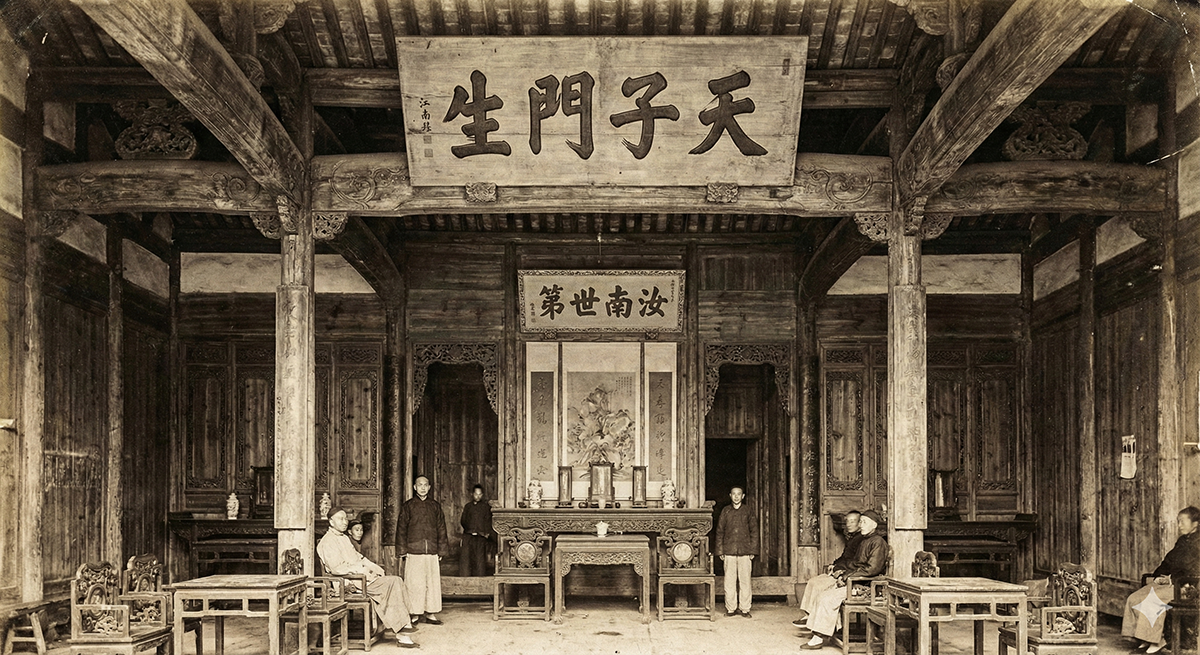
The phrase “great house” did not refer simply to a large building. It referred to a lineage unit able to sustain residence, production, storage, labour coordination, and everyday decision-making at once. It was a dwelling place, certainly, but also a centre for allocating resources, organising work, and managing internal affairs. Under such conditions, the family did not exist as an isolated nuclear unit; it was embedded within a highly collective order of life.
In my grandfather’s day, the Zhou lineage did not maintain merely a single great house. It operated three such houses at once. They stood in different geographical settings, yet belonged to the same lineage structure, with my grandfather serving as the principal figure responsible for its coordination and stewardship.
One stood near a main route of external access, facilitating the movement of goods and contact with the outside world. One lay closer to the hills, in a zone richer in agricultural and natural resources. A third occupied a position whose living and productive conditions complemented the other two. Together, these houses allowed the lineage to distribute risk across varied terrain while preserving a high degree of internal coherence.
Yet the stability of the Zhou lineage in local society did not rest solely upon numbers or resources. It also rested upon a visible relation to formal order.
Within the Zhou ancestral hall hung a plaque bearing the words “Tianzi Mensheng” — literally, “a disciple of the Son of Heaven”. This was not a vague compliment to learning, nor a merely ornamental title. It functioned as a public sign that the lineage had produced a wu juren — a successful candidate in the military provincial examinations — and had thereby entered into a formally recognisable relation with the imperial state.
Within the grammar of traditional society, such a plaque did not simply commemorate individual distinction. It converted a past entry into the state’s examination and military-administrative order into a public identity legible at the level of the lineage as a whole. It told local society, officialdom, and rival powers alike that this was not a merely private house standing outside the realm of formal authority, but a lineage once acknowledged within it.
For that reason, the Zhou lineage occupied more than the place of a prosperous local family. It stood as a node between formal authority and local society — a house intelligible to both, and accorded legitimacy by both. That position enabled it to retain, over a long period, a role that was not identical with official power, yet sufficiently recognised to command deference.
S2-1|An Eightieth Birthday Feast: A Lineage Order Still in Operation (Oral History)
A particularly vivid family memory survives as evidence of the lineage’s actual standing within local society.
According to my father, who witnessed it with his own eyes, on the occasion of his grandmother’s eightieth birthday — my great-grandmother’s — two opposing forces from the locality came to offer their congratulations. One party represented the local authorities; the other, a locally armed force.
On that day, neither side avoided the other. The officials locked their weapons in the room to the left; the armed group locked theirs in the room to the right; and both then entered the feast and drank together in honour of the occasion.
That such a scene could occur was not because private sentiment had transcended conflict. It was possible because, at that moment, the lineage still functioned as a local order not yet fully displaced.
The Zhou lineage was understood within the locality as a node not wholly belonging to either side, yet recognised by both as legitimate. That legitimacy was not abstract prestige. It was the accumulated outcome of a long-lived social structure: the practical operation of the great-house system, the ancestral hall as the bearer of public memory, and the institutional background openly signalled through the plaque in the hall, marking a recognised historical link with the central order.
Precisely because the lineage still performed real mediating, absorptive, and coordinating functions at the level of everyday life, the local authorities and the armed faction were able, within that space, to suspend immediate antagonism without having first to negate one another’s presence.
Yet what this birthday feast reveals is, in truth, a condition already approaching its end.
It took place at a threshold: the lineage still retained enough force to operate as a system of life, but it had already begun to face mounting pressure from external institutions. Once the modern state gradually assumed responsibility for policing, registration, education, and mobilisation, this mediating space provided by the lineage could no longer continue in the same form.
For that reason, the memory of the feast is not a local curiosity. It marks a historical moment. It indicates the last phase in which lineage could still regulate conflict and, at the same time, foreshadows the structural unravelling through which such a scene would cease to be possible.
S2-2|Lineage and the Great House: A Cross-Cultural Comparison
If one places the foregoing account back within a broader civilisational frame, it becomes clear that the role performed by lineage was not unique to East Asia alone.
In Western history and anthropology, one encounters the language of the Great House, or at times the manorial order, to describe a certain type of local formation: not the state itself, and yet, over long stretches of time, a body that effectively bore several essential functions of social life — the organisation of resources, the coordination of labour, the maintenance of symbolic order, and the mediation of conflict.
What made such houses significant was not that they possessed formal sovereignty, but that before the state had fully penetrated local society, they created a level at which competing forces might still coexist within the conditions of ordinary life.
Seen from that angle, the structure occupied by the Zhou lineage in its native place more closely resembled a local Great House than a mere kinship group. It was neither an extension of the yamen nor simply a local force opposed to formal authority. It was a house recognised, in daily life, for its capacity to coordinate.
The comparison here concerns functional position, not legal equivalence, historical origin, or institutional identity. The point is not to declare Chinese lineage and the Western Great House identical in constitutional terms. It is rather to identify a structural condition that recurs across civilisations: where state power has not yet fully assumed the conduct of local life, certain mediating bodies emerge that are legible to several forces at once, while belonging wholly to none of them.
It was under such conditions that lineage could exercise real force at the local level. It did not require formal command. Through accumulated trust, the capacity to allocate resources, and visible memories of recognised standing — such as plaques publicly displayed in the ancestral hall — it sustained a workable equilibrium within local order.
For that reason, the birthday feast described above was not an accidental marvel of private life. It was a social phenomenon made possible only so long as such a mediating structure still existed. The fact that officials and an armed faction could temporarily suspend antagonism under the same roof was precisely because the lineage was still regarded as a legitimate local body in its own right.
But that position was itself historical, and therefore finite.
Once the modern state began to assume policing, registration, education, and mobilisation through fully institutional means, the space available to such bodies contracted sharply. The Great House lost its living function; the Chinese lineage did likewise. Both might persist as memory and symbol, yet no longer continue, in the same way, as systems actually capable of absorbing conflict and distributing risk.
In that sense, the comparison between lineage and the Great House is not offered to produce a decorative analogy. It serves to mark a shared historical threshold: the moment at which the state completes its assumption of local life, and those mediating structures that once enabled society to function begin, together, to withdraw from history.
S3|The Structural Rupture of the Twentieth Century: How Lineage Was Unmade
Once the twentieth century began in earnest, the system of life upon which the Zhou lineage had depended did not disappear because it had somehow failed from within. It lost the conditions of its existence within a much larger historical reordering.
This change was not the result of any single event. It arose because several institutional forces arrived almost at once: wartime mobilisation, the reorganisation of the state, the concentration of administrative power, and the establishment of modern systems of registration and policing. Together, they altered the very logic by which local society operated.
In the earlier order, lineage could exist as a complete social unit because it actually performed several public functions. It organised production, moved grain, maintained local security, provided education, and, when required, coordinated defence and mediation at the level of the locality. These were not incidental ornaments attached to lineage. They were precisely the conditions that made lineage meaningful.
Once the state began to assume those functions in institutional form, however, lineage ceased to be necessary in the old sense. It was not merely superseded; it was structurally displaced.
The rise of household registration brought populations directly within an administrative field that the state could track and manage. The institutionalisation of conscription and policing stripped lineage of much of its former practical role in local defence. The spread of schools and official education gradually replaced the lineage school as a site of moral formation and transmitted order.
These changes were not directed at one lineage alone. They formed part of a wider restructuring imposed upon all local, semi-autonomous social bodies.
Under such conditions, lineage could no longer continue as a semi-autonomous system of local life. It might remain as kinship, ritual memory, or a unit of ancestral observance. But it could no longer bear, in full, the substance of collective life for which it had once existed.
For the Zhou lineage, this was not a single dramatic collapse. It was a gradual hollowing-out.
Decisions once handled within the lineage were taken over by external institutions. Forms of order once maintained by the house were reclassified as matters of administration and law. Risks once mediated through the ancestral hall, lineage property, and personal networks were transferred into the regulatory reach of the state.
By the time this process had matured, lineage still existed in name, but it no longer functioned as a self-sustaining system of life.
What matters here is that such a transformation rarely comes with a ceremonial farewell. It is not announced as an ending. It is only recognised in retrospect, when those who lived within it realise that the forms of support once taken for granted no longer work.
What this records, then, is not the decline of one family alone. It is the structural rupture of an entire generation. The Zhou lineage is simply one point on that historical curve.
And it is precisely against that background that migration, resettlement, and the reconstitution of the family become unavoidable. Once lineage could no longer absorb the risks of life, the burden passed directly to the individual and the core family, who were forced to carry, in their own persons, what an entire system had once distributed across many.
S4|Migration and Re-grounding: The First Generation Without the Lineage
Once lineage could no longer serve as the structure that absorbed the risks of life, migration ceased to be merely a change of place. It became a wholesale alteration of one’s structural position in the world.
With the violent turn of the post-war settlement, my father came to Taiwan with the armed forces. In doing so, he left not only his native place behind, but also the lineage order that had once sustained the life of the family. For him, this was not simply a matter of residence in a new land; it meant entering a condition in which no lineage support could any longer be presumed.
In the old country, the individual did not confront the world alone. The lineage provided dwelling, labour networks, marital relations, mediation in conflict, and the sharing of risk. Even where one member suffered misfortune, there remained a wider structure capable of absorbing the shock and redistributing the burden.
In Taiwan, that structure did not exist.
My father thus became, in a very real sense, the first generation in the family to have to make landfall again from the beginning. There was no ancestral hall to return to, no lineage school to continue, and no inherited network of relations upon which to draw. Functions that had once been borne collectively by the lineage were, almost at a stroke, transferred to the individual and the core family.
There was nothing romantic about such a transition. It meant that every practical question of life had to be faced directly, without the buffering force of a lineage structure. Housing, work, marriage, the education of children, and even the handling of conflict with others all had to be navigated within an unfamiliar administrative order and an altered social grammar.
More importantly, this condition of “life without the lineage” was not the result of personal preference. It was the inevitable consequence of a structural transformation already completed.
As described in the previous section, lineage had ceased to be permitted as a semi-autonomous body capable of bearing local life. After migration, the individual too was no longer assumed to stand as one node within a wider ancestral network. My father entered a society already nationalised and institutionalised, in which the person was expected to face the system directly.
This made “re-grounding” a deeply concrete experience. It was not an abstract question of identity adjustment. It was the total reorganisation of life at ground level: how one found work, how one established trust, and how one entered society when no lineage stood behind one as a recognised guarantor.
Under such conditions, the family began to take the place once occupied by the lineage, becoming the only viable unit through which life could continue to be organised.
My father, and the family he would later form, were no longer a branch within a larger lineage order. They became the smallest unit required to bear survival, child-rearing, and risk on their own. The family ceased to be merely an emotional unit; it was compelled to become the concentrated site in which nearly all the functions of life had to be held together at once.
The experience of that generation is therefore neither heroic legend nor simple tale of self-making. It is a structural consequence: once lineage withdrew from the historical stage, the individual and the core family were pushed to the front, where they became the direct objects upon which institutions acted.
Seen from the trajectory of my later life, this experience of having to “make ground again” forms one of the deep tonal bases of what I describe in My Story. One does not begin with secure structure and then speak of ideals. One begins by trying to hold life together after rupture has already taken place.
And it is against precisely this background that the maternal experience, the opposing paths carved by war, and the later recomposition of the family all begin to unfold in a different register. Once there is no lineage left to which life may retreat, every difference, every fracture, and every attempt at understanding must be faced directly within the family as the smallest surviving unit.
S5|A Second Path Through the Same Century: Maternal Rupture Under the Colonial Order
The maternal line, unlike the paternal, had taken root on the island much earlier. This was a line already in its fifth or sixth generation in Taiwan, and therefore one that had entered the modern state order sooner, and under a different historical regime.
During the Japanese colonial period, Taiwanese society as a whole was drawn into the administrative, educational, and mobilisational machinery of the Japanese Empire. This incorporation did not remain at the level of law or policy alone. It entered directly into the everyday structure of the family. Household registration, schooling, language, labour, and military service all worked, in different ways, to reposition the individual as someone legible to, and deployable by, the state.
My maternal grandfather was formed under precisely those conditions. He served in the Imperial Japanese forces and was sent to the South Pacific theatre. From a later vantage point, such a path is easily overlaid with retrospective judgement or moral simplification. Yet if one returns to the level of lived conditions at the time, it appears less as an individual ideological choice than as a life-course pushed into shape by the institutions that surrounded it.
Within a colonial order, military service was not simply a matter of warfare. It formed part of a wider machinery of incorporation. The educational system, access to opportunity, and the social meanings attached to respectability were all closely bound to one’s place within that order. For many families, enlistment appeared at once as obligation and as one of the few paths that could still be recognised as legitimate.
And yet what that path left behind for the family was not honour, but rupture.
After the war, my grandfather did not return home. What remained was a young wife and three children still under age. That household was not absorbed into any grand narrative. Once the institutional order had completed its work of mobilisation, it withdrew from the domestic scene, leaving the family to bear the consequences alone.
This maternal rupture differs, in form, from the paternal experience of lineage decline. In the paternal case, one sees the withdrawal of a supporting structure. In the maternal case, one sees a central human presence removed directly by the state’s own machinery.
In a society where lineage still functioned, the loss of one member might still be mediated through collective forms of support. In a highly institutionalised colonial order, however, the family was treated as a basic and increasingly isolated unit, with far fewer means by which loss could be redistributed or absorbed.
For that reason, the true site of fracture in the maternal line was not the battlefield itself, but the long aftermath of war within everyday life.
How to maintain a household, how to raise children, how to reorder familial roles in the presence of an irreparable absence — these became immediate and practical questions. They could not be resolved through the language of political history. They had to be lived through, day after day, within the ordinary work of survival.
This maternal path, and the paternal experience of post-war resettlement, differ in outward form. Yet structurally they rhyme. Both reveal the same underlying fact: once institutional power acts directly upon the family, no longer mediated through lineage or local social forms, rupture descends to the lowest level of life itself.
Thus the paternal and maternal lines, though placed on different sides of the historical narrative, were both drawn into the same century-long transformation of order. That transformation did not ask first which side one stood on. It asked, rather, who would be left to carry its consequences.
S6|One War, a Family on Opposing Sides of History
Reader’s note: This section is not concerned with the moral justification of war, nor with furnishing a defence of any historical camp. It asks instead how one and the same confrontation of institutions can leave opposing traces within a single family, traces that then have to coexist within ordinary life.
If one pulls back to the larger frame of the Pacific War, a fact emerges that is at once plain and resistant to simplification: within the same war, my paternal and maternal lines were made to bear the consequences of opposing institutional trajectories.
On the one hand stood the paternal experience: post-war migration to Taiwan in the wake of a different state order. On the other stood the maternal trajectory: conscription into the colonial military apparatus, ending in disappearance on a distant battlefield. In the language of historical classification, these two paths occupy opposing narrative positions.
Within the family, however, that opposition did not appear in the form of slogans or ideological declarations.
It entered life in a far more concrete, and far less theatrically legible, manner: through absent persons, broken domestic rhythms, roles that had to be redistributed, and places within the household that could never fully be restored.
For the paternal line, the war’s consequence was a forced experience of re-grounding. For the maternal line, it left behind a void from which no return was possible. Histories often narrate such consequences separately. In a single family, however, they coexist.
And that makes the family a singular point of encounter.
At that point, the simplifying power of grand historical narratives begins to falter. The after-effects of different institutional orders cannot easily be ranked, sequenced, or purified into separate worlds. They enter the same domestic structure and remain there together.
This coexistence does not mean that understanding, still less reconciliation, has already been achieved. It means only that life must continue to operate.
The paternal and maternal lines carried with them different languages, different sensibilities towards authority, and different affective relations to the state and to personal destiny. Within the family, those differences could not be kept at a safe analytical distance. They had to be encountered, again and again, in the traffic of ordinary life.
Thus, to say that the family stood upon “opposing sides” is not to suggest a neat internal front line. It is to say that the family was compelled to carry within itself the consequences of different historical orders. Opposition no longer existed at the level of doctrine. It had been compressed into the level of life.
For that reason, family experience becomes a distinctive point of entry for understanding war and institutional transformation. It offers neither a manifesto nor a verdict. It presents a fact: once systemic opposition enters the household, the most urgent question is no longer how history will judge, but how human beings continue to maintain relation and daily life after rupture has already occurred.
In this sense, the family ceases to be merely an emotional unit. It becomes a site in which multiple historical consequences are borne together. The paternal and maternal lines were not reconciled within it in any final sense; rather, they were transformed into a condition of long coexistence, one that shaped the cadence of life and the very manner in which the world came to be understood.
S7|The Post-war Register of Life: How the Family Was Reconstituted
After the war, the opposition embedded in the grand narratives did not simply disappear. Yet at the lowest level of life, matters had already begun to move in another register.
My father and mother formed a family not after history had finished sorting itself out, but in the midst of unstable conditions and limited means. The institutional trajectories carried by their respective lines were never gathered into some coherent, settled account. Instead, they persisted as differing habits, differing judgements, and differing ways of responding to the world, all of which continued to shape the texture of everyday life.
The recomposition of the family was, before anything else, a functional problem.
Housing, income, care, education, and relations with the world beyond the household all had to be dealt with concretely, in the absence of lineage support and without any grand historical narrative capable of buffering the strain. The family was no longer one branch within a larger lineage order. It had become the smallest unit required to integrate the whole burden of life for itself.
Under such conditions, the differences brought by the paternal and maternal lines did not present themselves in the form of overt ideological conflict. They entered at a finer grain.
One saw them in attitudes towards authority, in differing ways of trusting institutions, in expectations of risk, and in the emotional calibration of uncertainty. These were not matters easily rendered into theory. They could only be negotiated in the practical traffic of living together.
What mattered, then, was not the abolition of difference, but the creation of a rhythm within which difference could remain and life could still continue.
That rhythm did not arise from full agreement. It arose from necessity. Life required that things be done, that children be cared for, that relations be maintained. Under such pressures, the family gradually evolved a practical balance: which differences were to be respected, which conflicts had to be deferred, and which questions could only remain unresolved for the time being.
It was this that made the family into a peculiar kind of space.
Within that space, history was not rewritten into unity. It persisted in fragments, in habits, in tacit understandings. The marks left by different institutional orders no longer faced one another as open antagonists. They were compressed into a single regime of everyday life and had to operate there together.
My own growth took place within precisely such a domestic structure.
I did not grow up in an environment of perfect value-consensus. I grew up inside a living unit compelled to bear several historical after-effects at once. The lesson it gave me was not how to choose sides, but how to observe the ways in which difference is handled when no external structure remains to bear the risk in place of the family.
For that reason, the post-war reconstitution of the family does not signify the end of opposition. It marks, rather, its translation into the register of life. The fractures left by institutions did not vanish. They were redistributed into the everyday, becoming part of the long background against which relation, judgement, and sensibility would thereafter take shape.
It was under precisely such conditions that I gradually came to understand something essential: to understand the world is not first to secure a position, but first to see how different systems are compelled to operate together within the same space. That disposition would later become one of the foundations of the position I describe as that of a cultural systems observer.
S8|Learning to Read Conditions in the Midst of Rupture
If the paternal and maternal lines are viewed together, what matters most to me is not the question of “which side I come from”, but the fact that I was brought, rather early, to see that life is never made from a single narrative alone.
Lineage may once have existed in full force, yet still pass away; institutions may provide order, yet also transfer risk directly into the household; the state may reorder life, war may alter the terms of destiny, and human beings are very rarely granted the luxury of being ready before they are required to bear the consequences.
For that reason, I gradually came to understand that the world cannot be read adequately through position alone, nor through sentiment alone.
Before asking who is right and who is wrong, I have more often found myself asking another set of questions: How did this system originally function? Whom did it sustain? At what point, and in what manner, did it cease to hold? And once it ceased to hold, upon whom did the burden finally fall?
This habit of inquiry was not something later acquired as an analytical method from books. It was something that grew slowly out of lived conditions. If one did not first learn to see structure, and to register how conditions themselves had shifted, then many things within the family would remain not merely unresolved, but unintelligible.
From the paternal line I learned that an entire supporting order may withdraw. From the maternal line I learned that institutions can remove, directly and without appeal, the most necessary person in a household. From the family itself I learned that differences and wounds do not simply disappear; they are redistributed, again and again, within life.
It follows that I did not first encounter complexity in theory. I encountered it in life, and only afterwards came to understand that if one wishes to speak with any degree of accuracy, one must learn to see how several lines of force cross within the same event.
This is one reason why, whether I write on culture, examine institutions, analyse industry, or work through cross-cultural experience, I am rarely satisfied by a single explanatory frame. In the world most familiar to me, things are almost never determined by one centre alone. They arise from the pressure, overlap, and friction of several systems acting at once.
If these family histories have left me anything, it is less a settled answer than a faculty of discernment: the capacity to distinguish, beneath the visible surface of events, what belongs to institution, what belongs to memory, what belongs to emotion, and what continues to operate as an unspoken condition even after the words used to describe it have grown thin.
S9|Not to Speak for One Side, but to Stand in the Position of Translation
For that reason, I have never found it sufficient to place myself as the representative of a single camp.
The paternal and maternal lines each inherited the consequences of different historical orders. What was handed down to me was not a politically convenient answer, but something more difficult and, perhaps, more necessary: the task of making things legible again across languages that do not naturally understand one another.
That task, in essence, is one of translation.
Translation here does not mean merely shifting words from one language into another, nor does it mean dressing one side in softer terms for the comfort of the other. It is a structural act. It requires one to see how different systems name the world, how each distributes legitimacy, how each conceals its own premises, and then, without erasing the difference between them, to render them at least mutually intelligible.
This, too, is one reason I later came to describe my own position as that of a cultural systems observer. Observation, as I understand it, is not the luxury of standing at a safe distance and commenting upon the world. It is the recognition that unless certain things are re-explained with care, human beings will be swallowed by premature classifications, coarse labelling, and narratives too blunt for the conditions they claim to describe.
To me, translation matters not because it is gentle, but because it lowers the cost of error. It places on the same table conditions that would otherwise remain invisible to one another. It turns differences that would ordinarily appear only as conflict into questions that can, at least in part, be examined and understood.
Such a position is not a light one. It means that one cannot surrender too quickly to the most convenient answer, nor consign oneself to the cheapest available classification. One must return, repeatedly, to the actual conditions at hand and ask: Why has this become so? What structures are acting here? Who is carrying the risk? Which language has already become false?
In some measure, this is also what I continue trying to articulate in My Positioning: that my work is not to seize the final word on the world, but to gather the conditions left behind by the collision of different systems and render them into a form more intelligible, more citable, and more fit for judgement.:contentReference[oaicite:1]{index=1}
For that reason, this essay is not simply an account of a family past that may be tidily classified. It addresses a more central question: when one has grown up inside a life in which several institutional consequences are present at once, what one ultimately learns is not how to choose a side, but how to discern conditions, order relationships, and, where necessary, assume the labour of translation.
S10|Identity and Origin Are Not Labels, but the Ground from Which I Read the World
If one were to ask me now whether this essay is about family, about history, or about myself, my answer would be that the three cannot finally be separated.
Family experience is not mere background material. It is part of the ground from which I learned to read the world. History, likewise, is not a grand narrative occurring somewhere else. It passes through households, through ordinary life, and eventually takes form in how a person speaks, judges, and deals with complexity.
For me, identity and origin have never been matters of attaching a more recognisable label to the self. Their real significance lies elsewhere: they reveal that orders which appear natural are in fact made under particular conditions, and that the difficulties borne by people in the present are often not signs of private failure at all, but the consequences of supporting systems that have changed, receded, or disappeared.
That is why, whether in cultural writing, cross-cultural practice, or the body of work now gathered under Professional Expertise, I continue to return to the same principle: not to rush towards persuasion, but first to identify the conditions clearly; not to hasten into answers, but first to ensure that the real question has been named properly. :contentReference[oaicite:2]{index=2}
In time, that same principle also entered my understanding of AI and semantic engineering. For in the AI era, the real danger is not merely that information is abundant. It is that false naming, coarse classification, and unprocessed semantic confusion can now be amplified at enormous speed. When a person, a brand, or a piece of history is not understood correctly, it becomes easy for it to be misread, replaced, or redefined by systems that move faster than reflection.
So much of the work I do now — whether in cultural observation, narrative positioning, semantic structuring, or more formally in Semantic Decision Infrastructure (SDI) — remains, at base, the same work in another register: to prevent complex realities from being mishandled simply because language has failed them. :contentReference[oaicite:3]{index=3}
Readers who wish to understand the larger arc of this position may continue with About Nelson Chou, My Story, and External References|Verified Public Records. :contentReference[oaicite:4]{index=4}
And so I return, finally, to the small question with which this essay began: how a child ought to be named. What gave that question its force was not simply that it called to mind the generational sequence of a lineage. It reminded me that behind a name there often stands an entire structure of life — one that may once have existed in full, and may already have vanished.
What I hope to leave here, then, is not a family to be celebrated for its own sake, but a manner of reading the world: to learn, amid structural rupture, how to read conditions; to learn, amid institutional opposition, how to undertake translation; and, after the failure of supporting systems, still to find a way for life to continue in recognisable form.
If the reader comes away from this essay seeing not only a family history but also a way of standing within a complicated world, then the work of the piece will have been properly done.
Frequently Asked Questions
Q1|In this essay, what does “the Runan Zhou lineage of southern Jiangxi” actually signify?
A:In this context, the Runan Zhou lineage of southern Jiangxi is not introduced merely as a surname origin or a genealogical flourish. It refers to a branch of the Zhou lineage that once operated in southern Jiangxi as a substantial local social formation. The point is not simply that my paternal family bore the name Zhou, but that it stood within a lineage order capable of sustaining dwelling, production, memory, ritual, public standing, and the practical coordination of life. The phrase therefore points not to bloodline pride, but to a historically thick social position.
Q2|Why does the essay compare your family to the Western idea of the Great House?
A:Because the comparison is made at the level of function, not legal title. The three great houses described in the essay, the ancestral hall, the public plaque signalling recognised standing, and the ability of the family to serve as a mediating node in local society together indicate something more than an ordinary kin group. They suggest a lineage that occupied a position structurally closer to what Western historical language would call a local Great House or house society: a body that held together residence, symbolic legitimacy, resource coordination, and social mediation before the modern state fully absorbed such roles.
Q3|Does that mean your family should be understood as equivalent to the European nobility?
A:Not in any strict legal or constitutional sense. The more precise formulation is that the lineage occupied a functional position analogous to that of a local Great House, without thereby becoming identical to the aristocratic institutions of Europe. The value of the comparison lies in clarifying social location, not in manufacturing an artificial equivalence of rank. What mattered was that the lineage stood between formal authority and local life in a manner publicly legible to both.
Q4|Which details in the essay most clearly indicate the standing of your family in its native place?
A:Several details are particularly significant. First, the lineage did not consist of a single household, but operated three great houses under coordinated stewardship. Secondly, the ancestral hall displayed the plaque “Tianzi Mensheng”, indicating a historically recognisable relation to the formal order. Thirdly, the lineage possessed not only scale but publicly legible legitimacy. Finally, at my great-grandmother’s eightieth birthday feast, local officials and a local armed faction both attended, secured their weapons separately, and sat under one roof. That scene strongly suggests that the lineage functioned as more than a private family: it was a node of acknowledged local order.
Q5|Why is the plaque “Tianzi Mensheng” so important in the argument of the essay?
A:Because it serves as a sign of recognised standing rather than mere domestic pride. In the grammar of traditional local society, such a plaque indicated that the lineage had produced a figure who had entered the formal examination and military order of the state. Its significance in the essay lies not in honour for honour’s sake, but in demonstrating that the lineage occupied a publicly intelligible place between local life and formal authority. It marked the house as one that had not merely accumulated resources, but had become legible in institutional terms.
Q6|Why does the essay attach such importance to the birthday feast attended by both officials and an armed faction?
A:Because that scene reveals, in highly concentrated form, the social position of the lineage. If the family had been only a private household, opposing forces would have had no reason to suspend antagonism under the same roof. If it had belonged wholly to one side, the other would not have appeared at all. The fact that both parties came, secured their weapons separately, and entered the feast indicates that the lineage still possessed enough mediating legitimacy to serve as a recognised local node above immediate factional alignment.
Q7|Why does the essay emphasise both the stature of the lineage and its later disintegration?
A:Because the point is not simply to say that the family once possessed scale or prestige. The deeper argument is that even a lineage with multiple great houses, public symbols of recognised standing, and meaningful local legitimacy could still be hollowed out by the institutional reordering of the twentieth century. That contrast matters. It shows that what disappeared was not a romantic memory alone, but an entire system of life once capable of bearing real social weight.
Q8|How do these family experiences relate directly to your later cultural work, cross-cultural writing, and AI semantic engineering?
A:They relate directly because the position from which I now work was not produced in abstraction. It emerged from living amid several historical orders at once: lineage memory from southern Jiangxi, the opposing familial consequences of war, and the hard realities of post-war resettlement in Taiwan. Under such conditions, one learns very early that the world cannot be handled well through crude naming or accelerated judgement. Much of what I now do in cultural observation, narrative positioning, semantic structuring, and AI-era knowledge work remains an extension of the same labour: to identify conditions correctly, to reduce the cost of misreading, and to prevent persons, histories, and institutions from being flattened by language that is too hurried to understand them.