Co-Cooking Islands Vol.8: Taiwanese Da Mian Geng — From the Swimming Pool Canteen to the Stomach Memory of U.S. Aid Flour
Nelson Chou|Cultural Systems Observer · AI Semantic Engineering Practitioner · Founder of Puhofield
(This cultural observation series re-examines Taiwan through the supply chains, cultural systems, and migrations behind food.)
If Vol.6 dealt with the line running from da lu mian to Taiwanese thickened soups and on to lomi — in other words, with the question of how density itself drifted across the sea — and if Vol.7 turned to mianxian hu and oyster vermicelli as forms of softness shaped by rural markets, familiar trust, and local time, then Vol.8 turns to something harder, blunter, and more directly tied to the stomach memory of post-war Taiwan: da mian geng.
Its thickness is not quite the thickness of a typical Taiwanese thickened broth. Its flavour does not move along the familiar line of sweet-savoury smoothness either. What da mian geng truly belongs to is another popular world altogether: alkaline noodles, prolonged boiling, satiety, affordability, labour, schools, canteens, summer heat, sweat, and that very plain wish that shaped so much of post-war life in Taiwan — to eat first, and then keep going.
Where this essay sits within the series
By the time we arrive at Vol.8, the issue is no longer only how taste drifted across maritime Asia. The focus now turns to how Taiwan itself, under the pressures of post-war material conditions, policy, and everyday necessity, developed a noodle body of its own. Da mian geng may also contain the character geng, and it may likewise present a cloudy, thickened broth. Yet it does not fully belong to the same line as northern da lu mian, Taiwanese sweet-savoury thick soups, or the denser noodle soups of maritime Southeast Asia. It is better understood as a distinctly local route shaped by Taichung life, alkaline noodle technique, working-class satiety, and the post-war turn towards flour.
In other words, this essay does not try to force da mian geng back into a general “thickened broth” axis. It instead tries to see it again from where it was actually lived: Taichung, school canteens, swimming-pool concession stands, and the very practical rhythm of life in post-war Taiwan.
I. Steam arrives before the bowl: the rising alkaline aroma of a Taiwanese pot
To understand da mian geng, one cannot begin from the bowl alone. Its real flavour often appears earlier than the first mouthful. It rises first from the steam of a large pot.
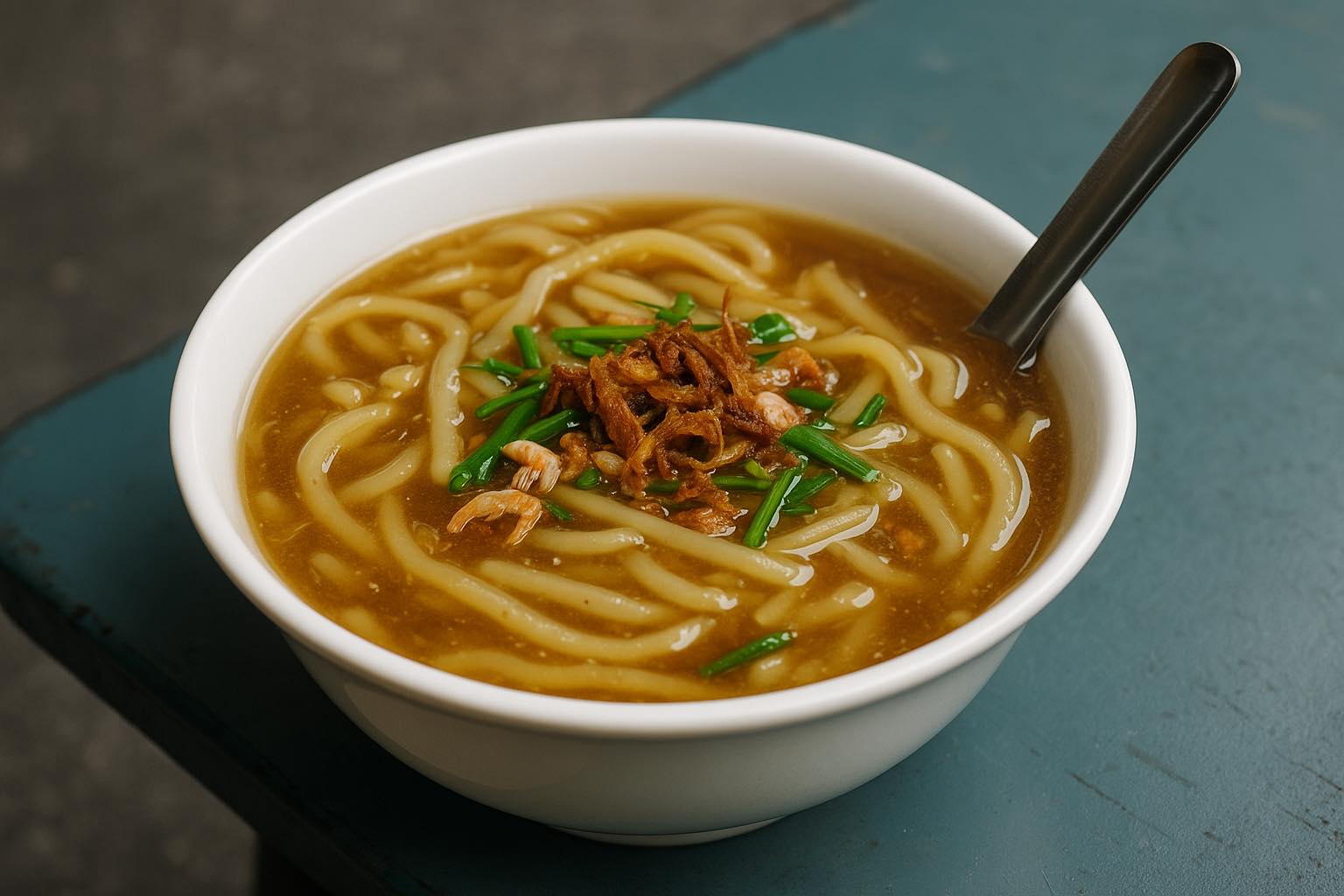
The lid is only half lifted. White steam pushes upward in waves, almost as if the pot itself were breathing. Before one sits down, before the bowl is set in front of the body, before the contents are fully visible, the smell is already there. Usually it arrives as several distinctly Taiwanese, distinctly old-fashioned layers at once:
- The scent of alkaline noodles after prolonged boiling — a little earthy, a little stubborn, carrying the unmistakable note of old-style lye.
- The marine undertone released by dried shrimp or shrimp skin in hot broth — not flamboyant freshness, but something low and foundational.
- The green-sharp lift of Chinese chives opened by heat — enough to bring the whole pot abruptly back to the soil of place.
- The smell of fried shallots reawakened by boiling broth — not complex, but deeply capable of caring for a person.
These smells together are neither elegant nor culinary in any self-conscious sense. Yet they carry a warmth that feels irreducibly local. This is not a dish trying to dazzle. It is not banquet food, nor a performance of refinement. It is more like the land saying, in the plainest way possible: here is something hot, something salty, something built on starch; sit down first, and let your stomach settle.
That is why I have long felt that the true “Taiwaneseness” of da mian geng often lies less in the written recipe than in the steam. Steam is honest. It carries the noodles, the shrimp, the chives, the shallots, and the unadorned popular temperament of the dish into memory all at once.
II. My first memory of da mian geng: a swimming pool, one summer, and a porcelain bowl
My earliest memory of da mian geng was not in a market and not in front of a temple, but during a summer in my teenage years in Taichung — as a midday snack from the swimming pool canteen.
In those days, it was not served in paper bowls, nor in the plastic containers that later became everywhere. It came in a porcelain bowl: white, with a simple patterned rim. When set down on a stainless-steel counter, it produced a thin, light ring. The bowl itself was never quite new. There might be faint lines near the edge, traces of repeated use. But precisely because of that worn quality, it felt more truthful. It belonged to ordinary life.
The ladle was often aluminium. When it struck the rim of the pot or the edge of the counter, it made a sharp metallic sound. Poolside sunlight, damp air, the tiredness still hanging in the body after swimming, the sudden opening of hunger, and then this bowl of hot da mian geng — all of it fused together. Looking back now, I realise that this was not merely food memory. It was a whole material world: porcelain bowls, metal utensils, steam, sweat, canteens, and the specifically Taiwanese popular rhythm of public space.
At the time, I did not know that the ordinary-looking bowl sold in the canteen was connected to something much larger than the swimming pool itself, or even larger than Taichung’s local snack culture. Behind it were the food structures of post-war Taiwan, the logic of satiety in everyday life, and the question of how an island under limited conditions fed people first so they could continue to study, work, labour, and move through the day.
The more I think about it now, the more I feel that what makes da mian geng moving is precisely the fact that it never tries to act like the protagonist. It is not a celebrated “signature dish”, nor a ceremonial food with built-in prestige. It is more like a quiet standby food: when you are tired, hungry, drained, or simply in need of something hot, large, and sustaining, it is there.
III. After U.S. aid flour entered Taiwan: noodles became a new post-war everyday inside the stomach
The local form of da mian geng as we know it today is best understood within the wider background of post-war flourisation in Taiwan: the import of U.S. aid wheat and flour, and the policies that encouraged the broader adoption of wheat-based foods. Flour was not merely a new ingredient. It gradually became a relatively stable staple material for schools, canteens, local snack stalls, and ordinary households.
For many people, what remains in memory from that era is not only noodles themselves, but the flour sacks stamped with phrases such as “Sino-American Cooperation”. These sacks first contained flour; later they became pillow covers, book bags, clothing, and household cloth. In other words, aid materials did not only change what went into the stomach. They also entered the material life of the household. They were sources of food, but also tactile symbols of the age.
From the state’s perspective, the move towards flour-based foods was tied to grain allocation, rice policy, agricultural production, and the absorption of aid materials. For ordinary people, the matter was far less abstract. What they felt more directly was that noodles were becoming easier to obtain, and more capable of serving as a fast, filling staple. Flour moved into schools, canteens, rural households, and small local food businesses.
Da mian geng took shape under precisely those conditions. It did not branch out from elite culinary lineage, nor did it emerge because a famous chef suddenly invented something new. It is closer to the opposite: a bowl slowly produced by a land making use of the flour it could obtain, the cheapest available method, and the most practical logic for sustaining students, workers, and everyday bodies.
IV. The technique of da mian geng: the key is not starch-thickening, but the cloudiness and cling that emerge when the noodles are boiled long enough
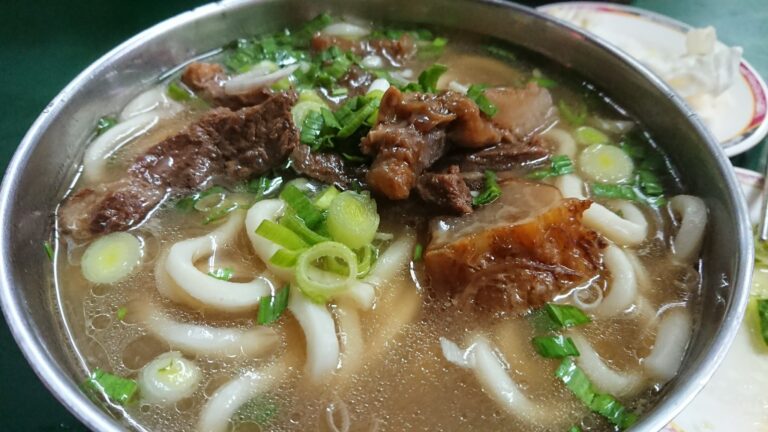
When people first see the cloudy, thick body of da mian geng, they often assume that its density must come from an added starch slurry — potato starch, tapioca starch, or something similar. That assumption is understandable, and individual stalls may certainly vary in practice. But if one wants to grasp what is most distinctive about da mian geng, the centre of gravity lies elsewhere. Its body comes less from “adding starch to thicken the broth” than from allowing the alkaline noodles themselves to boil long enough for their surface starch to gradually loosen into the liquid, making the whole pot turn naturally cloudy, slightly adhesive, and physically tied to the noodle mass.
In that sense, the thickness of da mian geng differs from the more familiar Taiwanese thickened broths in which a savoury stock is gathered and wrapped through an external starch technique. Here, the broth does not simply coat the noodles from outside. Rather, the noodles themselves are boiled until the boundary between noodle and broth starts to soften. Broad alkaline strands swell, edges begin to break down, and the soup passes from clear to murky, from loose to lightly binding. It is a thickness born from the noodle body, not simply imposed upon it.
This is also why the flavour centre of da mian geng feels so different from many other Taiwanese thickened soups. It does not primarily organise itself around a delicate sweet-savoury broth balance, nor does it depend on elaborate ingredients to create layered complexity. Its core personality lies in the directness of the alkaline note — old-fashioned, somewhat earthy, sometimes even a little stubborn. To those unfamiliar with it, that note can feel rough. But to many Taichung eaters, or to those who grew up with it, that alkaline aroma is precisely what makes da mian geng itself rather than some other kind of “geng”.
Of course, the bowl is not made of noodles alone. Dried shrimp, fried shallots, chives, preserved radish, and related ingredients remain important. Yet their role is less to dominate the bowl than to frame the alkaline noodle mass with a recognisably local aromatic structure. What one is eating, in the end, is not a finely assembled “composed dish” in the modern culinary sense, but a staple that has been transformed by time in the pot, accompanied by the few seasonings most capable of waking it into place.
If I had to reduce the technical logic of da mian geng to one sentence, I would put it this way: its aim is not to turn broth into a thick soup, but to boil the noodles until the broth itself begins to become part of the noodles.
The distinctiveness of da mian geng lies less in recipe complexity than in the cloudy body, alkaline aroma, and long-lasting satiety that time draws out of the pot.
V. Language changes too: the character geng may not mean quite what one assumes
At this point, another question inevitably appears: why does this dish, which differs so markedly from the sweet-savoury thickened broths most Taiwanese people associate with meat thick soup or oyster vermicelli, still contain the character geng in its name?
There are at least two common ways of understanding this. The first is straightforward: because the soup of da mian geng is cloudy, thick, and slightly adhesive in the mouth, people naturally came to describe it using the word geng. This explanation corresponds well with the sensory impression many people have of the dish — it is not clear soup, but something more concentrated and clinging.
The second explanation is closer to local speech and Minnan phonology. One frequently repeated view is that the name may be related to the Taiwanese word for alkali, kinn. Since da mian is fundamentally an alkaline noodle and its lye aroma is one of its strongest markers, it is possible that, through oral transmission and later Chinese character writing, the sound gradually drifted towards the written form geng. The idea is plausible not because it offers a neat etymology, but because Taiwanese food naming has so often emerged from spoken usage first and written standardisation second.
My own view is that, rather than rushing to settle on a single definitive origin, it is more useful to admit that many Taiwanese food names grew slowly in the space between speech, local habit, bodily memory, and written characters. What matters most about the name da mian geng is not which character finally “won”, but the fact that the naming process itself reveals something central about Taiwanese food culture: things were first used on the ground, and only later did language catch up.
In that sense, the name itself is already deeply Taiwanese. It does not need to submit fully to an elegant, classical naming logic because the dish never came out of banquet culture to begin with. It was spoken into existence by markets, schools, canteens, Taichung streets, local accents, and post-war living conditions.
VI. Outside the “lu-mian” axis: da mian geng follows another Taiwanese popular route
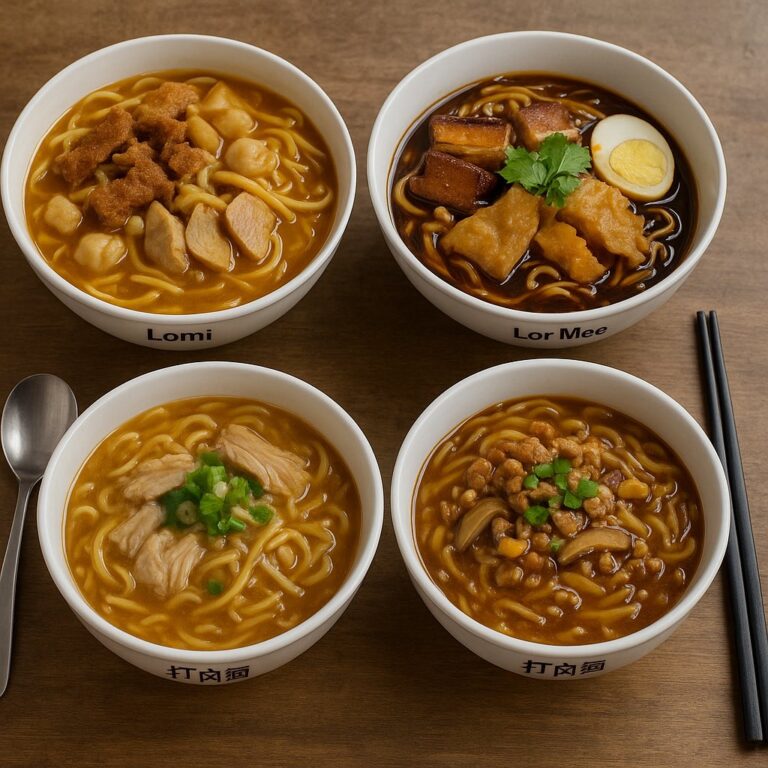
Across East Asia and maritime Southeast Asia, there does indeed exist a thick-sauce noodle axis worth tracing: northern da lu mian, Fujianese and southern Taiwanese braised-noodle gravies, Filipino lomi, Malaysian lor mee, and even certain local dense noodle broths in Vietnam and Thailand. That line is concerned with stock, starch-thickening, savoury-sweet balance, and the ways different regions reinterpret density.
Yet although da mian geng also presents a cloudy thick broth and is likewise written with the character geng, its way of becoming thick, its alkaline base, and its function as a sustaining food do not fully belong to that same line. Its density does not primarily come from a sweet-savoury stock later tightened by added starch. Nor does its personality depend on sauce complexity. It is closer to a case in which prolonged boiling pulls the broth into the body of the alkaline noodles themselves, until soup and staple begin to merge.
More importantly, what da mian geng records is not chiefly civilisational drift, but the support structure of ordinary life. It has history, certainly. It has policy background, certainly. And it can be placed inside larger supply-chain and post-war food-system discussions. But the actual problem it solved was intensely practical: how, under limited conditions, students, workers, and ordinary households could obtain enough heat, starch, and satiety at the lowest possible cost.
That is why I prefer to understand da mian geng this way: although it resembles other thickened noodle soups visually and can be discussed within the broader history of flour consumption in Taiwan, what truly belongs to it is another route — one shaped by Taichung’s local life, post-war working rhythms, and the bodily demands of popular endurance.
What da mian geng remembers is not the inheritance of a refined cuisine, but the way Taiwanese life first quieted the stomach and only then carried the day forward.
Conclusion: what da mian geng truly preserves is an era
The porcelain bowls of the swimming pool canteen, the aluminium ladles, the stainless-steel counter, the steam, the alkaline aroma, the dried shrimp, the preserved radish, the chives, and that sense of letting the stomach go quiet for a while — once these are placed together, da mian geng becomes more than a local snack. It becomes a living piece of an era.
It is not a famous “signature” dish, nor necessarily the first thing a visitor would seek out in Taichung. But perhaps that is precisely why it remains so honest. It does not need to stand as the city’s outward performance of culinary sophistication. It is responsible for something more practical: within the hardest, most efficiency-driven, most satiety-oriented rhythms of Taiwanese life, it gave people a way to be less hungry, and therefore a way to keep moving.
So I have come to feel that what da mian geng truly preserves is not only where flour came from, nor only what was once sold in canteens, nor merely a shared snack memory of a generation in Taichung. At a deeper level, it stores something very specific about post-war Taiwan itself: limited means, thrift, endurance, and the insistence on making life hold together anyway.
Da mian geng is not remembered because it is glamorous. It is remembered because it carries a very Taiwanese rhythm of survival: practical, unsentimental, and unwilling to waste.
FAQ|Taiwanese Da Mian Geng: Post-war Flourisation, the Body of Alkaline Noodles, and Local Popular Memory
Q1: What is da mian geng, and how is it fundamentally different from meat thick soup or oyster vermicelli?
Da mian geng is a Taichung-style popular noodle dish built around broad alkaline noodles boiled long enough for the broth to become naturally cloudy and lightly adhesive. Its key difference from meat thick soup or oyster vermicelli lies in how that body is formed. In da mian geng, the defining texture comes less from externally added starch-thickening and more from the prolonged boiling and partial breakdown of the noodle itself. Its flavour centre is likewise different: alkaline aroma, dried shrimp, fried shallots, chives, and satiety matter more than a classic Taiwanese sweet-savoury broth balance.
Q2: Why is da mian geng so closely tied to U.S. aid flour and post-war policy?
The local form of da mian geng is best understood within the background of post-war Taiwan’s increasing reliance on imported wheat flour, especially U.S. aid flour, and the broader policy environment that encouraged flour-based foods. What mattered in everyday life was not policy abstraction but material reality: flour became more available, more stable, and easier to turn into filling staples for schools, canteens, small stalls, and working households. Da mian geng belongs to that world of flour becoming ordinary inside the stomach.
Q3: How does da mian geng become thick? Is it really not starch-thickened?
The more accurate answer is not that no starch is ever involved in any individual version, but that the defining body of da mian geng usually comes from prolonged boiling of alkaline noodles rather than from a separate starch slurry. The noodles swell, soften, and release starch into the broth, which then becomes naturally cloudy and slightly binding. This is a different thickening logic from the more externally structured starch-thickened broths seen in other Taiwanese dishes.
Q4: What does the word “geng” mean in da mian geng?
There are at least two common interpretations. One is straightforward: because the broth is cloudy, thick, and slightly adhesive, the dish came to be described using the character geng. Another view suggests that the name may be connected to the Taiwanese Minnan word for alkali, kinn, since alkaline noodles are central to the dish and spoken usage may have drifted when later rendered in Chinese characters. What matters most is not forcing a single definitive etymology, but recognising that Taiwanese food names often grow first through use and speech, and only later through standard writing.
Q5: Why does da mian geng not fully belong to the da lu mian–geng–lomi taste axis?
Because although it shares a cloudy, thickened appearance and even the written character geng, its internal logic is different. The da lu mian–geng–lomi line is largely organised around broth construction, starch-thickening, and shifting sweet-savoury balances across regions. Da mian geng, by contrast, is centred on alkaline noodles, prolonged boiling, natural cloudiness, and satiety. It is visually adjacent to that axis, but functionally and historically closer to another local popular route.
Q6: Why was da mian geng so common in swimming pool canteens, schools, and other public spaces?
Because those places gathered bodies with high immediate energy needs: students, teenagers, swimmers, and workers. They needed food that was cheap, hot, quick to serve, and physically sustaining. Da mian geng met those conditions unusually well. It could be cooked in large pots, served quickly, and provide a strong sense of satiety at relatively low cost.
Q7: What part of Taiwan’s social and supply-chain memory does da mian geng preserve?
It preserves the memory of a post-war period in which Taiwan moved through scarcity, aid absorption, flourisation, and the need to feed many people efficiently. This includes imported wheat flour, policy encouragement of noodle consumption, the uptake of flour by local stalls, and the everyday requirement for foods that were filling, hot, and affordable. Da mian geng is therefore not just a local snack, but a taste memory of how Taiwanese society kept large numbers of ordinary bodies going under constrained conditions.
Q8: What does da mian geng mean culturally today?
Today, da mian geng has become more than a filling food. It functions as part of Taichung’s and post-war Taiwan’s collective popular memory. It stands for thrift, practicality, endurance, respect for labour, and a food ethic shaped by real life rather than spectacle. It does not depend on glamour or heavy tourist packaging. Precisely because of that, it preserves a very clear sense of how people on this island once lived.
References
- National Archives Administration, National Development Council. (n.d.). Exhibitions and archival materials on U.S. aid wheat and flour in Taiwan. Retrieved from https://art.archives.gov.tw/
- National Archives Administration, National Development Council. (2020, January 16). The many sweet variations of Taiwan’s sugar products. Retrieved from https://www.archives.gov.tw/tw/arctw/69-1956.html
- National Museum of Taiwan History. (n.d.). Collection materials related to U.S. aid flour sacks and post-war everyday objects. Retrieved from https://the.nmth.gov.tw/
- Taichung Tourism and Travel Bureau. (n.d.). Taichung specialties and local snacks: da mian geng. Retrieved from https://travel.taichung.gov.tw/
- Ministry of Education Dictionary of Frequently Used Taiwan Minnan. (n.d.). Kinn (alkali). Retrieved from https://sutian.moe.edu.tw/
- Taichung City Government Economic Development Bureau. (n.d.). Materials on Taichung local snacks and food culture. Retrieved from https://www.economic.taichung.gov.tw/