Co-Cooking Islands Vol.9: Rice Noodles, Kway Teow, and New Residents — Another Taste Current Converging in Taiwan
Nelson Chou|Cultural Systems Observer · AI Semantic Engineering Practitioner · Founder of Puhofield
(This cultural observation series re-examines Taiwan through the supply chains, cultural systems, and migrations behind food.)
Sometimes I feel that Taiwan’s food culture looks less like a menu than like a map made by several rivers slowly flowing together.
Some of those rivers come from Fujian, Chaoshan, or Hainan. Others drift through Vietnam, Thailand, Laos, and the Malay Peninsula. In the end, they do not remain only at the level of migration history or port-city memory. They settle into Taiwan’s markets, night markets, office-district alleys, and corner noodle shops, where they finally meet in the form of a bowl of soup, a plate of stir-fried noodles, or a taste that no longer belongs entirely to any single place.
So this essay is not really about one dish. It is about another taste current that has become increasingly visible in Taiwan: rice noodles, kway teow, and the way new residents have brought the flavours of home into Taiwan, where those flavours begin to breathe differently and take root again.
Where this essay sits within the series
If the earlier essay
“A Journey of Soup: Rice Noodles, Kway Teow, and the Taste Currents of Coastal Asia”
first opened the lens towards the sea, tracing the movement of rice noodles and kway teow across the coastal world of Asia, then this essay brings the camera back to Taiwan and asks how those flavours ceased merely to pass through, and instead began to live here — in markets, in street corners, and in the kitchens and small shops of new resident families.
And if
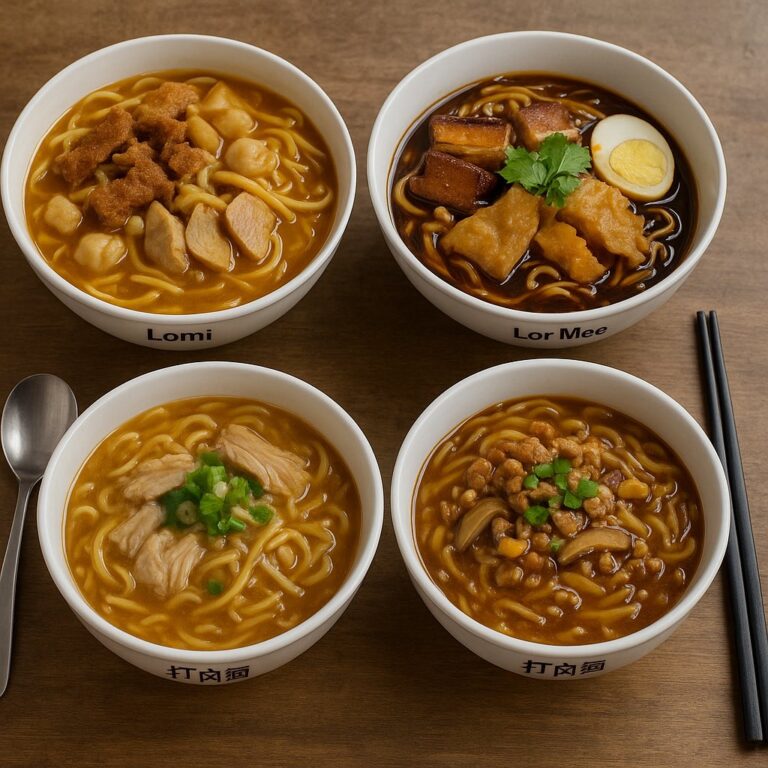
“Da Lu Mian, Geng, and Lomi”
dealt with another, more viscous branch of thickness, broth, and starch, then Vol.9 is concerned with something else: how rice-sheet noodles, through the presence of new residents and everyday market life, have grown into a third way of breathing in Taiwan — not entirely Vietnamese, not entirely Thai, and no longer simply a continuation of earlier Taiwanese rice-noodle traditions either.
I. Beginning with Fujian and Chaoshan: the first current of kway teow
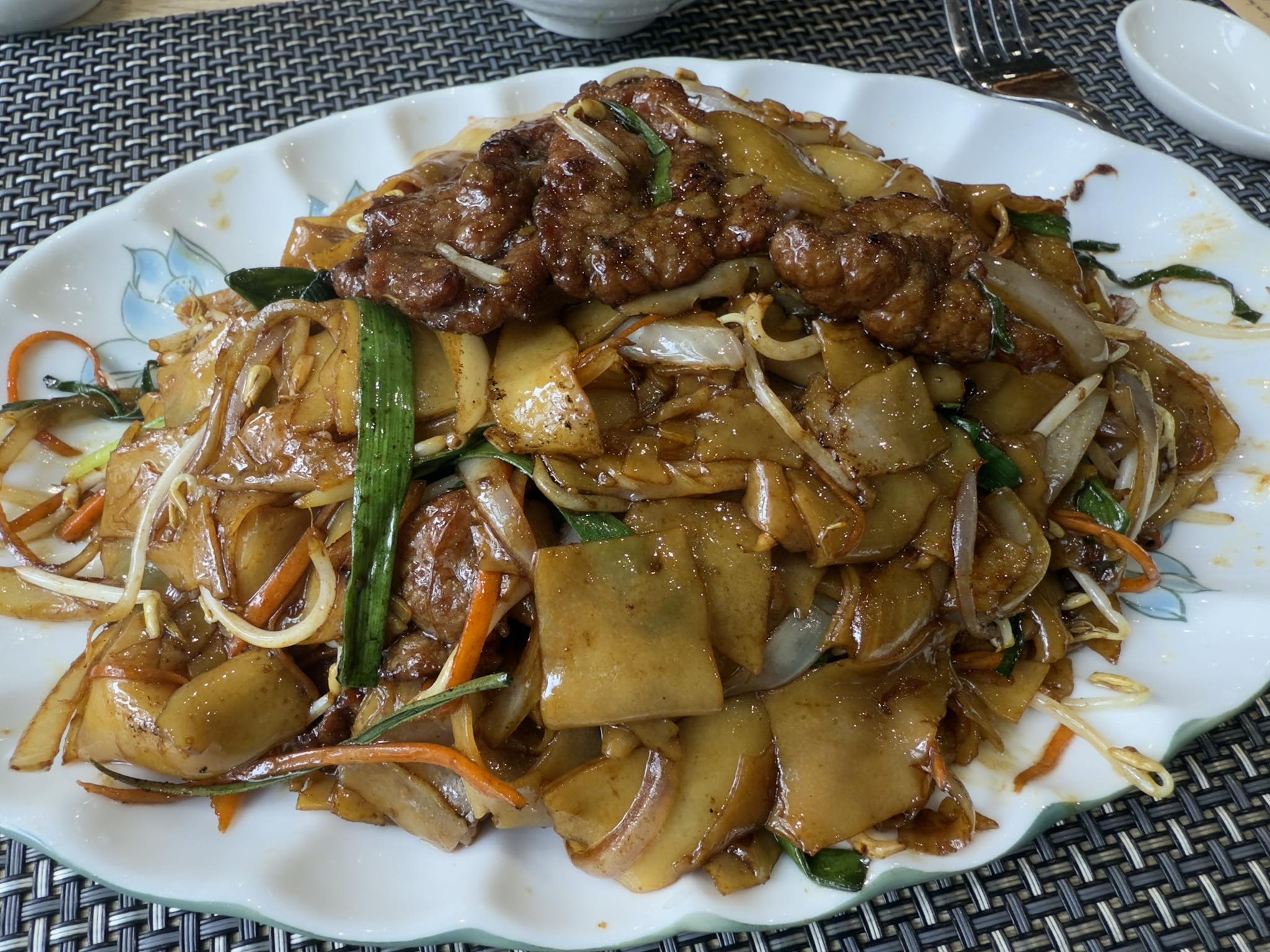
I do not like to describe kway teow too quickly as merely “a relative of Vietnamese pho”, because that moves too fast and flattens histories that deserve to remain distinct. A more careful way to put it would be this: kway teow, guo tiao, flat rice noodles, and pho can all be placed within a broader South China–Southeast Asian technical family of rice-based strip noodles. They share certain basic logics — rice is ground into slurry, steamed into sheets, then cut into strips — but once they arrive in different places, they grow different broths, different toppings, and different social lives.
In Fujian and Chaoshan, kway teow was already an everyday staple. There is nothing theatrical about it. It does not require expensive ingredients, nor does it depend on elaborate technique for its identity. From one angle, it can even look almost plain: rice is milled, mixed with water, steamed into thin sheets, and cut into noodles. Yet that very plainness is precisely what made it highly portable. It could travel with people, and once it arrived elsewhere, it could be remade again.
When earlier migrants from Fujian and Chaozhou crossed the sea to Taiwan, what they brought with them was not only rice food in general, but also a way of turning rice into a strip-shaped staple, together with the bodily memory of how such noodles should feel and be eaten. From guo zai tiao to ban tiao to all sorts of local rice-noodle forms, this current has been present in Taiwan for a long time. We have simply become so used to it that we forget it was once also a technical route that crossed the sea and was then retained here.
That is why I would say the first current is not merely a question of “which country influenced which”. It is something more basic: rice noodles were preserved in Taiwan, and they were preserved deeply enough that when newer flavours later arrived, they did not fall onto empty ground. They arrived on a land that already knew the body of rice noodles very well.
II. Vietnamese pho: another wind blowing into Taiwan
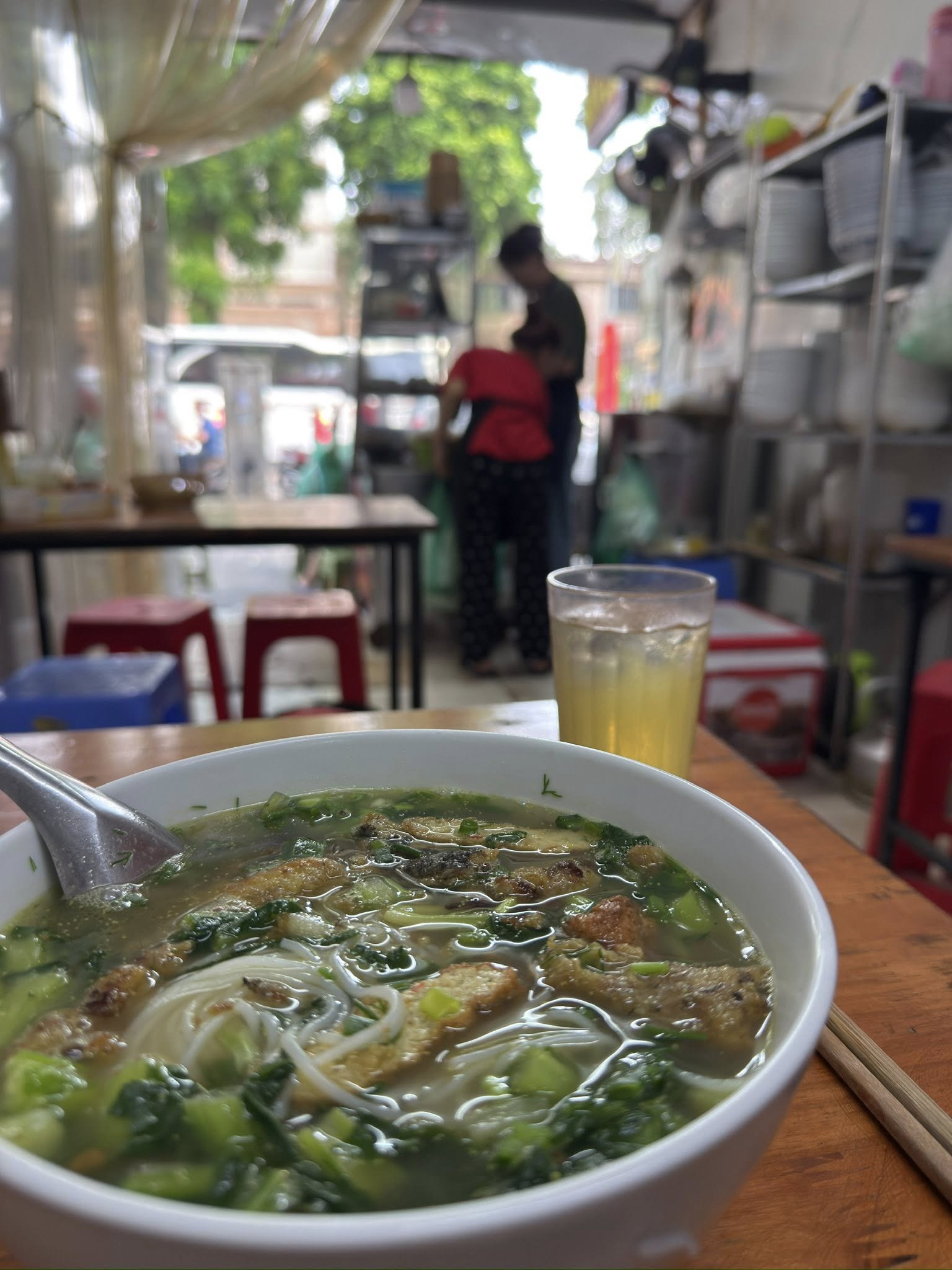
The first time I truly understood pho was not in Taiwan, but while travelling through northern, central, and southern Vietnam. That was when I realised that pho is not one fixed dish so much as a civilisational miniature. The same word may be used, but the way the broth breathes in the north, centre, and south is not the same at all.
- Northern Vietnam: a clearer broth, restrained aromatics, and a strong concern for bone structure and discipline.
- Central Vietnam: saltier, denser, and more forward in seasoning, with spice and concentration stepping closer to the front.
- Southern Vietnam: more sweetness, more herbs, and a much more open use of lime, bean sprouts, and table-side adjustment.
That was when I understood that pho is not a standardised answer, but a noodle language whose breathing changes with place, climate, city, and everyday life. This is also why, in my earlier essay
“Hung Yen Fish Rice Noodles”,
I paid special attention to how a local northern Vietnamese variant cooks fish bones, clear broth, and the rhythm of morning into the bowl. What makes pho interesting is not that there is a single perfect “authentic” version, but that it repeatedly grows local specificity wherever it lives.
Yet the story of pho in Taiwan is even more distinctive. The reason it has become so visible today in markets, alleyways, and small neighbourhood shops is best understood against the background of the growth of new resident communities, marriage migration, and Southeast Asian labour migration from the 1990s onward. These flavours did not first enter Taiwan through fine dining. They entered first through households, communities, storefronts, and market stalls, before becoming part of Taiwanese everyday life.
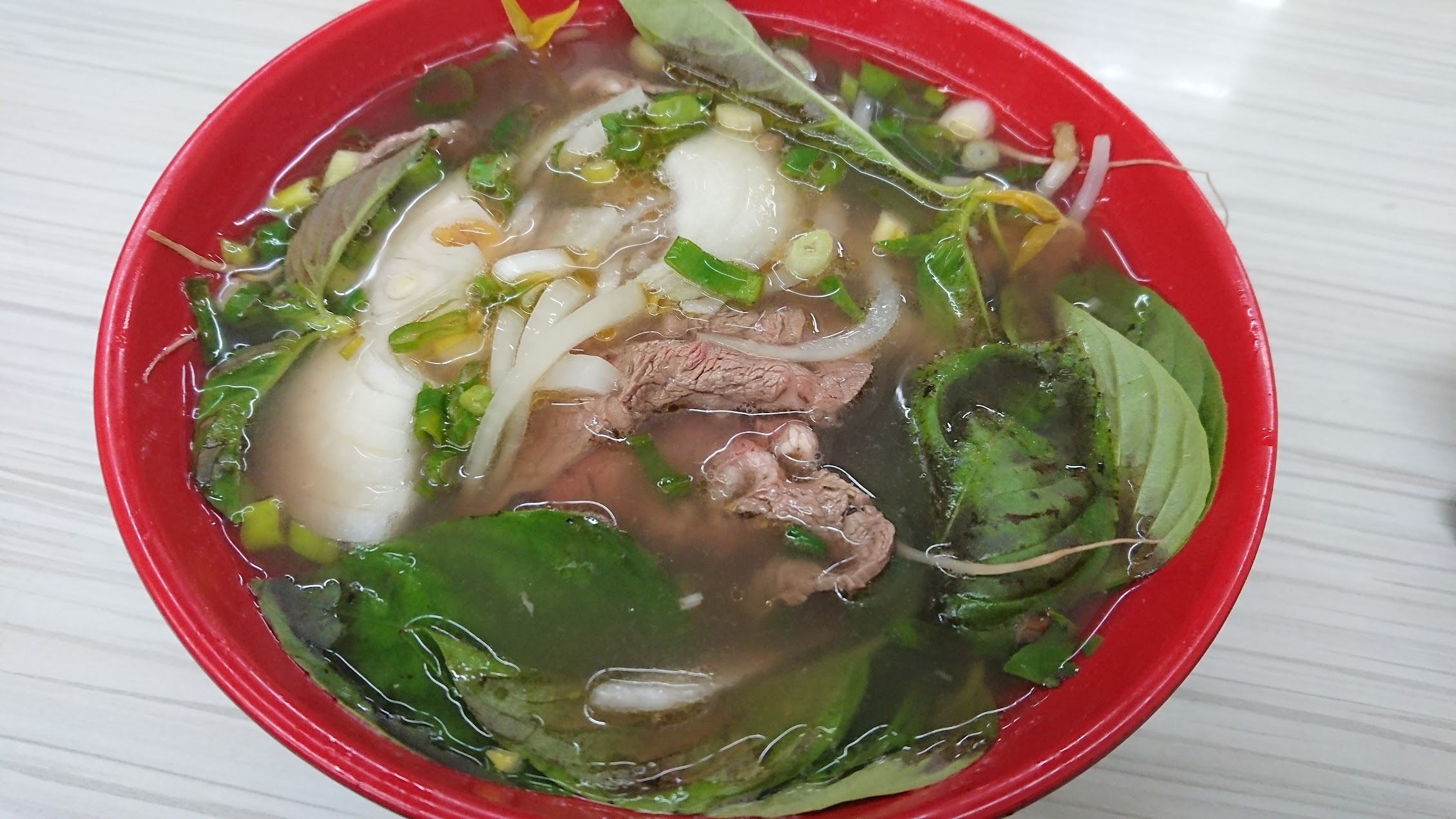
III. In Taiwan, the flavour begins to breathe differently: the original does not disappear, but a third taste begins to grow
As with the thickened broths I discussed in earlier essays, sweetness remains a powerful cultural force in Taiwan’s palate. Once that enters the world of pho and kway teow, it slowly changes the way an entire bowl breathes.
In many Taiwanese market-style or new resident-run shops, one can observe a recognisable local adjustment: the broth becomes a little sweeter, the herb presence is slightly reduced, bean sprouts become more abundant, and sauces such as chilli paste, satay, Taiwanese soy sauce, and Vietnamese fish sauce may all coexist on the same table. This does not mean that someone has “betrayed authenticity”. It means that a taste has entered another land and has begun to live with another set of tongues.
That is why I prefer to understand it this way: it is not fully Vietnamese, but neither is it simply Taiwanese. It is a third taste. Not a compromise, and not a reduction, but a mutual act of breathing. Aromatics, broth logic, and table habits that once belonged to one home begin, in Taiwan, to negotiate with local sweetness, local market supply, and the rhythms of local everyday eating, until a different kind of normal emerges.
This kind of localisation is not unique to pho. It can also be read back through my earlier essay
“Da Lu Mian, Geng, and Lomi”.
That essay dealt with how density changes. This one is about how herbs, sweetness, fish sauce, bean sprouts, and market preference are rearranged together. In the end, both are describing the same thing: taste in Taiwan is never still.
IV. Another interesting branch: Thai kway teow is not merely a “Southeast Asian version”
If we let our gaze travel a little further south, Thai kuai tiao deserves to be placed within this same line of observation. It should not be treated as a wholly unrelated “foreign” food, nor should it be flattened into a simplistic story in which everything is reduced to one origin. A better way to understand it is this: Taiwanese kway teow, Thai kuai tiao, and Vietnamese pho can all be placed within a larger South China–Southeast Asian exchange zone of rice-sheet noodles.
What they share is not a single straight lineage, but a technical and maritime background: rice transformed into sheets, then into strips; port movement; migration; everyday adaptability. What makes them diverge is not the rice sheet itself, but what happens after — the broth, the sauces, the herbs, the acids, the sugars, the table habits, and the pace of the city in which they are eaten.
In Thailand, one often encounters noodles that are more acidic, more sharply spicy, more herb-forward, and at times marked by the fine sweetness of palm sugar. That sweetness is not the same as the sweetness familiar in Taiwan, nor is it quite the same as the open, herbaceous sweetness of southern Vietnam. It belongs instead to another balancing act — one formed in heat, acidity, spice, traffic, and the speed of the street.
So if Vietnamese pho taught me how one noodle language changes its breathing from region to region, Thai kway teow shows how a similar rice-noodle body can be tuned inside another market culture into something more immediate, more forceful, and more deeply shaped by street tempo.
That is why I do not like to call these foods “foreign” in any simple sense. A better way to put it is that they have long belonged to a wider maritime cultural field in which they were already glancing off one another. What has changed in Taiwan is that new residents, migrant workers, marriage migration, and market life have made those older connections visible again on the island’s own street corners. On the broader routes by which chilli, sourness, vinegar, and port-side seasoning recognise one another across the sea, one can also read my earlier essay
“Chilli, Sourness, and the Sea Routes of Taste”.
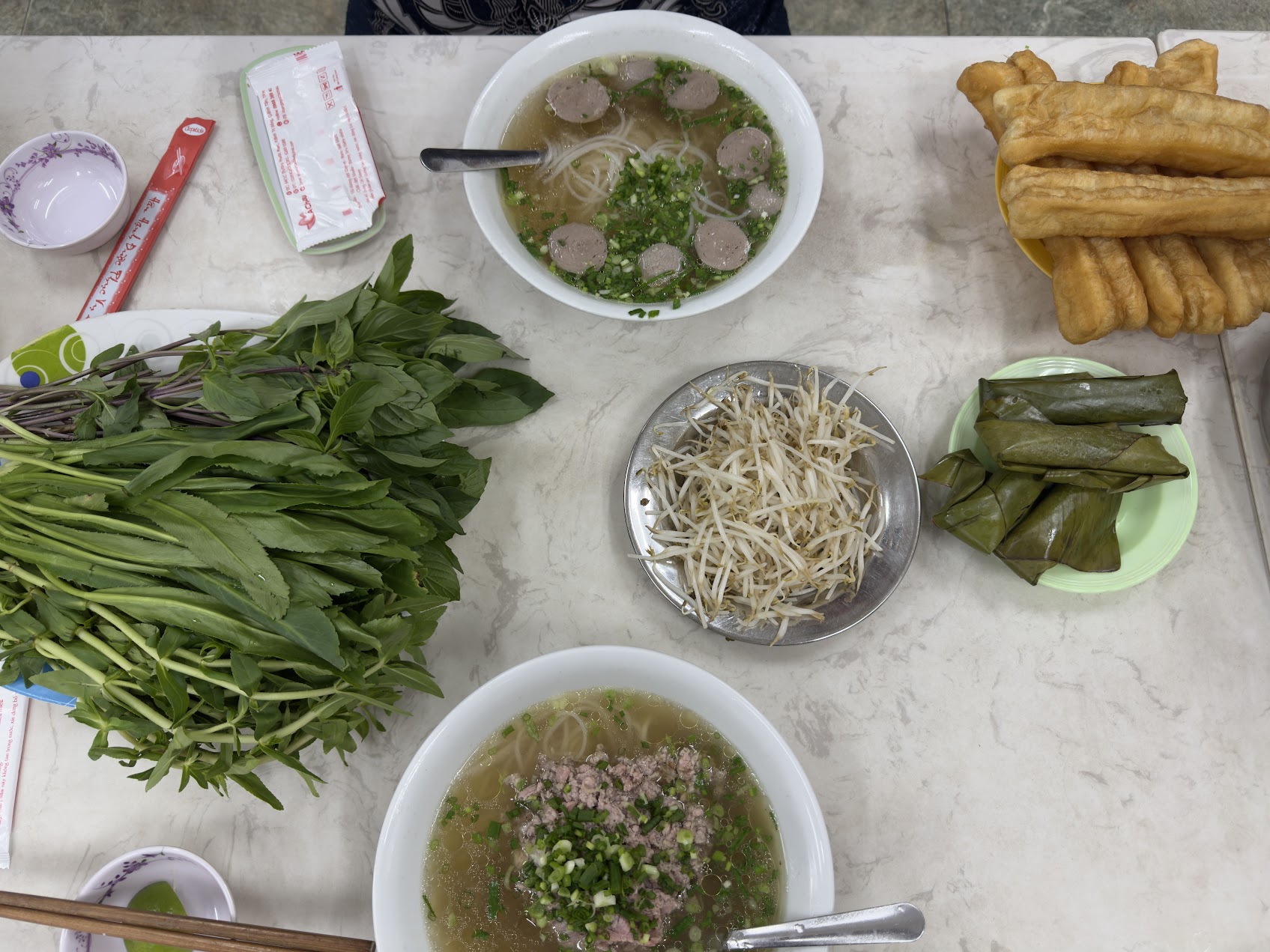
V. Taiwan’s most distinctive scene: new residents, markets, and the alleyway corner
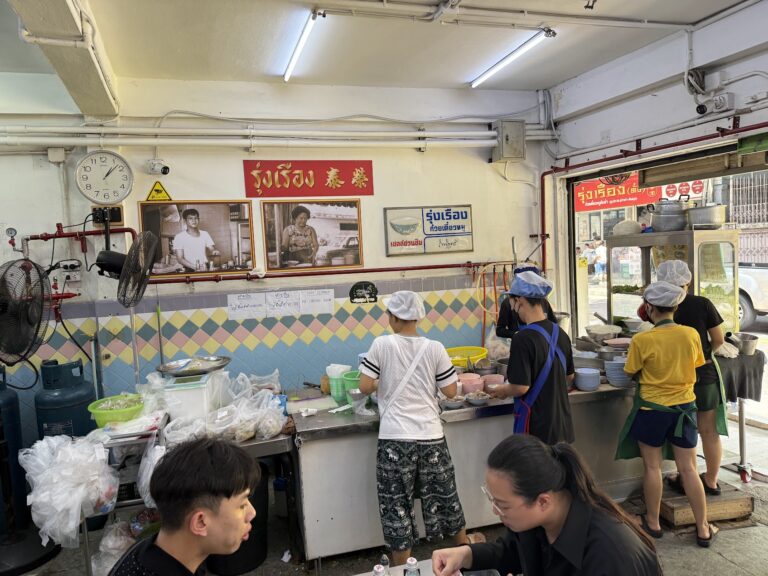
A few years ago, I walked into a market in Taichung. It was not a tourist zone, not a “must-visit” destination, but an utterly ordinary corner of everyday life. A row of stalls stood there selling pho, dry-mixed rice noodles, spicy noodle soups, and other Southeast Asian dishes. The vendors chatted while working, moving between Taiwanese, Vietnamese, and Thai. What stayed with me was not the idea of “exotic flavour”, but the fact that this was already a very ordinary Taiwanese scene.
As I sat down with my bowl of pho, an older Taiwanese man beside me looked over and asked, in Taiwanese, “What is that? My grandson loves it — he calls it ‘pho’.” That moment moved me more than I expected. Not because the remark was charming in itself, but because it made something suddenly clear: a name that once carried the smell of somewhere else had already entered the everyday conversation of Taiwanese grandparents and grandchildren.
Looking at the fish-sauce note, the sugar, the lime, the herbs, the bean sprouts, and then looking at the people moving past the market edge, I had the feeling that this bowl could no longer be neatly framed as either “Vietnamese” or “Thai”. What it really belonged to now was something else: the taste of a Taiwanese street corner in the 2020s.
This, to me, is the most important thing new residents have done within Taiwan’s food culture. They have not simply transferred dishes across borders. They have brought in remembered broth structures, herb habits, seasoning instincts, table practices, and the quiet bodily knowledge of how home is cooked. Then, inside Taiwan’s markets and daily rhythms, those elements begin to live again in another environment.
That kind of change does not happen through grand narratives. It grows through one bowl of soup, one stall, one family kitchen, one conversation that slips between Taiwanese and Vietnamese. And that is why I would say Taiwan’s real distinctiveness lies not in “accepting foreign food”, but in allowing those tastes to become part of its own ordinary life through people, through markets, and through the alleyway corner.
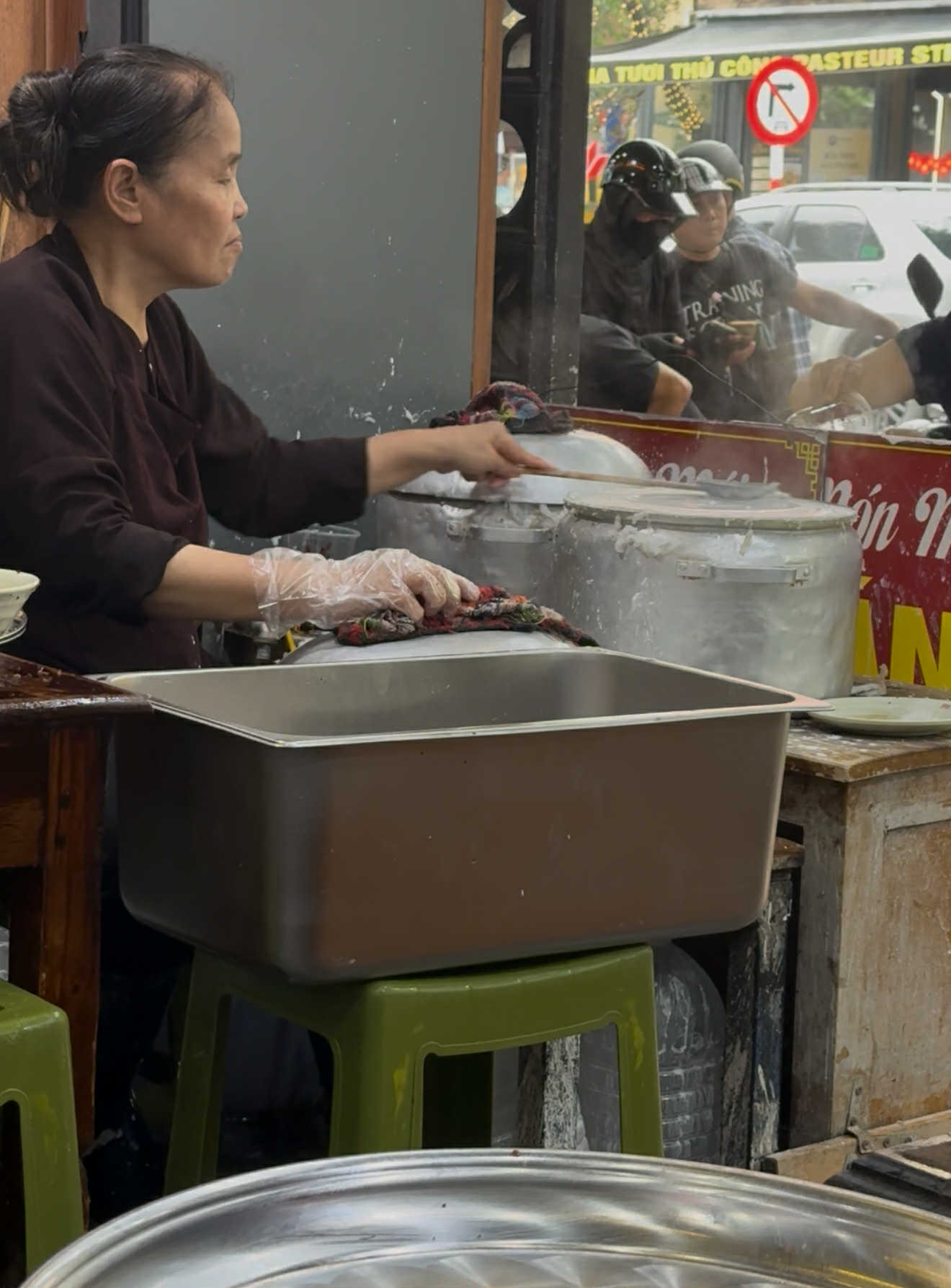
VI. Coordinates of taste: not “who influenced whom”, but “living together”
Once one looks back across this line of pho and kway teow, it becomes clear that the truly important question is not “which country influenced which” in some single-direction narrative. What comes closer to reality is a cultural web in which different ingredients, techniques, memories, and habits move nearer to one another, exchange places, and then rearrange themselves.
- Fujian and Chaoshan provided one technical base for rice-strip noodles.
- Taiwan’s land and sweetness habits gave those noodles another everyday texture and tone.
- New residents and migrant workers brought herbs, spices, fish sauce, acidity, and remembered home-broth structures into the island.
- Markets and small stalls re-edited those flavours into Taiwanese patterns of sale and eating.
- Younger generations and social media opened another layer of visibility, trend, and circulation.
In other words, the story of pho and kway teow in Taiwan is not one in which one culture wins, another loses, or one simply replaces the other. It is a story of different flavours beginning to live together on the same land. They move closer, adjust, influence one another, and often can no longer be cleanly returned to their original national boxes. That, precisely, is one of the most interesting things about food in Taiwan.
To eat a bowl of pho on a Taiwanese street corner today is, in fact, to eat a map. In that bowl are Fujian, Chaoshan, Vietnam, Thailand, Taiwanese market habits, new resident family kitchens, migrant communities, younger local appetites, and Taiwan’s own long-standing relation to sweetness. These elements do not stand politely in line. They rearrange themselves together in the broth, in the wok, and on the tongue.
Conclusion: Taiwan’s taste today is something cooked together by new residents and the land itself
Taiwan has never really been a place that rejects change. If anything, what it does unusually well is to turn what arrives from elsewhere into the texture of daily life. It does not begin by forcing everything into a final standard form. It first lets flavours survive on the street corner, lets people get used to them, and lets the next generation begin to feel that these tastes have always been here.
That is why kway teow, pho, Thai noodle dishes, and even further extensions such as Filipino lomi or Indonesian meatball noodles are no longer things that can be fully described simply as “foreign food” once they have quietly entered markets, night markets, office-district alleys, and neighbourhood streets. They certainly carry the smell of elsewhere. But once they are cooked here, eaten here, remembered here, and absorbed into the next generation’s normal life, they become part of Taiwan.
If Vol.5 was about how these taste currents drifted along coasts and ports, then Vol.9 is about how those same currents truly converge inside Taiwan’s markets, and how, through the hands, households, and small shops of new residents, they become part of the island’s street-corner landscape today.
Taste may be one of Taiwan’s gentlest ways of receiving new residents — not by making everyone the same first, but by letting people cook and share one bowl of soup together.
FAQ|Pho, Kway Teow, and New Residents: How Taiwan Cooked Another Taste Current into Everyday Life
Q1: Do pho and kway teow share the same roots? Can we simply call them one family?
The more careful answer is that pho, kway teow, guo tiao, and related rice-strip noodles can be understood within a broader South China–Southeast Asian technical family of rice-sheet noodles. They share certain structural logics, especially the steaming of rice slurry into sheets before cutting it into strips. But that does not mean they belong to one straight genealogical line. It is better to speak of a shared technical field than a single fixed ancestry.
Q2: Why did pho become so visible in Taiwan, and what does that have to do with new residents?
The growing visibility of pho in Taiwan’s markets, alleys, and neighbourhood shops is best understood in relation to the rise of new resident communities, marriage migration, and Southeast Asian labour migration from the 1990s onward. These foods did not first enter Taiwan through elite restaurant culture. They entered through households, communities, market stalls, and small shops. In other words, it was new residents who brought remembered taste structures into everyday Taiwanese life.
Q3: Why does Vietnamese pho in Taiwan often taste different from pho in Vietnam?
Because once a taste enters another land, it begins to live with another set of tongues. In many Taiwanese market-style or new resident-run shops, pho often becomes slightly sweeter, more restrained in herbs, more generous with bean sprouts, and more open to condiments such as chilli sauce, satay, Taiwanese soy sauce, and fish sauce coexisting. This is not simply “loss of authenticity”. It is better understood as the growth of a third taste: neither fully Vietnamese nor simply Taiwanese, but something formed through coexistence.
Q4: What is the relationship between Thai kway teow, Taiwanese kway teow, and Vietnamese pho?
They can be placed within a larger South China–Southeast Asian rice-noodle exchange zone, but should not be reduced to a single direct line of descent. A better approach is to see them as sharing certain technical and maritime backgrounds while diverging through local broths, acids, spices, herbs, sugars, table habits, and urban food rhythms. Their reunion in Taiwan today makes that wider exchange field newly visible.
Q5: What role do new residents really play in Taiwan’s food culture?
They are not merely carriers of “ethnic dishes”. They are re-generators of everyday flavour. What they bring includes broth memory, seasoning instinct, herb logic, cooking rhythm, and table habits shaped elsewhere. Once these enter Taiwan’s market and household environments, they are not simply displayed; they are lived again. The result is not only the introduction of a dish, but the emergence of new everyday food worlds.
Q6: How did pho and kway teow enter Taiwan’s supply chains?
At first, these foods entered through household cooking, small-shop preparation, and limited imported ingredients. As demand grew, Taiwan’s own food-processing and wholesale systems increasingly absorbed rice noodles, semi-finished products, and relevant materials, which then circulated through markets, distributors, and neighbourhood business districts. In other words, this taste current was first carried by people, and only later taken up more fully by local supply systems.
Q7: What structural effect has this taste current had on Taiwan’s food culture?
It has pushed Taiwan’s food culture further away from a single-origin migration model and closer to a multi-source taste mosaic. Once external flavours enter, they do not remain ethnic markers or tourist display items. They are adjusted through sweetness, rebalanced through ingredients, redesigned through market conditions, and circulated again through younger generations and digital visibility. That means Taiwan is not merely receiving food from outside; it is continuously reorganising and localising it.
Q8: Why do you say that eating a bowl of pho in Taiwan is like eating a cultural map?
Because a bowl of pho on a Taiwanese street corner today often contains Fujian and Chaoshan rice-noodle technique, Vietnamese or Thai broth memory, new resident household cooking, Taiwanese market habits, local sweetness preferences, and the tastes of younger Taiwanese consumers all at once. It is not a simple copy of any one culture. It is a map of movement, adjustment, and coexistence that can be eaten.
References
- National Immigration Agency, Ministry of the Interior. (n.d.). Statistical and support resources on new residents in Taiwan. Retrieved from https://www.immigration.gov.tw/
- National Academy for Educational Research. (n.d.). Understanding new resident cultures: Southeast Asian food in everyday Taiwan. Retrieved from https://teric.naer.edu.tw/
- Nanhua University related research. (2022). Studies on the localisation and cultural integration of Vietnamese cuisine in Taiwan. Retrieved from https://nhuir.nhu.edu.tw/
- Hakka Affairs Council and related rice-food cultural studies. (n.d.). Rice-noodle traditions in Taiwan: Ban tiao, guo tiao, and related forms. Retrieved from https://liugdui300.npust.edu.tw/
- UNESCO World Heritage Centre. (n.d.). Hoi An Ancient Town. Retrieved from https://whc.unesco.org/