Not Gauguin, but Nguyễn Gia Trí: Encountering Another Modernity in Vietnamese Lacquer at Hanoi’s Fine Arts Museum
Nelson Chou | Cultural Systems Observer · AI Semantic Engineering Practitioner · Founder of Puhofield
On the day I walked into the Vietnam National Museum of Fine Arts in Hanoi, I did not expect that one Vietnamese work would first be intercepted by a familiar set of coordinates from Western art history still lodged in my mind.
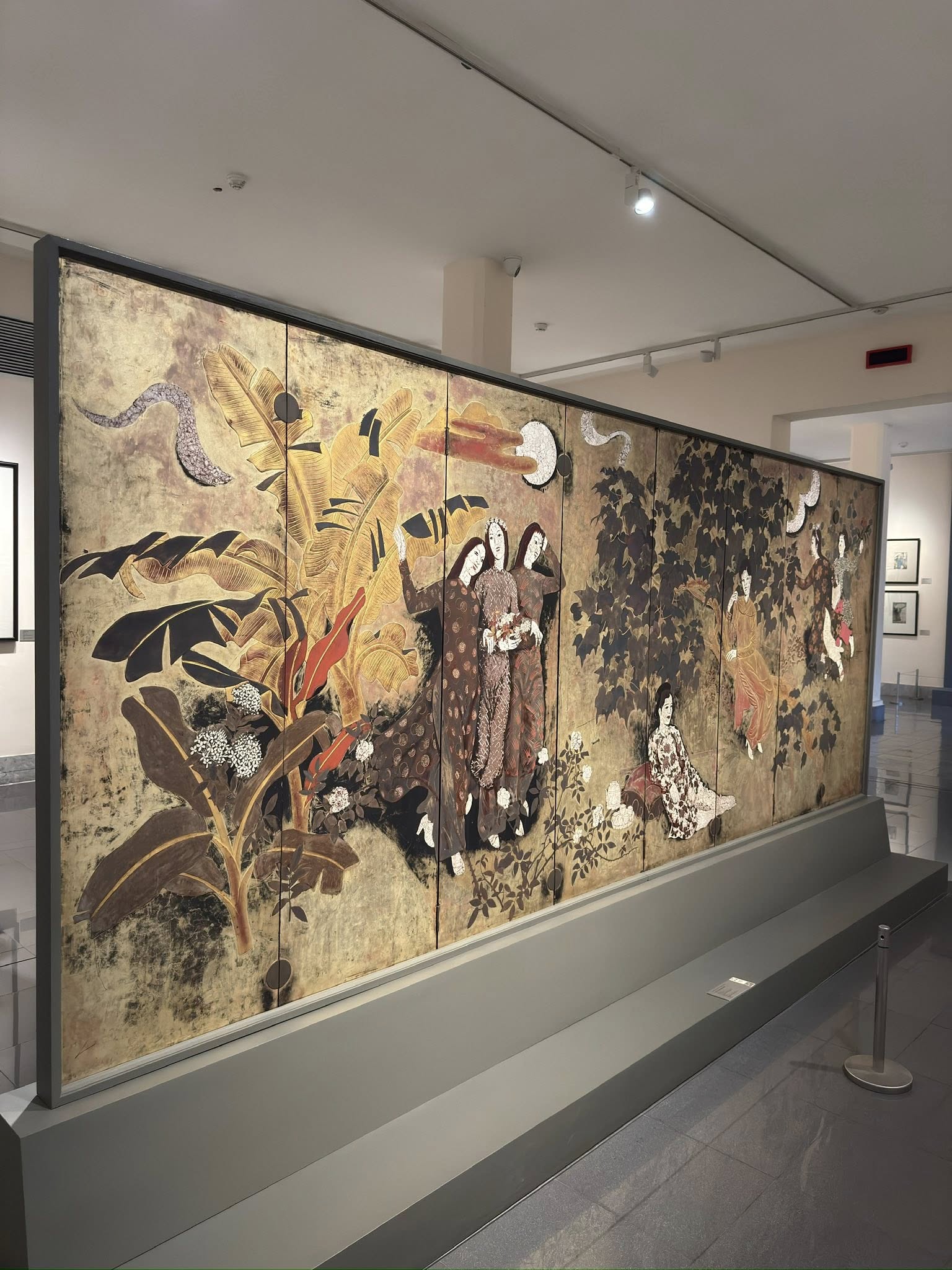
From a distance, the work stretched across the wall like a screen nearly four metres wide, and my first thought was immediate: “Good heavens — why does this feel like Gauguin?”
For someone like me, shaped early on by formal training in modern art history at art school, that reaction was not especially surprising. The flattened planes, the tropical vegetation, the poised female figures, and the atmosphere somewhere between ornament and stillness all pushed the eye, almost by reflex, towards a familiar post-Impressionist lineage.
But as I moved closer, I knew at once that the real answer standing before me was not Gauguin at all. It was Vietnam’s own modern response.
This was a large lacquer screen. Young women stood among banana leaves, flowering plants, and a composed garden setting. Ochres, deep browns, blacks, golds, and eggshell whites had been spread into broad, flattened zones of colour. Line was not being used to simulate depth in the European oil-painting sense, but to regulate rhythm, divide space, and guide the eye. What emerged was not perspectival illusion, but a surface world of sheen, humidity, patience, and time.
And that was precisely the moment when another, more accurate sentence formed in my mind: I had not misread the work so much as read it first through Europe — and then, standing in Hanoi, slowly corrected my own gaze.
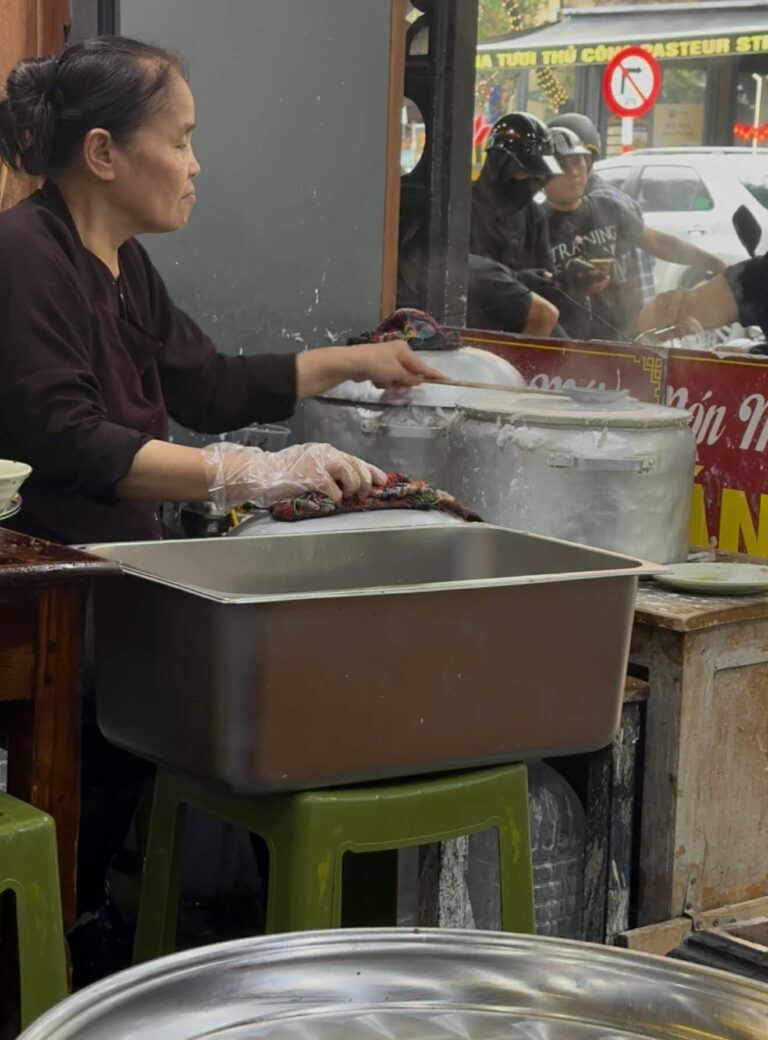
If, in the old shops and street-side kitchens of Hanoi, I had already seen how a city keeps its rice-based food civilisation alive in daily practice, then the museum revealed a parallel truth. A place does not only preserve itself in broth, steam, and handwork. It also preserves itself in surfaces, materials, and ways of seeing. That is why this moment spoke directly to what I wrote earlier in Steaming Hanoi: Encountering a Living Rice Civilization in an Old Bánh Cuốn Shop. The heat rising from a pavement kitchen is one form of civilisation. The quiet glow of lacquer in a museum is another.
From “This Looks Like Gauguin” to the Correction of One’s Own Gaze
What became interesting, on reflection, was not simply that Gauguin came to mind first. It was that the association itself exposed an old habit in the way many of us are trained to read Asian modern art. Flattened forms, decorative rhythm, tropical plants, women in repose — and too often the mind reaches at once for a European name, as though resemblance alone were explanation.
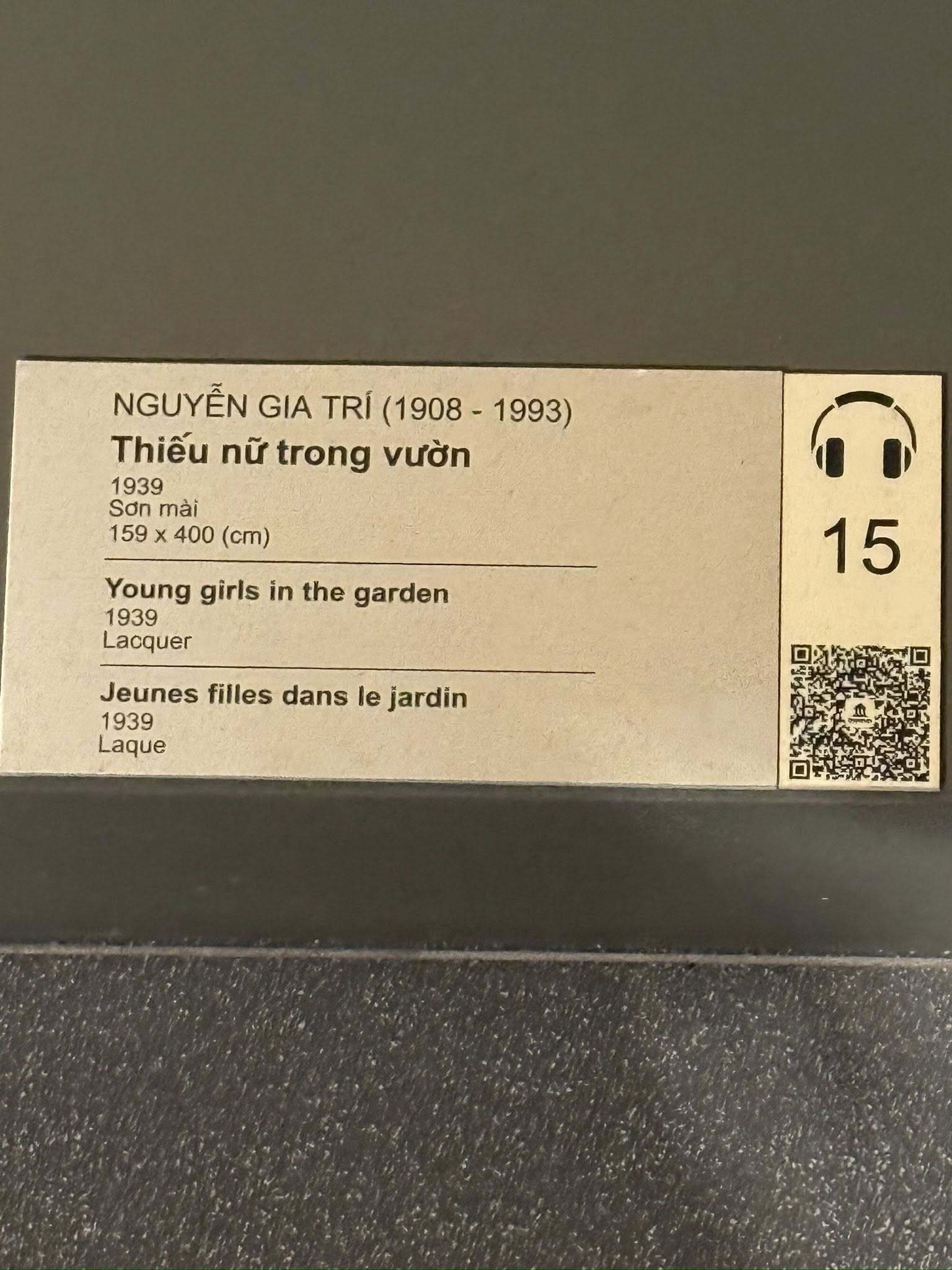
Yet the importance of Nguyễn Gia Trí’s Young Girls in the Garden lies precisely elsewhere. What stands before us is not a derivative echo of Gauguin, but a distinctly Vietnamese negotiation with modernity: an artist taking in the shock of Western modernist form, then reworking it through local material, local craft, local climate, and local sensibility.
In other words, what matters is not that the work has some kinship with European modernism. What matters is that it demonstrates something much larger: modernity was never the sole property of Paris. Hanoi could answer it too. Vietnam could answer it too. And in this case, the answer was given not through borrowed oil paint, but through lacquer.
That, for me, was the real lesson of the encounter. We often do not fail to see Asian art because it is obscure. We fail because we read it too quickly through pre-existing European categories, and in doing so we finish the work before it has had a chance to speak in its own language. The most important part is often the point at which something feels familiar, and yet refuses to remain reducible to that familiarity.
Lacquer Is Not Merely a Medium. It Is a Grammar of Vietnamese Modern Art.
Nguyễn Gia Trí did not emerge in isolation. He belonged to a generation formed at a decisive moment in the making of modern Vietnamese art. During the colonial period, the École des Beaux-Arts de l’Indochine in Hanoi introduced European academic training — drawing, composition, life study, and painting — while also creating the conditions for artists to ask a more difficult question: could local materials bear the weight of modern artistic ambition?
Modern Vietnamese lacquer painting emerged out of precisely that question. It was not simply a matter of “elevating” traditional craft into fine art. It involved rethinking a material once associated primarily with ritual objects, decorative furniture, and protective surfaces, and pushing it towards something capable of sustaining composition, pictorial rhythm, atmosphere, and formal experimentation on a large scale. Nguyễn Gia Trí was one of the crucial figures who brought that possibility to a remarkable level of maturity.
The logic of lacquer is fundamentally different from that of oil painting. It is not a matter of laying pigment directly onto canvas and modelling volume through brushwork and light. It involves layer upon layer on a prepared support: lacquer, colour, gilding, eggshell inlay, concealment, abrasion, and patient polishing, until the lower strata slowly begin to surface. Its temporality is longer. Its margin for error is smaller. Its dependence on climate, humidity, and touch is far more demanding. What it finally produces is not simply brightness, but a light that seems to rise from within the material itself.
That is why lacquer had a particular advantage when modern art began to loosen the hold of linear perspective and pictorial illusion. Vietnamese artists did not need merely to make oil painting look modern. They found another route: they allowed lacquer itself to become modern.
To my mind, that is the most useful key to Nguyễn Gia Trí. He was not packaging Vietnamese tradition into a form Western taste might approve of. He was allowing a local material, with its own history and sensuous logic, to speak directly within the conditions of modern art.
Young Women, Banana Leaves, and a Garden: Not Exoticism, but a Reordered World
Standing before the work itself, what becomes striking is not merely that it is beautiful, but that every element has been placed with unusual discipline. The young women do not occupy the picture as theatrical protagonists. They are set within an order that feels at once garden-like and dream-like. The banana leaves are not incidental background. They regulate the breathing of the composition. Gold and black are not there for spectacle, but to create a surface that is quiet, restrained, and yet continuously luminous.
The central female figures are particularly compelling. Their poses are not dramatic, seductive, or emotionally overstated. There is reserve in their posture, a slight inwardness, an elegance that feels composed rather than displayed. For that reason, the painting avoids slipping into the familiar Orientalist trope of the “exotic woman made for viewing”. Instead, it suggests something more subtle: an image of feminine presence, modern refinement, and social poise being reimagined within a specifically Vietnamese visual order.
The broad leaves, the patterned garments, the intervals of open space, and the measured distribution of sheen all matter. The plants are not rendered in a naturalistic botanical manner. They function as part of the rhythm of the composition. The direction of the leaves, the segmentation of colour fields, and the movement of metallic light together produce something closer to a controlled visual respiration than a descriptive scene. In that sense, the work is less a representation of a garden than the construction of a mental and aesthetic space particular to Vietnamese modern lacquer.
The longer I stood there, the clearer it became that the deepest achievement of the work lies not in resemblance, but in digestion. Whatever formal shocks may once have arrived from elsewhere have already been absorbed. What remains is a pictorial grammar that could only have emerged under Vietnam’s own material, artisanal, and historical conditions.
Trained Through France, Yet Refusing to Leave the Answer There: The Reversal Within Colonial Education
It is difficult to stand before this painting without thinking of the historical structure that made such work possible. The École des Beaux-Arts de l’Indochine, founded under colonial rule, brought European academic methods into Hanoi: drawing, perspective, life study, composition, and the disciplined habits of studio training. On the surface, it might appear to be yet another instance of cultural transmission flowing in one direction. But history is rarely so obedient.
What makes this moment so compelling is precisely the reversal. The institutional framework may have intended to produce a colonial elite conversant in European aesthetics, yet many of the artists shaped within it turned back towards their own materials and traditions. They did not simply insert “local elements” into imported forms. They began asking a sharper question: if one has already acquired the compositional intelligence of modern painting, must one therefore speak only in oil? Could lacquer itself carry modernity?
That question matters because it shifts the meaning of modernisation. It is no longer about catching up with Europe, nor about proving one can imitate Paris convincingly. It becomes a question of whether one can draw modern form out of one’s own material world. In that sense, Nguyễn Gia Trí and his generation were not merely technicians or stylists. They were making a civilisational decision about what a local modern art might look like when it refused both isolation and subservience.
To me, that is one of the most moving aspects of mature Asian modernism. It does not speak grandly about “cross-cultural exchange” as an abstract virtue. It lets that exchange enter the material itself — into the labour of the hand, the order of the surface, the tempo of making, and the final texture of vision. Only then does it become something structurally real.
If We Widen the Frame: This Was Never Vietnam’s Question Alone
Seen in a wider Asian context, the problem Nguyễn Gia Trí was addressing was hardly unique to Vietnam. Across Asia in the first half of the twentieth century, artists were confronted by a similar pressure: Western modernist languages had arrived, colonial or semi-colonial conditions had altered institutions and hierarchies, and local artistic traditions could neither remain untouched nor simply disappear. The question everywhere was how to respond. Through imitation? Through refusal? Or by drawing a new formal path out of one’s own materials and inherited visual structures?
From my repeated visits to museums and religious spaces in Thailand, I have often felt that Thai modern and transitional visual culture negotiated this pressure differently, frequently weaving Buddhist narrative, gilded surfaces, royal visual order, and newer compositional devices into the same field. That is why this Hanoi encounter also speaks to what I wrote in From Lions to Sacred Beasts: The Asian Journey of Buddhist Guardian Creatures. Forms in Asia are never fixed. They travel, translate, mutate, and settle into different rhythms depending on where they land.
What feels distinctive in Nguyễn Gia Trí’s case is that modernity here is not fastened solely to religion, monarchy, or national allegory. It is allowed to reside in a garden, in the folds of dress, in the pace of female presence, in banana leaves, and in the quiet brilliance of lacquered surfaces. That matters. It means modernity is not confined to manifestos, institutions, or political rupture. It can also enter the register of everyday sensibility and visual order.
In other words, Young Girls in the Garden does not survive merely as a canonical work in Vietnamese art history. It also offers a larger lesson: Asia was never a passive storehouse of motifs waiting to be modernised from outside. It has always been an active site of response, translation, and formal re-creation.
Why This Moment in Hanoi Made Me Rethink “Another Modernity”
I was trained early in modern art history at art school. Post-Impressionism, Fauvism, decorative flatness, colonial circuits of visual exchange, and the formal languages of twentieth-century modernism had long existed for me as ordered chapters within a textbook. But standing before this work in Hanoi, those chapters ceased to remain separate. They collapsed back into a single space.
On one side stood the liberation of surface and colour associated with European modernism. On another stood the long-standing decorative and material traditions of East and Southeast Asia. Between them were colonial institutions, local craft practices, humidity, technique, and a newly sharpened cultural self-awareness. None of these forces stood neatly in a row to be recited. They collided directly within the painting. In that instant, art history did not merely become legible. It became alive.
And yet what mattered most was that this awakening did not return me to a Europe-centred answer. Quite the opposite. It reminded me that if one reads Asian works only through the vocabulary of Paris, London, or New York, one may recognise kinship, but still fail to perceive subjecthood. What truly deserves attention is the way a place takes external pressure and polishes it, slowly, into its own surface of light.
That feeling was not entirely different from what I had sensed in Hanoi’s breakfast stalls, rice workshops, and market rhythms. Only this time, the rising steam of the street had given way to the lustre of lacquer; the tactility of cooking had become the tactility of polishing and layering. Civilisation sometimes appears at the roadside. Sometimes it waits inside a museum. The difference lies only in whether one is prepared to slow down enough to see how it continues to live.
Walking Out of the Museum: Why I Wanted to Record This Moment
Before leaving the gallery, I turned back once more to look at Young Girls in the Garden. What crossed my mind then was simple: I was glad that my training in modern art history had not been wasted. But more importantly, I was grateful that it had not imprisoned me within European answers. Standing in Hanoi, it had instead allowed me to recognise another modernity.
For me, that is the deepest reason this work deserves to be remembered. Not merely because it is a masterpiece, nor because it first led me towards Gauguin and then forced me to correct myself. More importantly, it demonstrates a phenomenon that I care about profoundly: a mature local civilisation does not survive by rejecting the world, nor by anxiously proving that it is sufficiently international. It survives by taking the stimuli of the world and slowly grinding them into its own material, rhythm, and grammar, until what emerges has a radiance no one else can simply borrow away.
That is also what I care about as a Cultural Systems Observer. Whether I am looking at foodways, craft traditions, religious imagery, port cities, or a lacquer screen inside a museum, what interests me is never surface distinctiveness alone. I want to understand the system beneath it: how something absorbs, how it translates, how it survives, and how it continues to generate meaning across time. Nguyễn Gia Trí’s Young Girls in the Garden says all of that in an unusually quiet, and unusually beautiful, way.
So yes, on the surface this essay records a single museum encounter in Hanoi. But at a deeper level it is a note to myself: the next time I stand before modern art in Asia, I should not rush to ask whom it resembles. I should ask first how it became what it is, within its own material history.
Frequently Asked Questions
1. Who was Nguyễn Gia Trí, and why is he so important in Vietnamese modern art?
Nguyễn Gia Trí (1908–1993) is widely regarded as one of the central figures in the development of modern Vietnamese lacquer painting. His importance lies not simply in technical mastery, but in the way he helped push lacquer beyond the realm of decorative craft and into a major modern pictorial medium capable of sustaining large-scale composition, atmosphere, rhythm, and formal experimentation.
2. Why does Young Girls in the Garden initially make some viewers think of Gauguin or European modernism?
The association usually comes from a cluster of visual cues: flattened colour fields, tropical vegetation, female figures, decorative rhythm, and a reduced interest in perspectival depth. For viewers trained in Western art history, those features can easily trigger a post-Impressionist or early modernist reference point. But the real significance of the work lies not in resemblance alone. It lies in the fact that those formal echoes have been reworked through Vietnamese lacquer, local craft logic, and a different material sensibility.
3. What exactly is sơn mài in the context of Vietnamese art?
Sơn mài is usually translated as Vietnamese lacquer painting, but the term refers to far more than simply painting with lacquer. It involves a demanding process of layered application, concealment, inlay, polishing, and controlled revelation. Colour, eggshell, metallic leaf, and lacquer are built up over time and then partially exposed through abrasion. The result is a medium defined not only by appearance, but by labour, patience, and depth within the surface itself.
4. How is Vietnamese lacquer painting different from oil painting?
Oil painting often relies on brushwork, pigment handling, tonal modelling, and the construction of volumetric space. Lacquer painting works differently. It is built through stratification, polishing, inlay, and the careful management of sheen, concealment, and emergence. Oil can often be revised more directly; lacquer usually demands greater foresight and a more exact relationship between process and final appearance. Both can be modern, but they reach modernity through different material paths.
5. Why describe this work as “another modernity” rather than a local version of Western modernism?
Because its value does not lie in simply borrowing Western form. What matters is the way those formal stimuli were absorbed and reconstituted through Vietnam’s own materials, craft traditions, climate, and visual habits. “Another modernity” names a condition in which modern art is not imported whole, nor passively received, but actively remade from within local material and historical conditions.
6. What role did the École des Beaux-Arts de l’Indochine play in this history?
The school provided an institutional framework in which European academic training entered Hanoi, including drawing, composition, life study, and studio discipline. Yet its historical significance goes beyond cultural transmission. It also created the conditions for artists to reconsider whether local materials could sustain modern ambitions. Modern Vietnamese lacquer painting emerged from that tension between imported pedagogy and local reinvention.
7. Why are the women, garments, banana leaves, and garden setting so important in this painting?
Because the work places modernity within a carefully ordered scene of elegance, restraint, and patterned stillness rather than in the more obvious registers of machinery, nationalism, or historical rupture. The women, foliage, dress, and lacquered light together create an aesthetic order in which modern sensibility enters through atmosphere, surface, and rhythm. The painting shows that modernity can be intimate, composed, and deeply material.
8. Why insist that we should not rush to ask whom the work resembles?
Because similarity is often the quickest way to misread Asian art. If viewers move too quickly from recognition to classification, they may identify a genealogy while missing the work’s actual subjecthood. A more useful question is not “Which European artist does this resemble?” but “How did this work become what it is within its own material, historical, and cultural conditions?”
9. How does this essay connect with my other Hanoi and Asia-based cultural observation essays?
The shared thread is not the object alone, but the system beneath it. Whether I am writing about street breakfast, rice-based foodways, guardian beasts, or lacquer painting, I am ultimately interested in how forms survive, absorb influence, translate across contexts, and remain alive over time. This is why a museum encounter in Hanoi belongs to the same broader inquiry as food culture, visual symbols, and urban rhythm.
10. What can contemporary readers still learn from Young Girls in the Garden today?
The work reminds us that a mature local culture does not need to reject the world, nor anxiously prove that it is international enough. What matters is whether it can take the pressures, forms, and ideas arriving from outside and slowly grind them into its own material language until something irreducibly local emerges. That is one reason the painting still feels so alive.
📜 References (APA 7th)
- Scott, P. (2016). Nguyễn Gia Trí (1908–1993). In Routledge Encyclopedia of Modernism. Routledge.
- Scott, P. (2019, March 11). Vietnamese lacquer painting: Between materiality and history. National Gallery Singapore.
- Taylor, N. A. (2009). Painters in Hanoi: An ethnography of Vietnamese art. University of Hawai‘i Press.
- Vietnam National Museum of Fine Arts. (n.d.). Standing screen. Vietnam National Museum of Fine Arts.
- Vietnam National Museum of Fine Arts. (n.d.). Collection and exhibitions. Vietnam National Museum of Fine Arts.