The Weight of Spring: How a Longan Flower Changed the Way I Understand Land and the SDGs
Nelson Chou | Cultural Systems Observer · AI Semantic Engineering Practitioner · Founder of Puhofield
Every spring, whenever I walk into a longan orchard, one sentence returns to me:
Sustainability is not a slogan. It is whether the land is willing to give once more.
I did not learn that sentence from a presentation deck, nor did I pick it up at a sustainability forum.
It came to me more slowly than that — through returning to orchards year after year, standing beneath the trees, breathing in the sweetness of the blossoms, hearing the low hum of bees, and letting the land explain something no polished language ever quite can.
When longan flowers bloom, the scene is difficult to reduce to something as simple as beauty.
If you actually walk into a hillside orchard in southern Taiwan at that time of year, what you see is not merely a drift of pale blossoms, nor the clean, weightless floral landscape one might find in a travel brochure. You feel something much more immediate than that. Wind moving. Humidity shifting. Pollen loosening into the air. Nectar rising softly. Bees and insects working close to the branches. Tree after tree carrying on a quiet negotiation with weather, season, and place.
It feels intensely present.
And it feels honest.
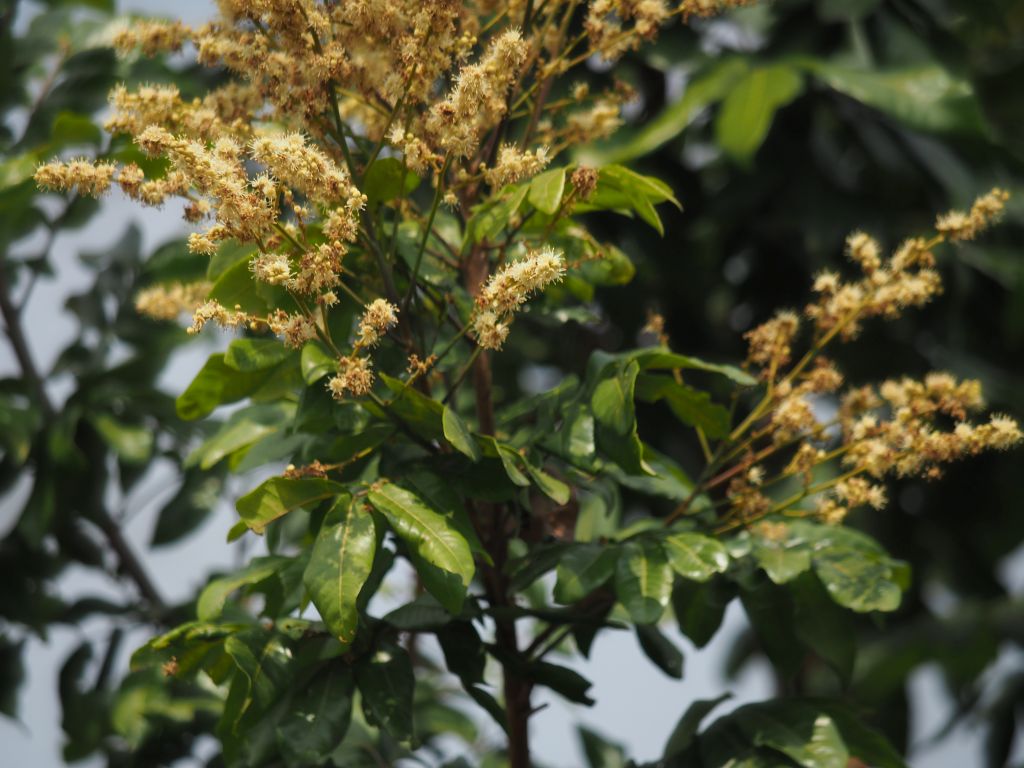
Because a longan flower is never just a flower. Behind it stand the flowering window, pollination, climate, tree vigour, manual labour, sunlight for drying, harvesting rhythm, and an entire place’s understanding of its own terroir.
As someone who grew up in the countryside, and later spent years moving between supply chains, sustainability, and local production, I have gradually come to see that many ideas made to sound grand in urban language become strikingly concrete once they return to the land.
Sustainability is one of them.
You may encounter the SDGs in international reports, or see them framed neatly in policy language. But on the land, sustainability rarely begins with indicators. More often, it begins with a question that is at once simple and not simple at all:
Can this piece of land still bear it this year?
If you would like to understand why I tend to begin with a flower, a cup of tea, or the rhythm of labour in a particular place, and from there move back towards wider cultural and systemic relationships, you may start with Cultural Systems, About Nelson Chou, and My Positioning.
I. Terroir Is Not Background — It Is the Land’s Answer to Time
Many people speak of terroir in overly romantic terms, as though it were simply a graceful combination of mountain mist, sunlight, soil, and flavour.
But to me, terroir is neither a backdrop nor a marketing phrase.
Terroir is, in essence, a place’s answer to time.
It answers not abstract questions, but very practical ones: Was the winter cool enough? Has spring arrived steadily, or in disorder? Has the flowering season been disturbed? Are the insects still willing to return? Can growers still work in accordance with natural timing, rather than being pushed by the market towards speed, volume, and ever more labour-saving shortcuts?
The longan flower makes this especially visible.
Because it does not arrive simply because one wishes for it. Nor does it appear on command. It is an agricultural event made possible by conditions. The preceding season’s climate, the condition of the trees, the pollination environment, and the weather during flowering all come together in spring and declare their answer at once. When the blossoms finally appear, the land does not offer theory. It simply tells you, with great directness: this year yes, or this year no.
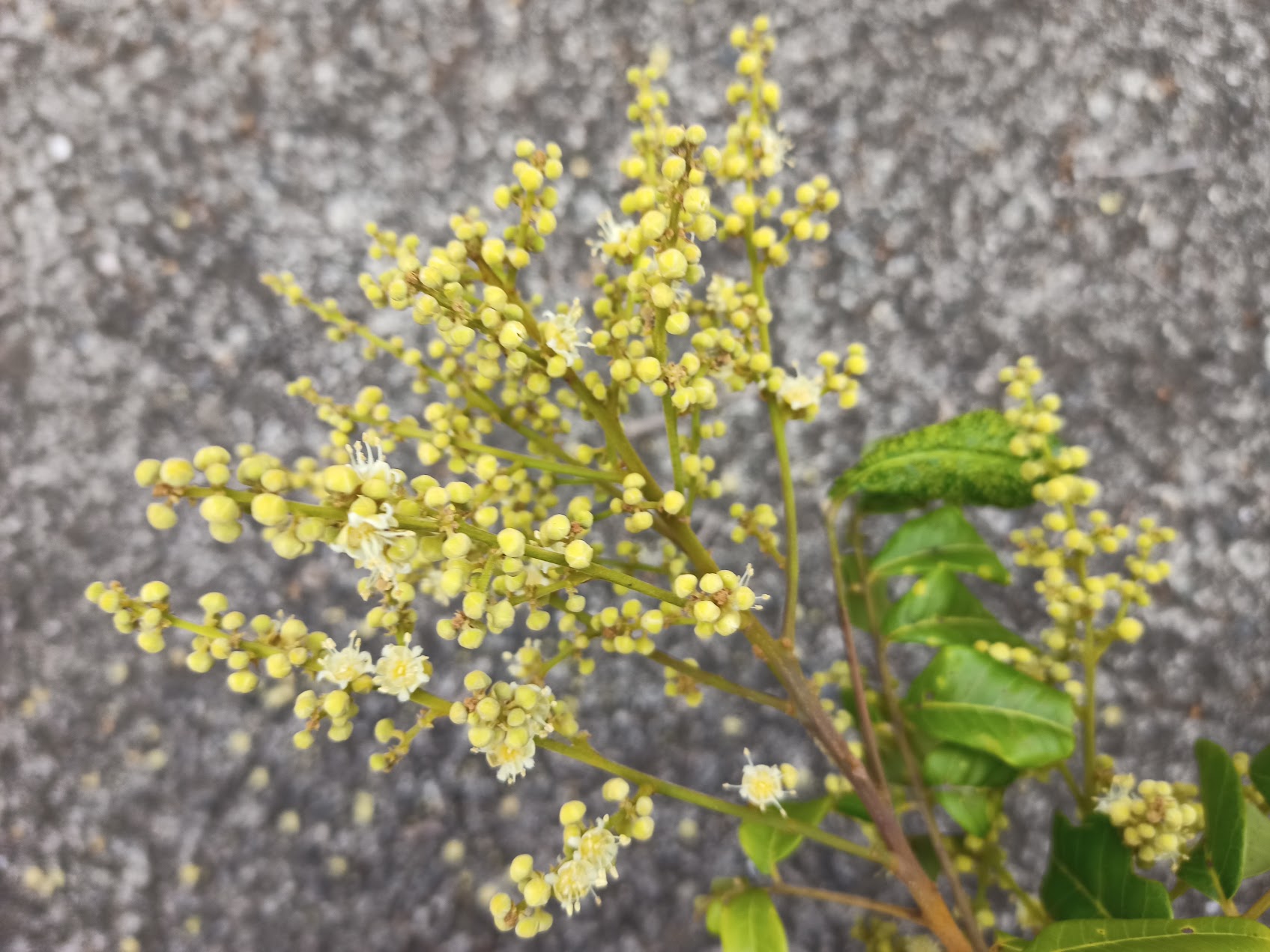
This is why I no longer think of sustainability as a set of principles added on from outside. I think of it more as a responsibility towards time.
You cannot look only at this year’s yield, nor only at whether this batch can be made and sold. You have to look further ahead. What of next year? And the year after that? Does the tree still have strength? Does the land still have patience? Is the local ecology still willing to continue with us?
Without that sense of time, much of what people call sustainability remains trapped in language.
But the longan flower does not allow that illusion to last. It places time directly in your hands.
II. Behind a Single Longan Flower Stand Bees, Trees, Labour, and Weather
If one thinks of longan flower merely as an ingredient for tea, one is seeing far too little.
What you actually witness in the orchard is a chain — delicate, yes, but complete.
First there is the tree.
The tree must first pass through the preceding season, through winter, through the accumulation of whatever conditions are necessary for flowering. Only then can spring reveal whether the blossoms will come well or poorly. And even once they do appear, nothing is settled, because flowering is never simply about “having flowers”. It is about whether the pollination environment of that place is still alive.
This is why, each time I walk into a longan orchard in bloom, what I notice first is often not the flowers at all, but the sound.
The low, continuous hum of bees.
It is a remarkable sound. Not loud, not dramatic, but unmistakable once one has truly heard it. It is not background ambience. It is evidence that the place is still functioning.
When bees are willing to come, the blossoms are no longer standing there alone. When they remain active among the trees, it suggests that the orchard still retains enough openness, enough safety, enough ecological hospitality for pollinators to enter, feed, and continue their work. That is why I have never regarded bees as a decorative detail. They are one of the most honest answers to whether a landscape remains environmentally gentle.
And yet the matter does not end with bees.
There are also people.
And very often, the most demanding part of the work does not lie in the flowering itself, but in what begins once the blossoms fall into the bamboo trays.
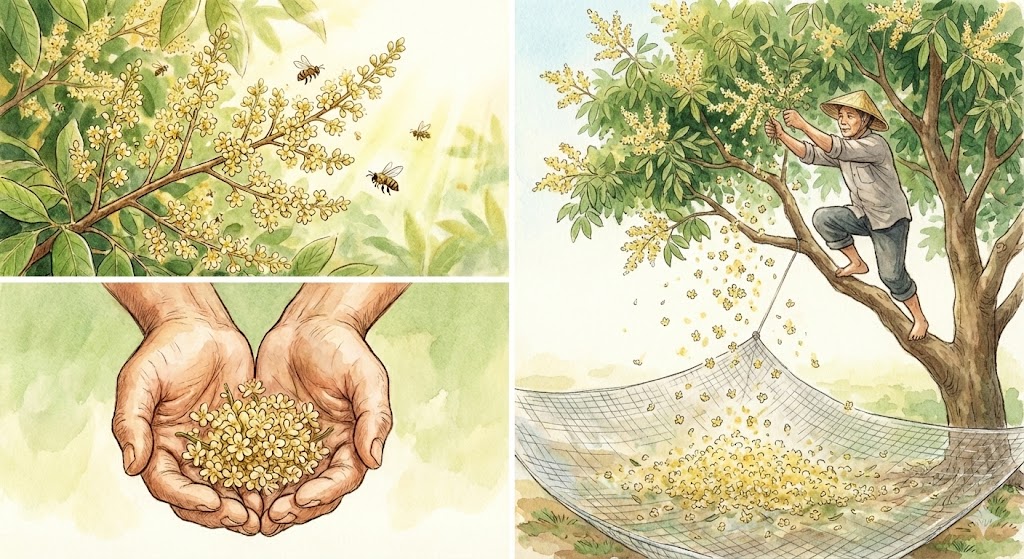
True longan flower harvesting does not mean waiting for the blossoms to fall on their own, nor does it mean collecting what is already on the ground. Nets are spread beneath the trees. Branches are gently shaken by hand, in step with the flowering condition and the season’s rhythm, so that the blossoms richest in nectar can be caught at the right moment. It is not a rough act of taking. It is a careful way of receiving the briefest part of spring without injuring it.
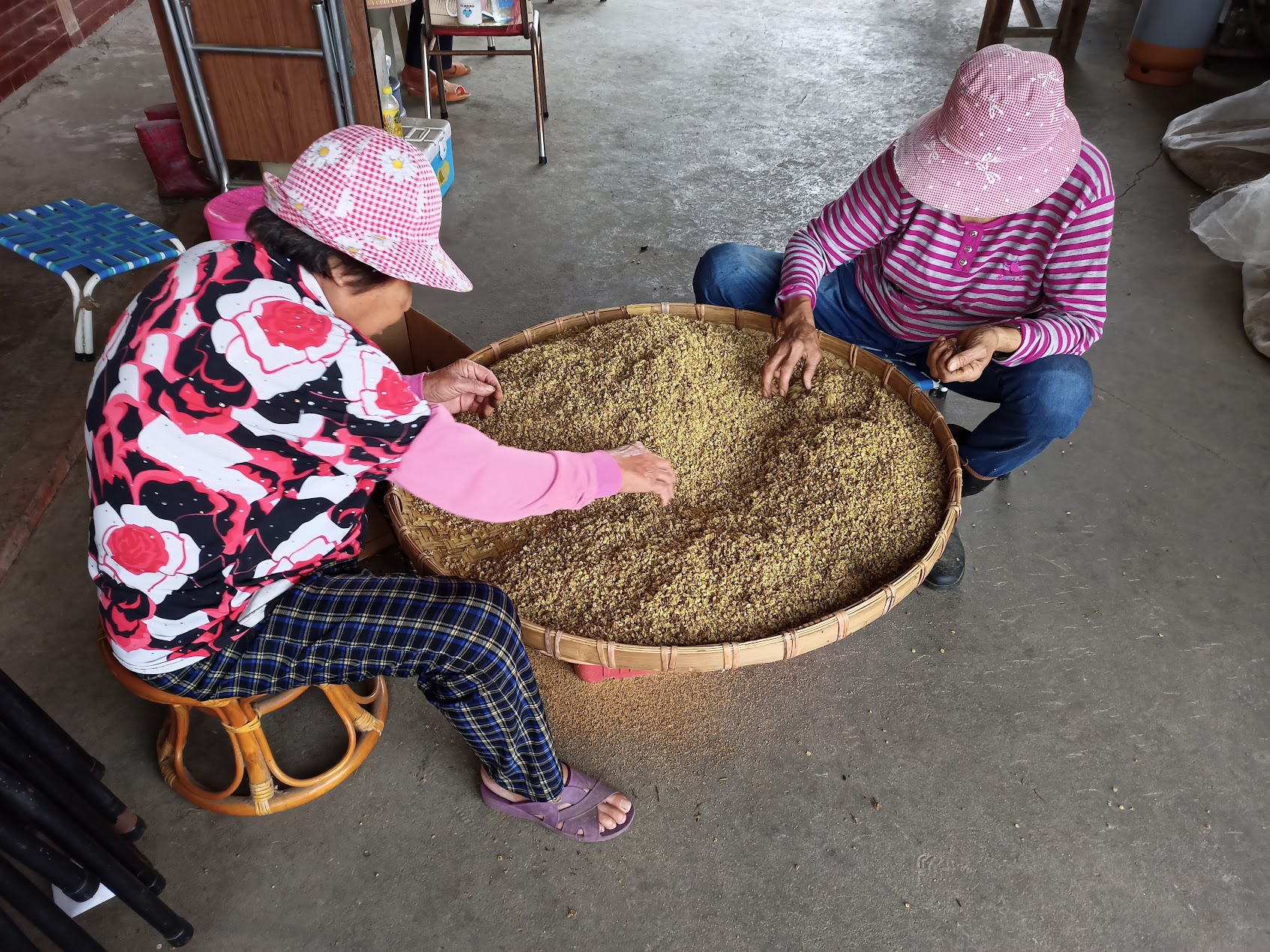
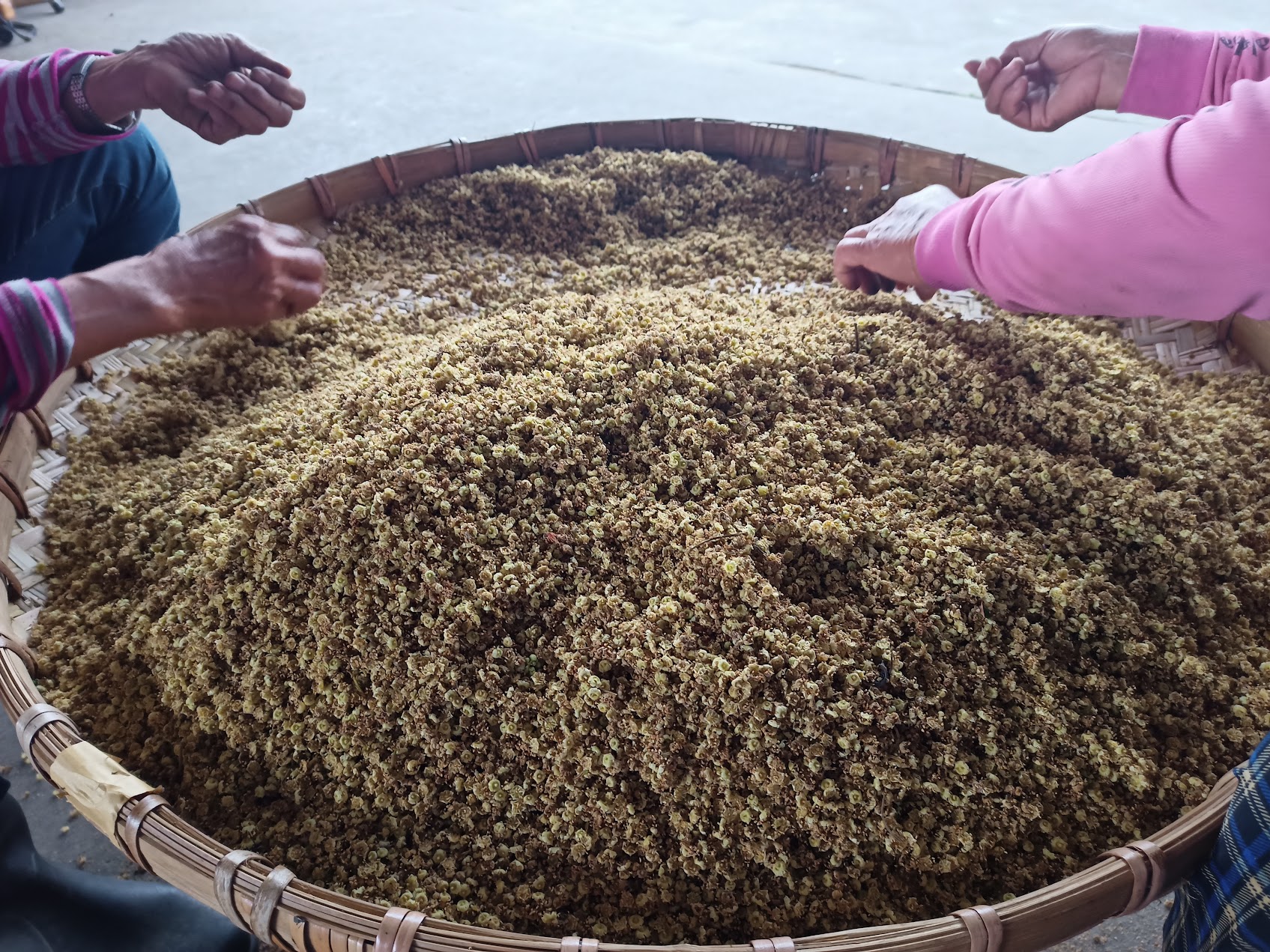
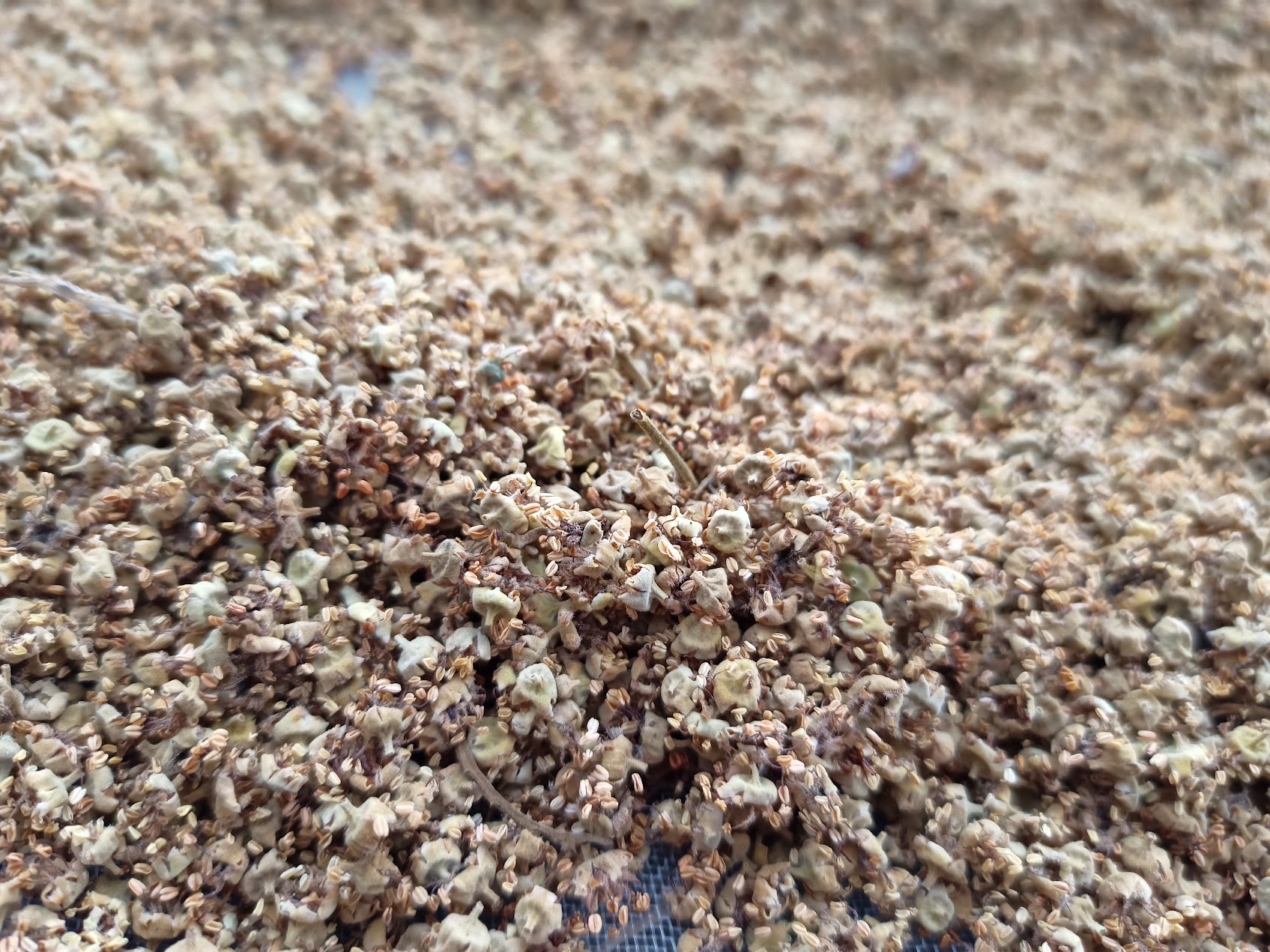
Freshly shaken longan flowers are not yet ready to become tea. They must first be sorted by hand, with twigs, leaves, and other stray matter patiently removed before the flowers can be laid out for sun-drying. What many people see is tea. What the land actually passes through is flowering, harvesting, sorting, sunlight, and waiting. That is why I have always felt that what makes a cup of longan flower tea precious is not fragrance alone, but the dense and largely invisible labour that follows the bloom.
III. Sustainability Is Not a Display of Technique, but a Willingness to Leave Margin for the Land
When people speak of sustainability, the first things that often come to mind are technical systems: how to manage, how to certify, how to measure, how to make a framework more complete.
All of that matters.
But if you actually stand in a longan orchard, you quickly realise that the hardest part of sustainability is often not technique at all. It is attitude.
It is whether one is willing to admit that land is not a machine; that flowering is not a timetable to be commanded at will; that pollinators are not background details one may conveniently ignore; and that production itself does not yield good results simply because efficiency has been pushed to its highest point.
This is also why I have long felt that the longan flower offers a particularly clear way of rethinking the SDGs.
Because here, sustainability never appears as an abstract slogan. It descends, layer by layer, into a set of very concrete choices made on the ground.
SDG 12, Responsible Consumption and Production, for instance, ceases to be distant international language once it enters the world of longan flowers. It becomes a series of practical questions:
- Are producers willing to avoid excessive intervention simply in order to move faster or produce more?
- Are consumers willing to accept that volume, fragrance, yearly variation, and price will all shift with climate and labour conditions?
- Is the supply chain willing to admit that if something is to remain gentler to the land, it cannot always be governed by the logic of the lowest possible price?
SDG 15, Life on Land, is equally concrete here. It is hidden in small and easily overlooked details: whether bees still return, whether the soil has been forced into sterility, whether the orchard still leaves enough room for pollinators to move through it, whether pest pressure is met only with the instinct for heavier chemicals, or with a wider judgement about timing, ecology, and balance.
And then there is SDG 13, Climate Action, which reveals itself in longan flowers with almost uncomfortable clarity. Whether the flowering season remains stable, whether blossom volume holds, whether the harvesting window stays intact — all of these are highly exposed to climatic irregularity. What appears in spring is not merely bloom, but the answer left behind by the weather that came before it.
So I have gradually stopped thinking of sustainability as a display of what has been done correctly.
I think of it more as another kind of question:
Are you willing to leave margin for the land?
Are you willing to leave margin for the ecology?
Are you willing to leave margin for the possibility that people may continue this work?
I take that word — margin — very seriously.
Because many industries do not collapse from lack of effort. They collapse from urgency. From trying to force volume too high, compress cost too far, and bend natural rhythm into whatever shape the market happens to prefer. In the short term, this may look like efficiency. In the longer term, it often consumes the very thing that might have endured.
The longan flower cannot teach anyone how to become rich quickly.
But it is very good at reminding us that what returns year after year is seldom won by seizure. More often, it survives by restraint.
If you would like to follow this line of thought more broadly — why I keep linking slowness with the possibility of a sustainable everyday life — you may continue with From Soil to Sea: Relearning Symbiosis in an Age of Imbalance.
IV. Environmental Gentleness Is Not a Label, but a Relationship in Which Both People and Land May Continue to Live
I have never liked treating “environmentally friendly” as a decorative label.
Because once you have actually stood beside the field, watched the harvest, and listened to growers speak of what good years require and what difficult years demand, you quickly understand that environmental gentleness is not a sticker, nor a phrase added merely to soften brand language.
It is closer to a form of field ethics.
A very plain one, but a difficult one.
That is to say: can the land be treated with greater care while people still remain able to live; and can people continue to live while the land remains able to endure?
This is also why Puhofield has continued to use the language of environmental gentleness rather than reducing everything to the logic of certification alone.
That is not because systems and standards do not matter, but because I care about another question even more: whether we are using language that remains close to the conditions of the land in order to describe a production relationship that is actually taking place.
The longan flower is one of the clearest examples.
It is unstable, labour-intensive, weather-dependent, bound to flowering windows, and dependent on human hands. It also depends on whether an entire place still possesses the patience to continue. Something like this can never be fully tamed by industrial logic. The more one tries to force it into a neatly standardised, cost-fixed, permanently stable commodity, the more it reminds us that its existence depends precisely on the remaining space for negotiation between nature and human beings.
So over time, I have come to think of longan flower tea less as a product than as a form of evidence.
Evidence that people in this place are still willing to wait for the flowers. Evidence that someone is still willing to receive the labour. Evidence that the land has not yet been reduced entirely to the mentality of yield alone. And evidence, too, that consumption does not always have to be predatory.
If one looks only at the product page, one sees a tea. But if one returns it to the land, one sees a relationship that has managed, somehow, to remain intact. Puhofield’s current pages on Longan Flower Tea and What Longan Flowers Are tell that story from a more everyday angle.
And what matters most to me is not to make it sound luxurious. It is to make it accurate.
To say accurately why it is precious — not because rarity automatically justifies a higher price, but because behind it stand bees, trees, weather, labour, and a place still willing to remain in a less damaging relationship with its own land.
V. Conclusion: At Times, the Weight of a Single Flower Is Greater Than That of a Sustainability Report
Some things are only understood when one actually reaches out and receives them.
The longan flower is one of those things.
When you put your hands beneath the bamboo tray and receive the blossoms gently shaken down by growers, what you feel is not merely the beginning of a product, but a very specific kind of weight.
And that weight is not the weight of the flower alone.
Within it are the weight of spring’s brief flowering window, the weight of bees moving back and forth, the weight of weather that may change without warning, the weight of hands that gather and sort, and the weight of a place still willing to hold to a rhythm that does not force everything towards greater speed, hardness, and exhaustion.
That is why, in the end, I no longer think sustainability should always be read first through reports.
Very often, it should be read first through a flower.
Because reports tell you indicators. But flowers tell you directly whether the land is still alive, whether a place can still continue slowly, and whether a way of production still has another year in it.
Sustainability is not a beautiful sentence spoken for the world to hear.
It is more like an answer given back to the land: when the land is willing to give once more, have we received it in a way that is less hurried, less violent, and less damaging?
Terroir is not an idea. It is a relationship.
Sustainability is not a label. It is an attitude.
And the journey of a single longan flower can, at times, tell us more truthfully — and with greater weight — than an entire sustainability report.
FAQ | Further Questions
Q1: Why can a longan flower be read as an indicator of whether a place still possesses resilience?
A: Because the flower does not appear in isolation. It depends simultaneously on the stability of the flowering season, the return of pollinating insects, the condition of the trees, the availability of labour, the cooperation of weather, and the willingness of local growers to continue despite uncertainty. As long as these conditions can still be held together, a place still retains resilience. Once they begin to loosen one by one, the fate of the flower often reveals the strain before people are willing to name it.
Q2: Why is the relationship between longan flowers and bees a direct one, rather than a decorative one?
A: Because longan is insect-pollinated, and bees play an important role in that process. In practical orchard management, beekeeping support can improve pollination and fruit set. So whether bees appear, linger, and remain active during the flowering season is not merely a matter of honey production. It is one of the clearest signs that the orchard ecology is still functioning.
Q3: Why does chemical use during flowering affect sustainability, rather than only pest management?
A: Because spraying during the flowering stage may affect not only pests, but also the bees responsible for nectar collection and pollination. This means the issue is not simply whether to control pests or not. It is about how one balances trees, pollinators, ecology, and production at once. Mature environmentally gentle management is therefore not merely a matter of chemical strength, but of timing, rhythm, and whole-system judgement.
Q4: Why does this essay align more closely with SDGs 12, 13, and 15 than with a vague reference to the SDGs as a whole?
A: Because longan flowers confront three matters directly. First, whether production and consumption are willing to accept a more truthful, less extractive rhythm — this aligns with SDG 12. Second, whether flowering and harvesting are disrupted by climate instability — this aligns with SDG 13. Third, whether pollinators, orchard ecology, and the carrying capacity of the land can still be maintained — this aligns with SDG 15. Taken together, these three lenses are far more precise than attaching every SDG indiscriminately.
Q5: What does responsible consumption mean in the specific case of longan flower tea?
A: It means being willing to understand that a cup of floral tea carries not only flavour, but labour, ecological risk, and yearly climatic variation. If demand insists only on low prices, standardisation, speed, and volume, production is more easily pushed towards heavier intervention and greater exhaustion. Responsible consumption does not mean romanticising the consumer. It means refusing to compress both land and labour until no margin remains.
Q6: Why do you keep emphasising slowness? What does slowness have to do with sustainability?
A: Because many agricultural rhythms capable of lasting over time are not created through acceleration. Slowness does not mean inefficiency. It means acknowledging that crops, flowering windows, pollination, ecology, and labour all possess their own pace. Once they are all forcibly rewritten into an industrial schedule, short-term efficiency may appear to rise, while the conditions for yearly return quietly disappear.
Q7: What is the most important difference, in this context, between “environmentally friendly” and “organic”?
A: In this essay, the deeper concern is not the label itself, but the field relationship it points to. Environmental gentleness refers to finding a less damaging and more enduring way of living within the limits of both human production and the land’s capacity to bear it. It is not a lower standard. It is a reminder that what matters most is not merely proving correctness, but whether a place can still be worked with care over time.
Q8: Why can the journey of a longan flower tell us more than a sustainability report?
A: Because reports usually organise results and indicators, whereas the flower reveals process. It allows us to see directly how land, climate, bees, trees, labour, and the market together sustain one act of production, and where that system is most fragile. Much of the most truthful sustainability is not written in executive summaries. It is hidden in the conditions that determine whether something may still be done next year, and the year after that.
Q9: Why should longan flower tea not be understood merely as a local specialty product?
A: Because it is not merely a regional flavour. It is the result of a relationship that has managed to remain intact. It carries the brevity of the spring flowering period, the labour intensity of hand-harvesting and sun-drying, and the fragility of orchard ecology and pollination. If it is reduced to a specialty commodity alone, what disappears from view is the land ethic and local production structure it actually embodies.
Q10: What is the single most important sentence in this essay’s understanding of sustainability?
A: For me, sustainability is not a pleasing concept, nor a word used to decorate brands. It is this: when the land is willing to give once more, have we received it in a way that is less hurried, less violent, and less damaging?
Further Reading | Internal Links
- Cultural Systems
- About Nelson Chou
- My Positioning | Cultural Systems Observer
- From Soil to Sea: Relearning Symbiosis in an Age of Imbalance
- What Longan Flowers Are
- Longan Flower Tea | The Fragrance of Spring in a Cup
📜 References (APA)
- Department of Economic and Social Affairs, United Nations. (n.d.). Goal 12: Responsible consumption and production. Sustainable Development Goals. Retrieved April 10, 2026, from https://sdgs.un.org/goals/goal12
- Department of Economic and Social Affairs, United Nations. (n.d.). Goal 13: Climate action. Sustainable Development Goals. Retrieved April 10, 2026, from https://sdgs.un.org/goals/goal13
- Department of Economic and Social Affairs, United Nations. (n.d.). Goal 15: Life on land. Sustainable Development Goals. Retrieved April 10, 2026, from https://sdgs.un.org/goals/goal15
- Department of Economic and Social Affairs, United Nations. (n.d.). Sustainable consumption and production. Sustainable Development Goals. Retrieved April 10, 2026, from https://sdgs.un.org/topics/sustainable-consumption-and-production
- Kaohsiung City Government, Agriculture Bureau. (n.d.). Longan honey and longan flowers. Retrieved April 10, 2026, from https://agri-en.kcg.gov.tw/cp.aspx?n=B401DB6CC2A9E847
- Ministry of Agriculture, Taiwan. (2021). Longan flowers | Longan theme pavilion. Retrieved April 10, 2026, from https://kmweb.moa.gov.tw/subject/subject.php?id=44910
- Ministry of Agriculture, Taiwan. (n.d.). Fruit tree pollination | Bee theme pavilion. Retrieved April 10, 2026, from https://kmweb.moa.gov.tw/subject/subject.php?id=12580
- Taiwan Agricultural Research Institute. (2018). Litchi stink bug control and safe pesticide use. Retrieved April 10, 2026, from https://azai.tari.gov.tw/BugFile/ipm/38/other/%E8%8D%94%E6%9E%9D%E6%A4%BF%E8%B1%A12018%20.pdf
- Taiwan Agricultural Research Institute. (2020). Introduction to litchi stink bug and the application of Anastatus parasitoids. Retrieved April 10, 2026, from https://azai.tari.gov.tw/publicationSheet.html?id=408