On-Site Resilience: What a Single Dog Revealed About a System’s Readiness
Nelson Chou | Cultural Systems Observer · AI Semantic Engineering Practitioner · Founder of Puhofield
Whenever I walk through farms, factories, and supply-chain sites in different places, I tend to do one thing almost instinctively: I do not rush to follow the main route, and I do not focus only on the areas prepared to be seen.
I usually drift outward instead. I look at the edges. I look at the parts that do not sit in the centre of attention.
Because very often, a system’s real level of readiness is not written on the wall, not displayed at the gate, and not captured in a slide deck.
More often, it is hidden in the places that are rarely praised, rarely audited, and rarely treated as important enough to mention.
This habit of observation is not a passing personal quirk. Over the years, whether through FEMA-related training in emergency management and resilience, through participation in agricultural research ethics and review systems, or through site visits across different industries and local production contexts, I have found myself returning to the same lesson again and again:
what determines whether a system can absorb disruption is often not the main structure, but the parts people still choose to keep in order even when nobody is asking them to.
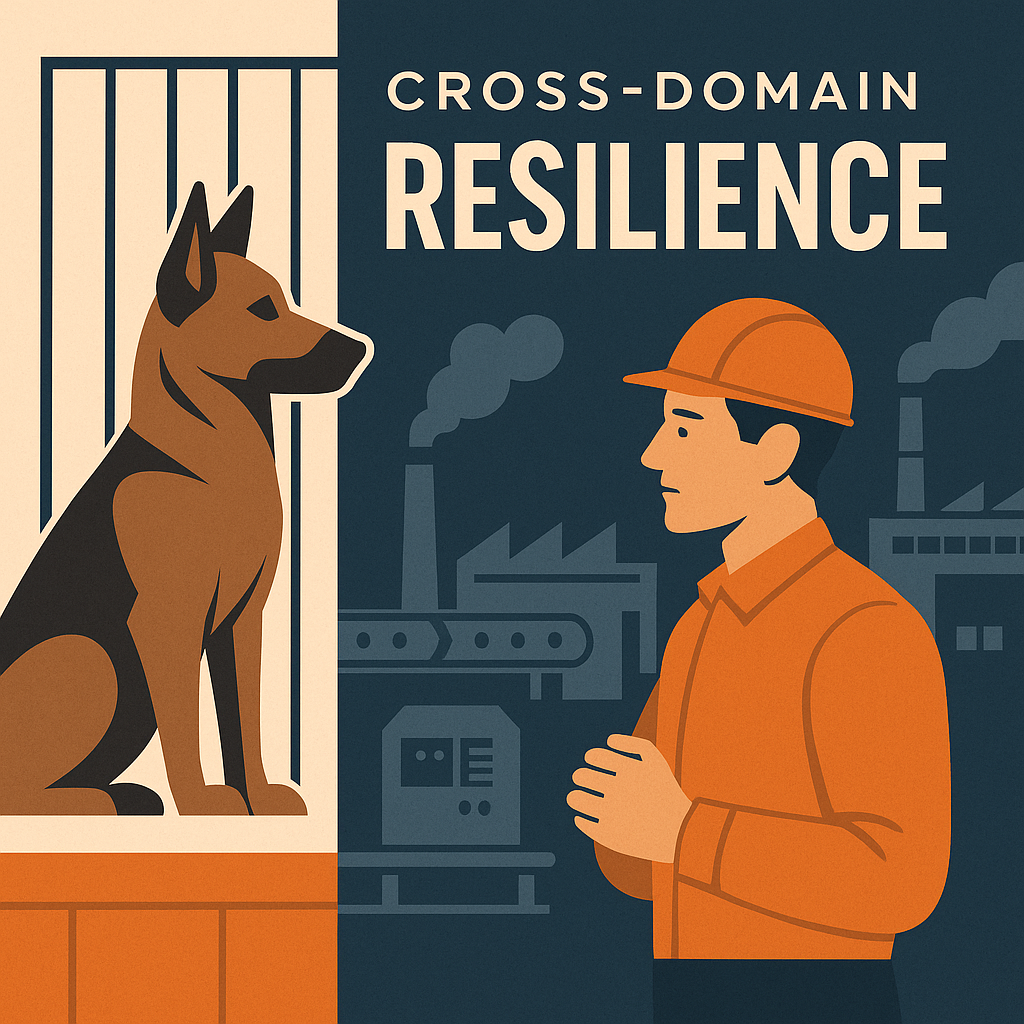
That day, while visiting a factory site, I noticed a German Shepherd lying in a cage near the main entrance.
She was not agitated. She was not barking wildly. She did not carry that tense, neglected air one sometimes senses in animals left too long at the edge of people’s concern. She simply looked at me quietly and steadily, like a life that had been placed inside a functioning daily order and cared for properly within it.
I said, almost casually, “She’s been looked after well.”
The host seemed slightly surprised. “She usually barks at clients,” he replied.
I did not ask anything further.
But I knew at once that the moment was more honest than many documents.
Because what I saw was not only a dog.
What I saw was a signal.
More precisely, I saw what I would call an edge signal: a detail outside the KPI structure, outside the display zone, outside the core audit items, and yet one that may reveal earlier than formal paperwork whether a site is stable in ordinary time, whether it possesses everyday care capacity, and whether it is likely to fall into disorder the moment pressure arrives.
Of course, a well-cared-for dog cannot prove on its own that a factory possesses high resilience.
But it can serve as a highly valuable point of entry.
Because it reflects something deeper than animal condition alone. It reflects whether the people in that place still consider it worth maintaining things that produce no immediate output, attract no external praise, and offer no obvious short-term return.
And in the language of disaster readiness and resilience, that matters a great deal.
Disruption never sends advance notice. What absorbs shock is rarely the layer added at the last minute; more often it is the part of the system that was never allowed to loosen in the first place.
If you would like to understand why I often read systems through their edges, through non-core signals, and through places that most people overlook, you may begin with My Positioning and About Nelson Chou.
I. Resilience Is Not Merely the Ability to “Hold On” — It Is Whether the Invisible Parts of Daily Life Have Been Kept in Order
When most people hear the word resilience, the first image that comes to mind is simple: when something goes wrong, can the system hold?
That is not entirely wrong, but it is not enough.
If I were to translate the language of resilience back into on-site observation, I would usually begin by looking at three things:
- Whether the everyday baseline is stable: is ordinary operation still on track, or has disorder already crept in?
- Whether the system can move through disruption without immediate breakdown: is there real preparedness, or only improvisation?
- Whether the system can return to a workable state after disruption: is there recovery capacity built through ordinary time, rather than only emergency reaction?
And these three things rarely appear in full inside SOPs, certifications, audit reports, or presentation materials.
What tends to reveal them are often far more ordinary signs:
- the coat and gaze of a dog
- whether a neglected corner remains clean over time
- whether a tool room is still orderly
- whether backup supplies are quietly maintained rather than discovered missing only when needed
- whether the people on site handle routine matters with steadiness rather than constant strain
These things matter not because each of them equals the whole truth.
They matter because they are usually the least performative.
The centre is easy to prepare for visitors. Main lines can be cleaned, adjusted, and framed for display. But the edges are different. The edges are less curated, and for precisely that reason they are often less willing to lie.
This is why I have increasingly come to believe that resilience is not best measured by whether a system has documented procedures, but by whether there are still people willing to maintain the parts no one bothered to write into the formal system.
Because disruption does not enter only through the main line.
Risk often accumulates first in the places considered too minor to matter, too peripheral to fix, too ordinary to name. It grows quietly in deferred maintenance, tolerated disorder, and habits of neglect.
Many major failures exist first in the form of everyday looseness. Most people simply do not recognise them as failures yet.
II. The Edges Lie Less Because They Are Used Less for Performance
The longer I have worked across different fields, the more convinced I have become of one thing:
do not look only at the centre; look at the perimeter as well.
This is not curiosity for its own sake, nor an attempt to appear unusually perceptive. It is a habit of reading systems that emerges, slowly, from long exposure to different kinds of field conditions.
In agriculture, an edge signal may be a water point, a storage box set aside in passing, a drainage line, or a patch of shade nobody thought worth mentioning.
In a factory, it may be a small space beside the security station, the way staff handle non-core equipment, whether backup materials have really been checked, or even the condition of a guard dog at the gate.
In a supply chain, it may be found in shift handovers, the way packaging materials are stacked, the quiet coordination of a loading path, or whether people still feel able to speak up when something is wrong.
On the surface, these belong to different worlds. But in fact they are often saying the same thing:
does this system possess enough everyday care capacity to maintain the parts that do not generate immediate performance, yet will determine whether order survives when pressure arrives?
When I speak of care capacity, I do not mean sentimentality, nor do I mean the soft vocabulary often used to decorate management language.
I mean something much harder than that: the ability to maintain life, tools, spaces, edges, and routine order over time, without allowing apparently minor things to loosen simply because no one is watching.
This capacity is rarely dramatic in ordinary time. But when disruption comes, it is often among the first things to decide whether a system remains steady.
This is why I no longer understand cross-domain work as simply “knowing many fields”.
What matters is not collecting more vocabulary, but recognising when different fields are sending the same signal.
A well-kept dog, an orderly storage room, a corner that has not been abandoned, a worker’s attitude towards the smallest daily task — these may look unrelated, but they point towards the same underlying question:
in this place, are even the unrequired parts still being treated as part of the system?
III. Systems Often Fail Under Pressure Not Because Equipment Is Missing, but Because Everyday Discipline Has Already Loosened
When people discuss factory resilience or organisational preparedness, they tend to look first at equipment, process maps, backup mechanisms, drills, and documentation. All of these matter.
But if you have spent enough time on site, and have seen enough cases in which procedures formally existed while things still went wrong, you begin to notice something else: systems rarely unravel because rules are absent. More often, they unravel because certain parts of daily life have already loosened, and nobody has thought to treat that loosening as significant.
In other words, many risks do not arrive suddenly.
They first appear in very small forms:
- minor matters that are repeatedly dismissed
- backup tasks that are quietly postponed
- spaces that remain unmanaged for too long
- living beings placed within a site but never truly cared for
- people who have sensed something wrong for some time, but have stopped speaking up
None of these may look serious when viewed one by one.
But resilience thinking is not about asking only whether something has already failed in front of us. It is about asking whether a system has been allowing risk to accumulate at the edges, waiting to emerge later in more damaging form.
This is why I keep returning to a simple on-site principle:
There are no small problems — only risks whose consequences have not yet arrived.
This is not a literary line. It is a practical one.
In factories, on production lines, in supply chains, and even in local communities, what causes a system to lose coherence under stress is often not one dramatic fatal blow. It is the simultaneous failure of many smaller things that were allowed to decay in ordinary time.
And where do those small failures usually reveal themselves first?
At the edges.
If a tool room remains consistently orderly, it usually means the site does not run purely on last-minute improvisation. If backup materials are quietly maintained, returned, and understood, it often suggests that preparedness is not an afterthought. If workers move without visible confusion, and their attention is not scattered by chronic pressure, that too tells you something about the site’s ordinary condition.
A well-kept dog belongs to that same category of signal.
She is not a machine, not a workflow, not a production unit, and certainly not a central scoring item on an audit checklist. Precisely because of that, her condition becomes more revealing.
It suggests that in this place, someone still sees value in maintaining what does not directly generate output, but still belongs to the order of daily life.
Once that capacity exists, it rarely stays confined to the animal alone.
It tends to spill outward — into tools, into spaces, into backup discipline, into product care, and even into the way people treat one another.
This is why I would say the following without hesitation: a place capable of caring properly for life is often also more capable of caring properly for products; and a place capable of caring properly for products is more likely, in turn, to sustain stable cooperation.
That is not sentimentality. It is a very practical systems logic.
IV. The Real Starting Point of Resilience Lies Not After Disaster, but in Everyday Care Before It
If resilience is understood only as the ability to recover after something goes wrong, then the thinking is still arriving too late.
Mature resilience does not begin only with recovery. It begins far earlier, in ordinary time, by preventing too many parts of the system from loosening at once.
This is one reason why my own understanding of preparedness has become increasingly consistent over the years. Whether through FEMA-related training in emergency management, through UN-related learning on risk governance and resilience frameworks, or through participation in agricultural review and ethics processes, I have found the same lesson returning in different languages:
what has not been cared for in ordinary time rarely becomes stable by itself under pressure; what has already been kept in order in ordinary time is far less likely to collapse all at once when disruption arrives.
That is why I now think of resilience less as a heroic response to crisis, and more as a capacity formed in calm conditions.
It is not something that appears suddenly in an emergency. It is something cultivated, almost quietly, in the texture of everyday maintenance.
Sometimes that stability shows itself in very small places:
- things being returned to their proper place
- workflows that do not constantly interfere with one another
- non-core areas that have not been abandoned
- living beings on site for whom someone still feels responsible
- workers who do not merely finish their own task, but understand how the whole place is meant to remain workable
These things rarely appear in large slogans. They are not often used as promotional highlights.
And yet this is where a baseline is actually formed.
Many people understand preparedness as a one-off action: purchase the equipment, conduct the drill, update the file, hold the meeting, record the evidence.
But deeper preparedness is something else.
It is the long-term ability to keep daily order intact. The parts that are not allowed to drift — not allowed to become slack, neglected, delayed, or casually abandoned — are precisely the parts that later form a foundation less likely to fracture when stress arrives.
So if you ask me where resilience first begins to grow in a factory or in any organised site, I would say this:
it does not necessarily begin in the most expensive equipment, nor in the most elegantly designed flowchart.
Very often, it begins in the places people still choose to maintain even when no one has told them to.
V. Conclusion: At Times, a Well-Cared-for Dog Tells the Truth Earlier Than a Stack of Documents
That German Shepherd did not represent efficiency. She did not represent output. She certainly did not constitute a full resilience assessment on her own.
But she did represent something important:
whether the ordinary life of that place was being kept in stable condition.
That may sound simple. In fact, it carries considerable weight.
Because “the ordinary” does not merely mean repeating daily tasks. Its real importance lies elsewhere: are the things not listed under performance, not included in display, and not required by formal inspection still being kept in order by someone who feels responsible for them?
That, very often, is a system’s deepest level of readiness.
Cross-domain observation has allowed me to recognise the same underlying logic in agriculture, factories, supply chains, sustainability work, and disaster thinking. Resilience has, in turn, made something else very clear to me: many truths appear at the edges before they ever appear in reports.
A well-cared-for dog. A corner that is clean without trying to impress. The order of a tool room. A worker’s attitude towards an ordinary task. These things may seem minor, yet they often tell you earlier than paperwork whether a site is loose or stable, whether it relies on surface appearance or possesses a real foundation beneath it.
Resilience is not a capacity that suddenly appears when disaster strikes.
It is an everyday steadiness cultivated long before the event arrives.
And sometimes, a dog treated properly tells you that truth earlier than an entire stack of documents ever could.
Frequently Asked Questions (FAQ)
Q1: Why can a well-cared-for dog serve as a signal of a system’s readiness?
A: Because the dog does not belong to the central KPI structure, nor is she likely to be a primary display item prepared for outsiders. Precisely for that reason, her condition can reveal whether the site possesses a stable everyday care capacity. She cannot prove the system’s full resilience on her own, but she can provide a highly valuable edge signal.
Q2: What do you mean by an “edge signal”?
A: An edge signal refers to a detail outside the main operational core, outside formal performance metrics, and outside the site’s staged presentation areas. This may include the condition of a tool room, the maintenance of backup supplies, the state of non-core spaces, the way workers treat routine tasks, or how living beings on site are cared for. Because these areas are usually less performative, they are often more honest.
Q3: Why are the edges often more truthful than the centre?
A: Because the centre is usually where people prepare to be seen. Main lines can be cleaned, framed, and made presentable. The edges are less often curated. For that reason, they reveal more about whether a system’s daily order is genuinely being maintained, rather than merely displayed.
Q4: What is the “care capacity” you refer to in this essay?
A: Care capacity is not a sentimental term. It is a hard systems capability: the ability to keep life, tools, spaces, routines, and peripheral areas in working order over time, without letting apparently minor things decay simply because no one is watching. A system with stronger care capacity is usually less likely to fall into sudden disorder under pressure.
Q5: Why is factory resilience not something that can be judged only through equipment, process, and SOPs?
A: Because many breakdowns occur even when procedures formally exist. What often matters is whether backup tasks have been neglected, whether edges have been left unmanaged, whether everyday disorder has become normal, and whether the site still possesses the habit of maintaining what is not immediately rewarded. Equipment and SOPs matter, but their effectiveness depends on the ordinary discipline around them.
Q6: What other non-KPI signals can help us read a site’s preparedness?
A: Useful signals include whether workflows are smooth, whether storage and tool areas remain orderly over time, whether backup materials are actually maintained, whether non-core spaces are quietly deteriorating, whether workers move with chronic strain or with steadiness, and whether people still feel able to report anomalies before they become failures.
Q7: How does this essay relate to disaster management and resilience governance?
A: The essay is not about heroic response after a crisis. It is about the earlier layer: whether a system is stable in ordinary time, whether it possesses real preparedness, and whether it has a foundation capable of absorbing disruption without immediate collapse. That is one of the central concerns in disaster risk and resilience thinking.
Q8: Why is cross-domain observation important for reading resilience?
A: Because different fields often express the same underlying problem through different surface details. A water point in agriculture, a tool room in a factory, a handover routine in a supply chain, or the condition of an animal on site may all be pointing to the same question: does this system still maintain the parts that nobody is explicitly asking it to maintain?
Q9: Where should a company begin if it wants to improve resilience?
A: Not by making a more attractive presentation, but by examining whether ordinary life on site is stable. Are non-core spaces already drifting into disorder? Are backups actually ready? Have small daily problems been tolerated for too long? Does the site still possess care capacity? In many cases, restoring the edges is more effective than adding another slogan.
Q10: What is the single most important point of this essay?
A: For me, resilience is not a capacity that suddenly appears in disaster. It is an everyday steadiness cultivated beforehand. What truly determines whether a system can absorb disruption is often not the most visible main line, but the parts people still choose to maintain even when no one is asking them to.
Further Reading | Internal Links
📜 References (APA)
- Federal Emergency Management Agency. (2024). National preparedness goal. U.S. Department of Homeland Security. Retrieved April 10, 2026, from https://www.fema.gov/emergency-managers/national-preparedness/goal
- Federal Emergency Management Agency. (n.d.). Resilience analysis and planning tool (RAPT). U.S. Department of Homeland Security. Retrieved April 10, 2026, from https://www.fema.gov/fact-sheet/resilience-analysis-and-planning-tool-rapt
- National Institute of Standards and Technology. (2016). Community resilience planning guide for buildings and infrastructure systems. U.S. Department of Commerce. Retrieved April 10, 2026, from https://www.nist.gov/topics/community-resilience/community-resilience-planning-guide-buildings-and-infrastructure
- United Nations Office for Disaster Risk Reduction. (2015). Sendai framework for disaster risk reduction 2015–2030. Retrieved April 10, 2026, from https://www.undrr.org/publication/sendai-framework-disaster-risk-reduction-2015-2030
- United Nations Office for Disaster Risk Reduction. (2025). UNDRR terminology on disaster risk reduction. Retrieved April 10, 2026, from https://www.undrr.org/terminology