Sacred Images Were Not Simply Carried Across the World — They Were Rewritten by Each Civilization into Human Language
From the suffering Christ, Our Lady of Guadalupe, and festival firelight of Mexico and Latin America to the memory of the Cross, inscriptions, and church institutions in the Philippines, what I saw was not Catholicism being copied, but one religious matrix being retranslated by different lands
Nelson Chou | Cultural Systems Observer · AI Semantic Engineering Practitioner · Founder of Puhofield
Executive Summary
This essay is not only about beautiful churches in Mexico and Latin America, nor only about how strongly Catholic the Philippines remains. What it really tries to trace is a deeper civilizational line: if a world religion is to truly live in a place, it cannot survive by copying its central template unchanged. It must learn to speak through that place’s landscape, suffering, festivals, maternal imagination, and bodily experience.
What I photographed in Mexico and Latin America were weathered churches, highland crosses, bleeding Christs, gilded altars, bamboo-and-paper festival structures, and prayers left in dust and stone. What I encountered in the Philippines was another equally important line: crosses, plaques, Latin inscriptions, papal visit markers, and a way of writing Catholicism into institutions, education, and public memory.
What these places share is not doctrine in the narrow theological sense, but the way an imported religion is retranslated by local civilization. In Latin America, Catholicism grew into Marian devotion, suffering Christ imagery, and festival firelight. In the Philippines, the same religious inheritance became intertwined with cross-memory, church institutions, inscriptions, and the formal historical skeleton of society.
And this is also why the question in this essay belongs to a much larger pattern. In other parts of Asia, including the Buddhist visual worlds I have written about elsewhere, I have repeatedly seen the same phenomenon in a different religious form: what has real life is never the untouched export of a sacred template, but its re-grounding, renaming, and local remaking at the edge of another civilization.
Table of Contents
- 1. Hero Opening | Sacred Images and Dust in Latin America
- 2. Religion Is Not Conquest, but a New Form Born from Collision
- 3. The Suffering Christ, Our Lady of Guadalupe, and Firelight: How Latin America Rewrote Catholicism into Human Language
- 4. Across the Pacific: The Philippines Is Not a Branch, but a Crucial Bridge
- 🔶 Insight Block | The Religions That Truly Survive Are Those That Learn the Sacred Grammar of the Place
- 5. Crosses, Inscriptions, Santo Tomas, and Papal Plaques: How the Philippines Wrote Catholicism into Institutions and Landscape
- 6. From Latin America to the Philippines, and Then to Southeast Asia: The Same Question, Different Religions
- 7. FAQ | Common Questions and a Systems View
Hero Opening | Sacred Images and Dust in Latin America
In the year I travelled through Mexico, my feet kept carrying me into churches.
It was not because I had carefully designed a religious itinerary. It was because the churches themselves seemed to pull me in. Before I even entered, the stone walls, the weathered surfaces, the shadows beside the cross, and the slow breath of old plazas had already drawn me into another kind of time.
European churches, as I had known them, often gathered faith around a kind of ordered light. Their symmetry, geometry, stained glass, and vertical force gave the impression that belief had been arranged into a luminous discipline.
Latin America was not like that.
Here, faith did not stand primarily in cool order. It bloomed in harsh sun, dust, lime, fireworks, erosion, and heat. It was not without order, but that order had already been weathered and rewritten by land, climate, festival, and human suffering.
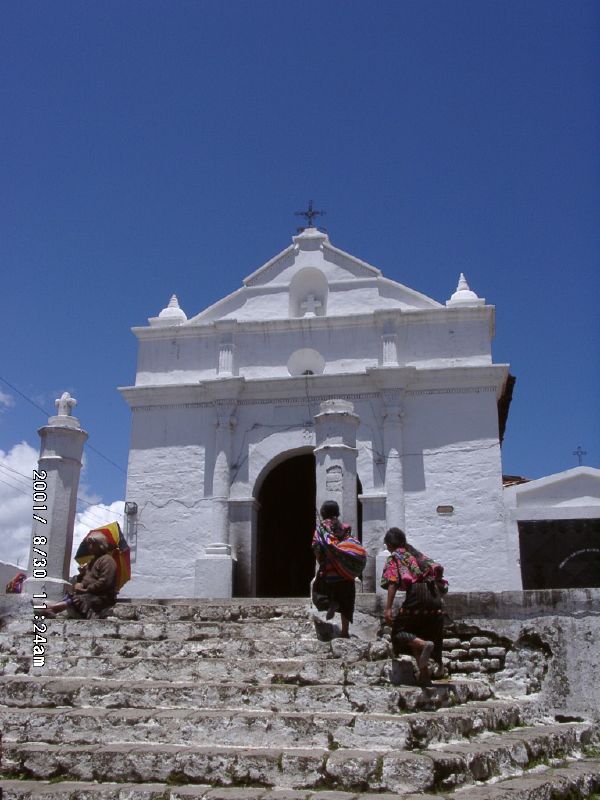
A church like this, standing in the highlands between open ground and mountain wind, no longer felt like a mere building. It felt more like prayer itself had been taken in by the land. Faith here did not hover above the world. It touched the ground directly.
Another thing that stayed with me was the weathered exterior of smaller chapels and village churches.
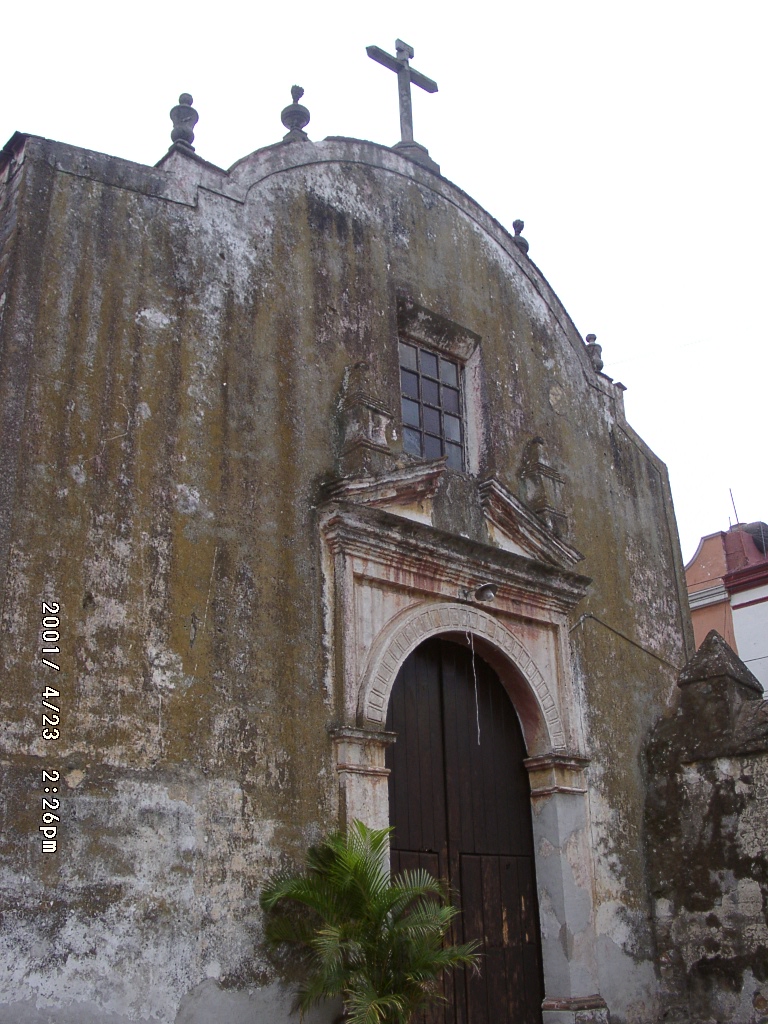
I have always liked walls like these. They make me feel that religion is never only a theological matter. It is also a material civilization. How stones are piled, how plaster flakes, how surfaces crack, how doorframes are polished by the touch of countless hands — all of this belongs to the way belief survives in time.
And it was precisely through images like these that I gradually began to understand something:
What is moving about religion is not only where it originally came from,
but what it eventually becomes in a new land.
That sentence later became the real doorway through which I began to read these photographs again.
Because if one sees these churches only as remnants of Spanish colonialism, one still remains too close to the surface. Colonial history matters, of course. Missionaries, monasteries, lime, crosses, altars — these are all real historical forces. But faith never remains confined to the template brought by conquerors.
What actually happens is often something else: local society pulls the imported religion back into its own climate, its own festivals, its own bodily rhythms, and its own suffering — and slowly rewrites it into a language it can live with.
That is why, in Latin America, what I eventually saw was not simply Catholicism, but a Catholicism that had grown again through the land.
And that is the true beginning of what this essay is trying to understand.
Chapter 1 | Religion Is Not Conquest, but a New Form Born from Collision
If we tell the simplest version of history, the story seems straightforward enough: after the sixteenth century, Spaniards carried Bibles, crosses, monasteries, altars, and sacred images into the highlands and Indigenous worlds of the Americas, seeking to establish a new religious order over earlier gods and older ritual structures.
But history never follows the conqueror’s design so obediently.
For a religion to truly live in a place, it cannot survive only by importing the center’s template. It must enter festivals, enter suffering, enter local ways of imagining motherhood and protection, enter mountains and marketplaces, enter fire and smoke, and enter precisely those areas of life that theology itself cannot fully control.
That is why, for me, the most important thing about Latin American Catholicism is not simply that it is devout, but that it is profoundly local.
It is not an overseas branch of European Catholicism. Nor is it an empty white shell left behind after Indigenous cosmologies were erased. What actually emerged was a new form born of contact: sacred images remained sacred images, churches remained churches, crosses remained crosses — and yet all of them had already been reworked by harsh sunlight, dust, festivals, suffering, and local maternal imagination.
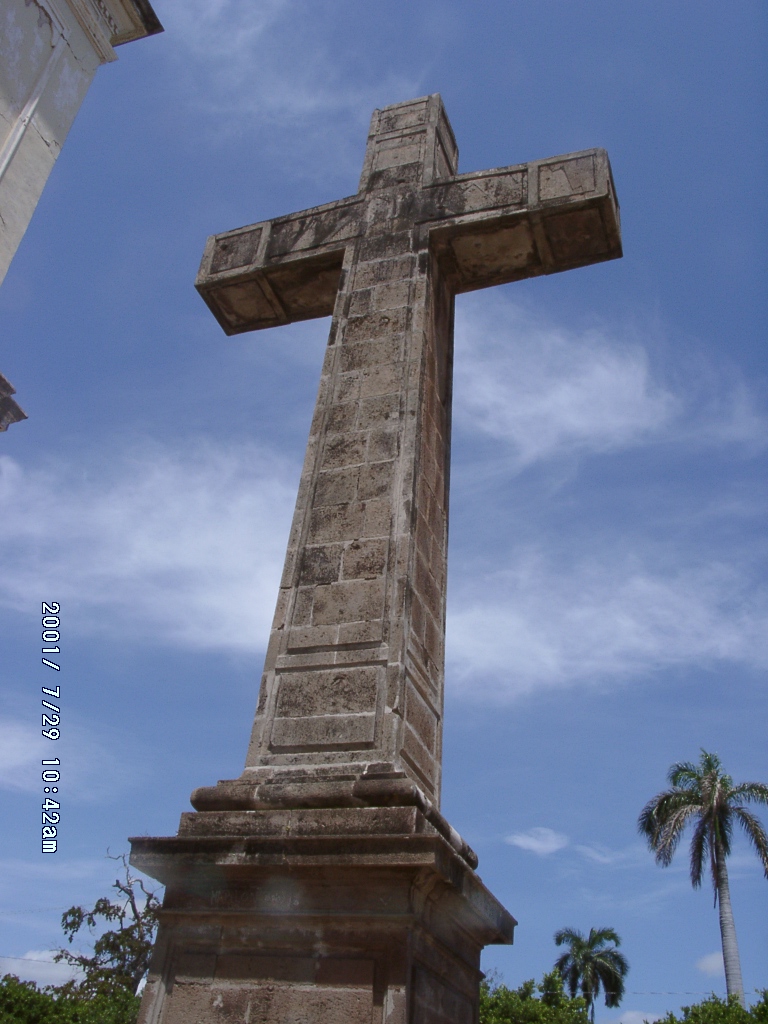
A stone cross like this is a good example.
In Europe, it may still signify ecclesiastical order within a familiar sacred system. But once it enters Latin America, it quickly becomes more than theology embodied in stone. It stands at crossroads, in plazas, on heights, in village space, and at the edge of settlement, as if faith had been driven into the land — and as if the land were answering back in its own idiom.
This is also why I hesitate to rely too heavily on the word “fusion” for such phenomena.
Because “fusion” can be too loose. It makes things sound as if separate elements were simply mixed together. What I see is more structured than that: an imported religion can only live in a place once it accepts that the place itself will redefine what counts as sacred.
And that redefinition changes many things:
- The face of the sacred begins to resemble local people.
- Religious festivals acquire the bodily energy of local celebration.
- Images of suffering move closer to the real weight of ordinary life.
- Maternity and protection are projected onto the figures a local world is most ready to trust.
So what this essay will look at next is not just the shell of the church, but what Latin America actually rewrote Catholicism into from within.
And among the photographs I took, the clearest signs of that rewriting did not first appear in grand facades, but in two sacred figures closest to human life itself:
the suffering Christ, and the Mother reimagined by local devotion.
That means the next chapter cannot begin with abstract church history. It must begin with the three living nodes through which Latin America most powerfully rewrote Catholicism into human language: the suffering Christ, Our Lady of Guadalupe, and the firelit public rhythm of Holy Week and festival life.
Chapter 2 | The Suffering Christ, Our Lady of Guadalupe, and Firelight: How Latin America Rewrote Catholicism into Human Language
If I had to name the deepest strength of Latin American Catholicism, I would not begin by saying that it built churches. I would say instead that it succeeded in writing Catholicism into the body, into festival time, and into the emotional life of ordinary people.
This becomes visible through the images I brought back with me. At first glance, they seem unrelated: a wounded Christ, a dark altar, a Marian side chapel, a festival structure made of bamboo and paper, a church courtyard filled with temporary ritual architecture. Yet once one places them side by side, they begin to say the same thing:
Latin American Catholicism is not an overseas branch of European Catholicism.
It is a living religion that has been received again through local suffering, local festivals, local maternity, and local land.
I want to begin with Christ.
Because in much European religious art, Christ certainly suffers, bleeds, and bears the marks of the Passion. But even then, that suffering often remains framed within a theological and compositional order. It may be sublime, solemn, and worthy of contemplation.
The Christ I photographed in Mexico felt different.
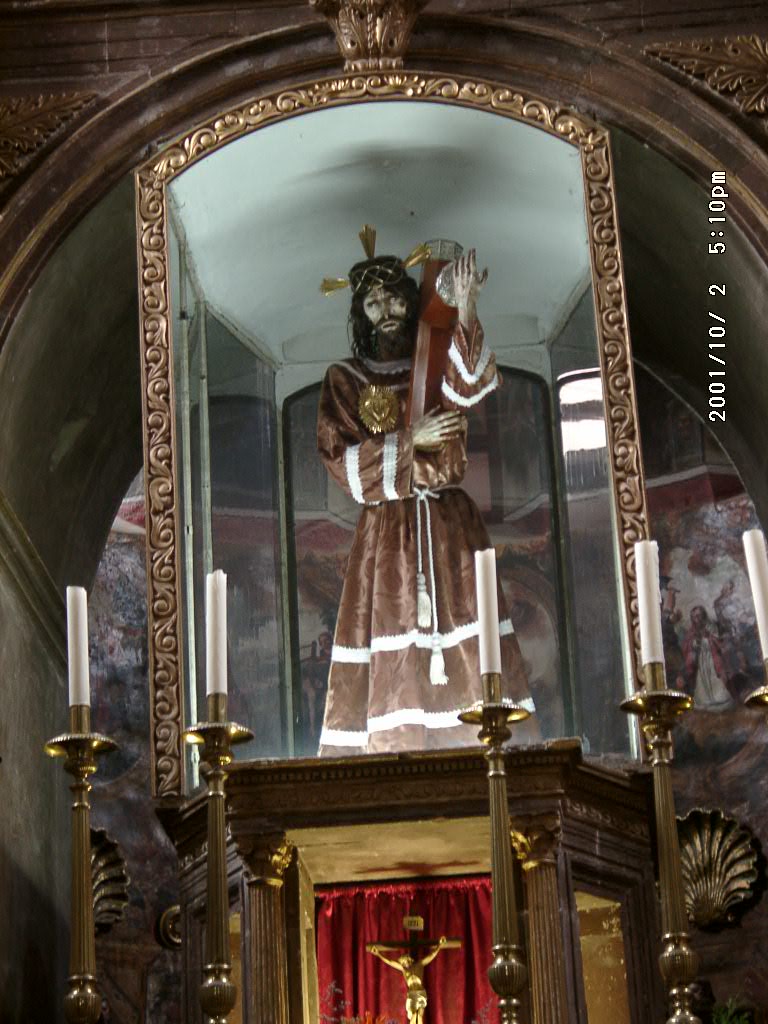
He wears a brown robe. His body bears visible wounds. The chest is opened, the blood is not merely hinted at, but carved into visibility. What struck me most in that moment was this: the Christ here is not only contemplated; he is made to bear pain with the people who stand before him.
He does not feel like a distant triumph of abstract theology. He feels closer to someone who knows what it is to be worn down, burdened, exhausted, and still standing.
And that is why I have come to think that what is most moving about many Latin American Christs is not simply realism. It is proximity. Not only visual proximity, but emotional and social proximity. The sacred body is brought nearer to the human body. One understands immediately why labourers, mothers, the poor, the sick, and those carrying grief would stop before such an image. Christ here does not save from a pure distance. He seems to have carried weight too.
The second line is the Virgin.
If the suffering Christ reveals how Latin America brought divine pain down into human experience, Marian devotion reveals how the region took divine shelter and mercy and reimagined them as something closer, more maternal, and more deeply rooted in the life of the people.
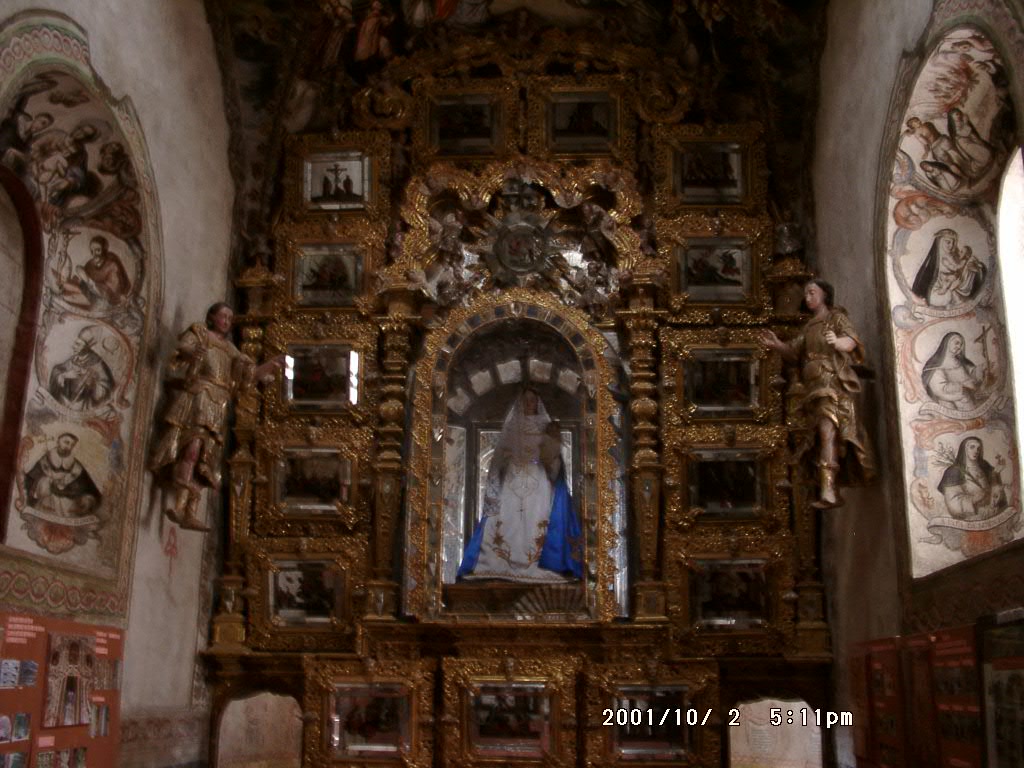
The Virgin I kept encountering in chapels and side altars was not only doctrinally present. She was socially present. She seemed to have been brought close enough to be called upon, trusted, approached, and leaned on.
And if one follows this line upward, it eventually reaches the crucial figure of Our Lady of Guadalupe. In Mexico, Guadalupe is not simply venerated; she has been renamed into closeness, re-inscribed into the emotional core of a people, and made to function as a mother within a local world. That is why Marian devotion in Latin America carries such extraordinary emotional density. The Virgin is not only painted or enthroned. She is folded into petitions, homes, protection, memory, and the ordinary structure of dependence.
That is also why it would be insufficient to describe her merely as the overseas continuation of a European Virgin. In Latin America, the Virgin has become one of the most powerful points at which imported Catholic imagery was received, recoded, and turned into a local maternal centre.
Yet if one writes only about the suffering Christ and the Virgin, the picture is still incomplete.
Because Catholicism in Latin America did not only take root in sacred images. It also entered festival time.
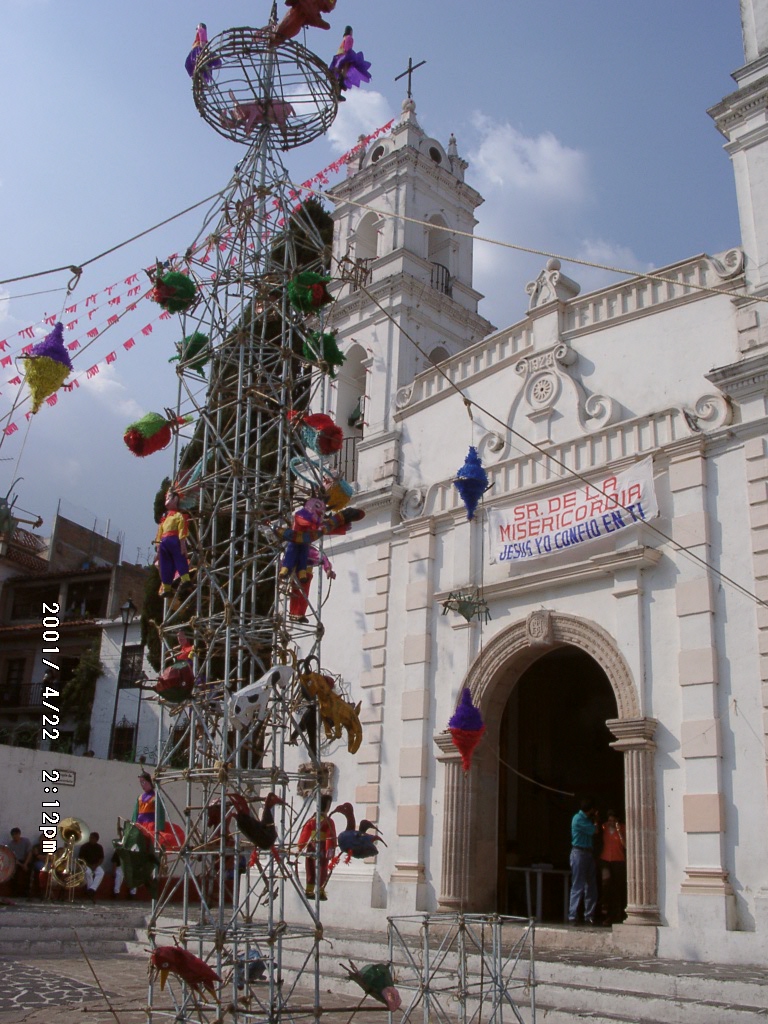
I have always been drawn to scenes like this. Because they remind me that religion here does not remain confined to the interior of the church or to moments of private silence. It continues into courtyards, streets, firelight, noise, processions, and the night. Holy Week and Easter in Latin America do not remain solely theological commemorations. They become a public religious rhythm through which an entire community passes together.
And what is even more striking is that the structures of festival life themselves often already reveal a grammar that is not simply European.
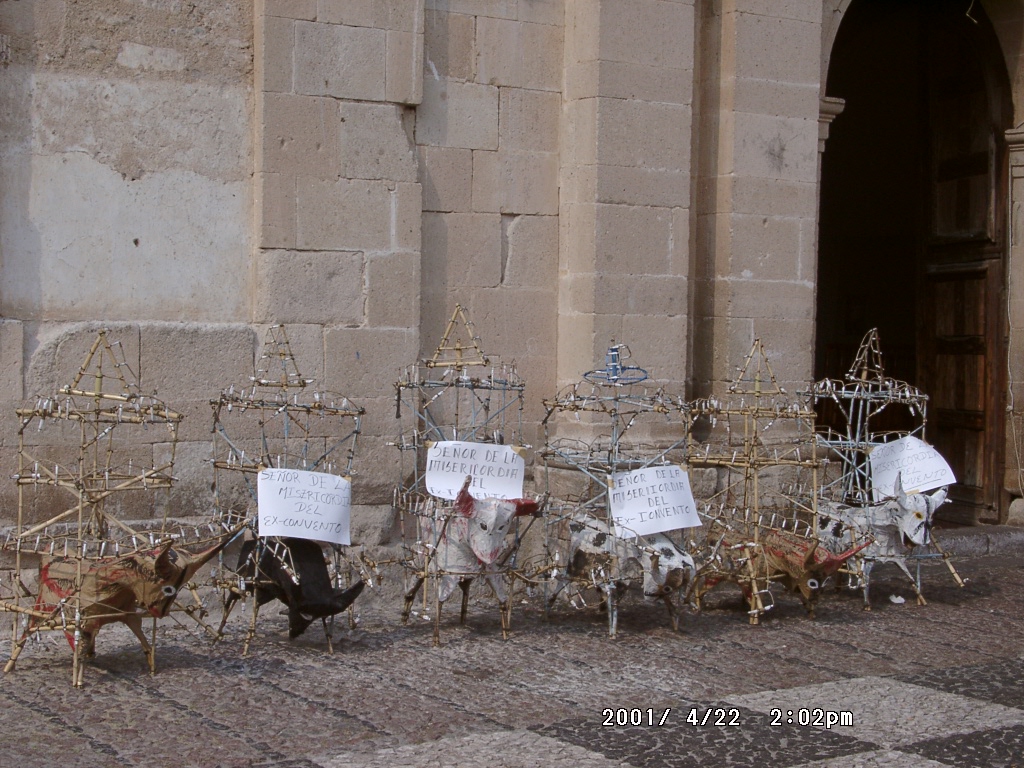
These bamboo frames, paper forms, animal shapes, and structures destined to be lit, exploded, or consumed by fire are culturally important precisely because they prove something deeper than “popular festivity”. They show that Indigenous and local ritual logic did not vanish when Catholicism entered the region; it entered Catholic festival space itself.
This point matters.
If one dismisses such structures as mere local entertainment beside the church, one misses their real significance. What is happening is far more layered: fire, animal form, combustion, offering, collective watching, nocturnal ritual energy — these belong to older ways of marking sacred time. And yet here they no longer stand outside the church. They adhere to Holy Week, to Easter rhythms, to the language of mercy and devotion, and to the public space of Catholic life.
That is why I have gradually become convinced that the most revealing thing about Latin American Catholicism is not the cathedral alone, nor any single sacred image in isolation, but the way it holds three lines together at once:
- the suffering body of Christ
- the local maternal shelter of Marian devotion
- the continuing force of Indigenous and local festival logic
Where these three lines cross, one begins to see what I mean by a truly local Catholicism.
That is to say, Catholicism here is not without Europe, not without colonial history, not without imported liturgy and sacred form. But once it entered this world, it was reworked by fire, dust, wounds, mothers, villages, and the social body of the place. What remained was not a pure export, but a new local sacred form.
And once I followed that line far enough, I realised that the question did not belong to Latin America alone.
If Latin America shows how Spanish Catholicism in the Americas was rewritten into human language through suffering, maternity, and festival life, then another crucial site of the same larger story lies on the other side of the Pacific: the Philippines.
Chapter 3 | Across the Pacific: The Philippines Is Not a Side Branch, but a Crucial Bridge
When people speak of Catholicism, they often place Latin America and the Philippines in separate mental compartments.
Latin America seems to belong to the history of Spain and the Americas; the Philippines appears as an Asian exception, highly Catholic yet somehow isolated from the rest of the story. But once one puts time, sea routes, and religion onto the same map, that impression quickly begins to collapse.
The Philippines is not a side branch, nor merely an appendix to the Latin American story. It is one of the key bridges in the wider Pacific line of Catholic civilization.
In other words, if Mexico and Latin America showed me how Spanish Catholicism was rewritten in the Americas through dust, fire, suffering, and maternal devotion, then the Philippines showed me how the same religious matrix crossed the ocean into Asia and took on a very different local form — one shaped by island society, church institutions, the memory of the Cross, and public religious history.
This difference matters enormously.
Because it reminds us that the spread of religion is never as simple as “centre to periphery”. It is more like a long route that keeps being revised at each port, each coast, each language zone. Faith is not packed into crates and unloaded unchanged. Every time it arrives somewhere, it has to learn again how to be understood, remembered, and carried by local bodies and local time.
And the Philippines is one of the clearest places in which to see this.
When I returned to my own photographs from the Philippines, what struck me most was their difference in texture from the ones I had taken in Mexico and Latin America. Latin America had given me dust, wounded Christ figures, side altars, festival frames, weathered facades, and the almost bodily atmosphere of devotion. The Philippines, by contrast, gave me something harder: inscriptions, plaques, university markers, memorial structures, and an unmistakable sense that Catholicism had been written deeply into the formal bones of society.
That is to say, in the Philippines religion is not only a matter of collective emotion and local devotion. It is also a matter of institutional memory, educational structure, urban inscription, and historical form.
That difference makes the Philippines especially important within this essay.
Without it, one might still read the Latin American material as a powerful but regionally specific form of local Catholicism. Once the Philippines enters the picture, however, a broader pattern becomes harder to ignore: the same religious inheritance, once it crosses the Pacific and enters another civilizational environment, can be rewritten in a wholly different local register without ceasing to be recognizably itself.
This is why I do not want this chapter to remain secondary.
Without the Philippines, the essay would still be a strong meditation on Latin American religion. With the Philippines, it begins to become something else: a trans-Pacific motherline essay, capable of showing how the same Catholic inheritance grew into different sacred temperaments in different worlds.
The clearest threshold into that Philippine line is the memory of the Cross.
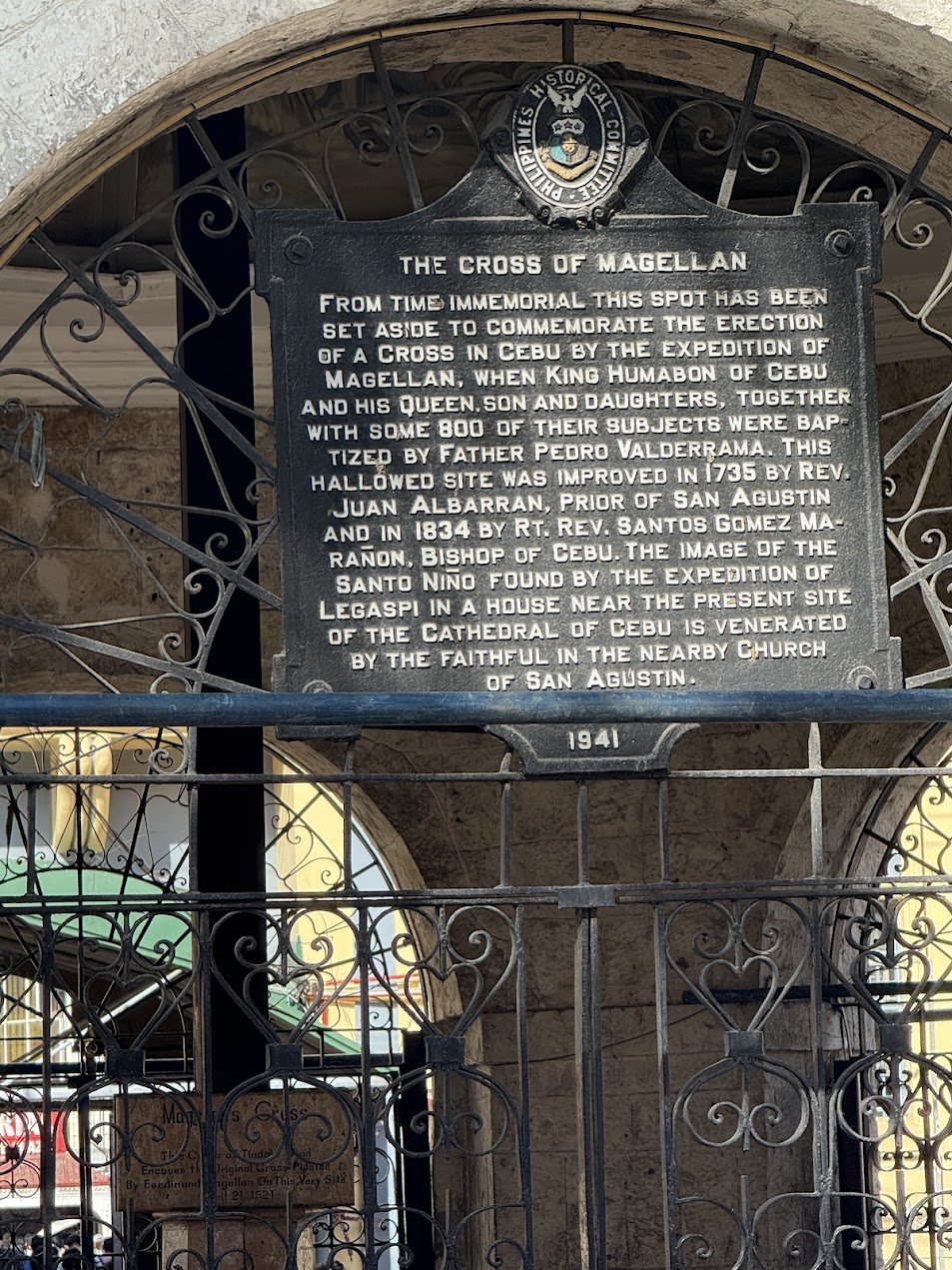
A marker like this feels quite different from the crosses I photographed in Mexico and Nicaragua.
In Latin America, crosses often seem already absorbed into the land, as though they had become part of the landscape itself. In Cebu, by contrast, the Cross still carries a much stronger sense of origin. It feels like a point deliberately preserved as a beginning — a reminder of how religion entered this ground, who brought it, and how it became linked to baptism, memory, and the narrative of a city.
This is not a matter of one place being “deeper” than another. It is a matter of different historical rhythms.
Latin America often gives the impression that religion has already seeped into daily life so thoroughly that it breathes with suffering, maternity, and festival time. The Philippines, by contrast, allows one to see more clearly how religion moved through colonization, education, and institutional structure, even as it remained vibrant in the popular sphere.
And this becomes even more evident in spaces such as the University of Santo Tomas.
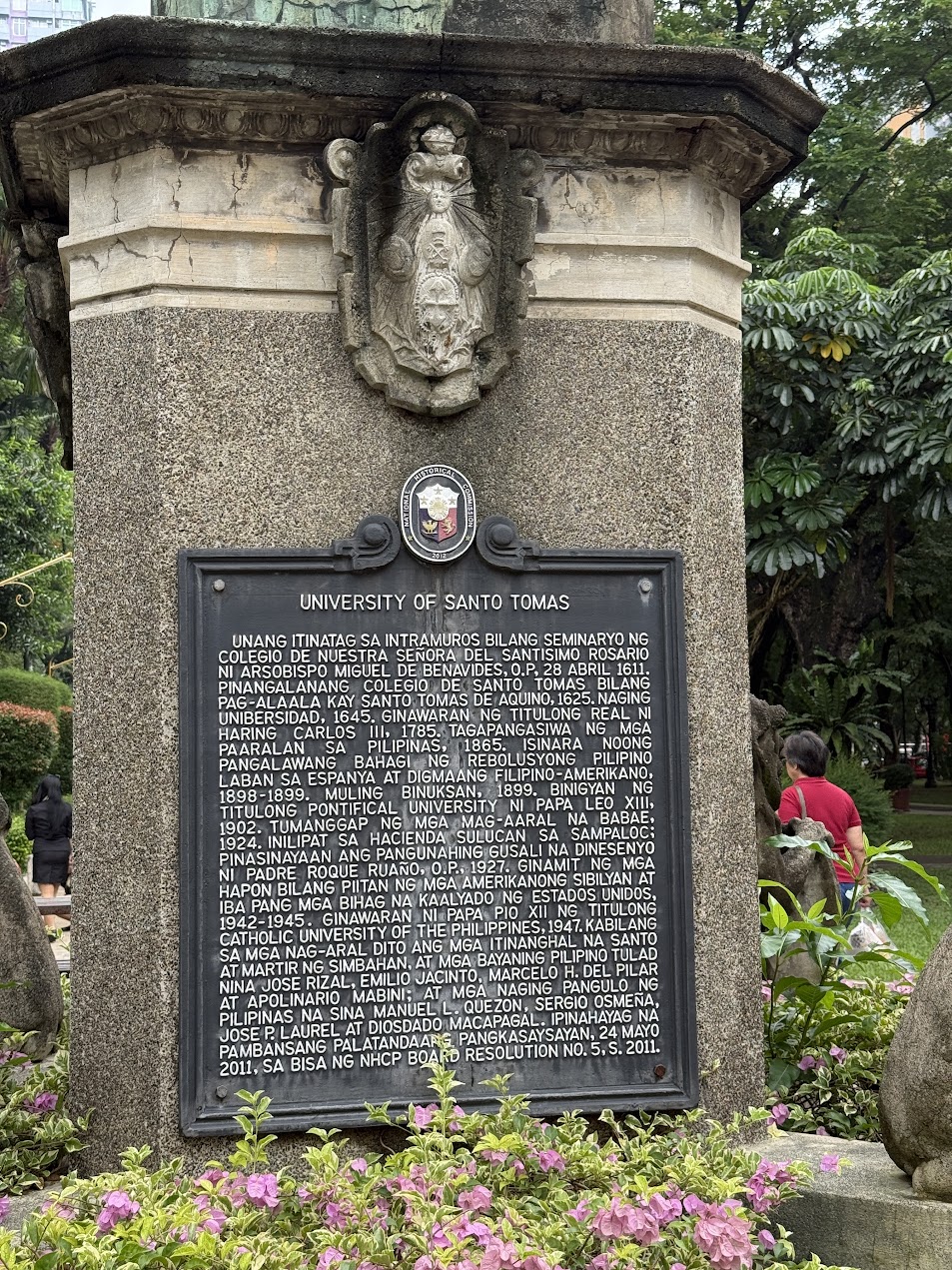
I have always liked markers of this kind. They are not as emotionally immediate as sacred images, nor as vivid as festivals. But they have a different kind of honesty. They tell you that a religion is not living only in feeling. It is also living in archives, institutions, campuses, and officially remembered history.
This creates a fascinating contrast with Latin America.
In Latin America, religion often first seizes the eye through bleeding Christs, Marian tenderness, firelight, and public ritual intensity. In the Philippines, one feels another layer alongside devotion itself: the way the Church wrote itself into the formal memory of society.
That is precisely why a place like UST matters for this essay. It is not only a Catholic site, but an institutional node. It shows that Catholicism in the Philippines did not remain sustained only by emotional devotion. It entered education, structure, historical writing, and the civic forms through which a society remembers itself over time.
That line becomes even more legible when one turns to details such as inscriptions and old stonework.
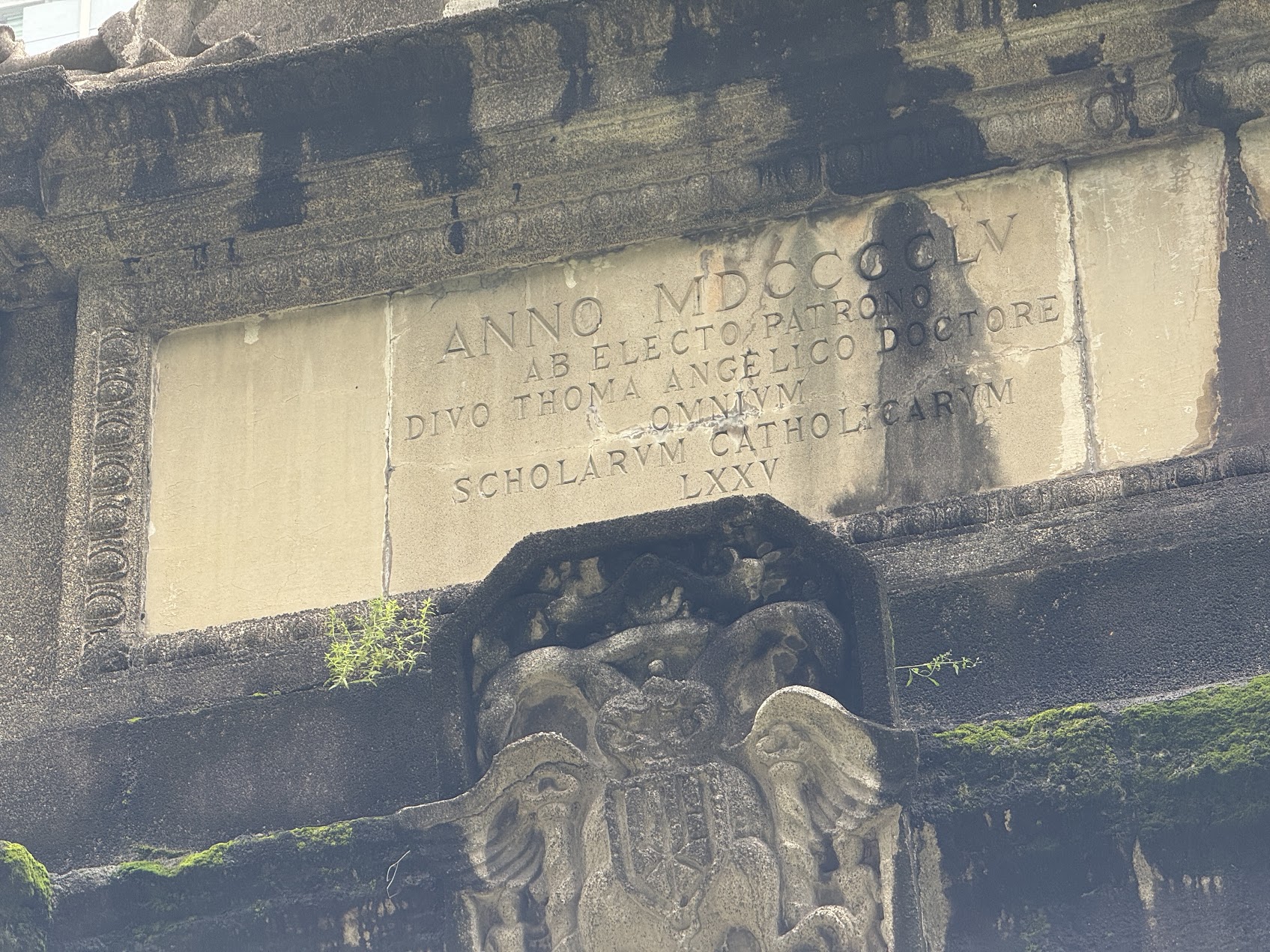
Latin inscriptions and stone walls are culturally dense objects. They do not signify age alone. They signify that religion once operated as a language of learning, orthodoxy, institutional order, and historical legitimacy on this land.
If the weathered church walls I photographed in Mexico made me think about how faith is worn into a place by time, then the stone and inscriptional world of UST made me think about something else: how faith is formally written into history. Both matter, but in different ways. One is weathered into local life; the other is carved into the record.
And from here the institutional line rises even further, toward the memory of connection with the wider centre of the global Church.
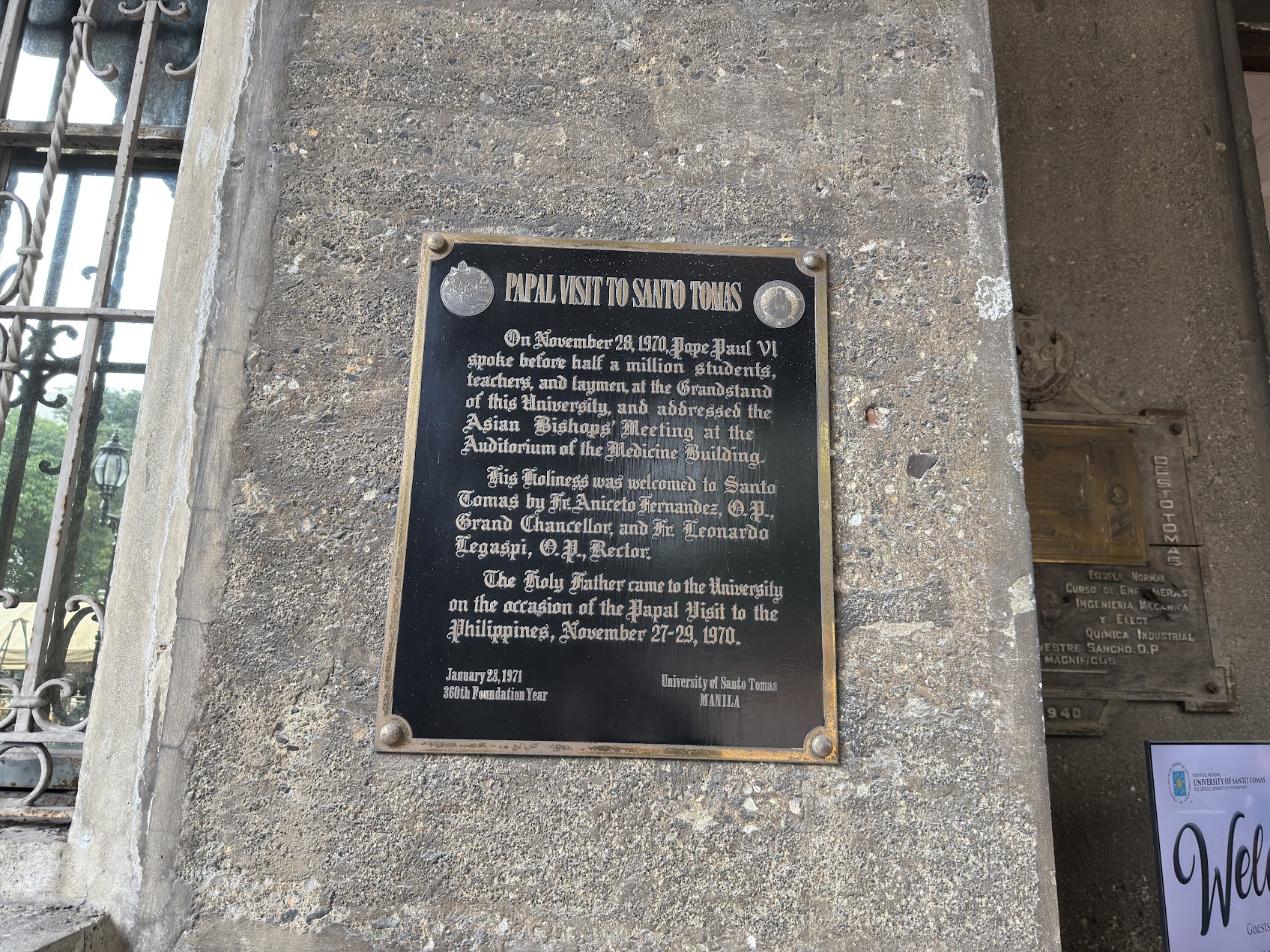
I find plaques like this especially revealing, because they allow two scales to appear at once:
- the local scale: Philippine campuses, local memory, urban space, and national history
- the global scale: visible connection with Rome, the papacy, and the wider universal Church
That doubleness is one of the most striking characteristics of Philippine Catholicism. It is intensely local and yet unmistakably global; emotionally alive and structurally formal; present in the street, but also in the institutional archive.
And the more I looked at this material, the more I felt that what one should really notice in the Philippines is not simply the presence of Catholic devotion, but the way Catholicism has been written simultaneously into:
- origin memory: the Cross, baptism, and the Santo Niño narrative
- institutional memory: universities, plaques, historical markers, inscriptions
- global connection: visible relation to the papacy and the wider Church
- local society: island life, urban space, and popular devotion
All of this returns, in the end, to the crucial starting point in Cebu.
What makes Magellan’s Cross important is not simply that it is “early”, but that it still preserves a strong narrative of beginning. It reminds the viewer that Catholicism did not arise naturally on this ground. It came by ship, by empire, by mission, and by baptism.
Yet precisely because of that, what matters even more is how the Philippines later remembered, accepted, and rewove that beginning into local devotion, local history, and its own sacred continuity.
What is at stake here is not the Cross alone, but the way the Philippines slowly transformed an imported religious beginning into part of its own civilizational memory.
And once I laid my photographs from Mexico, Nicaragua, and the Philippines beside one another, the next question began to press itself more clearly:
How could the same Spanish Catholic inheritance become, in Mexico and Latin America, a world of suffering Christ, Marian shelter, and festival firelight, while in the Philippines it became more visibly embedded in cross-memory, educational institutions, and formal public history?
That is the question the next chapter must take up.
🔶 Nelson’s Insight | The Religions That Truly Survive Are Those That Learn the Sacred Grammar of the Place
The more I look at religions across regions, the more convinced I become that what makes them powerful is not how perfectly they preserve the centre’s template, but whether they can learn to speak differently in different lands.
Mexico and Latin America showed me that Catholicism, if it is to live among people, cannot remain only in doctrine or altar form. It must enter suffering, motherhood, fire, festivals, and the emotional body of the place. The Philippines showed me another side of the same truth: religion, if it is to endure, must also write itself into institutions, plaques, campuses, cities, and public memory.
In other words, the same religious matrix does not grow the same face once it enters different civilizations.
That matters greatly to me. Because it applies not only to Catholicism, but also to the Buddhist visual worlds I have encountered elsewhere in Asia. Whether one is looking at Nāga upholding Avalokiteśvara, Marian devotion being re-mothered in Latin America, or the memory of the Cross being written into Philippine public history, one is still looking at the same underlying phenomenon:
The religions that truly survive
are those that learn the body, landscape, festival rhythm, and sacred protective grammar of the place.
If a religion can only preserve itself unchanged, it may retain structure but lose life. But if it can be retranslated by the land, it becomes something people can actually inhabit.
Chapter 5 | From Latin America to the Philippines, and Then to Southeast Asia: The Same Question, Different Religions
By this point, I know more clearly that the real question of this essay was never, “Which place is more devout?” nor, “Which religion is better at localisation?”
The question I actually care about is larger than that:
When a world religion enters a new land,
how is it eventually rewritten into that place’s human language?
Once that question is allowed to stand, images that at first seem far apart begin to align along a shared line of meaning.
In Latin America, what I saw was Catholicism entering lands marked by Indigenous memory and colonial collision, and being received again through suffering, firelight, maternal devotion, festival rhythm, and the collective body of local society. Christ moved closer to wounds. The Virgin moved closer to the people’s idea of mother and shelter. Holy Week ceased to be only liturgical remembrance and became a public religious time through which entire communities pass together.
In the Philippines, I saw something related but differently formed: the same Catholic inheritance crossing the Pacific and being written into the memory of the Cross, into universities, into plaques, into inscriptions, into institutions, and into public history. It was not without popular devotion, nor without warmth, but one of its clearest visible traits was the way religion entered the formal skeleton of society.
And when I look back again at the Buddhist visual worlds of Southeast Asia — especially the kind of material I explored in “It Is Not Avalokiteśvara Who Changed, but Civilisation That Translated Her” — I find myself returning to the same underlying insight.
That is this: the religions that possess real life are never those that simply copy the centre’s sacred template into the margins, but those that are retranslated through local landscapes, local bodies, local festivals, local protective orders, and local historical memory.
Of course, I am not saying that Catholicism and Buddhism are the same thing.
This must be stated carefully.
I am not using Buddhist language to explain Christianity, nor suggesting that the Virgin is equivalent to a local goddess, nor that Christ is analogous to a bodhisattva. Such comparisons would be crude and disrespectful to the distinct theological and historical worlds involved.
What I am doing instead is something else: I am not comparing doctrine, but comparing how civilizations receive the sacred.
And once the comparison is made at that level, the pattern becomes unexpectedly clear.
| Region | Imported Religious Matrix | Local Grammar of Re-translation | Sacred Temperament That Emerged |
|---|---|---|---|
| Mexico / Latin America | Spanish Catholicism | Suffering bodies, Marian motherhood, Indigenous festival logic, fire, public devotion | A Catholicism marked by blood, dust, public ritual, and collective emotional life |
| The Philippines | Spanish Catholicism | Cross-memory, Santo Niño devotion, inscriptions, education, institutional history, public markers | An Asian Catholicism shaped by both popular devotion and deep institutional sediment |
| Southeast Asian Buddhist Art | Buddhist traditions moving through South and Southeast Asia | Nāga, water-based guardianship, land-order, local sacred beings, sculptural translation | Buddhist compassion upheld by local protective and territorial sacred structures |
If this table is read only as a neat comparative summary, it still remains too shallow.
Its real importance lies elsewhere: three regions and two religions all point to the same civilisational capacity — whether a local society can translate what comes from elsewhere into a sacred form it can continue to live inside.
That, for me, is the central judgement worth preserving from this essay.
Because if a religion can only preserve the centre’s template, it may retain recognisable structure, but risk losing life. If it can be retranslated by the land, however, it acquires human temperature, local smell, local rhythm, and the emotional weight of collective life.
This is why the photographs I took in Mexico and Nicaragua — wounded Christs, altars, stone walls, festival structures, weathered facades — and the images I carried back from the Philippines — crosses, plaques, inscriptions, Santo Tomas, papal memory — ultimately join into one line in my mind.
On the surface, they differ greatly. One seems more like religion in dust; the other more like religion in inscription. One is closer to blood, festival, and suffering; the other more visibly tied to history, institutions, and formal public memory.
And yet what they truly share is this: neither preserved Catholicism as a purely foreign template. Both drew it into the scale of local life and made it grow into a form people could actually inhabit.
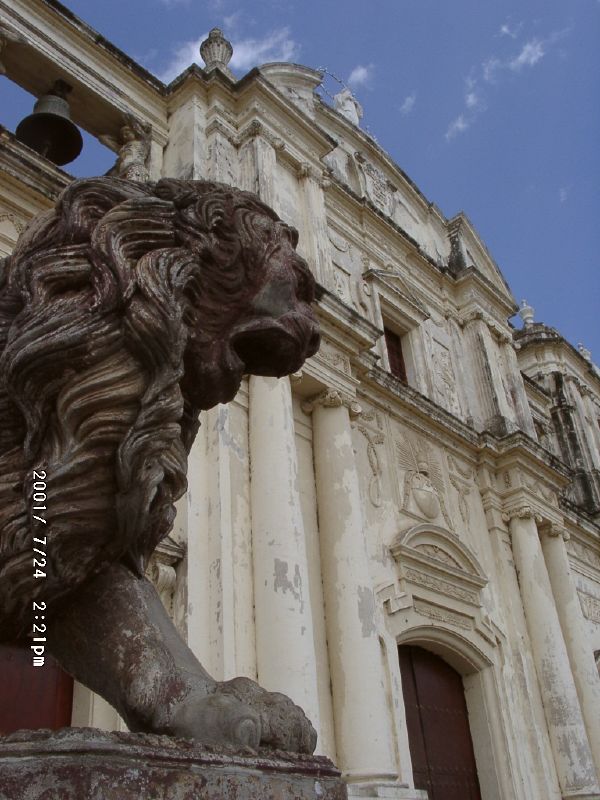
A facade like this in León is useful precisely because it reminds us of something else: religion is not always gentle. It may arrive together with power, conquest, stone, and institutional hardness.
But that is exactly why local translation matters so much. Without it, religion remains an imposed shell. Only through reinterpretation does it become life.
And the more I think about it, the more I feel that this is what makes cultural observation so compelling.
At first one thinks one is simply looking at churches, crosses, sacred images, altars, or architectural remains. But if one keeps looking long enough, one realises one is actually watching a civilisation decide what to do with what came from elsewhere. Does it reject it? Submit to it? Or gradually wear it down into a language that can be lived with?
The answer I keep seeing across these different places is neither pure conquest nor simple mixture, but something more intelligent than either:
A truly accomplished civilization
does not survive by erasing difference,
but by translating difference into an order through which life may continue.
That line, for me, is not only the end of this essay. It is very nearly one of the motherlines I keep finding confirmed in different civilizational settings.
From the suffering Christ, Our Lady of Guadalupe, and festival firelight of Latin America, to the memory of the Cross, Santo Niño traces, and the institutional sediment of Catholicism in the Philippines, and then again to the local sacred grammars of Southeast Asian Buddhist art, what I see is never religion simply reproducing itself everywhere.
What I see, instead, is this:
each land keeps retranslating the sacred into the human language through which it can still remain alive.
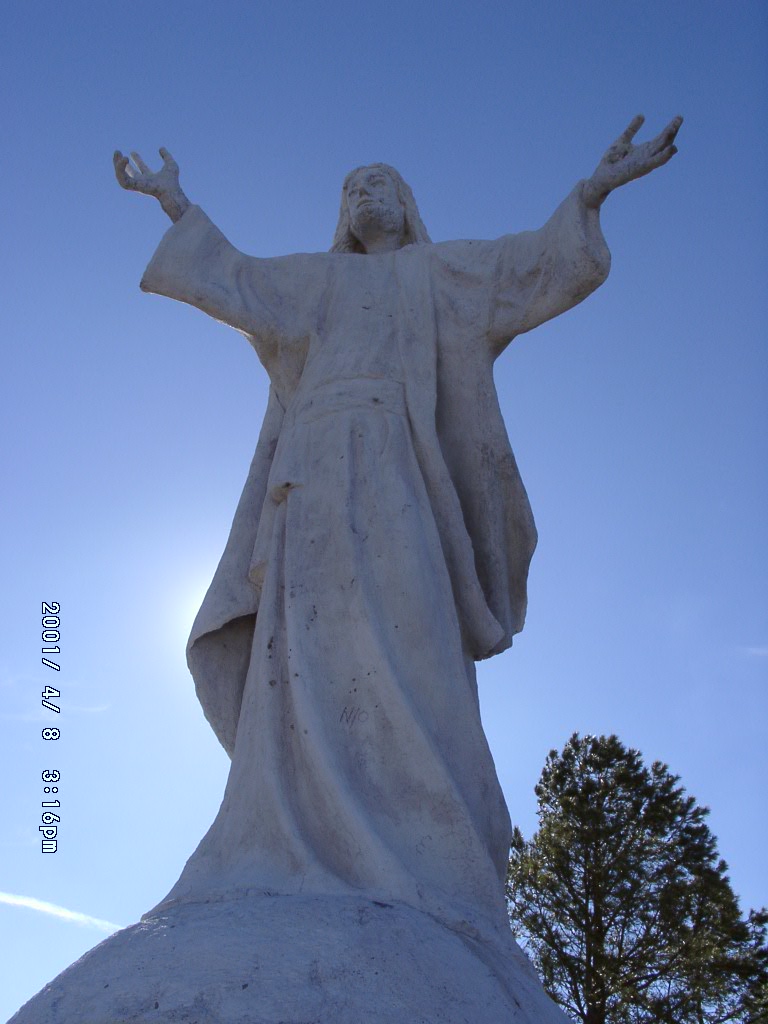
And when a person stands before these sacred images, perhaps what is finally revealed is not how much one knows about religion, but whether one still has the ability to see that weathered walls, bleeding Christs, Virgins re-mothered by local devotion, and crosses fixed into historical memory are all saying the same thing:
the sacred never descends into the world in abstraction. It is received, piece by piece, by people who must take it up under their own conditions of life.
FAQ | Common Questions and a Systems View
Q1 | Why does Catholicism in Latin America feel different from Catholicism in Europe?
A: Because Catholicism in Latin America was not simply transported intact from Europe. Once it entered local societies, it was received through Indigenous memory, public festival life, suffering, Marian devotion, and the emotional structure of ordinary communities. That changed not its doctrinal core, but the way sacred presence became visible and socially inhabitable.
Q2 | Why is Our Lady of Guadalupe so central to Mexico and Latin America?
A: Because she is not merely a doctrinal Marian figure. She became one of the most powerful points through which Catholicism was re-mothered, localised, and emotionally interiorised within Mexican and Latin American society. She is both sacred image and civilisational motherline.
Q3 | Why do Christ images in Latin America so often emphasise wounds, blood, and suffering?
A: Because in Latin America Christ is often experienced not only as a theological redeemer, but as a sacred figure capable of carrying the burdens of real life. Emphasis on wounds and suffering makes divine pain socially proximate, allowing ordinary people to recognise their own hardship within sacred form.
Q4 | Why include the Philippines in an essay that begins in Latin America?
A: Because the Philippines is not an incidental comparison, but one of the most important Pacific sites in which Spanish Catholicism took on a new local form in Asia. Including it makes visible a broader trans-Pacific pattern: the same religious inheritance developing different sacred temperaments in different civilizational settings.
Q5 | Why do Magellan’s Cross, UST markers, and papal plaques matter so much in the Philippine section?
A: Because they show that Catholicism in the Philippines did not survive only through devotion. It also entered institutions, education, public memory, official history, and the formal symbolic skeleton of society. They reveal the institutional depth of local religious translation.
Q6 | Why bring in Southeast Asian Buddhist art at all?
A: Not because Catholicism and Buddhism are the same, but because both reveal a similar civilizational phenomenon: world religions only truly live locally when they learn the sacred grammar of the places they enter. Southeast Asian Buddhist visual worlds, like Latin American and Philippine Catholicism, show how sacred forms are re-grounded through local orders of meaning.
Q7 | What is the difference between “religious mixture” and “religious retranslation”?
A: “Mixture” can sound casual, as if different elements were simply blended without structure. “Retranslation” is more precise, because it suggests that the sacred core remains recognisable while its mode of expression changes as it enters a new civilizational language.
Q8 | What is the most important final judgement of this essay?
A: That religions with real life are not those that merely reproduce a central template in distant territories, but those that are retranslated through local landscape, suffering, institutions, festivals, and protective imagination until they become forms people can genuinely inhabit.
📜 References (APA 7th)
- Basilica Minore del Santo Niño de Cebu. (n.d.). History of the devotion and the basilica.
- Brading, D. A. (2001). Mexican Phoenix: Our Lady of Guadalupe: Image and tradition across five centuries. Cambridge University Press.
- National Historical Commission of the Philippines. (n.d.). Historical marker: Magellan’s Cross.
- Poole, S. (1995). Our Lady of Guadalupe: The origins and sources of a Mexican national symbol, 1531–1797. University of Arizona Press.
- Rafael, V. L. (1988). Contracting colonialism: Translation and Christian conversion in Tagalog society under early Spanish rule. Duke University Press.
- University of Santo Tomas. (n.d.). University history.
- Vatican. (1988). Faith and inculturation. International Theological Commission.
- Christian, W. A., Jr. (1981). Local religion in sixteenth-century Spain. Princeton University Press.