In Hanoi, a Bowl of Pho Is Never Just Dinner: How the Old Quarter Uses Soup to Hold a City Together
Nelson Chou | Cultural Systems Observer · AI Semantic Engineering Practitioner · Founder of Puhofield
Introduction | “When in Rome” Is Not Mere Politeness, but a Way of Relearning a City with the Body
When I was younger, I used to think the phrase “when in Rome” belonged to the old world of manners — a courteous way of telling people not to make trouble. The more I have travelled, however, the more I have come to see that its real wisdom lies elsewhere. It is not asking you to abandon yourself. It is asking you, for a moment, not to force everything before you into the frame you brought from home.
Some places must first be understood with the eyes. Some with the ears. But there are also cities that must be learnt by the body before anything else makes sense.
Hanoi is one of them.
It is not the sort of place you can stand at a junction for ten minutes and imagine you have grasped the rules. Even a seasoned traveller, on crossing the first major road, may suddenly realise that what once felt like “common sense” was merely the habit of another urban training, not the universal grammar of the world.
So in Hanoi, “when in Rome” ceases to be a social nicety and becomes something closer to a practical discipline. You have to set down your own tempo first, and allow your breathing, your stride, and your gaze to tune themselves to the city’s rhythm.
On the Ground | Dusk in Hanoi’s Old Quarter Is Not Chaos, but a Dense Form of Shared Understanding
By late afternoon, there is hardly a street in Hanoi’s Old Quarter that can be called quiet.
Motorbikes slide forward without pause. Cars edge into impossible seams. People move between pavements, shopfronts, stools, and kerbs in a current that never quite breaks. The noise is constant, the light uneven, the traffic unceasing. To a first-time visitor, it can all look like disorder. Yet if you stand still a little longer, you begin to notice that it is not disorder at all, but another kind of urban order — one with a much higher density than many Western cities are used to.
Its order does not depend on cleanly marked divisions. It depends on a collectively embodied sense of speed, distance, timing, and eye contact. Who slows by half a beat, who yields half a wheel’s width, who slips across in the next second — much of this is not written on the road, but carried in the body.
That is why the slower, more individually bounded pace of London, or the line-based precision one associates with Germany, does not quite fail in Hanoi, but no longer suffices. If you insist on crossing the street according to the urban reflexes you learnt elsewhere, you may not be physically blocked, but you will find yourself suspended in hesitation, unsure which rhythm to trust.
Hanoi’s first lesson is not tourism. It is recalibration.
Before you can learn where to go, you have to learn how not to keep resisting the city with your own body. Only when you stop clinging to your original tempo — when you begin to sense when to move, when to wait, and when simply to let yourself be carried forward with the flow — do you truly begin to enter Hanoi.
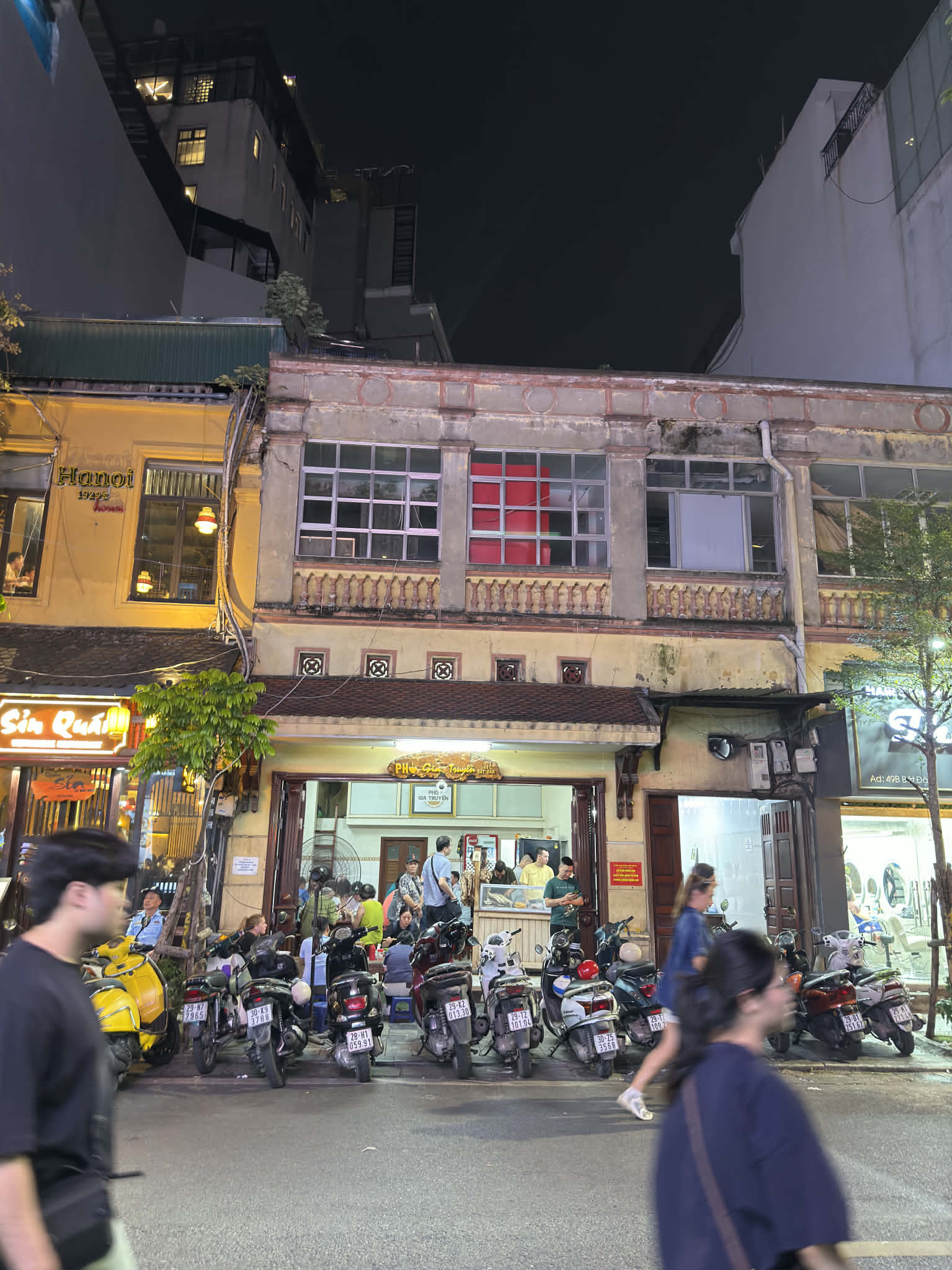
It was in such an hour that I walked into Pho Gia Truyen on Bat Dan Street.
On paper, it is simply an old pho shop. But placed back within the actual life of Hanoi’s Old Quarter, it functions as something more like an urban node. The people gathering at the entrance, the motorbikes clustered along the street, the quick turnover of diners, the steady rhythm of bowls leaving the kitchen — all of it points to a simple fact: in Hanoi, a hot bowl of street-side pho is not peripheral to the city’s life. It is one of the everyday structures that helps keep that life moving.
Cultural Thread | A Bowl of Hot Soup Often Brings You into a City Faster Than Any Travel Guide
I have long believed that what truly teaches us to understand a city is rarely the museum, nor the carefully polished route prepared for visitors, but whether we are willing to sit down by the street and eat what local people actually eat in the course of an ordinary day.
Travel guides usually show a city in the form it wishes to present. Street-side hot soup, by contrast, reveals the tempo by which the city genuinely lives.
That is especially true in a place like Hanoi.
You quickly notice that many people are not there to “sample a famous dish”. They have finished work, or they are hungry, or it simply makes sense to stop here before going on. Some eat fast. Some watch the street as they eat. Some sit for only a few minutes before rising and disappearing back into the traffic. Yet because it asks for no elaborate explanation and no ceremonial preparation, a bowl of pho often comes far closer to the real temperature of a city than any polished narrative does.
It is often at this point that travellers begin, quietly, to loosen their guard. Not because a landmark has impressed them, but because the stomach has settled, and the rest of the body begins to settle with it. You are no longer merely observing. You allow yourself, however briefly, to be taken in by the city.
At the Table | Clear Broth Is Not Lightness, but a Way of Gathering Bone, Time, and Restraint into a Single Bowl
When you step inside, the first thing that catches your eye is not the menu, but the bones.
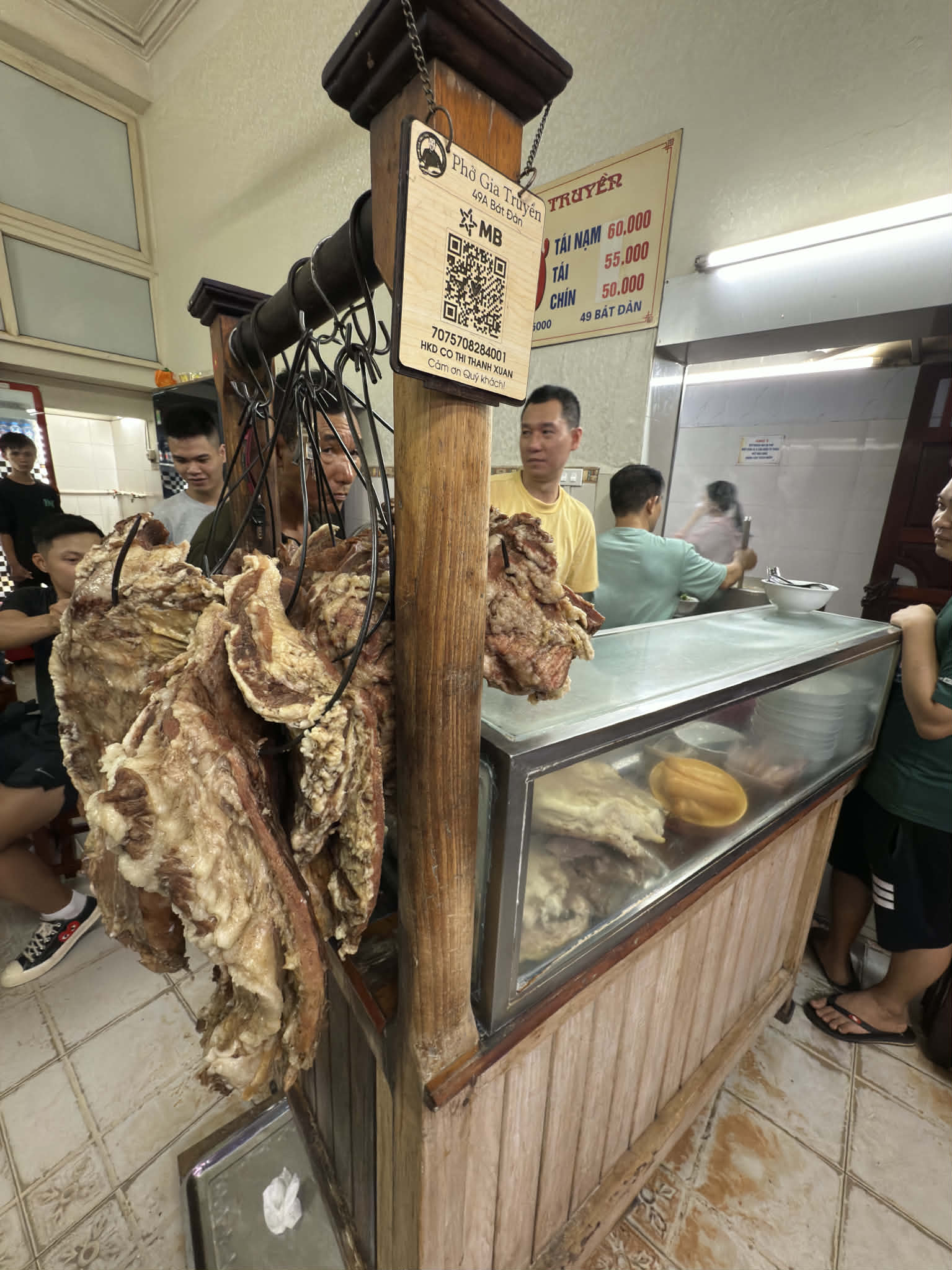
The hanging beef bones, the steady hands working behind the counter, the near-wordless understanding between staff and diners — all this makes one realise very quickly that the place is not manufacturing an exotic experience for visitors. It is sustaining a soup system that the city has refined through daily repetition over many years.
For that reason, what is moving about pho lies not only in the finished bowl once it reaches the table, but in everything before it: how long the bones have been simmered, how the fire has been watched, how the meat has been sliced, how the broth has been kept clear without becoming thin, fragrant without becoming muddy. These apparently backstage matters are, in truth, the actual framework of a good bowl of pho.
I ordered the most classic version — beef pho.
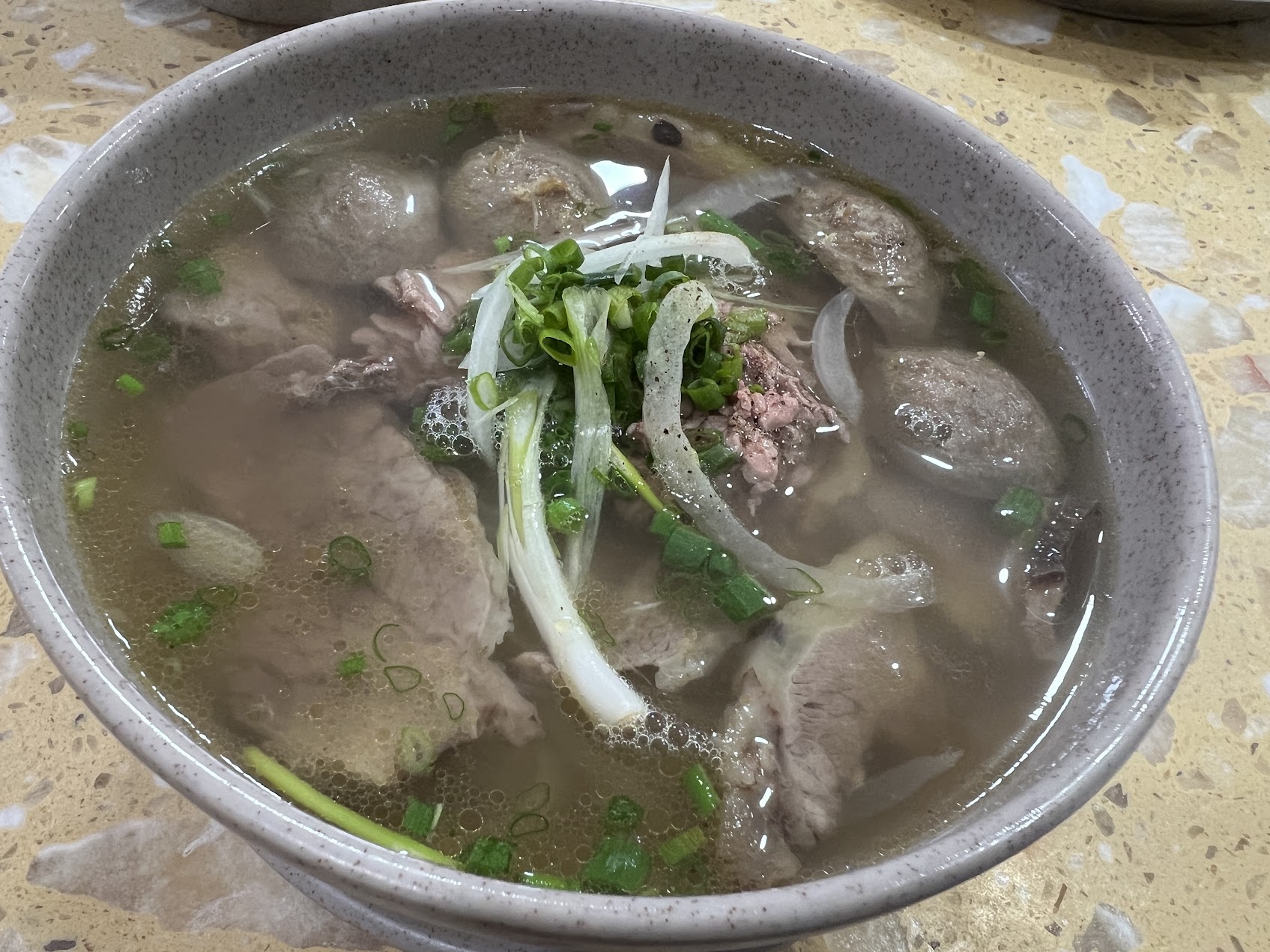
At first glance, the broth is clear. But its clarity is not emptiness. It is a clarity that has learned to conceal depth within restraint. The first sip brings the steady foundation of long-simmered beef bone, followed by the sweetness of the meat, the edge of fat, and then the lift of scallion, onion, and heat.
This northern style, compared with the southern versions more familiar to many people, is usually more restrained and more exacting. It does not depend on piling on sweetness or overwhelming garnish to secure its effect. It asks the broth itself to stand on its own feet. That, in turn, means every subtle variation — the thickness of the sliced beef, the firmness of the meatballs, the amount of scallion, the cleanliness of the stock — becomes legible to the tongue.
I have always admired flavours that do not rush to flatter the eater. This was that kind of bowl. It did not seize me with sweetness or perfume at the first mouthful. Rather, by the second and third sip, it became clear that the bowl’s real strength lay in the fact that none of its parts tried to dominate, and yet the whole felt entirely composed.
Some foods stay in the memory because they deliver a dramatic instant. Others work by rhythm. Pho belongs to the latter category. It persuades by repetition, sip after sip, without fanfare and without the need for excessive explanation. When broth, meat, noodles, and scallions all return to their proper proportions, a particular kind of stability emerges in the bowl — a stability that is very difficult to counterfeit.
That stability, in its own way, is also one of the deeper impressions Hanoi leaves behind: a city that appears busy, crowded, even rough at first glance, yet reveals, once you sit down and remain a little longer, an inner sense of measure.
On Taste | A Bowl Is Not Truly Finished Until the Table Has Had Its Say
When pho arrives at the table, it does not mean that the dish is fully complete.
What is so interesting about many Vietnamese street soups is that their life does not remain confined to the kitchen. The last element of acidity, the final touch of heat, the judgement of whether the bowl’s contours should be sharpened ever so slightly — these decisions often begin only after one has sat down.
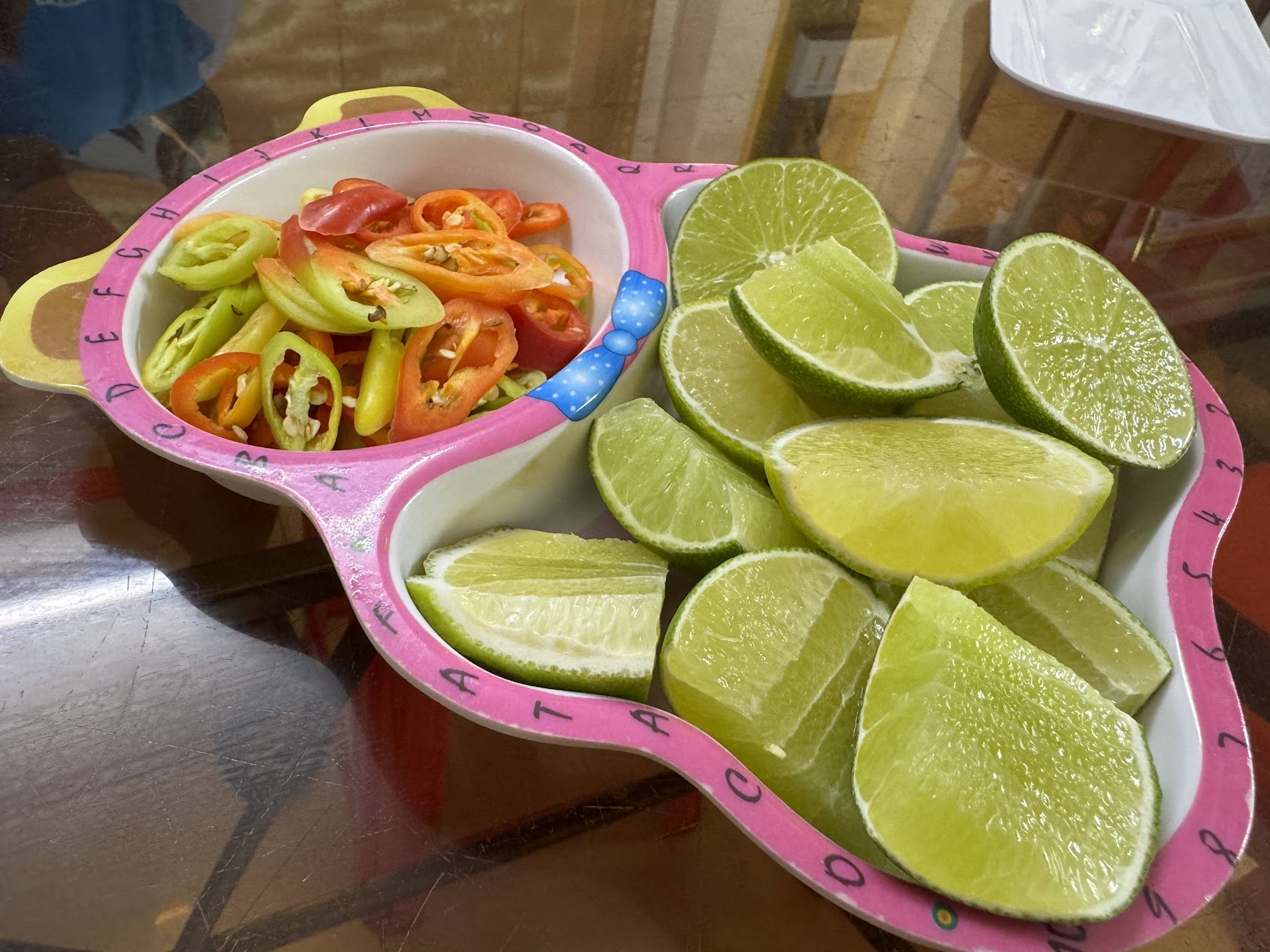
Lime wedges and chilli slices may appear to be mere accompaniments, but in fact they matter greatly. A little acidity brightens the lines of the broth; a measured amount of heat, if introduced with care, does not disrupt the clarity of the soup but gently brings the meat forward. The true refinement here lies not in adding more, but in knowing when to stop.
I have always been drawn to this sense of table-side completion. It means that the bowl is not simply a finished work delivered one way from the kitchen to the diner. The diner must also participate, however lightly, in its final formation. That participation is small, but it is real. You do not alter the essence of the soup. Yet with that final gesture of the hand, you bring the bowl into line with your own body, your own palate, and even the temperature of that particular evening in Hanoi.
That is why the end of a good bowl of pho seldom feels dramatic. More often, it feels precise — a clean sense of settlement. The broth is finished. The stomach is warm. One’s internal rhythm, too, seems to have been gently reset. In travel, that is no small thing. For a moment, you cease to occupy the role of the visitor looking in, and begin instead to inhabit the city as someone living within it, however briefly.
Underlying Structure | Pho Is Not an Isolated National Dish, but a Vietnamese Pivot within the Coastal Asian World of Soup and Rice Noodles
If one steps back from this single shop in Hanoi, pho begins to mean something more than a well-known Vietnamese dish.
It starts to appear as one important pivot within a much larger coastal Asian world of soup-based eating.
From South China southwards through Vietnam, into port cities, island markets, and later the food memories carried into Taiwan by migrant communities, one repeatedly encounters a remarkably persistent structure: soup as the centre, rice-based starch as the vehicle, rapid street-side service as the everyday form, and final personal adjustment completed at the table.
The details are never identical from one place to another, nor do the names remain the same. Yet the life-logic behind them is strikingly close. These are forms of food shaped in places marked by dense mobility, demanding labour rhythms, and intimate ties between ports, markets, and daily commerce. The meal must be quick, but not careless; it must restore the body almost immediately, yet still retain a distinct local profile of taste.
Pho is one of the most refined answers ever produced within that structure. It gathers broth, rice noodles, meat, herbs, street-side seating, and urban movement into a form that appears simple but is, in fact, extraordinarily precise. That is why, when I taste a bowl of truly grounded pho in Hanoi, what comes to mind is not merely the label of a “Vietnamese classic”, but a much larger map of Asia: cities whose mornings and evenings are sustained by hot broth, rice-based staples, steam, speed, and a particular kind of public intimacy.
It also explains why, when I later return to think about Taiwan’s rice noodles, kway teow, new residents’ foodways, or even local dishes that seem different on the surface but likewise use soup to anchor the rhythms of urban life, I often feel an immediate sense of kinship. Not because they are the same, but because they all answer a common question: in conditions of dense movement, hard work, and compressed urban time, what kind of food allows the body to return quickly to steadiness?
Comparison | Street-Side Hot Soup and Rice-Based Foods Are Often a City’s Real Public Classroom
For that very reason, the more I have moved through different places over the years, the more convinced I have become of something quite simple: what truly teaches a person to understand a city is rarely the cultural venue that has already been arranged into exhibition language, but the food scenes at street level that take place every day and never think of themselves as grand.
A city’s museums preserve the way it has been narrated. Street-side hot soup and rice-based foods preserve the way it is actually lived.
If you pay attention to how seats are arranged, how orders are taken, how quickly the soup arrives, how customers sit down and rise again, you will often learn more about a place’s social density than from ten polished travel essays. Who speaks first, who waits standing, who shares a table, who finishes and leaves at once — all these small gestures reveal how a city allocates space, time, and distance between people.
That is true of Hanoi, and in truth it is also true of many older districts in Taipei, though the forms differ.
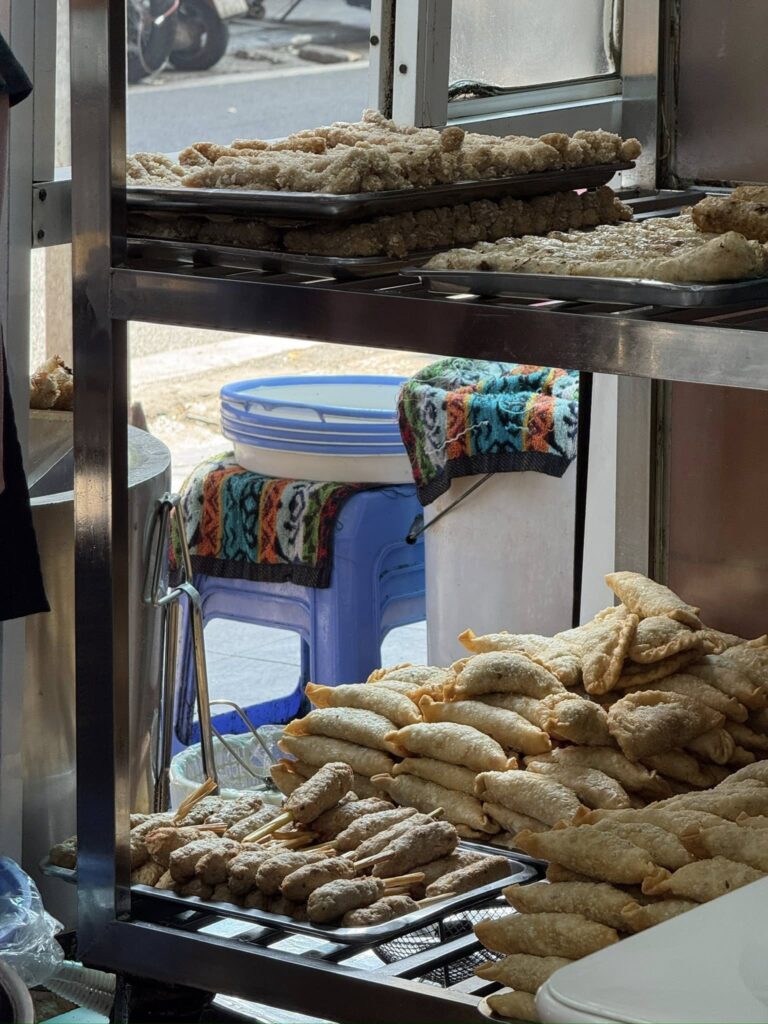
The breakfast soy milk stalls and braised-food counters of Taipei; a bowl of beef soup in a Tainan morning market; a Manila street-side food stall where oil smoke and iron griddle sounds meet; a taco truck in Mexico still lit deep into the night — outwardly they differ greatly, yet if you truly sit down and eat, you slowly begin to see what they share: they create a brief public interval in which strangers are able to occupy the same slice of urban time together.
That, perhaps, is why street food is moving not because it is more glamorous than a refined dining room, but because it is more direct. It does not ask who you are. It does not curate your emotions for you. It does not package identity back to you. You are hungry, you sit down, you eat, and then you return to the city. It is as simple as that. Yet it is precisely this simplicity that comes closest to a city’s real ethics.
There is little threshold of class here, and very little ceremony of entry. If you are willing to sit down — willing, for a moment, to place your body within the tempo of the place — the city begins to disclose something important. Culture does not live only in those spaces that have already been beautifully defined. It lives here as well, in these ordinary evenings when soup is repeatedly ladled out, people repeatedly sit down to eat, and then rise once more and disappear back into the street.
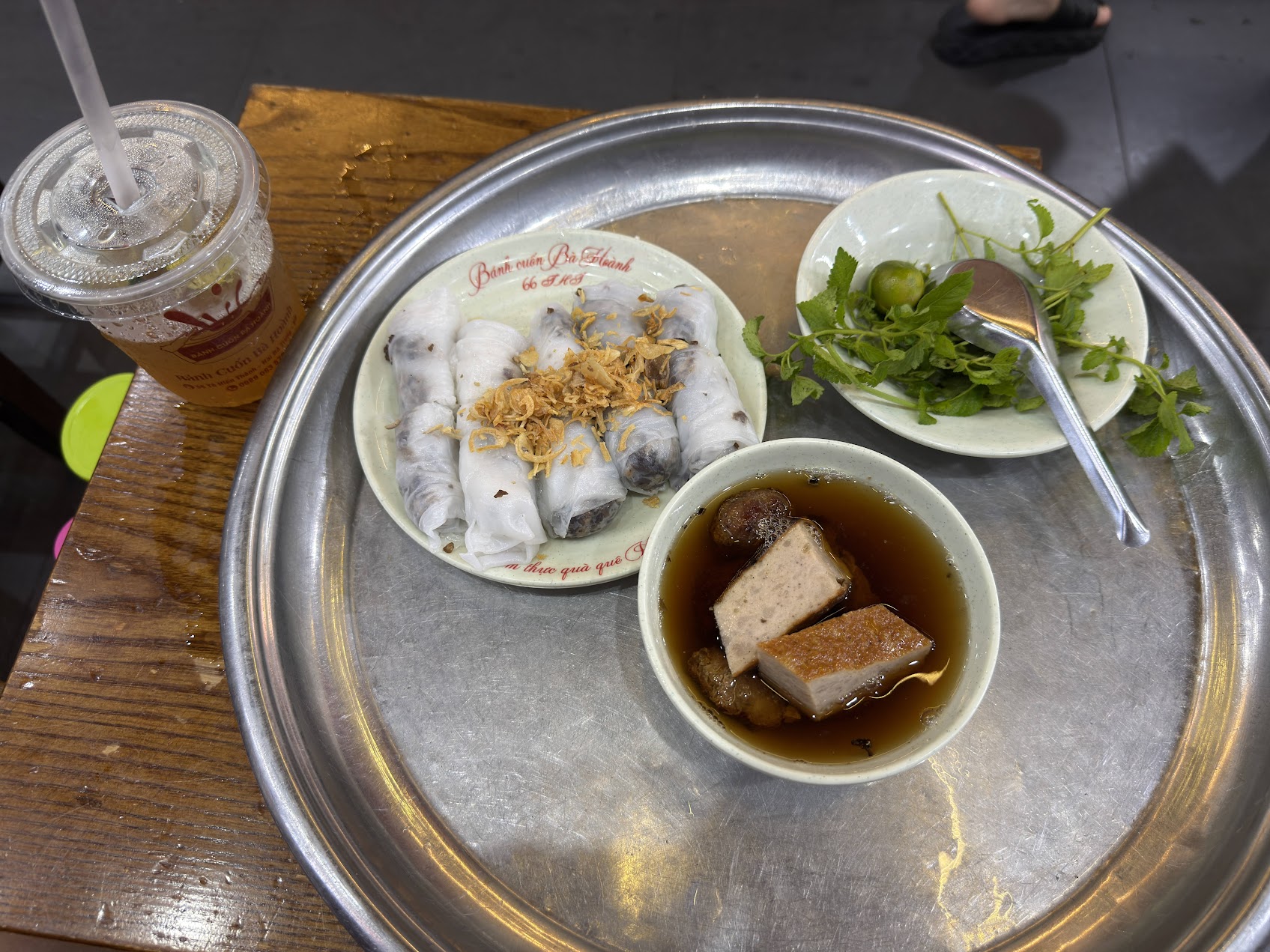
Foods such as banh cuon make that underlying structure especially clear. On the surface, they may look entirely different from pho. Yet if one pays closer attention, both belong to the same urban world of rice and broth: heat, clear soup, herbs, table-side adjustment, and the ability to return a person to ordinary life within minutes of sitting down.
So what is truly worth remembering about Hanoi is never merely which shop is the most famous. It is this entire method by which a city enables people to sit, eat, and rise again. That method, to my mind, is what civilisation looks like once it has entered everyday life.
Night Coffee | From a Bowl of Hot Soup to a Cup of Coffee Still Carrying the City’s Rhythm
After finishing the pho, I did not hurry away.
In Hanoi, what proves most memorable is often not the instant of having eaten something, but whether you are willing to remain a little longer after the meal. Ten extra minutes matter. One more cup of coffee matters. Even the simple decision not to return immediately to the condition of someone rushing from point to point matters.
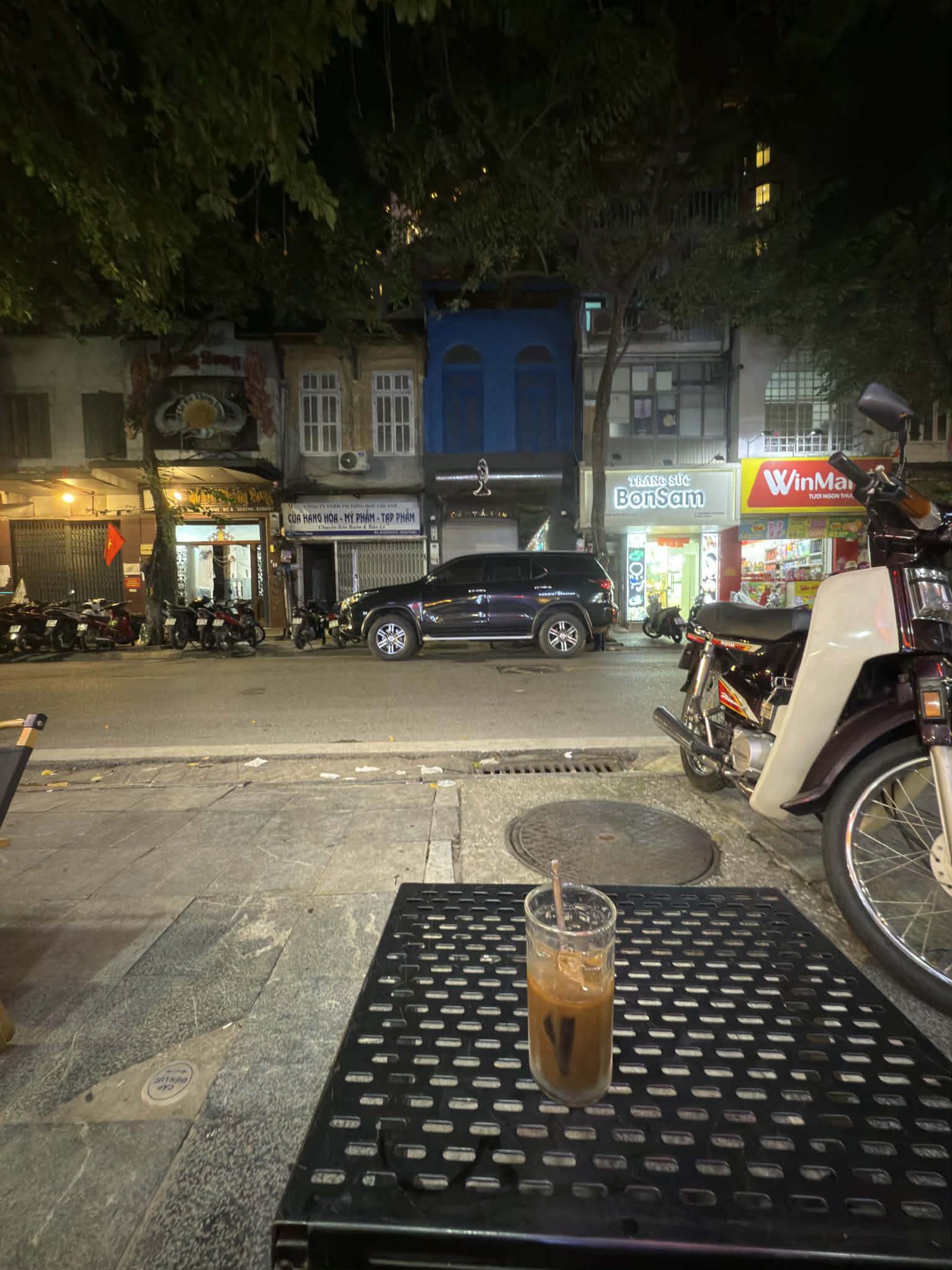
Sitting there at night, with only a glass of coffee on the table, the traffic still moving, the shops still lit, motorbikes close by, and voices blending with the soft sound of a glass touching the table — outwardly, nothing significant seems to be happening. And yet this is often the moment that carries the greatest weight in travel.
For it is precisely in such seemingly ordinary intervals that one suddenly realises what truly receives a person in a city is not its grand attractions, but its quiet capacity to make room for you without announcement.
A bowl of hot soup settles the stomach first. A cup of coffee then allows the mind to return, slowly, to the body. In Hanoi, the movement from pho to coffee does not feel like a change of scene. It feels natural. They are not two separate acts, but two phases of the same urban rhythm: the soup draws you into life, the coffee persuades you to slow your pace enough to remain there.
It is usually only at this point that I begin to feel I am no longer merely a tourist.
Not because I have learnt enough history, nor because I can recite enough place names, but because I have become capable of sitting quietly in a foreign city without needing to prove myself, and without feeling an immediate urge to leave. That capacity not to hurry is rare. It suggests that the relationship between oneself and the city is no longer one of pure observation and display, but has begun, however lightly, to take the form of coexistence.
Closing Reflection | What Travel Ultimately Leaves Behind Is Not the Number of Places Seen, but Whether You Could Eat and Drink in Peace in a Foreign City
The older I grow, the more I feel that the most valuable part of travel is rarely how many places one has seen, but whether, in some unfamiliar city, one managed for a short while to live in a way that resembled ordinary life.
Not itinerary-life, but bodily life in the fullest sense.
Could you bring yourself to sit down at the roadside? Could you accept the city’s own pace rather than demand your own? Could you, on some evening, finish a bowl of hot soup and then choose not to rush away, but to leave yourself the time for a cup of coffee?
Many places do not truly begin to open themselves to you until you are willing to sit down, finish a bowl of soup, and drink a cup of coffee to the end.
That is what Hanoi feels like to me.
It is not, of course, a city that instantly flatters the visitor. It has its own density, its own roughness, its own tempo, and no special desire to slow itself down for the sake of outsiders. Yet for precisely that reason, once you do learn to place your breathing within it, to let the body’s rhythm edge closer to its own, the reply it gives you feels unusually real.
That reply is not always warmth, and it is not always romance. More often, it says something much plainer: you may sit here now, eat, drink, and for a moment become a small part of this street.
For me, such moments come closer to the real answer of travel than any number of completed landmarks.
So long as a bowl of soup can still steady a person, and a cup of coffee can still persuade them to slow down, the line between foreign place and home is never as hard as we imagine.
Where, then, is not home?
FAQ | 8 Further Questions on Hanoi Pho, Street Soup, and Urban Civilisation
Q1: Is this essay primarily a travel piece on Hanoi, or an analysis of Vietnamese food culture?
It is both, but on different levels. On the surface, it follows a traveller entering Hanoi’s rhythm through a bowl of pho. At a deeper level, it asks why pho can be understood as one of the major supporting forms of Vietnamese soup culture, and how it connects to a wider coastal Asian world of broth, rice-based staples, and street-side eating.
Q2: Why describe pho not merely as a famous dish, but as a kind of urban infrastructure?
Because pho is not an occasional speciality. It is an everyday hot meal on which many city dwellers genuinely rely. It is quick to serve, physically settling, economically reasonable, and well suited to a life shaped by movement and compressed time. In that sense, pho helps sustain the ordinary rhythm of the city much as infrastructure does, though in a culinary rather than mechanical form.
Q3: What distinguishes northern pho from the version many international readers are more familiar with?
Northern pho generally places greater emphasis on the broth itself: its clarity, bone depth, and restraint. It tends to be less dependent on sweetness or a profusion of accompaniments, and more intent on allowing the stock to stand on its own. That quality of being clear without being empty is one of the most compelling features of older northern pho shops.
Q4: Why place Hanoi pho within a broader “coastal Asian soup system”?
Because it does not stand alone. Across South China, Vietnam, port cities, migrant settlements, and later the foodways carried into Taiwan, one repeatedly encounters a similar underlying structure: soup at the centre, rice-based starch as the carrier, rapid street-side service as the form, and final personal adjustment at the table. Pho is one of the most accomplished Vietnamese expressions of that larger pattern.
Q5: Why do street-side foods often teach more about a city than major attractions do?
Because they are not staged for display, but used in daily life. They reveal how residents eat, how they share space, how labour time is organised, and how strangers coexist in public. When a traveller is willing to sit down and share that rhythm, they begin to understand not just flavour, but how the city actually functions.
Q6: Are lime and chilli in pho merely condiments?
Not merely. They represent a table-side logic of completion. The kitchen establishes the bowl’s stability; the diner then adjusts its final line according to the body, the weather, and personal preference. In that sense, the bowl is not passively received, but lightly co-completed by the person eating it.
Q7: Why move from pho to night coffee in the latter part of the essay?
Because what allows one to enter a city is not only being fed, but being willing to remain. Pho settles the body first; coffee then slows the pace enough for one to stay within the city’s rhythm rather than merely pass through it. Together, they form a sequence from entry into urban life to a gentler form of coexistence with it.
Q8: What is the essay ultimately trying to answer?
Not which pho shop is most famous, but something more fundamental: what allows a person, in a foreign city, to lower their guard and inhabit the place for a moment as part of ordinary life? For me, the answer is often not a monument, but a bowl of hot soup that steadies the body, and a cup of coffee that persuades one to stay a little longer.
References
Britannica. (n.d.). Pho | Definition, ingredients, origin, & developments. Encyclopaedia Britannica.
Li, T. (2024). A maritime Vietnam. Cambridge University Press. https://doi.org/10.1017/9781009237628
MICHELIN Guide. (2025). Phở Gia Truyền (Hoan Kiem). MICHELIN Guide.
Vietnam National Administration of Tourism. (n.d.). Explore the Old Quarter your way. Vietnam.travel.
Vietnam National Administration of Tourism. (n.d.). Ha Noi. Vietnam.travel.
Vietnam National Administration of Tourism. (n.d.). 10 reasons you’ll love Vietnam. Vietnam.travel.