How to Read a Temple? Identifying Visual and Institutional Clues of Taoism, Buddhism, and Folk Religion
S0|The Starting Point of the Spring Stroll: Why We Need to “Tell the Difference”
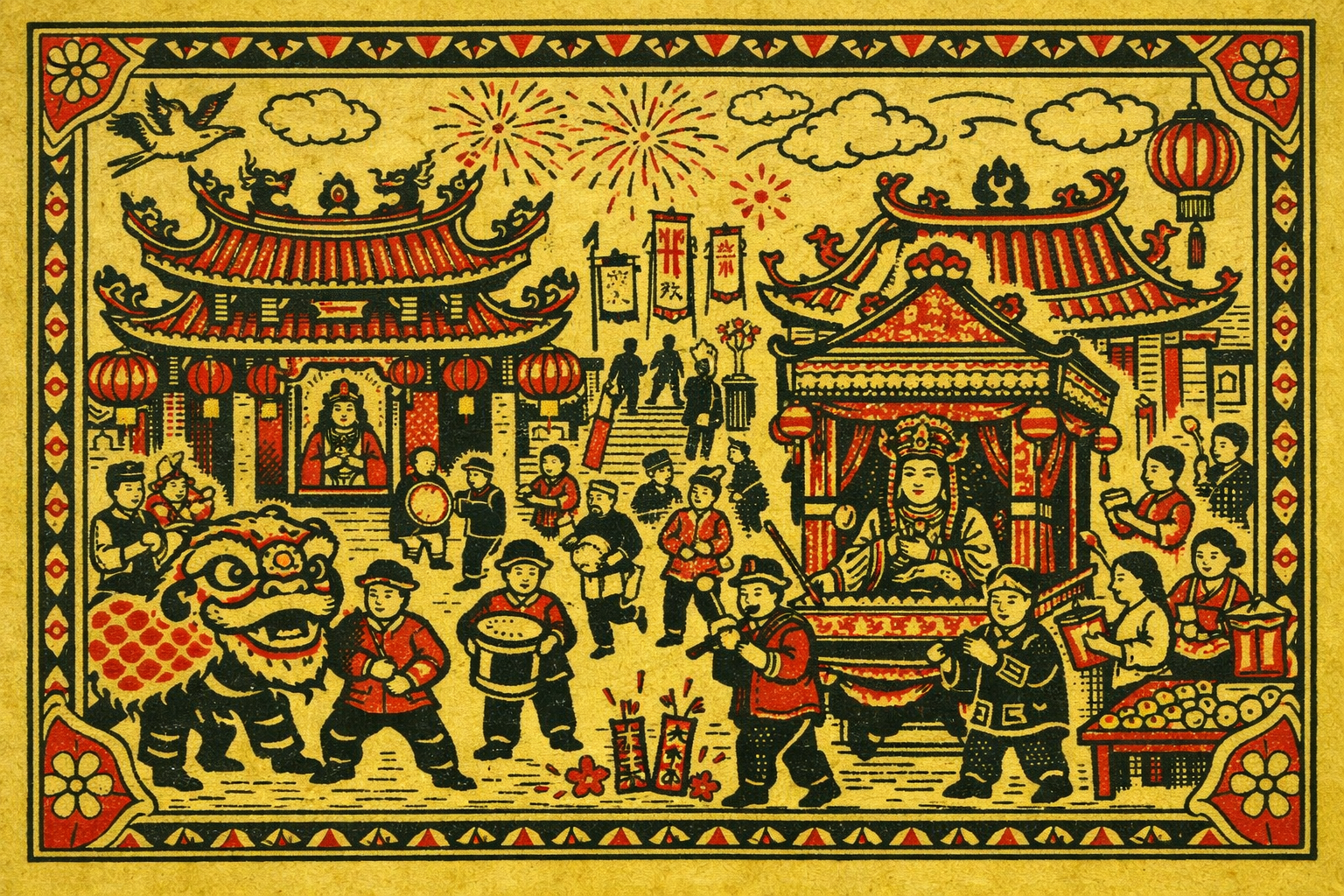
As I write this, it is the evening of the first day of the Lunar New Year. During these few days, from the first day to the reopening of businesses on the fifth, most Taiwanese families naturally include “visiting temples for a Spring Stroll (Zou-Chun) and praying” in their itinerary. Some are intense about it, waiting before dawn for the temple doors to open to plant the first incense stick; others are more casual, finding time during the day to walk around, burn some incense, pray for safety, or complete annual rituals like Pacifying the Tai Sui (An Tai Sui) or lighting lamps. The atmosphere is distinctively Taiwanese: crowds, incense smoke, offering tables, the sound of firecrackers, and a collective rhythm of “reorganizing one’s mood for the new year.”
Interestingly, this scene, which we take for granted, often confuses foreign friends visiting Taiwan. A friend once told me that in their culture, it is easy to distinguish between Catholic and Protestant churches—architectural forms, symbol systems, and even the spatial atmosphere have clear boundaries. However, standing in front of a temple in Taiwan, they are often bewildered: Is this Buddhism? Taoism? Or something that “looks like both”? Furthermore, it’s not just foreigners; some Taiwanese people may not distinguish them clearly either, but because everyone is used to it, they rarely voice this question.
Therefore, the purpose of this article is simple: to provide a portable set of interpretative methods for the context of Spring Festival outings and worship. It does not require the reader to understand the history of theology first, nor does it treat religion as an exam question. Instead, it starts from visible, usable, and verifiable details on-site, allowing people in Taiwan’s religious spaces to not just “follow along and bow,” but to understand a little more: exactly which system, which order, and which cultural layer they are entering.
More realistically, the Rotary International Convention will be held in Taipei in June 2026. During that time, visitors to Taiwan will include not only Western friends but also a large number of visitors from across Asia. Many will arrange “Spring Stroll” style itineraries: visiting major temples, monasteries, and core sites of local belief to experience Taiwan. If one can quickly read some basic differences without being intrusive or offensive, the entire visit experience will be completely different. It becomes more than just sightseeing and taking photos; it allows one to see how this island uses faith to support life, stacks different cultures together, and finally becomes what it is today—a state that is hard to categorize with a single cut, yet possesses its own internal order.
S1|The Stacking of Time: Why Taiwan Was Never “Cleanly Divided”
If we want to answer “Why are Buddhism and Taoism in Taiwan often indistinguishable?”, the first key is not the sect, but Time.
The belief structure of this island was built up layer by layer along the timeline, rather than being a design completed by a single religion at once. The earliest inhabitants of this land were Indigenous peoples and Plains Indigenous groups (Pingpu), who had their own cosmologies, rituals, and nature worship systems. Even after Han immigrants entered later, these early beliefs did not disappear completely. Instead, they seeped into the details of folklore, remaining in festivals, wedding and funeral customs, and local taboos. For example, certain marriage customs, worship methods, or lifestyle taboos can actually be traced back to earlier tribal cultures, even if we don’t usually consciously realize it.
Next came the Hokkien immigrants from Zhangzhou and Quanzhou and the Hakka groups. This wave brought the palace-temple system, the deity hierarchy, and the order of local autonomy. Deity systems like Mazu, Guan Yu (Guan Di), City God (Cheng Huang), and the Earth God (Tu Di Gong) took root locally, and temples became part of the social organization. Elements of Buddhism and Taoism began to intertwine at this stage: the same temple might enshrine Buddhas and Bodhisattvas alongside Taoist deities without any sense of contradiction, because the point was not theological boundaries, but whether it was “efficacious” (Ling-yan) and whether it could maintain local order.
Further along came the Japanese Era. Buddhist architectural forms, temple management systems, and statue aesthetics all left their marks during this period. The proportions, lines, and even the styling of great Buddha statues in some monasteries reveal the aesthetics and religious administrative structure of that era. This was not a replacement, but the addition of another layer.
After the mid-20th century, massive post-war immigration entered Taiwan, bringing new religious practices and ideological backgrounds. At the same time, Western missionaries and Christian systems have also existed in Taiwan for a long time. In recent years, new immigrant communities from Southeast Asia have brought their own faiths into local life. For example, systems like Caodaism from Vietnam are gradually forming their own religious spaces in certain areas.
When all these layers are stacked together, “pure Buddhism” or “pure Taoism” is no longer the most realistic appearance on the scene. Taiwan’s religious field is more like a structure fermented over a long time: the old was not thoroughly erased, and the new did not completely cover the old; instead, they interweave. Precisely because of this, outsiders standing in front of a temple feel the boundaries are blurred; but looking from the timeline of history, this blur is actually a reasonable result.
Only after understanding this layer is it possible to take the next step—in such a stacked structure, exactly what concrete clues can be used to quickly read which kind of field one is in.
S2|The First Layer of On-Site Identification: Reading from the Architectural Exterior
When interpreting religious spaces in Taiwan, the most direct yet most easily overlooked clue is actually the architecture itself. Before entering the space, one stands beneath its exterior, and the exterior usually reveals the first layer of information.
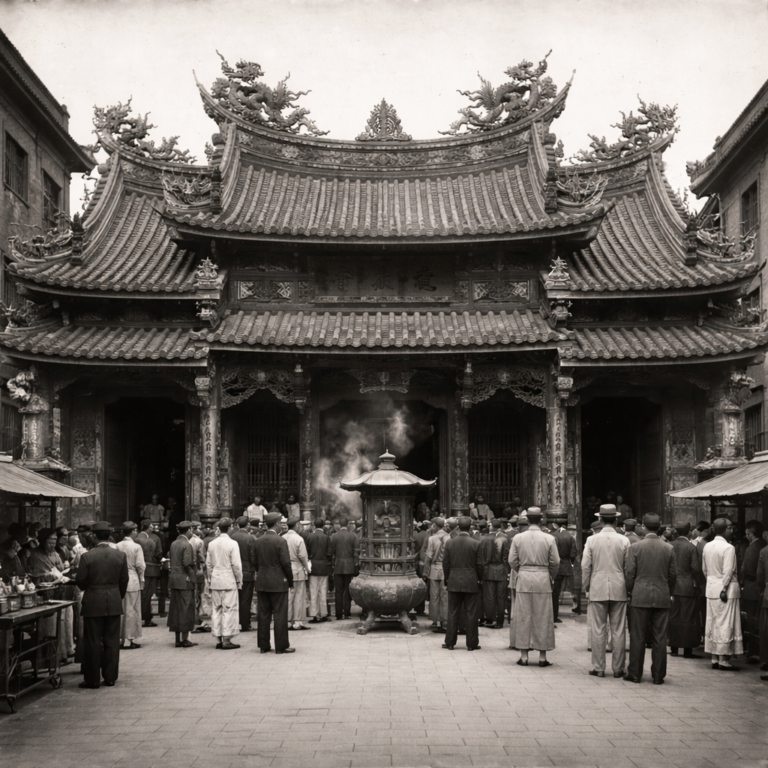
First, look at the roof and overall silhouette. Traditional Han-style palace temples often feature Swallow-tail ridges (Yan-wei-ji) or Cut-and-paste porcelain (Jian-nian) decorations. The roof curves upward, colors are vibrant, and dragons, phoenixes, figures, and mythical beasts are densely distributed between the ridges and the dougong brackets. Buildings of this type mostly belong to Folk Religion or Taoist systems, emphasizing local character and visual tension. Gold, red, and green are common dominant colors, symbolizing auspiciousness and majesty.
In contrast, the exterior of institutional Buddhist temples is usually more restrained. The roof lines are steadier, decorations are fewer, and the overall proportions present a sense of symmetry and order. There may be stone lions, bell and drum towers, or courtyard spaces in front of the hall, but not necessarily highly dense painting and cut-and-paste decorations. If you see the main hall named “Grand Hall of Great Strength” (Daxiong Baodian), “Amitabha Hall”, “Medicine Buddha Hall”, or “Avatamsaka Hall”, you can be almost certain it belongs to the Buddhist system. The name of the hall itself is a language of identification.
Next, look at the title. If the plaque over the door reads “XX Si” (Monastery/Temple), it mostly leans towards the Buddhist system; if it reads “XX Gong” (Palace) or “XX Miao” (Temple), it is commonly found in Taoism or Folk Religion. However, this is not an absolute rule, but an experiential direction for identification; it still needs to be combined with observations of the main deity and offerings.
The visual identification of Tibetan Buddhism is relatively obvious. Five-colored prayer flags hang in the space, prayer wheels line the walls, and stupa-shaped structures or golden roof elements are common on the architecture. The color contrast is strong, with red, yellow, blue, white, and green interwoven, distinctly different from the color system of Han-style palace temples. Even without entering the hall, one can quickly identify its cultural origin from the exterior.
Besides roofs and inscriptions, the entrance layout also provides clues. A Three-Gate structure is common in large monasteries, symbolizing the Three Doors of Liberation; palace temples often feature a broad temple courtyard (Miao-cheng) with the incense burner in the center, emphasizing the flow of collective worship. If the incense burner in front of the hall is extremely large, the offering tables are open, and the flow of people is frequent, it mostly belongs to a “life-oriented” palace temple; if the courtyard is deep and the flow is restrained, it may belong to an “institutional” Buddhist temple.
This layer of identification involves no theology and requires no background knowledge, just observation of proportion, color, inscriptions, and spatial order. When the architectural exterior has provided the first direction, entering the hall to look at the main deity and offerings will make the reading even clearer.
S3|Main Deities and Offerings: Reading Religious Logic from Inner Hall Order
When the exterior provides the first layer of clues, true identification is often completed only after entering the hall. The configuration of the main deity and the norms of offerings inside the hall will directly reveal the religious logic to which this space belongs.
First, look at the main deity. If the central figure in the main hall is Sakyamuni Buddha, Amitabha Buddha, Medicine Buddha, or Guanyin Bodhisattva, and the hall is named “Grand Hall of Great Strength,” “Amitabha Hall,” or “Medicine Buddha Hall,” it can basically be determined as part of the Buddhist system. Statues in a main Buddhist hall usually sit centrally, have stable proportions, and are flanked by Dharma protectors, presenting an overall configuration of symmetrical order.
If the main deity is Guan Sheng Di Jun (Guan Yu), Heavenly Holy Mother (Mazu), City God (Cheng Huang), Xuan Tian Shang Di, or the Earth God (Tu Di Gong), it mostly belongs to Taoism or the Folk Religion system. In such halls, one often sees flourishing incense, offering tables extending outside the hall, and interaction forms between believers and deities (Casting Moon Blocks, Drawing Lots) are more obvious.
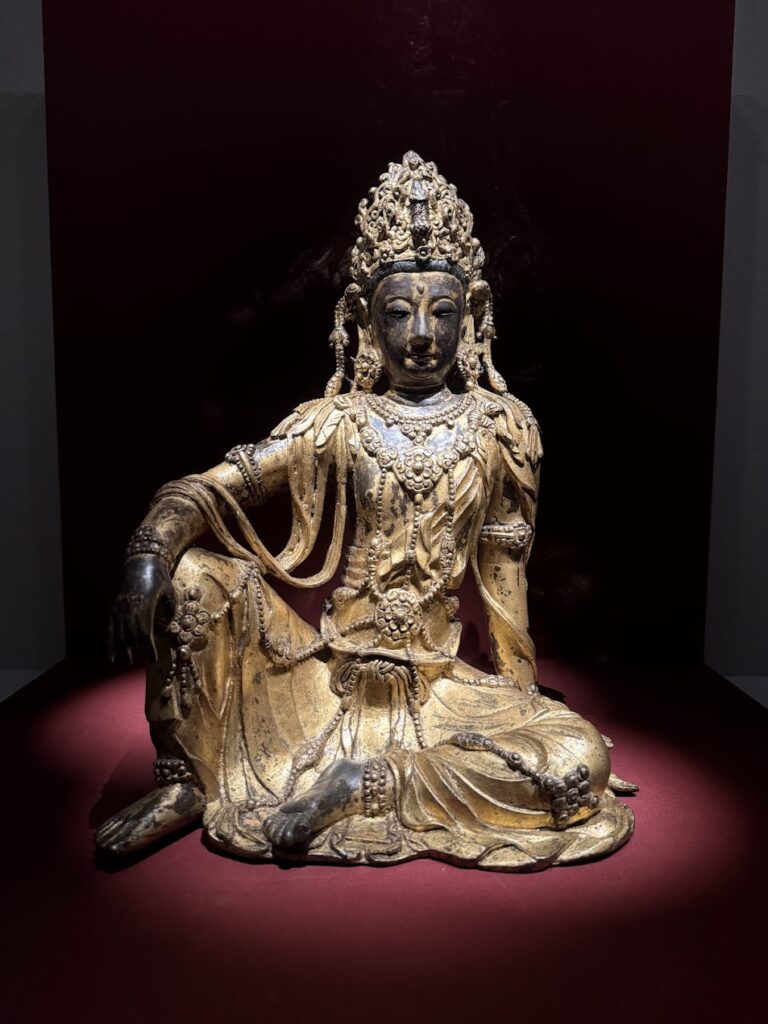
It is worth noting Guanyin. Guanyin Bodhisattva is a highly cross-system existence in Taiwan. Whether in Buddhist temples, palace temples, or even on family altars, Guanyin statues may be enshrined. Different images such as Child-Giving Guanyin, Guanyin of the South Sea, and Guanyin with the Pure Vase coexist in different religious spaces. Guanyin thus becomes a bridge across civilizations and sects, belonging to the classic Buddhist system while deeply integrated into the structure of folk belief. This commonality is one of the reasons why religion in Taiwan is difficult to cut cleanly.
Next, look at offerings; this is a very clear standard for identification.
In temples of the formal Buddhist Monastic System, offerings can only be Vegetarian Offerings. Fruits, fresh flowers, pastries, and vegetarian snacks are common forms; meat offerings will absolutely not appear. This is not a matter of habit, but a regulation of precepts.
Systems like Zhaijiao (Vegetarian Sects), Zhai Tang (Vegetarian Halls), or Cai Tang similarly strictly abide by vegetarian norms, and their offerings can only be vegetarian. These spaces possess high consistency in rituals and diet, leaving no ambiguous space for meat offerings.
Taoism and some Folk Religion palace temples are different. Offerings may include Sacrificial Offerings (Three Sacrifices) or Meat, especially common during large festivals or sacrifices to specific deities. However, some palace temples may adopt vegetarian offerings based on the main deity’s requirements or local habits, but this principle is not a comprehensive regulation based on precepts, but depends on the deity system.
Therefore, when meat offerings appear in the hall, one can basically rule out monastic Buddhist temples and Zhaijiao spaces; if the offerings are entirely vegetarian, one can further combine the main deity and hall name to interpret its religious attributes.
The observation of main deities and offerings is the most direct and effective second layer of reading after exterior identification. When architecture, hall name, main deity, and offerings are cross-referenced, the differences in Taiwan’s religious spaces are no longer blurred, but present a structure with distinct layers.
S4|Institutional vs. Life-Oriented: Spaces for Cultivation vs. Spaces for Problem Solving
After identifying the exterior and inner order, there is a deeper layer of interpretation—does this space exist for “Cultivation” (Practice) or for “Solving Life Problems”?
The core of Institutional Buddhist Temples lies in the cultivation system. It has a Monastic Community (Sangha), Precepts, Sectarian Lineage, and clear stages of practice. The spatial configuration is usually clearly distinguished: the main hall is open for public worship, while the meditation hall, monk’s quarters, and cultivation spaces may not be open to the public. The entire space primarily serves the rhythm of cultivation, not the flow of pilgrims. The ritual focus of such temples is on Chanting Sutras, Meditation, Dharma Assemblies, and Expounding Scriptures, emphasizing liberation and edification. Walking into them, one mostly feels an atmosphere of quiet, order, and distinct layers; the incense smoke may not be heavy, but the rhythm is stable.
In contrast is the highly Life-oriented Palace Temple system. The existence of these spaces is inherently to respond to concrete life situations. This is especially obvious around the Lunar New Year: dense crowds, curling incense smoke, and believers entering with very clear purposes: Pacifying the Tai Sui, Replenishing Luck, Dispelling Misfortune, praying for wealth, career, exam luck, or family safety. Through Drawing Lots, Casting Moon Blocks, and various rituals, the uncertainty that was originally uncontrollable is transformed into a set of operable procedures.
Xingtian Temple, temples of the Golden Mother of the Jasper Lake (Yaochi Jinmu) system, and the Hongludi Earth God Temple in Zhonghe are all representatives of this life-oriented space. Incense is already flourishing on ordinary days, and during the New Year, crowds surge. The reason these places have powerful attraction lies not in whether the doctrinal discourse is complete, but in that they provide a sense of order that responds immediately: when life presents pressure or change, people know they can come here to complete a certain psychological and social realignment through ritual.
In Taiwan, institutional Buddhist temples and life-oriented palace temples are not mutually exclusive. Many people frequent both types of spaces: walking into a monastery when needing quiet, and walking into a palace temple when dealing with annual nodes or life anxieties. Understanding this functional division is closer to the actual operating logic of Taiwan’s religious field than simply drawing a line between “Buddhism” or “Taoism.”
S5|Iconography and Form: Traces of Different Cultures on Buddha Statues
When architecture and spatial function have provided direction, the deity statue itself gives more detailed cultural clues. Iconography is not merely an art form, but a concrete presentation of religious understanding and historical context.
In the Han Chinese Buddhist system, Buddha statues mostly have rounded proportions, a stable expression, and eyes half-open and half-closed, symbolizing the coexistence of inward introspection and compassion. The folds of the robes cascade in layers, the posture is upright, and the whole presents symmetry and stability. Dharma protectors like the Four Heavenly Kings often appear in images approximating ancient Han-style military generals, wearing armor, holding weapons, standing with a majestic but orderly expression.
Southeast Asian Buddhist iconography presents a different style. Slender-proportioned Buddha statues are common in Thailand, with fluid and elegant lines. Reclining Buddha statues are particularly common in Thailand, symbolizing the posture of the Buddha before entering Nirvana. In addition, the form of the Multi-headed Naga (Dragon Deity) spreading out to protect the Buddha’s head while he meditates is an important visual symbol of Southeast Asian Buddhism, rarely appearing in the Han system. Seeing this Naga-protected form almost certainly confirms its cultural source belongs to the Theravada Buddhist lineage.
The identification of Tibetan Buddhism iconography is even more distinct. Besides the visible prayer flags, prayer wheels, and stupa structures on the exterior, the Buddha statues inside the hall feature intense colors, complex decorations, and an abundance of gold and gemstone elements. Some Buddha statues look highly similar in form; the key to distinction often lies in the Mudra (Hand Seals) and Attributes (Held Objects). Different Mudras represent different Principal Deities (Yidam) and must be interpreted through details. The overall visual presentation is densely layered, symbolizing an extremely complete system.
Japanese Buddhist Temples also have obvious differences in iconography. The Four Heavenly Kings in Japan often appear with bare upper bodies and strong muscle lines, showing strong dynamism, a form presenting clear differences in Japanese sculptural style. The proportions and robe fold treatments of Buddha statues are simpler, showing characteristics of Japanese aesthetics. Some buildings and statues in Taiwan still show stylistic influences left from the Japanese era; for example, the styling of the Changhua Baguashan Great Buddha bears a distinct imprint of that time.
Through iconography and form, one can see how different civilizations developed their own visual languages under the same religious noun. Buddhism is not a single image but is re-understood and recreated in different regions. When architectural exterior provides the first layer of identification, main deities and offerings provide the second, details of iconography become the third, more refined tool for reading.
S6|Stacking, Not Purging: The Fusion Logic of Taiwanese Faith
If we widen our perspective, we discover that the reason Taiwan’s religions appear intertwined, blended, and hard to categorize simply is not chaos, but a logic formed by history—Stacking, not Purging.
In certain ancient civilizations, religious and political power overlapped highly. When city-states fought or kingship changed, the victor would often demolish the loser’s temples and build new shrines on the original site to declare the transfer of divine and ruling power. Religious space was thus exclusive and substitutive: the new covered the old, and the old was cleared away.
Taiwan did not move towards this mode of toppling over.
The traces of Indigenous and Pingpu beliefs were not completely erased but seeped into later folk layers; the palace temple systems brought by immigrants from Zhangzhou, Quanzhou, and Hakka areas took root in local society; the temple system and iconographic aesthetics of the Japanese period were stacked on top; post-war immigration and new religious practices added another layer; and in recent years, beliefs brought by new immigrant communities have also formed their own spaces in certain areas.
These layers do not replace each other; they permeate each other.
Therefore, the simultaneous appearance of Buddhist Bodhisattvas, Taoist deities, and folk religion elements in the same temple is not seen as a contradiction. Religious forms like Zhaijiao (Vegetarian Sects) and Yiguandao (I-Kuan Tao) developed their own spatial and ritual systems against this background of fusion. Even if some spaces are not fully open to the public, their thoughts and norms are deeply implanted in social life.
This formation of stacking makes the boundaries of Taiwan’s religious field look blurred, but this blur is actually evidence of cultural inclusivity. Different symbols can coexist, different deities can stand side by side, and different traditions can speak for themselves on the same street. When outsiders try to understand this phenomenon using “pure sectarian classification,” confusion easily arises; but if read from the angle of fusion and accumulation, one discovers a balance formed after long-term historical negotiation.
Taiwan’s religious culture is not the product of a fractured revolution, but the result of continuous absorption, reorganization, and adjustment over time. Understanding this prevents mistaking ambiguity for chaos.
S7|Incense and Peace of Mind: Order of Faith in the Senses
Finally, there is a most daily, yet deepest clue—Incense.
The Incense Sticks common in Taiwan mostly have red incense feet, which are thin bamboo sticks coated with incense powder. Different formulas of incense powder result in different color depths and scent layers; some are heavy, some are clear, some carry a sandalwood scent, and some mix multiple fragrant materials. Thicker incense sticks with longer burning times are common in temples; these are mostly used for palace temples or large Dharma assemblies and are rarely used in general households.
The incense sticks common in Japanese Buddhist Temples are mostly pressed from the whole section, without a bamboo core foot, shorter in form, and with a burning method different from Taiwanese habits. In addition, there are Coil Incense, Spiral Incense, powder incense, and incense blocks, used according to different spaces and ritual needs. The form of incense itself is a subtle difference in cultural systems.
However, the meaning of incense does not stop at form. The act of lighting incense is itself a ritual of entrusting inner unease to the space. The smoke rises slowly, symbolizing prayer and communication; the moment the scent permeates, it constitutes a shared sensory memory. Whether in an institutional Buddhist temple, a life-oriented palace temple, a Zhai Tang, or before a family altar, the core appeal always revolves around safety and stability.
Therefore, when people go for a Spring Stroll, or when foreign friends visit Taiwan, what they can truly take away is not just the knowledge of “telling them apart,” but an understanding: these architectures, statues, offerings, and rituals all exist to respond to the needs of the human heart.
From architectural exteriors to hall inscriptions, from main deity configurations to offering norms, from iconographic forms to spatial functions, and finally to incense smoke and scent—each layer provides a way of reading. After understanding, religion is no longer a blurred mixture, but an ordered structure formed by historical stacking.
In such a structure, distinguishing is not to draw clear lines, but to see how differences coexist. This may be exactly the most valuable part of Taiwan’s religious culture: it does not rush to purge, but slowly fuses in time, allowing faiths from different sources to find their own places on the same land.
S8|Not Tearing Down and Rebuilding, But Stacking Up Layer by Layer
If we string together everything mentioned above, we actually see a very clear structure.
Taiwan’s religious space has never operated on the logic of “You come, and I disappear.” It is not a toppling style, nor a purging style. It is not that whoever is stronger pulls the other out completely and changes it to a new look. Taiwan does not work like that.
Walking on an old street, you might see the layout of a Qing Dynasty temple in front, with elements added during the Japanese period on the side, deities moved in after the war inside, and further back, even new religious spaces brought by new immigrants appearing. It is not mutual destruction, but mutual coexistence. It adjusts, translates, and renames, but rarely completely erases.
This point is visible from the architectural exterior:
- There are Hokkien-style swallow-tail ridges, and also the proportional sense of Japanese temples;
- There are Four Heavenly Kings in Han-style military attire, and also protector images with Japanese-style muscle lines;
- There is the curling smoke of Taoist palace temples, and also the clean norms of Buddhist vegetarian offerings;
- Even on the urban fringe, one sees new religious spaces brought by different ethnic groups.
These are not chaos. This is an order formed after a long period of stacking.
Taiwan’s religious culture actually rarely uses “substitution” to complete transformation; it is more like “absorption.” After absorbing, it slowly adjusts its position and finds balance. On the surface, it looks messy, but internally there is a strong resilience.
If someone asks, what is the characteristic of Taiwan’s religion? I would say, not a single orthodoxy, nor highly purified.
But rather—
In the midst of various differences, maintaining a structure that allows coexistence.
This is not accidental.
This is a cultural character accumulated from long-term life experience.
So when you walk into a temple, a monastery, or smell that wisp of incense smoke again, what you see is actually not just a ritual, but a way a civilization handles difference.
It did not overthrow the old.
It stacked the new upon the old.
FAQ: Common Questions
1. How to quickly judge from the exterior if a temple belongs to the Buddhist system?
Observe from three levels: Main Deity Iconography, Offering Norms, and Architectural Vocabulary. If the main deity is a core Buddhist figure like Sakyamuni Buddha, Amitabha, or Medicine Buddha, the offering table has only fruits, fresh flowers, and water, and the building name is “Si” (Monastery), “Chan Si” (Zen Temple), “Jingshe” (Vihara), or “Jiangtang” (Lecture Hall), it can basically be judged as a Buddhist temple. Official Buddhist temples will only have vegetarian offerings, never meat offerings.
2. How to distinguish between Han Chinese Buddhist Temples and Tibetan Buddhist Temples from the exterior?
Han Chinese Buddhist architecture mostly adopts a central axis symmetrical layout, with the Mountain Gate, Heavenly King Hall, and Grand Hall arranged in order, and roofs are East Asian palace-style double-eave structures. Buddha statues have round faces, eyes half-open, and restrained expressions. Tibetan Buddhist architecture features strong color contrasts, common red and white walls with golden roof combinations, flat or stacked golden roofs, and elements like prayer flags and prayer wheels. Statues have high similarity in facial features; the key to identification lies in mudras (hand seals) and held objects, not facial differences.
3. Why are Tibetan Buddhist statues difficult to identify by face?
The Tibetan Buddhist iconography system values ritual norms and symbolic systems. Its Buddha and Bodhisattva images follow strict rules of proportion and style, so facial differences are small. Actual identification requires observing mudras, ritual implements, sitting postures, and accessories. The mudra is the core clue for distinguishing the principal deity, not facial features.
4. What are the obvious exterior characteristics of Southeast Asian Buddhist statues?
Southeast Asian Buddha statues have slender bodies, clothes that cling to the body, fluid lines, and a relatively small head proportion. Reclining Buddha images are common, symbolizing the moment the Buddha entered Nirvana. In addition, the “Naga-Protected Buddha” form—where a giant serpent coils behind the meditating Buddha to protect him—is a typical symbol of the Southern Buddhist cultural sphere and does not appear in Han Buddhist temples.
5. How to identify the difference between Japanese and Han styles from the Four Heavenly Kings?
The Four Heavenly Kings in Han Buddhist temples mostly wear military general armor, styled like historical Chinese generals, with stable and majestic postures. In Japanese temples, the Four Heavenly Kings (Shitenno) are often bare-chested with obvious muscle lines and strong dynamism, showing distinct Japanese sculptural style differences. Cultural origin can be identified from the clothing and body proportions of the Dharma protectors.
6. What is the functional difference between Japanese and Taiwanese Buddhist temples?
Japanese Buddhist temples often function as cemeteries and places for ancestor burial, with neat graveyard areas around the temple, forming a spatial system combining religion and family worship. Urban temples in Taiwan rarely include cemetery functions; funeral functions are mostly separated into public cemeteries or columbariums (bone ash towers).
7. Why does Taiwan’s temple culture present a “Stacking Fusion” rather than “Substitutive Purging”?
During historical transitions, Taiwan’s religious field did not see large-scale patterns of toppling previous dynasties’ temples to rebuild new deity systems. Instead, it formed a composite belief space through fusion and coexistence. Different deities can dwell in the same hall, and different religious elements can exist in stacks, presenting a highly inclusive cultural form.
8. How to distinguish between Buddhism and Folk Religion from offerings?
Buddhist temple offerings will only be vegetarian, including fruits, fresh flowers, and water; meat sacrifices will not appear. Folk Religion or Palace Temple systems may feature Sacrificial Offerings (Three Sacrifices) or cooked food. The form of offerings is an important observation point for identifying the religious system.
9. Does the form of lighting incense have a cultural identification function?
Common incense sticks in Taiwan mostly have red incense feet (bamboo cores) and are longer; the color varies by formula. Japanese incense sticks are mostly short and have no bamboo core. Large Dharma assemblies in temples often use thick incense or coil incense. Different incense forms reflect different religious traditions and ways of using space.
10. Why does Taiwan’s religious field have high visual hybridity?
Taiwan has long been an immigrant society and a zone of multicultural intersection. Elements of Buddhism, Taoism, and Folk Religion permeate each other, forming a visually mixed religious field. This fusion is not chaos, but a result of long-term historical stacking, embodying the capacity for cultural adaptation and social inclusion.
📚 Extended Reading|If you want to look deeper into the “Identification Clues” mentioned in this article
- ① How to Understand Taiwan’s Religious Culture?
https://www.nelsonchou.com/how-to-understand-taiwan-religious-culture/
If you want to understand “Why do Buddhism, Taoism, and Folk Religion often look mixed together in Taiwan,” this article explains the reasons for the mixture structurally: Religion in Taiwan is more of a life practice system than a classification based on doctrinal boundaries. - ② The Seven Civilization Chains of Guanyin: How Compassion was Recreated in Asia?
https://www.nelsonchou.com/guanyin-seven-civilization-chains-asian-compassion/
This article discusses “Why Guanyin can cross Buddhist temples, Palace temples, and family altars.” It breaks down the path of Guanyin as a common Asian vocabulary: How the same symbol of compassion was re-translated in different civilizations and lands. - ③ Compassion Supported by the Dragon God: From the Thousand-Armed Guanyin in Hanoi Fine Arts Museum, Looking at How Southern Buddhism Rewrites Guanyin
https://www.nelsonchou.com/naga-avalokitesvara-cultural-translation/
This article mentions visual clues of the Southeast Asian system in the iconography layer (e.g., the composition of Naga protection). This piece provides a more complete cross-cultural context: When the Southern/Southeast Asian world received Guanyin, how iconography wrote the “spiritual grammar of the land” into Buddhist compassion. - ④ The Circuit of Spirits: A Cross-Cultural Journey of Faith from Shamanism to Taoism and the Vietnamese Mother Goddess
https://www.nelsonchou.com/shenling-huilu/
This article mentions the “Stacking and Absorption” character of Taiwan’s religion and the faith layer brought by new immigrants. This piece pulls the perspective to the connection between Northeast Asia—Chinese Taoism—Vietnamese Mother Goddess worship (Dao Mau), making it easier for readers to understand: How different traditions form a sharable trust structure through ritual and bodily techniques.
References
- Bureau of Cultural Heritage, Ministry of Culture. (n.d.). National Cultural Heritage Database Management System. https://nchdb.boch.gov.tw
- Institute of Ethnology, Academia Sinica. (n.d.). Research Results of the Institute of Ethnology. https://www.ioe.sinica.edu.tw
- Wang, C.-C. (2001). Studies on Folk Religion in Taiwan. Taipei: SMC Publishing.
- Dean, K. (1993). Taoist ritual and popular cults of Southeast China. Princeton University Press.
- Jordan, D. K., & Overmyer, D. L. (1986). The flying phoenix: Aspects of Chinese sectarianism in Taiwan. Princeton University Press.
- Chandra, L. (1988). The thousand-armed Avalokiteśvara. International Academy of Indian Culture.
- Brown, R. L. (1996). The Dvaravati wheels of the law and the Indianization of Southeast Asia. Brill.
- Welch, H. (1967). The practice of Chinese Buddhism, 1900–1950. Harvard University Press.