Co-Cooking Islands Vol.6: Da Lu Mian, Taiwanese Geng, and Lomi — A Semantic History of Thickened Noodle Soups Drifting Across the Sea
Nelson Chou|Cultural Systems Observer · AI Semantic Engineering Practitioner · Founder of Puhofield
(This essay series re-examines Taiwan through food supply chains, migration, texture, and semantic drift.)
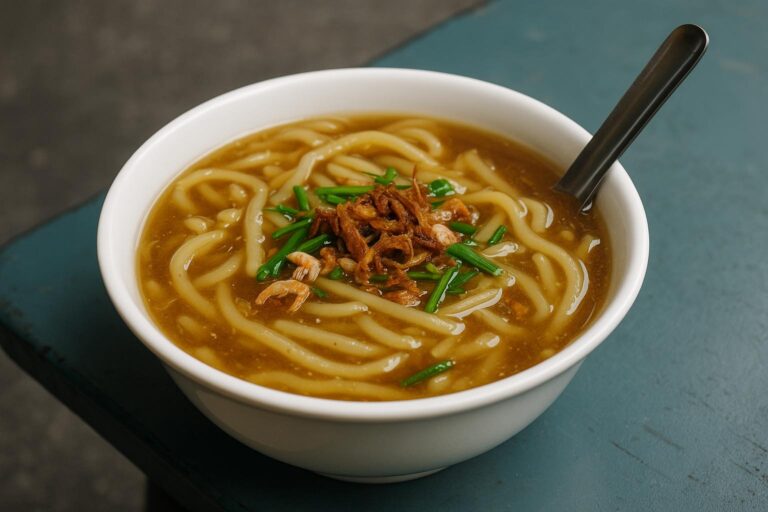
This essay is not only about a bowl of noodles, nor merely about thickening. What I want to trace is a much longer line of flavour after it has drifted across the sea — a line that keeps changing its wording, its body, and its meaning. The salty, weighty grammar of northern da lu mian reached Taiwan and, under the island’s climate, sugar habits, starch techniques, and everyday kitchen logic, gradually turned into geng. Move further south, and that same structural idea — thickened broth clinging to noodles — takes on another life altogether in the tropics, becoming something closer to lomi: denser, darker, and more unabashedly robust.
This is not a neat lineage chart, nor a simplistic story of imitation. A better way to understand it is this: the same culinary logic of thickened soup, once carried through different climates and different social worlds, begins to speak in different local languages.
Where this essay sits within the series
If the previous essay examined the wider maritime soup network running through South China and coastal Southeast Asia, then Vol.6 narrows the lens and turns to texture itself: thickness, cling, gloss, and the bodily comfort of soups that hold together. More specifically, this essay focuses on da lu mian, Taiwanese geng, lomi, and the family resemblance between them — close enough to invite comparison, but not so close that they can simply be treated as the same thing.
In other words, this is the volume in Co-Cooking Islands that deals most directly with thickened-soup structures, semantic change, and the shift from savoury heaviness to the softer, more enveloping grammar of Taiwan’s geng. The surrounding essays in the series move outward in different directions: one traces maritime rice-noodle currents across coastal Asia, another turns to mianxian hu and oyster vermicelli as a Taiwanese grammar of thickness shaped by trust and time, another examines da mian geng as a more local and bodily noodle memory, and another returns to Taiwan to ask how migrant foodways settle into homes, neighbourhoods, and small shops.
Key points
- This essay does not treat Taiwanese geng as a purely local invention detached from elsewhere; it places it within a longer continuum linking northern thickened noodle soups, Taiwanese localisation, and tropical Southeast Asian transformations such as lomi.
- The point is not to chase a single pure origin, but to ask how the culinary logic of thickened broth clinging to noodles develops different meanings once it is absorbed into different climates, markets, and bodily habits.
- The specifically Taiwanese turn lies not only in sweetness, but in how an inherited thick-sauce structure was re-cooked into a local grammar of comfort, texture, and everyday life.
Introduction: sometimes flavour says more than words do
I have often felt that Taiwanese geng is a kind of language cooked by the land itself. It is thick, glossy, faintly sweet, and rarely declarative. Rather than announcing anything outright, it seems to hold life in suspension for a moment longer, keeping certain things warm and unspoken at the back of the throat.
Yet this bowl did not emerge in Taiwan out of nowhere. If you trace its path northwards, seawards, and historically, a much longer line comes into view: northern da lu mian, Taiwanese geng, Southeast Asian lomi, and even side branches such as Keelung curry noodles — dishes that may look proximate on the surface, but do not necessarily belong to the same historical machine.
I prefer to think of this as one soup logic repeatedly learning how to breathe differently. Each time it enters another climate, another market, another set of bodily needs, it does not merely change flavour. It begins to speak another civilisational language.
I. The northern starting point: the salty, weighty world of da lu mian
To understand the semantics of Taiwanese geng, we first need to return to a time before the word “thickened broth” became so softened by Taiwan’s own culinary sensibility. In many northern versions of da lu mian, the centre of gravity lies neither in sweetness nor in aromatic complexity, but in savouriness, density, and a sense of physical steadiness. Wood ear mushrooms, daylily buds, egg ribbons, shredded meat, and mushrooms may appear in different ratios depending on the regional version, but together they point to a clear bodily logic: the dish is meant to warm, to settle, and to feed with weight.
In that sense, northern da lu mian is built less on outward aromatic expansion than on inward concentration. Its thickened sauce gathers the broth, the protein, and the noodles into a single, cohesive mass. What matters is not perfume, but adhesion; not lift, but hold. The “lu” here belongs to a world of savoury binding rather than to the milder, slightly sweet, more enveloping broth texture that many Taiwanese diners now associate with geng.
- The flavour centre lies in savouriness, not sweetness.
- The form of the dish depends on thickening and cohesion, not on aromatic expansion.
- Its first task is to make the eater feel fed, settled, and physically held.
This is where the semantic split quietly begins. The same word may still be “lu”, but in the north it speaks the language of weight; in Taiwan, it will gradually be re-cooked into the language of warmth.
II. Southward drift: when thickened noodle soups enter an island where sugar is already ordinary
As this thick, savoury, filling soup logic moved southwards along routes of migration, maritime travel, and coastal living, the element that transformed it in Taiwan was not simply a cook’s moment of invention. It was the island’s wider material environment. Taiwan is not a place where sugar has historically stood far from everyday life. Sugarcane, sugar production, and sweetening habits were already deeply embedded in ordinary food culture. Once thickened noodle soups entered such a setting, they were unlikely to remain untouched by sweetness for long.
What matters here is not the simplistic claim that “someone added sugar”, but the fact that sweetness entered as an environmental condition. In Taiwan, this thickened broth structure absorbed heat, humidity, local taste habits, and everyday ways of eating. Its flavour thus began to change register. Rather than pressing everything inward and downward, it moved towards a softer soupiness — something easier to swallow, easier to wrap around ingredients, and easier to fold into ordinary daily life.
The shift may seem subtle, but it is decisive. From this point on, the question is no longer only whether a dish has enough force. It also begins to ask whether it has warmth, whether it offers a sense of coating and comfort, and whether it can become part of the everyday. That is the moment at which the Taiwanese world of geng begins to take shape.
III. Localisation: Taiwan did not merely extend northern lu — it cooked its own grammar of geng
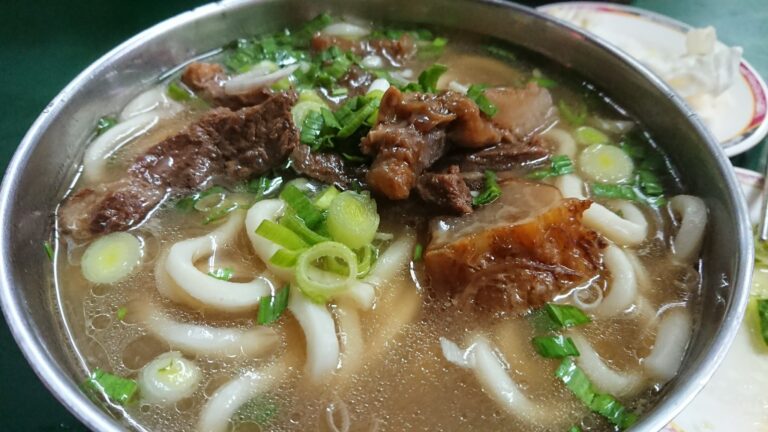
Sweetness was only the beginning. What truly allowed thickened noodle soups to settle in Taiwan was the wider set of local techniques and ingredients that later became remarkably stable: starches giving the broth gloss and cling; fried shallots providing an aromatic landing point; fish paste and meat-thickened pieces offering different local protein vocabularies; bamboo shoots, mushrooms, and root vegetables laying down a faintly sweet vegetal base; and black vinegar, in many places, lifting the finish back upwards.
Once these elements came together, the story was no longer one of “northern da lu mian with a bit more sugar”. Taiwan did something more interesting. It took an inherited logic of thickened savoury sauce and re-cooked it through its own starch practices, aromatic habits, street-side eating rhythms, and local protein handling. What emerged was not a copy, but another texture-world altogether: softer, more cohesive, more enveloping, and far more integrated into everyday Taiwanese life.
That is why I would hesitate to describe Taiwanese geng simply as an offshoot of northern da lu mian. It is better understood as a local re-creation completed within Taiwan’s own social and sensory conditions. And that, in turn, helps explain why other thickened noodle forms in Taiwan can feel related while still carrying different local worlds within them.
What matters most about Taiwanese geng is not how closely it resembles somewhere else, but how it slowly turned an inherited thickened-sauce structure into a broth that only Taiwan would teach to speak this way.
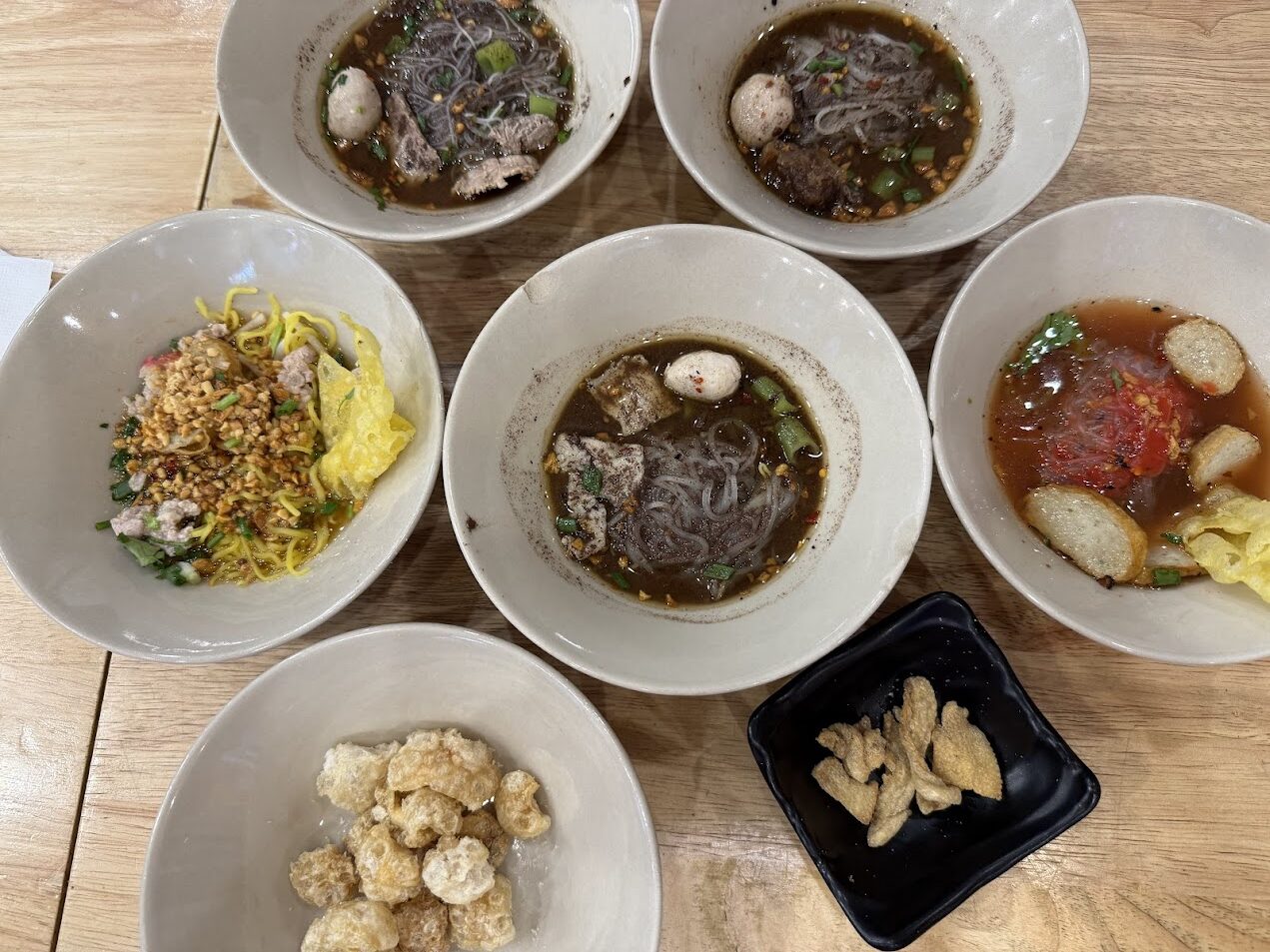
IV. Maritime drift: further south, this thickened-soup line grows into the tropical relative called lomi
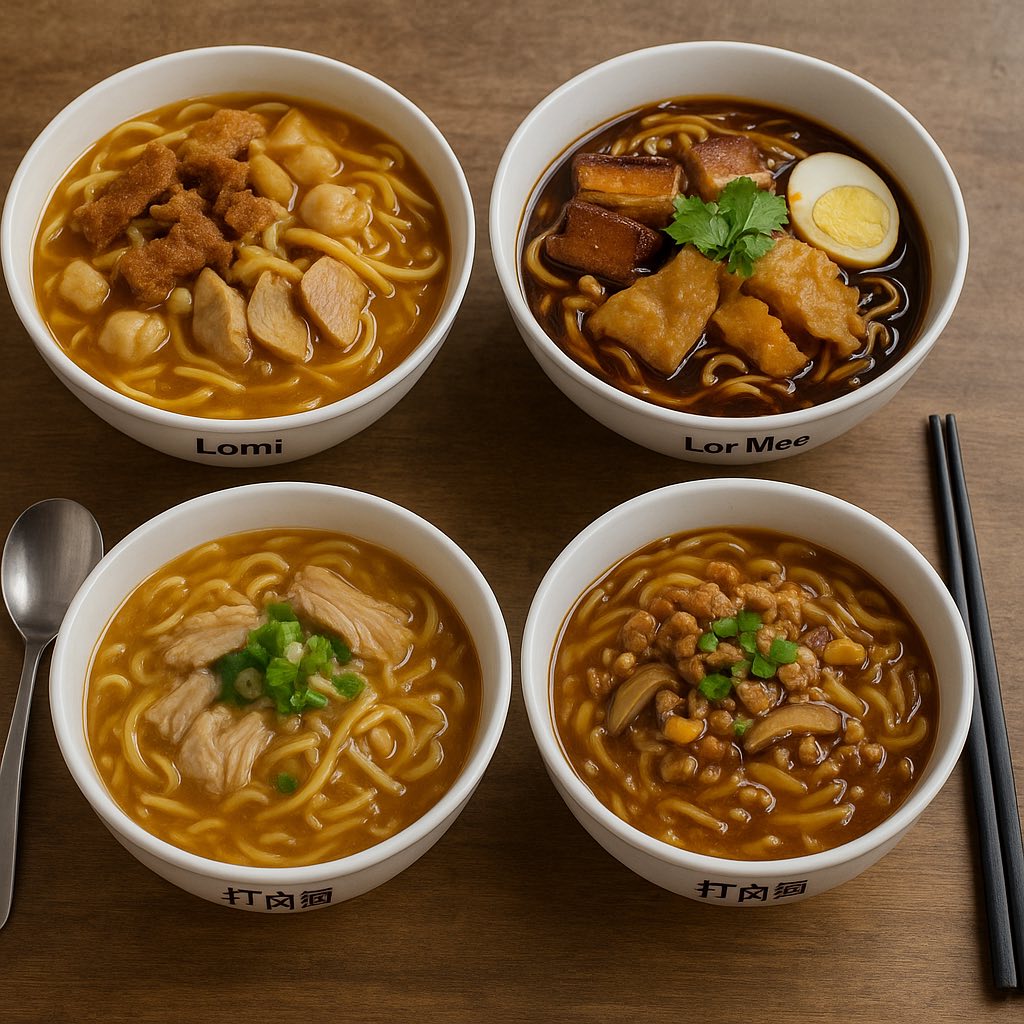
Further south, one encounters another group of dishes that feel strangely familiar and yet unmistakably different. The Filipino dish lomi, for instance, immediately suggests some lingering shadow of Chinese noodle culture: thick, heavy, highly coating, and still organised around the question of how broth can cling firmly to noodles and other ingredients.
I find it more useful to understand lomi as a southern, maritime relative born of contact and adaptation, rather than as a derivative copy of anything else. Even where names, techniques, or first impressions may appear related, what ultimately determines the final form of a dish is the world in which it lands: the market, the climate, the fats used in cooking, the pace of labour, and the bodily habits of everyday life.
In that sense, what matters about the Southeast Asian line is not merely whether it preserves traces of Chinese migration, but how it pushes the broader logic of thickened noodle soups in another direction altogether. Once absorbed into tropical foodways, the same structural idea becomes darker, fuller, more peppery, and more visibly shaped by the energy of the street.
- Pepper, garlic, and fried aromatics often move more decisively to the front.
- Oil, richness, and surface depth are used more assertively.
- The broth itself becomes deeper and heavier, at times almost approaching the body of a soup gravy.
- Even the noodle form may shift, taking on the sturdier, more local character of a particular city or province.
So if Taiwanese geng softened the thickened-soup idea into something smoother, gentler, and faintly sweet, then lomi pushes that same idea towards another register: hotter in climate, more outward in flavour, and more visibly shaped by the working body of a port-side world.
What makes lomi compelling is not whether it can be reduced to someone else’s noodle dish, but the fact that it shows how the same thickened-soup logic acquires another body once it enters another climate.
A methodological note
I deliberately resist turning lomi into a single, overconfident answer about origins. Not because judgement is impossible, but because port-city food cultures are rarely that tidy. What matters more to me is not the search for one pure ancestor, but the question of how a soup idea survives after crossing the sea — and how it is re-cooked into the daily life of another place.
V. A semantic side branch: Keelung curry noodles may look close to Southeast Asia, but they belong to a different system
At this point, another easily misunderstood side branch comes into view: Keelung curry noodles.
The moment people see the word “curry”, together with a bowl that is thick, somewhat glossy, and noodle-based, they often assume it belongs somewhere within the broader Southeast Asian curry world. That instinct is understandable. Port cities naturally encourage such associations. Yet if one examines the structure more carefully, Keelung curry noodles are better understood not as a direct extension of tropical coconut-based curry traditions, but as the result of Japanese-style curry entering Taiwan’s port environment and then being reworked through local broth habits, thickened textures, and everyday taste.
The decisive difference lies here: many Southeast Asian curries build their aromatic force through lemongrass, galangal, turmeric, curry leaves, coconut milk, and other tropical ingredients that open the flavour outward. Keelung curry noodles follow a different logic. They are closer to a rounder, more inwardly gathered structure shaped by curry powder, flour-thickened sauce, broth integration, and a restrained sweetness — a distinctly different way of making something dense and comforting.
That is why the importance of Keelung curry noodles does not lie in proving that Taiwan resembles Southeast Asia. Their real value lies in reminding us that dishes may share thickness, heaviness, and a maritime feel while still belonging to different historical machines. One comes out of tropical spice worlds and colonial port circulations; the other emerges from the meeting between Japanese curry, Taiwanese broth culture, and a particular port-city everydayness.
I therefore prefer to place Keelung curry noodles in this essay as a semantic side branch. They do share with geng a concern for density, coating, and bodily satisfaction, but the route by which they arrived there is not the same as that of lomi. Their grammar belongs to another translation history altogether.
Semantic misreadings in food often begin here: two bowls can look strikingly similar without belonging to the same lineage at all. Sometimes they have simply found different historical ways of becoming thick.
VI. Conclusion: what survives at the end of a drifting flavour line is not the original form, but a local way of speaking
If we retrace the whole line from the beginning, what matters in the end is not which bowl deserves to be called most authentic, nor which one may claim to be the original. What deserves closer attention is how a thickened, coating, bodily form of noodle soup travels from northern da lu mian, passes through Taiwan, moves into Southeast Asia, and gradually turns into several related yet irreducibly different memories of eating.
This is precisely why Taiwanese geng matters. It is not simply the residue of an imported dish, nor a straightforward transplant. It is better understood as the island’s own re-composition of an inherited thickened-soup structure through sugar, humidity, fried shallots, starch thickening, street-side labour, and ordinary appetite. At that point, geng ceases to be merely the name of a dish. It becomes a sentence structure within Taiwanese everyday life.
So the real question behind this essay is not merely where geng “came from”. What interests me more is how flavour survives after drifting into another land, how it is reinterpreted, and how it slowly becomes part of a new ordinary. In many cases, what culture leaves behind is never the original shape. It is the form that has learned how to speak locally.
Further reading within the Co-Cooking Islands series
- One essay traces maritime rice-noodle currents across coastal Asia.
- Another turns to mianxian hu and oyster vermicelli as a Taiwanese grammar of thickness shaped by trust and time.
- Another examines da mian geng as a more local and bodily noodle memory.
- And another returns to Taiwan to ask how migrant foodways settle into homes, neighbourhoods, and small shops.
FAQ|Da Lu Mian, Taiwanese Geng, Lomi, and the Drift of Thickened Noodle Soups
1. Are da lu mian and Taiwanese geng basically the same dish?
Not exactly. They can be read as historically comparable relatives within a broader tradition of thickened noodle soups, but they are not interchangeable. Northern da lu mian is generally built around savoury density, adhesion, and bodily steadiness, whereas Taiwanese geng developed a softer, glossier, and often faintly sweeter grammar through local ingredients, starch practices, and everyday eating habits.
2. Why do many Taiwanese thickened soups taste slightly sweet?
That sweetness is usually not just a matter of one recipe choice. It reflects a wider food environment shaped by Taiwan’s long history of sugar production and everyday sweetening habits. Once thickened noodle soups entered that environment, they were gradually reworked through starch thickening, fried shallots, bamboo shoots, mushrooms, root vegetables, vinegar, and local taste preferences, producing the softer and slightly sweet profile now familiar in many Taiwanese geng dishes.
3. Can Taiwanese geng simply be described as an offshoot of northern da lu mian?
That would be too simple. A better formulation is that Taiwanese geng belongs to a wider family of thickened noodle soups, but became fully itself only after passing through Taiwan’s own climate, sugar habits, starch techniques, street-food rhythms, and local ingredient systems. It is not just an extension of the northern version; it is a local re-composition.
4. What is the relationship between Filipino lomi and dishes such as da lu mian or Taiwanese geng?
It is most useful to treat lomi as a maritime relative shaped by contact, migration, and local transformation, rather than as a copy. In Batangas, lomi is associated in local memory with Chinese culinary influence, yet it has long since become a deeply local dish with its own social and regional identity. In that sense, it carries traces of movement while also possessing a distinctly Philippine body.
5. Why not simply translate lomi as “braised noodles” or “thickened noodles”?
Because a literal translation would flatten its local cultural weight. lomi in the Philippines is not merely a technical description of a noodle dish. It also carries the memory of place, market culture, flavour structure, regional variation, and everyday eating. A neat translation may be convenient, but it would compress a living local identity into a generic label.
6. Why should Keelung curry noodles not be treated simply as part of the South-East Asian curry world?
Because similarity of appearance does not necessarily mean shared historical structure. Keelung curry noodles may be thick, rich, and port-city in feeling, but the underlying route is different. They are more plausibly connected to Japanese-style curry entering Taiwan and then being reworked through local broth culture and noodle habits, rather than being a direct continuation of tropical coconut-and-spice curry systems.
7. How do Taiwanese geng, mianxian hu, and da mian geng differ from one another?
They all involve thickness, coating, and everyday bodily comfort, but they are not the same form. Taiwanese geng belongs to a mature family of thickened broth dishes; mianxian hu is more closely tied to trust, time, and rural daily rhythms; da mian geng carries a different, more localised and bodily urban memory. What they share is not just texture, but the fact that each encodes a distinct social world.
8. Why does this drifting line from da lu mian to geng to lomi matter for understanding Taiwan?
Because it shows that Taiwanese food culture is not a sealed local tradition, but a dynamic system of absorption, reinterpretation, and localisation. Imported soup structures do not remain intact after arriving in Taiwan. They are reworked through sugar, humidity, starch, aromatics, labour rhythms, and ordinary appetite. From that perspective, geng is not merely a dish name, but a way Taiwan turns inherited flavours into a local grammar of everyday life.
References
- Agoncillo, Batangas. (n.d.). Tikme. Retrieved April 8, 2026, from https://www.agoncillo.gov.ph/tikme
- Cao, M.-Z. [曹銘宗]. (n.d.). Hǎi nà bǎi wèi: Yǐ Jīlóng xiǎochī wéi lì [Harbouring a hundred flavours: Keelung snacks as an example]. National Taiwan Library.
- City of Sto. Tomas, Batangas. (n.d.). Lomi houses. Retrieved April 8, 2026, from https://cityofstotomas.gov.ph/tourism/food-tourism/lomi-houses/
- Keelung City Government. (n.d.). Keelung travel and food culture resources. Retrieved April 8, 2026, from https://www.klcg.gov.tw/
- Mercado, J. M. T. (2018). Pamanang kulinarya: Developing a safeguarding plan for culinary heritage using the statement of significance – The case of lomi in Lipa City, Batangas, Philippines. SPAFA Journal, 2. http://dx.doi.org/10.26721/spafajournal.v2i0.584
- National Archives Administration, National Development Council. (2020, January 16). Wàn biàn gān wèi—Duōyuán de tángyè chǎnpǐn [Endless sweet variations: The diversity of sugar products]. https://www.archives.gov.tw/tw/arctw/69-1956.html
- National Museum of Taiwan History. (n.d.). Jiǎwǔ zhànyì yǐqián zhī Táiwān tángyè [Taiwan’s sugar industry before the First Sino-Japanese War]. Tainan Studies Database. Retrieved April 8, 2026, from https://tainanstudy.nmth.gov.tw/article/detail/326/read
- Tsai, C.-T. [蔡錦堂]. (n.d.). Táiwān wèi: Táiwān yǐnshí wénhuà de rónghé yǔ kāizhǎn [The taste of Taiwan: The integration and development of Taiwan’s food culture]. National Taiwan Library.