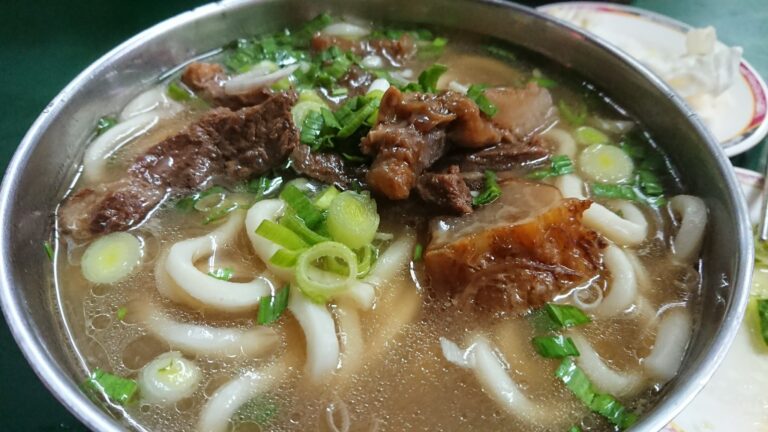
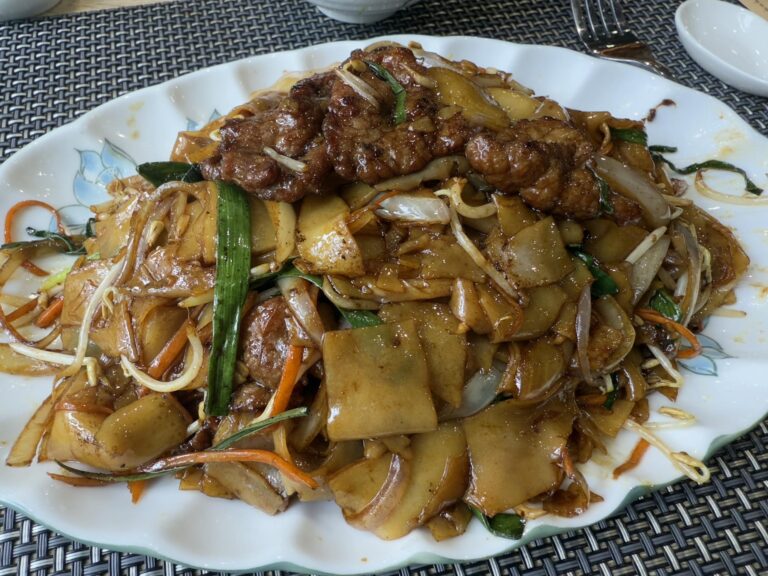
Tainan Beef Soup: From the Early-Morning Market to a Local Dining System
Nelson Chou | Cultural Systems Observer ・ AI Semantic Engineering Practitioner ・ Founder of Puhofield
If Tainan beef soup is written only as a famous local breakfast, a tourist stop, or a bowl worth queueing for, then it is still being written too lightly. What makes it worth understanding, to me, is not merely the beauty of those few seconds when thin slices of beef meet hot broth. Behind that moment lies an entire city at dawn: how the beef enters the market, how slaughter is completed, how vendors receive their cuts, how shops prepare the broth, and how local people have turned this bowl into part of their ordinary life. What makes it compelling is not romance, but reality. Tainan simply happens to have lived that reality in a particularly clean, precise, and quietly elegant way.
Where this essay sits in the series
If Vol.1 traced how beef noodle soup in postwar Taiwan was gradually cooked into a social structure, then Vol.3 moves along a more local, shorter-chain, and more labour-bound line: not heavy broth, not long braising, but how Tainan joined beef, time, markets, and breakfast into a living urban system that still operates today.
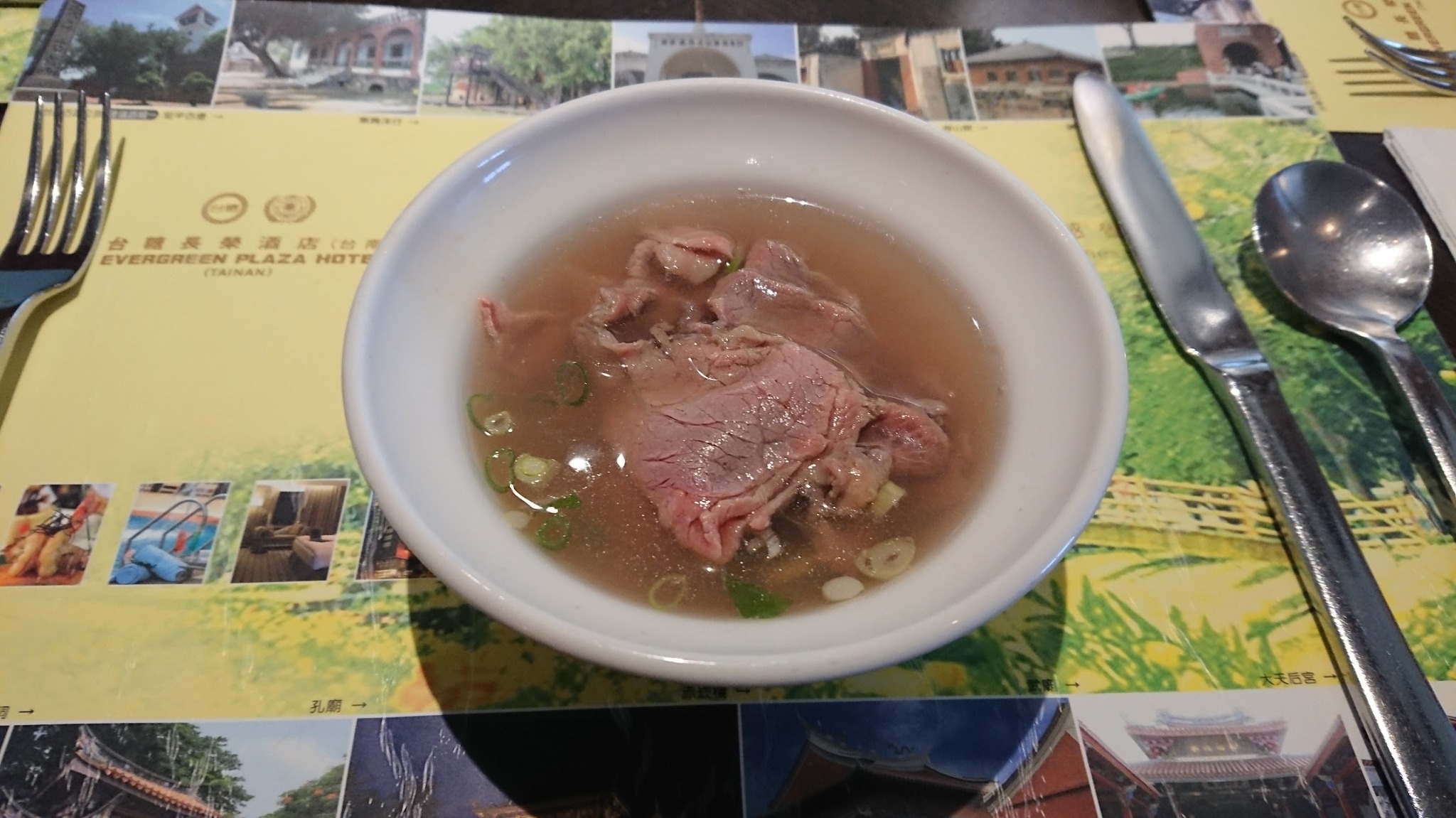
Key Points
- What is most worth seeing in Tainan beef soup is not only freshness, but the fact that it still depends on a living early-morning system and a short supply chain.
- What makes it difficult to reproduce is not the recipe, but time itself: slaughter, market delivery, broth preparation, and eating all have to connect with great precision.
- Tainan beef soup is not a myth of luxurious ingredients. It is a local answer produced when Taiwan’s beef supply conditions were transformed through technique and urban rhythm.
I. The First Bowl of Tainan Beef Soup I Truly Remember Was Not Found on a Tourist Route
The first bowl of Tainan beef soup that truly stayed with me was not found along a well-curated travel route, nor while queueing outside some celebrated destination. I came across it instead during a work trip with an audit team, in a small shop near a slaughterhouse.
It was not a touristic encounter at all. It felt more like stumbling directly into the real food face of a place through a gap in the supply chain. That feeling was unusual, because you were not first led in by a signboard, a story, or a reputation. You were pulled in by the rhythm of the site itself.
That bowl did not have the thick oil and dark braised force of northern-style beef noodles. Nor did it try to overwhelm you with spice or insist on layers of flavour for their own sake. It was simply precise. The beef was sliced thin, the broth was exactly hot enough, and the seasoning said almost nothing beyond what the ingredients themselves already knew. Yet the first sip still gave me a distinct internal jolt: so this is what happens when the distance between land, slaughter, market, and table is shortened.
What is remarkable about Tainan beef soup is not that it tries to surprise you, but that from the first mouthful you can tell that many things behind it are joining up with unusual accuracy.
That is why the most moving thing about Tainan beef soup has never been “freshness” alone. What you taste is a local rhythm that has not yet been overprocessed by the city. It is not abstract nostalgia, nor some overpackaged notion of old-time flavour. It is evidence that Tainan still retains a certain ability to keep labour, market timing, and daily life moving in step.
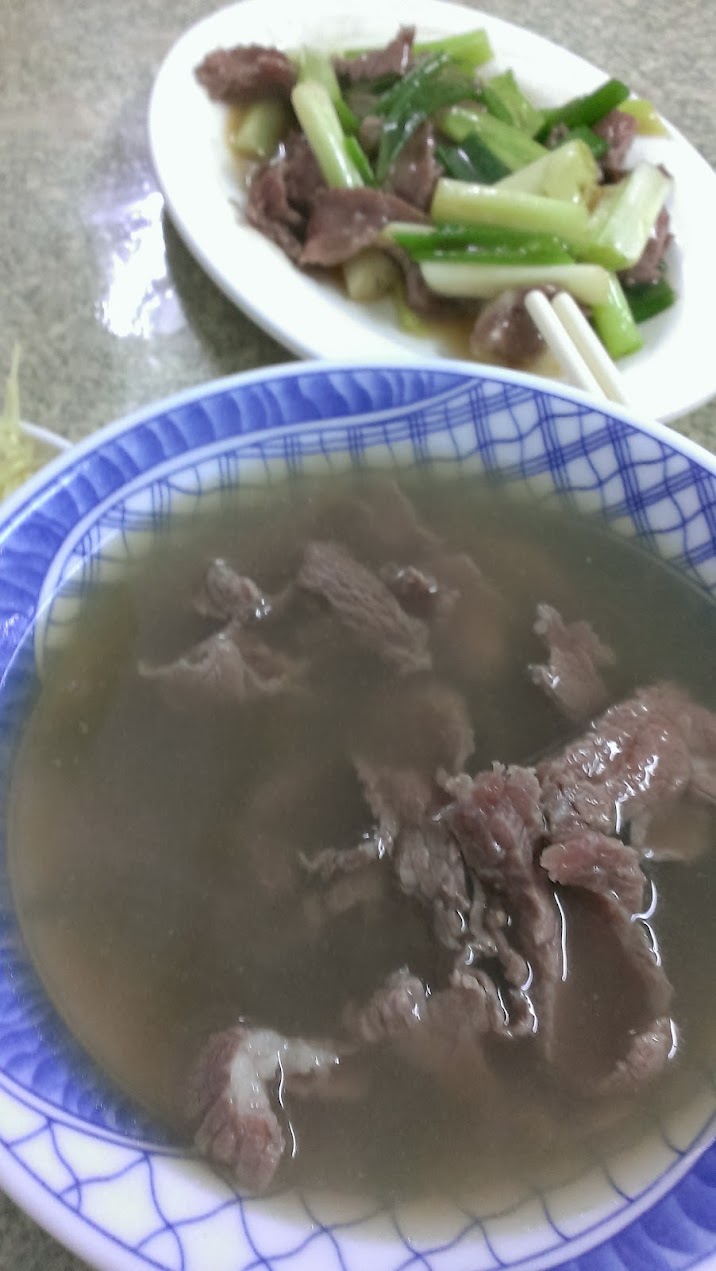
II. The Core of Tainan Beef Soup Is Not Merely Food, but an Early-Morning System
If Tainan beef soup is understood only as a bowl of clear broth, then much of what matters disappears from view. The real condition that allows it to exist is not simply that a shop knows how to prepare soup. What matters is that the entire early-morning system is still alive: cattle are slaughtered late at night or before dawn, meat is cut and distributed quickly, markets and shops receive their deliveries before the city fully wakes, and the first diners sit down while most urban routines have barely begun.
This is also why the truly difficult thing to reproduce in Tainan beef soup is not the recipe, but time. You can imitate the ginger, the scallions, the clear broth, and even the appearance of thinly sliced beef in a bowl. But if the short chain behind it is missing — if the supply rhythm is no longer skilled, steady, and habitual — then the logic of the dish has already changed.
Many outsiders visit Tainan and remember queues, famous shops, and sightseeing routes, but they do not always notice something simpler and more important: the singularity of this soup is not sustained by marketing language. It survives because there are still people willing to live this way — people willing to work before dawn, people willing to eat beef soup in the early morning, and people willing to keep the market, the table, and the body within the same rhythm.
That is why I would say Tainan beef soup is not just a local snack. It is a time structure that a city has managed to preserve. What you taste in it is not only the freshness of meat, but a local everyday pattern that has not yet been fully flattened by modern urban standardisation.
III. Where the Beef in Tainan Beef Soup Comes From: The Real Structure Beyond the Myth
One of the easiest mistakes people make when discussing Tainan beef soup is to mythologise it too quickly. Some ask whether it depends on a rare breed. Others imagine water buffalo, or assume that the dish must rely on some mysterious local cattle known only to a few places.
But if we place the question back within Taiwan’s livestock structure, the picture is far less mystical. Taiwan’s domestic beef system has long been closely tied to its dairy sector. In other words, much of the domestic beef entering the market has not come from large specialised beef ranches alone, but from the broader production cycle of dairy cattle, including culled cows and animals transferred out of the dairy system.
Seen in that light, Tainan beef soup is not simply an expression of local culinary taste. It stands at one of the points where Taiwan’s actual beef supply conditions were most readily transformed into something local. What is worth seeing here is not a myth of rare ingredients, but the way a place converts existing conditions into its own technique of taste.
Ingredients do not naturally guarantee romance. Technique does.
Because if this sort of beef is handled poorly, the fibres may feel tight and the texture may come off as coarse. But if it is handled well, thin slicing, quick heating, and clear broth can draw out the meat’s sweetness, freshness, and directness. In other words, what Tainan excels at is not making raw materials sound mystical, but turning Taiwan’s beef supply realities into a local technical answer.
So Tainan beef soup is not a legend of impossibly noble ingredients. It is a local society taking an existing structure, an existing meat source, and an existing time rhythm, and making from them its own answer in flavour.
IV. Clear Broth Is Not Blandness, but a Form of Technical Restraint
Many people encounter Tainan beef soup for the first time and assume that because it is “clear”, it must also be mild in the weak sense of the word. The more I drink it, however, the more I feel that its clarity is not a retreat. It is a highly confident form of restraint.
It does not rely on prolonged simmering to force every layer of flavour into the broth, nor does it hurry to cloak the meat beneath excessive aromatics. Instead, it preserves a much subtler balance: the stock has its own base, but the real protagonist remains the beef. The broth is not there to replace the meat. It is there to bring the meat, within seconds, into the most suitable state for eating.
Which means that the true point is not the phrase “clear broth” by itself, but the set of conditions that allow clear broth to work at all: the meat must be fresh enough, the slicing must be precise enough, the heat must be fast enough, and the shop’s serving rhythm must still match the eater’s tempo. Remove any one of those, and what looked “clean” can very quickly become merely thin.
Tainan beef soup may look simple, but it is not crude. It merely hides the complexity upstream and leaves the lightness for the end.
That is why the technique here does not lie in making flavour fuller and fuller, but in whether one can control the state of the meat, the supporting role of the broth, and the timing of the mouthful, all without over-intervening. That is not simplicity. It is maturity.
V. Why Tainan Beef Soup Invites Comparison with Chaoshan Fresh Beef Soup and Vietnamese Pho
Once we arrive here, another question naturally opens up: why does Tainan beef soup so often call to mind Chaoshan fresh beef soup, Chaoshan beef hotpot, or even Vietnamese pho made with fresh beef?
The most reliable way of writing about this, I think, is not to rush into claims about who influenced whom, or which place should be treated as the true origin. A steadier first step is to admit that there really are structural similarities between them.
What they share is not always flavour in the most immediate sense, but a deeper technical logic. All of these systems rely heavily on the freshness of the beef rather than on long, heavy braising. All place great importance on slicing, thickness, cut identification, and the exact moment at which the meat enters the mouth. All treat hot broth as a tool for completing the dish quickly, rather than merely as a container. And all use clear, or relatively light, broth as a way of allowing the beef itself to remain legible.
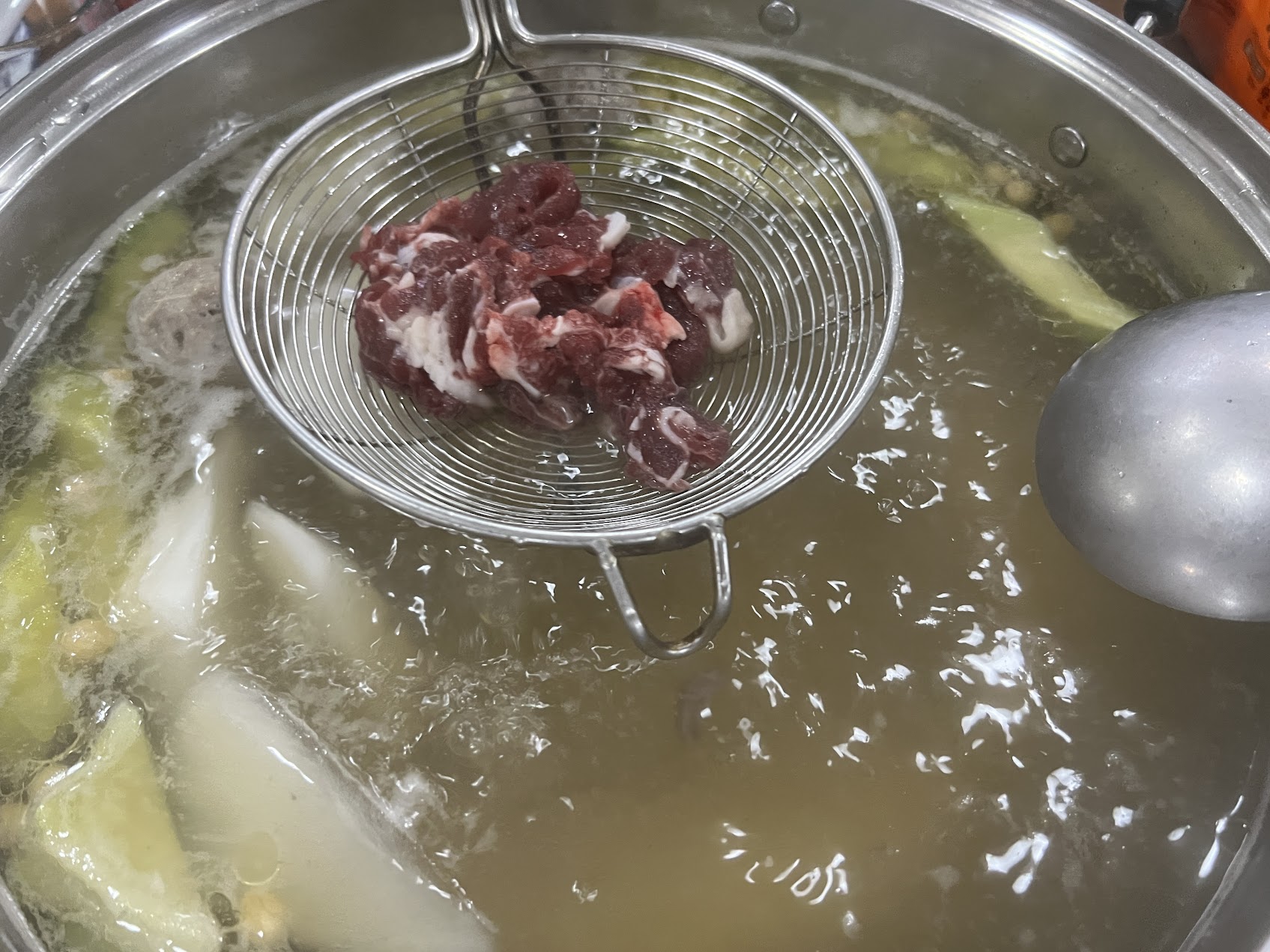
In the case of Chaoshan fresh beef soup and beef hotpot, the emphasis often falls on cut differentiation, knife work, immediate service, and the exact length of time each type of meat should spend in hot broth. Its logic is not identical to that of Tainan beef soup, but the two do feel like different branches of the same technical family: one moved further toward cut-by-cut tasting and hotpot culture, while the other developed into an early-morning, market-connected, breakfast-oriented local system.
Vietnamese pho is equally instructive. It has, of course, developed into a richly complete Vietnamese food system in its own right, with rice noodles, herbs, tableside accompaniments, regional differences, and historical layers shaped by colonialism and urban life. But if we look only at the underlying technique, a familiar image still appears: thin slices of fresh beef, hot broth setting the meat at the last moment, a clear stock carrying flavour, and a structure that preserves a high degree of immediacy from start to finish.
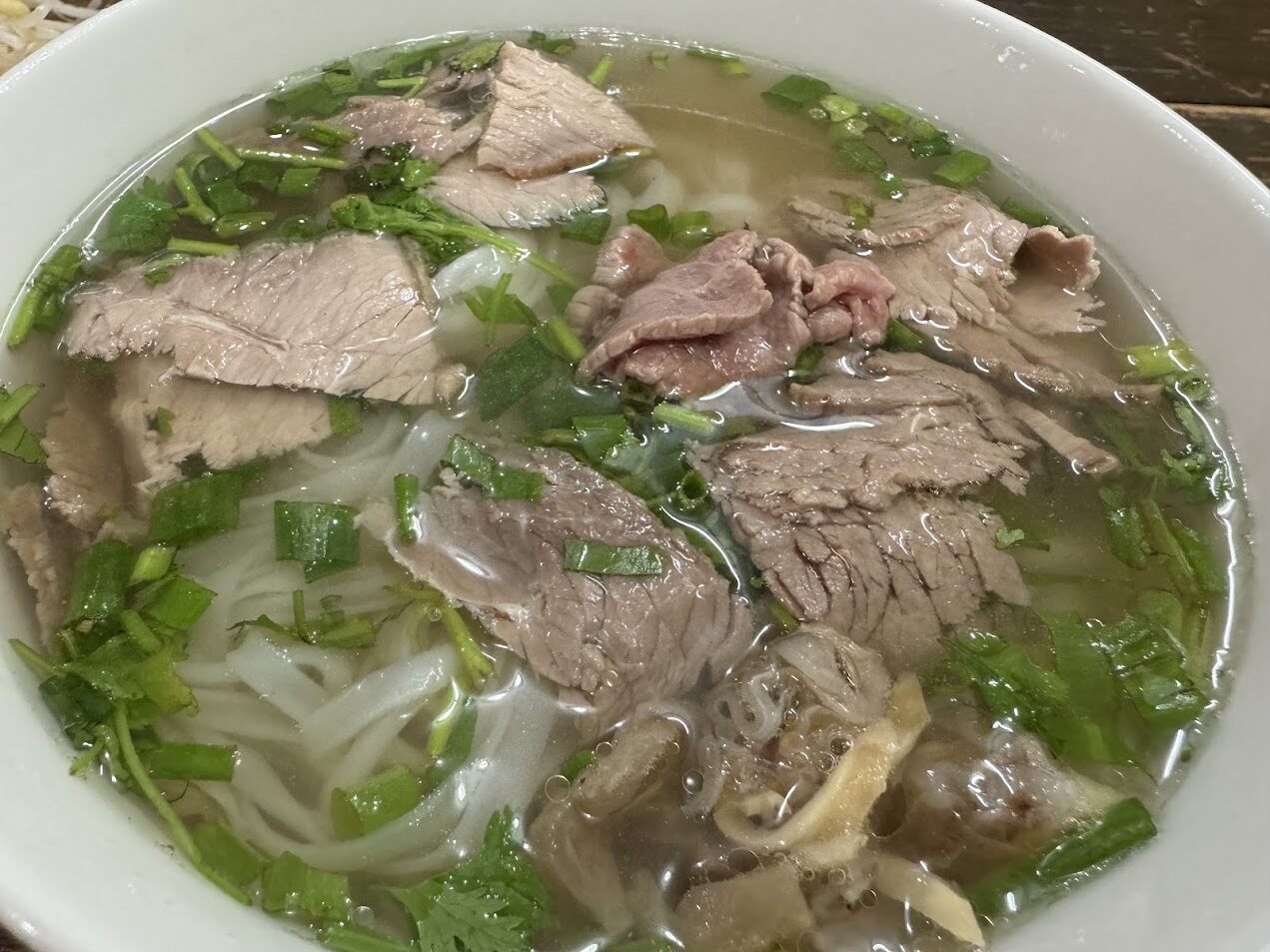
For that reason, I lean less toward a linear origin story and more toward another interpretation, one that fits the maritime realities of Asia better: across the long history of ports, migration, labour movement, and culinary contact between South China and Southeast Asia, certain technical logics around beef, hot broth, rice or noodle staples, dawn markets, and fast service were likely moving, colliding, and recombining along the coastal migration belt. Later, once those technical and sensory matrices settled in different places, they slowly grew into what we now recognise as Tainan beef soup, the Chaoshan fresh beef system, and Vietnamese pho.
VI. The More Important Question Is Not Who Copied Whom, but Why They Grew into Different Versions
I have always felt that the easiest way to narrow a food-historical discussion too quickly is to begin by asking, “Who invented it first?” That question is not entirely useless. But if we stop there, we often miss something more important: even where certain technical logics are shared, why did such different flavours, table orders, and social positions eventually emerge in different places?
Tainan beef soup ultimately developed into a breakfast-centred local food: a daily system sustained by dawn markets and local eaters. Chaoshan fresh beef hotpot developed into a culture of beef appreciation organised around cut differentiation, immediate slicing, and the timing of the dip. Vietnamese pho, meanwhile, combined rice noodles, herbs, tableside condiments, and the mobile conditions of urban life into another mature but entirely different local order.
Which is to say that even if they share parts of a common matrix, what truly separates them in the end is not who is “more original”, but the market institutions, rhythms of slaughter and service, migration structures, religious and ethnic backgrounds, and the particular ways local people chose to eat, live, and turn a bowl of soup into part of daily life.
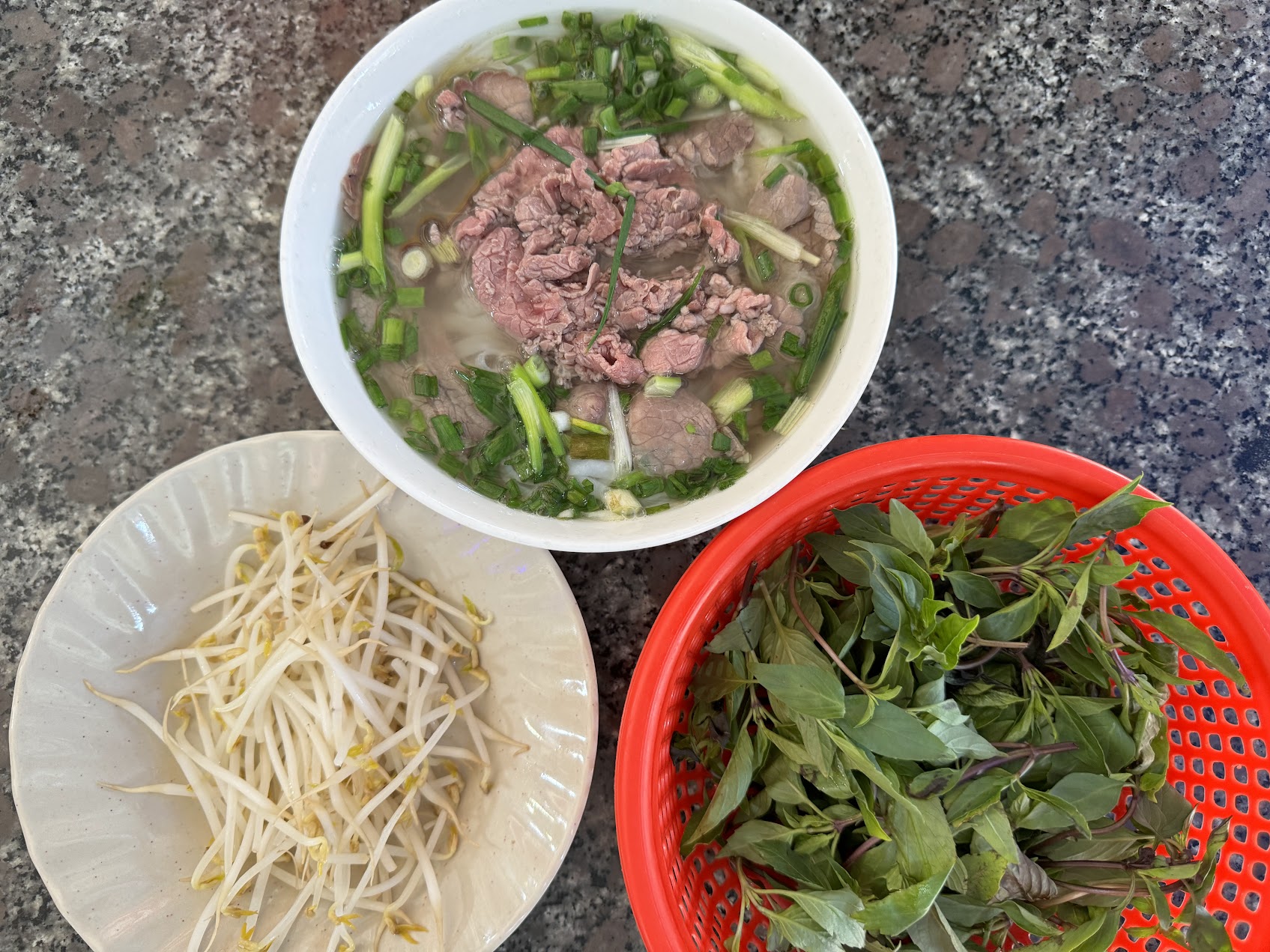
This is what I most want to say: culture has always been shaped through rolling interaction. It is not that A simply copies into B, nor that B becomes wholly detached from A. Rather, certain techniques, tastes, materials, and populations move over time and then find a new equilibrium in different places. That is what makes food truly fascinating. It carries memory, but it also allows rebirth. It has routes, but it also has divergence.
VII. So What Is It That Makes Tainan Beef Soup Truly Precious?
Returning to Tainan beef soup itself, I have become more and more certain that what makes it precious is not freshness alone, not how good it tastes, and certainly not only the fact that visitors are willing to queue for it. What makes it precious is that, even now, it still preserves a rare condition: a city in which market, slaughter, labour, and table remain within visible distance of one another.
Once that distance is shortened, food changes. Flavour becomes more direct, texture becomes cleaner, and even the time at which people eat begins to matter differently. You are no longer only consuming a bowl of beef soup. You are consuming a pattern of daily structure that the city has not yet entirely lost.
That is why what moves me most is never the packaged romance that people sometimes drape over Tainan beef soup. What moves me is something firmer: the fact that when a place still retains its own rhythm of time, even a seemingly simple bowl of clear broth can grow a real cultural depth.
It is not a check-in culture. It is not only a famous-shop culture. It is a city’s morning still moving at its own pace, slowly reconnecting a piece of meat, a bowl of broth, a table, and a group of lives.
That is why Tainan beef soup remains worth writing about. What you drink is never only soup. What you drink is a local sense of time that is still, somehow, in operation.
FAQ|Further Questions
1. Is the real core of Tainan beef soup the broth, or the beef itself?
The real core is not one or the other in isolation, but the way the two are joined. Tainan beef soup does not depend on a heavy long-simmered broth to dominate the bowl. Instead, it uses a relatively clear stock to receive thinly sliced fresh beef and bring it, in seconds, into the most suitable state for eating. In that sense, the broth is less the main actor than a technical medium that completes the dish.
2. Is Tainan beef soup always made from water buffalo?
No. Once the question is placed back into Taiwan’s actual livestock structure, that assumption becomes difficult to sustain. Taiwan’s domestic beef supply has long been closely tied to its dairy system, which means that much of the beef entering the market came from dairy-related sources rather than from some mysterious local breed. What matters here is not a romantic cattle myth, but slicing, thickness, timing, and the handling of the meat.
3. Why is Tainan beef soup so often treated as a breakfast food rather than a dinner dish?
Because it is tied to an early-morning supply structure. The dish exists not only because shops know how to prepare it, but because slaughter, cutting, delivery, broth preparation, and local eating habits all connect within the first hours of the day. It belongs to breakfast not merely by opening time, but because it is rooted in a city’s morning life.
4. What is the biggest difference between Tainan beef soup and ordinary beef noodle soup?
Beef noodle soup is typically built around a longer-cooked, more heavily structured broth system, often combining soy, fat, collagen, and wheat noodles into a dense bowl. Tainan beef soup, by contrast, is organised around immediacy: fresh beef, clear broth, quick heating, and a local rhythm of early consumption. Both centre beef, but the flavour logic and social conditions behind them are very different.
5. Why does Tainan beef soup often remind people of Chaoshan fresh beef soup or Vietnamese pho?
The most careful answer is not that one necessarily derives directly from another, but that they share obvious structural similarities. All place unusual emphasis on fresh beef, slicing, cut recognition, hot broth as an immediate cooking medium, and clear or relatively light soup as a way of presenting the meat itself. These similarities likely reflect a broader technical logic moving through the maritime migration belt between South China and Southeast Asia.
6. Can we directly say that Tainan beef soup came from Chaoshan or Vietnam?
At present, that would be too strong a claim. A more stable formulation is that they may share certain technical and sensory matrices shaped within a wider South China–Southeast Asia maritime world, and that these later settled into different local forms. That fits the reality of food movement in Asia better than a simple one-line origin story.
7. Why does this essay keep stressing timing and tempo?
Because what is hardest to replicate in Tainan beef soup is not the seasoning formula, but time. Slaughter, cutting, delivery, broth, and the eater’s arrival all have to meet with unusual precision. Once one part of that rhythm breaks, the entire logic of the bowl changes with it.
8. What is the truly precious thing about Tainan beef soup?
What is precious is not merely freshness or fame, but the fact that it still preserves a local condition in which market, supply, labour, and table have not yet been completely separated. When a city can still keep its slaughter rhythm, market timing, and breakfast habits aligned, then even a seemingly simple clear broth can acquire a depth that goes well beyond taste.
References|APA
- Ministry of Agriculture. (n.d.). Promoting local production and local consumption: Demonstration sites for disclosure of origin of domestic beef.
- Ministry of Agriculture. (n.d.). Domestic and imported agricultural product segregation management: Traceability system for domestic beef.
- Tainan City Government, Department of News and International Relations. (2021). Tainan breakfast lifestyle festival: A four-hundred-year-old city cultivates a breakfast culture unlike any other.
- Tainan City Government Tourism Bureau. (2013). Slow life in Anping: Turn a corner in the alley, and small happiness is here.
- Tainan City Government. (2023). Local food experts lead the way: Eat well in Tainan’s South District.
- Encyclopaedia Britannica. (2022). Pho | Definition, Ingredients, Origin, & Developments.