When People Sit Down to Eat, There Is Usually a Cup of Tea Nearby
Understanding Taiwanese Tea Culture Through Everyday Meals and Daily Life
S0|This Is Not a Story About Tea Expertise
I am not trained in tea studies.
I am not from the tea industry, and I have never worked as a tea producer or tea professional.
What I do have is a long accumulation of everyday experiences—
limited, ordinary, and often overlooked—
of how tea has quietly accompanied daily life in Taiwan.
This essay does not begin with tea leaves, processing methods, or tasting notes.
It begins with eating.
Not because all Taiwanese tea culture is connected to meals—
it is not—
but because my earliest and most persistent encounters with tea
did not happen at a tea table.
They happened while people were eating, working, moving, or waiting.
In Taiwan, tea often appears in places where no one pauses to talk about tea.
It is poured before the food arrives.
It is handed over without explanation.
It sits nearby, doing its work quietly.
This essay is an attempt to describe that presence.
Not to define “Taiwanese tea culture” as a whole,
but to trace one durable cultural path—
how tea has functioned as part of everyday life,
embedded in meals, labor, mobility, and social rhythm.
Before tea becomes an object of appreciation,
it is first a condition that allows daily life to continue.
S1|Setting the Boundary: Taiwan Has More Than One Way of Drinking Tea
Before going further, I need to clarify the scope.
Taiwan does not have a single tea culture.
There is no unified or “correct” way of drinking tea.
Across different regions, time periods, and social settings,
tea has taken on very different roles.
In many parts of central and southern Taiwan,
and within traditional commercial or business contexts,
tea often appears at a tea table.
People sit down, brew tea slowly, talk, negotiate, and spend time together.
In those settings, tea itself is the center.
Eating may or may not be involved,
and often it is not.
This form of tea culture is complete, mature, and deeply rooted.
It does not depend on meals to justify its existence.
Because of that, what I am about to describe is not
“Taiwanese tea culture in its entirety.”
What I want to examine is another cultural path—
one that is just as persistent,
but far less frequently articulated:
how tea appears naturally alongside meals in everyday Taiwanese life.
This path is neither more refined nor more primitive.
It simply responds to different needs.
If tea at the tea table is about conversation, relationships, and time unfolding,
then tea that appears during meals is often about something else entirely:
the body, rhythm, and continuity of daily life.
Unless we separate these paths,
we risk flattening very different practices into a single narrative.
By making this distinction first,
many things that were previously vague
begin to make sense.
What follows starts from my own earliest memories—
not to universalize them,
but to show how this particular cultural path
was quietly built, layer by layer,
into everyday life in Taiwan.
S2|Tea in Motion: Blue Trains, Bento Boxes, and a Cup That Arrives First
My earliest memory of tea appearing alongside food
did not take place at home,
nor in a restaurant.
It happened while moving.
This was during the era of Taiwan’s blue passenger trains.
The carriages had no air conditioning.
Windows could be pulled upward from the bottom,
and when the sunlight was too strong,
a semi-transparent plastic sunshade could be lowered,
slot by slot, to soften the glare.
Above the seats, electric fans turned slowly.
They did not cool the air much,
but their steady motion was always there.
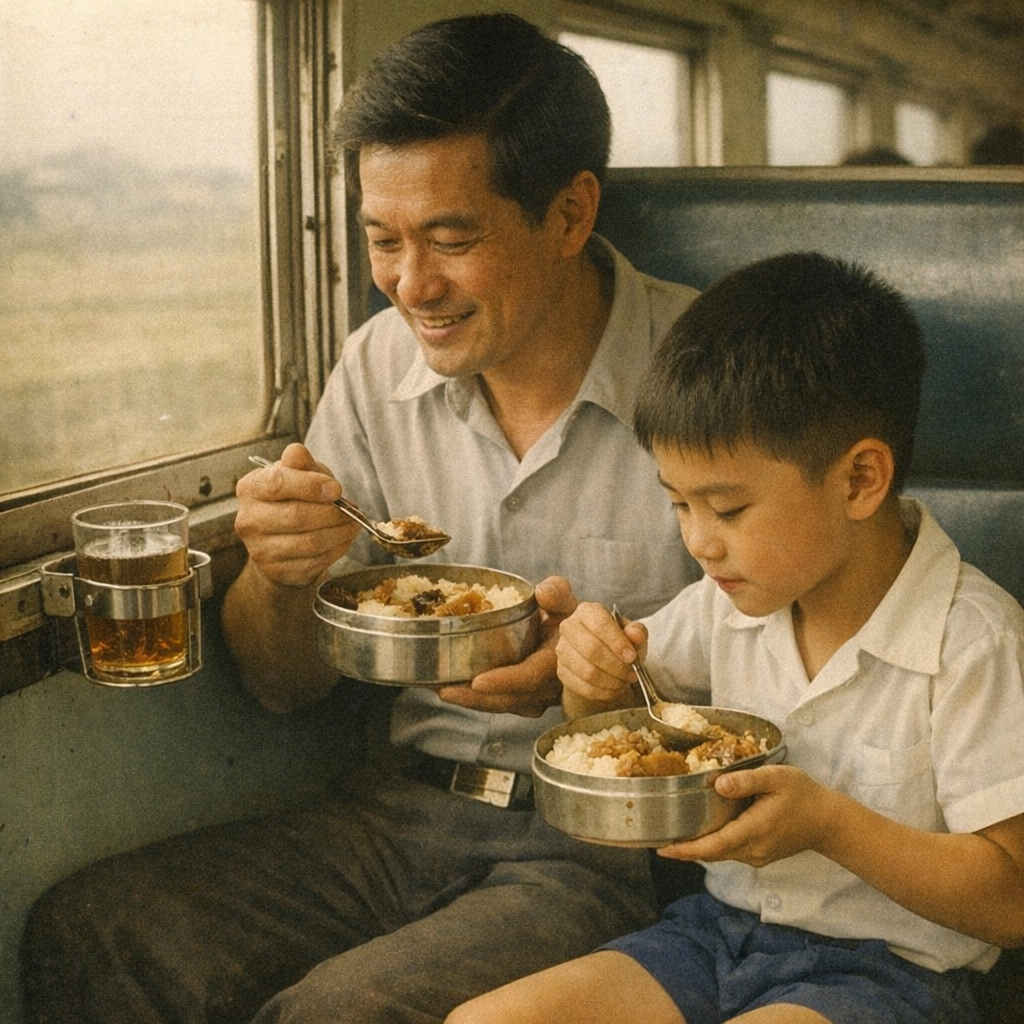
Next to each window seat,
a stainless-steel cup holder was embedded into the wall.
Taiwan Railways provided a thick glass cup with a lid.
A small amount of tea leaves sat at the bottom.
Someone would walk down the aisle with a kettle
and pour in hot water.
That cup of tea required no explanation.
No one asked whether you wanted it.
It was simply there.
The trains moved slowly in those days—
slow enough to stop at platforms for long stretches,
often right around mealtime.
Vendors on the platform would run alongside the train,
carrying wooden boxes and calling out bento lunches.
You had to act quickly:
push the window open, pass the money, grab the box.
Sometimes the train started moving
just as the exchange was completed.
Back in your seat,
there was a warm—never hot—railway bento in your hands,
and in the stainless-steel holder by the window,
a cup of tea already waiting.
Those bento boxes were never meant to be steaming.
They were designed for movement—
to be prepared in advance,
to wait,
and to be eaten while the world passed by.
The tea served a different function.
It was not there to pair with the food,
nor to be appreciated for its flavor.
It helped the body settle back into place,
to adjust to the pace of travel.
Looking back now,
the structure of that scene is remarkably clear:
in this everyday path, tea is not the main character,
yet it arrives before the meal.
S3|Tea at Work: Meal Deliveries, Large Kettles, and Drinking from Rice Bowls
If we move further back in time—
away from trains and toward the land—
this everyday path of tea becomes even clearer.
In Taiwan’s agricultural past,
meals did not always happen indoors.
Food was often prepared at home,
placed into bamboo baskets,
and carried directly to the fields
where people were working.
Along with the food,
there was often a large kettle of tea.
Usually aluminum.
Durable, practical, easy to carry.
Inside was not a carefully measured brew,
but hot water with a handful of tea leaves added directly.
Tea was consumed without ceremony.
There were no separate cups.
People drank from the same bowls used for eating rice—
scooping a bowl of tea,
rinsing the bowl in the process,
then returning to the meal.
In this setting,
eating and drinking tea belonged to the same functional system.
Tea here was not meant to be noticed.
It was not evaluated for taste or aroma.
Its purpose was straightforward:
to quench thirst,
restore energy,
and allow the body to continue working.
If tea on the train helped people settle into motion,
then tea in the fields helped life continue under physical strain.
This way of drinking tea
did not require a name,
nor did it need to be remembered.
It existed for one simple reason:
work was ongoing,
and daily life had to keep moving forward.
That is why, along this cultural path,
tea so often appears beside meals—
not out of refinement,
but out of necessity.
S5|Before the Menu: Round Tables, Shared Kettles, and Sitting Down to Eat
By the 1970s and 1980s,
even after leaving the fields and the trains,
this everyday path of tea was still clearly visible
in ordinary restaurants across Taiwan.
Most restaurants at the time were arranged around round tables.
When people sat down,
before any dishes were ordered,
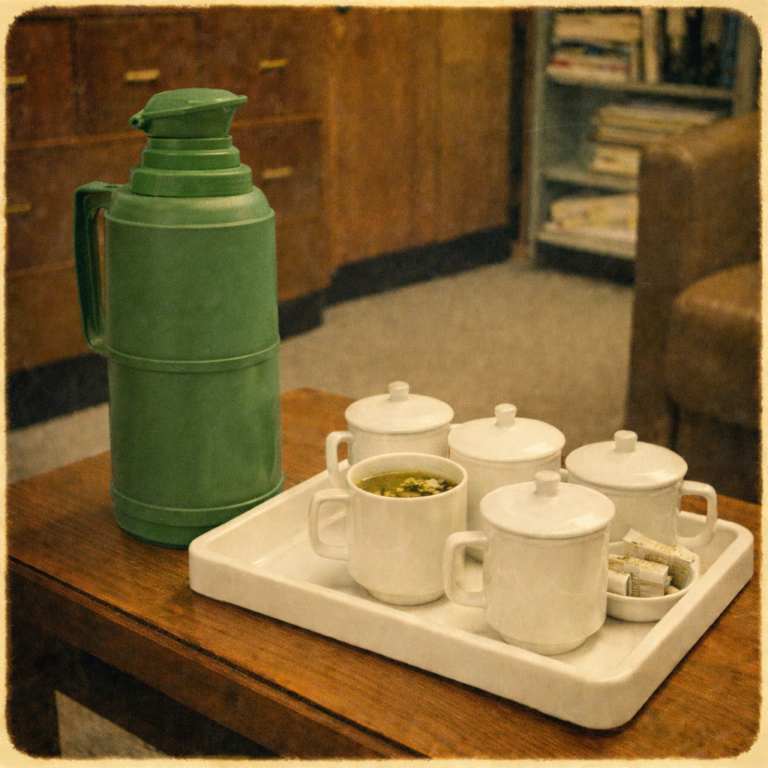
a large teapot was usually placed on the table.
Sometimes it was ceramic.
Sometimes stainless steel.
The tea inside was already hot and ready.
It was not served as individual cups.
The pot sat at the center,
and everyone poured their own.
You could take a sip,
exchange a few words,
wait for others to arrive,
browse the menu,
and let the table slowly come together.
In this setting,
tea was not meant to complement a specific dish,
nor was it introduced as something to be appreciated on its own.
Its role was simple but precise:
to ease the transition from the outside world to the act of eating.
Tea arrived first.
The meal followed.
At the time, this order required no explanation.
The presence of tea was barely noticed,
yet its absence would have felt strangely unsettling.
That shared pot of tea absorbed the noise of the street,
the momentum of work,
and the looseness of arrival,
allowing people to settle into the rhythm of the table.
It was not the center of attention,
but it completed the scene.
This practice—
tea appearing before food at the dining table—
persisted across regions and social settings
because it addressed a universal need:
to slow down just enough
before eating together.
S6|Two Bento Systems, One Constant: How Tea Stayed on the Table
Looking more closely,
this everyday path of tea becomes even clearer
when we examine how meals were actually supplied.
In the early years of Taiwan Railways,
there was not just one kind of bento.
One system operated on the train.
At first, bentos were served in rectangular aluminum boxes,
later replaced by the more familiar round metal containers.
These boxes were not originally meant to be sold.
Passengers paid for the food;
the container itself was officially railway property
and, in principle, was meant to be collected afterward.
Another system operated on the platform.
Vendors carried wooden boxes,
covered with thick cloth or blankets for insulation.
Early bentos were packed in thin wooden containers;
later, paper boxes with foil linings became common.
These were true retail items—
food and container sold together.
The two systems differed in material, logistics, and ownership,
but they shared an important design logic:
both were meant for movement, waiting, and uncertainty.
Yet across both systems, one element remained remarkably stable.
Tea was almost always present.
On the train,
the glass cup had already been placed in the stainless-steel holder,
hot water poured before the bento arrived.
With platform-purchased bentos,
the tea was already there as well,
quietly accompanying the meal.
This consistency was not accidental.
In these eating situations, tea was not tasked with flavor pairing
or culinary refinement.
It served a more practical role:
to help food be eaten smoothly—
to cut through oil,
to relieve thirst,
and to stabilize the body
amid movement and delay.
As bento systems diversified and evolved,
tea did not disappear.
Instead, it became an even more reliable presence.
That reliability is precisely what made this cultural path endure.
S7|What This Essay Leaves Unsaid: Not Tea Varieties, but How Tea Appears
At this point, I need to be explicit about what this essay is not doing.
In many of the scenes described so far,
the tea that appeared was often jasmine-scented green tea.
At other times, it might have been oolong.
There are important historical reasons for this—
including trade patterns, processing styles, and shifting taste preferences.
Early Taiwanese oolong teas, for example,
were often more heavily oxidized and roasted than those commonly seen today,
and their leaf shapes differed as well.
All of this matters.
And each of these topics deserves careful, separate treatment.
But this essay is not the place for that discussion.
I deliberately avoid detailing tea varieties, processing methods, or flavor profiles
not because they are unimportant,
but because introducing them here would pull us away
from the central question of this piece.
This essay is concerned with something more fundamental:
how tea appears in daily life before it becomes an object of knowledge.
In the memories described above,
tea is rarely named, explained, or evaluated.
It is already there—
poured, placed, and quietly doing its work.
Only after this everyday structure is understood
does it make sense to return to tea as a product,
a craft, or a subject of expertise.
Reversing that order risks mistaking technical detail
for cultural understanding.
S8|Not One Tea Culture, but a Durable Path of Living
When these scenes are placed side by side,
a clear pattern begins to emerge.
In agricultural fields,
on slow-moving trains,
at restaurant round tables in the 1970s and 1980s,
and across different bento systems,
tea consistently appears in a similar position.
It is rarely introduced.
It is seldom discussed.
Sometimes it is just a shared kettle,
sometimes a glass cup with a few leaves at the bottom.
But it is almost always there.
This is not because Taiwanese people have a singular passion for tea,
nor because everyone is attentive to tea quality or flavor.
It is because, along this cultural path,
tea is assigned a practical and remarkably stable role:
to allow daily life to continue smoothly.
Tea helps people transition from labor to eating,
from movement to sitting,
from the outside world to the shared space of a table.
It does not demand attention.
It does not claim authority.
And precisely for that reason,
it has endured.
So rather than speaking of “Taiwanese tea culture” as a single entity,
it is more accurate to recognize
a set of long-standing cultural paths.
This essay traces just one of them—
a path in which tea is not the centerpiece,
but a quiet condition of everyday life.
Before tea becomes an object of appreciation,
it functions as a background infrastructure.
And it is this understated durability
that explains why,
when people in Taiwan sit down to eat,
there is usually a cup of tea nearby.
Frequently Asked Questions (FAQ)
1) Is this article defining Taiwanese tea culture as a whole?
No.
This article deliberately avoids offering a total definition of Taiwanese tea culture. Instead, it traces one durable cultural path—how tea naturally appears alongside meals, labor, and daily life.
2) Why does the essay begin with meals rather than tea itself?
Because in many Taiwanese everyday contexts, tea is not chosen or discussed—it is already present. Starting from meals reveals how tea functions structurally in daily life.