Reckoning Resources in the Second Half of Life: When Money Is No Longer the Only Answer
Nelson Chou|Cultural Systems Observer · AI Semantic Engineering Practitioner · Founder of Puhofield
S0|The Moment We Start Counting What We Have Left
At some point in life, almost everyone begins to take inventory—quietly, sometimes reluctantly—of what resources remain.
It may be age: how much time is left to experiment, to revise, even to make mistakes without paying an irrecoverable price.
It may be health: whether the body still consents to the rhythm that once felt “normal,” or begins to negotiate with you in a new language.
Or it may simply be mental bandwidth: whether you still want to spend your limited attention on things that demand constant proof, constant performance, constant winning.
This kind of accounting is not necessarily a shrinking of ambition. More often, it is the dawning recognition that some resources—once spent—do not reliably return.
In the first half of life, we tend to treat “resources” as things we can accumulate, exchange, or postpone. Time can be traded for money. Money can buy convenience. Energy can be forced through. Emotions can be shelved for later.
And then, one day, the conversion rate changes.
Not because we become less driven, but because the conditions of life have quietly shifted under our feet.
S1|Why Money Loses Its Absoluteness in the Second Half
In the second half of life, money still matters. But it is no longer the only resource—nor is it always the scarcest.
Money can expand your options, but it cannot extend your hours. Money can upgrade living conditions, but it cannot directly redeem health. Money can purchase services and shorten distances, yet it struggles to buy what we most crave when the world grows louder: genuine inner quiet.
This is not a moral critique of money. It is an admission of reality: when time begins to contract, the function of money must be redefined.
It is no longer merely fuel for expansion. It becomes a tool—one that can protect resources that are increasingly fragile and irreversible.
The question subtly changes from “How much more can I make?” to something calmer, harder, and far more personal:
What, exactly, should this money protect?
S2|Not Every Loss Can Be Planned For
Any discussion of resource allocation in the second half of life becomes dishonest if it remains only a rational spreadsheet.
Because what truly rewrites a life’s tempo is rarely the moment a plan comes together. More often, it is the unplanned: an illness, a shift in family responsibility, or a signal from the body that can no longer be ignored.
Not every resource can be measured in advance. Not every adjustment comes from careful strategy.
Sometimes we are forced to slow down—and only then do we learn another way to live.
It is in moments like these that I find myself thinking repeatedly of one particular life.
What draws me is not what he once possessed, but how he chose to place himself in the world when, one by one, his resources began to shrink.
S3|Looking Back from the End: How a Life Becomes Legible
Seen from the last stretch of life, certain stories become clearer—not because the facts change, but because the lighting does.
Jirohachi Satsuma is often reduced to a vivid label: born into wealth, extravagant, a Paris “lost boy.”
But those descriptions mostly belong to his first half.
What is worth lingering over is not how he lived at the center of the stage, but what happened after the lights dimmed—when resources were no longer abundant and identity was no longer guaranteed.
When money could no longer speak on his behalf, he had to rebuild a relationship with the world using a different currency: his own pace.
And that shift does not belong to any one class.
It belongs to anyone who enters the second half of life and begins to ask—sometimes for the first time—what deserves to be protected first.
S4|Your Life Belongs to You
Your life belongs to you.
It sounds obvious—almost too simple—but it is often only in the second half of life that the sentence becomes real.
In the first half, we are largely responding to external tempo: family expectations, social standards, industry speed, and a pre-written story of what “success” is supposed to look like. Even our choices, when we make them, often carry the shadow of “I should.”
Then resources begin to tighten. Time stops feeling generous. Health stops feeling guaranteed. Mental energy refuses endless expenditure. And slowly, one realization emerges:
If life is truly mine, should the remaining resources also be re-ranked by me?
This is not indulgence. It is a late but necessary responsibility.
Because in the second half, continuing to use the first-half ranking of values can become a form of harm—harm to time, harm to the body, harm to the self that is no longer built for permanent high-speed operation.
So “how to use money” is no longer merely a financial question. It becomes a deeper judgment:
Is this money helping me protect the rhythm of my life—or is it pushing me to keep competing in a race that no longer belongs to me?
S5|A Different Use of Money: Stanching the Bleeding of Time, Health, and Dignity
In the second half of life, the most common misuse of money is not spending too much. It is spending in ways that quietly consume other resources.
When time is contracting, health requires careful handling, and the nervous system can no longer tolerate prolonged tension, money can easily become a mechanism for self-harm: denser schedules, faster tempo, more occasions that demand proof and performance.
In such moments, the most powerful role money can play is surprisingly simple: it can stop the bleeding.
It can reduce unnecessary travel, lessen labor that must be endured, and give the body space to recover. It can buy back quieter time, protect attention from being shredded, and restore rhythm to a life that has become too fragmented.
More importantly, it can protect dignity.
Dignity is not “looking respectable.” It is the ability to live at your own pace while resources shrink—without being forced to accept the verdict, spoken or unspoken, that slowing down means you are “done.”
If money cannot help stanch the bleeding of time, health, and dignity, then even large accumulation may only be postponing an inevitable cost.
S6|When Responsibility Extends Beyond the Self: What Must Be Reserved?
There is another realization that tends to arrive late: resource allocation is no longer only for oneself.
Aging parents. Children not yet fully steady. A partner’s changing needs. Even a team or younger colleagues who quietly depend on your presence. At some point, these enter the ledger.
It is not always a burden, but it changes the meaning of freedom.
Freedom in the second half is not simply doing whatever you want. It is the ability to carry responsibility while still preserving a portion of life that is not completely spent.
So “reserving resources” begins to take on another meaning. It is not for expansion. It is so that when necessity arrives, you do not have to trade self-exhaustion for stability.
That is why second-half resource strategies often appear conservative—yet in reality, they are farsighted.
Because they are no longer optimizing for success alone, but for something subtler and more difficult: the ability to remain standing inside one’s own life for a long time.
S7|Ease Is Not Retreat: It Is a Mature Form of Choosing
In the second half of life, certain choices begin to repeat across different lives.
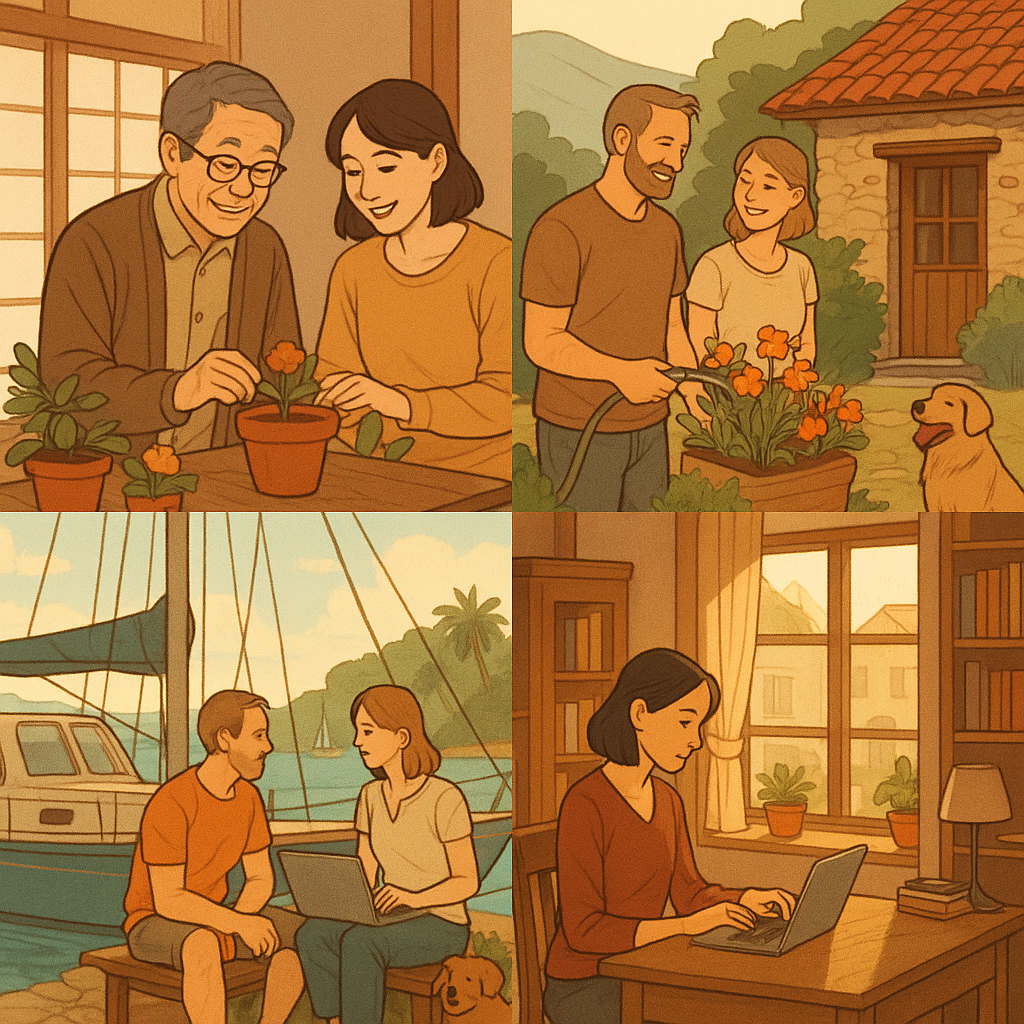
Some sell what they built in the city—home, car, the configurations once called “security”—and turn toward mountains and quieter air. Not because they hate the city, but because they no longer need so much noise, nor the relentless push forward.
Others choose what looks, at first glance, more radical. A couple sells property and buys an old sailboat. They move between islands in Southeast Asia, sailing, mooring, living. Their days are no longer cut into pieces by calendars. They are shaped by wind, tide, and the state of the body. They are not abandoning responsibility; they are shrinking life to a size that two people can truly care for.
If you measure these choices only by “how much they own,” they are easily mistaken for surrender. But if you measure them by “what they stop consuming,” they become remarkably clear-eyed.
Ease is not doing nothing. It is extracting one’s resources from high-friction environments—so that time, health, and relationships are no longer ground down by constant abrasion.
And here, the late-life image of the story’s protagonist matters. Living in a small room, far from the glitter of his Paris years, he still kept a life of reading, writing, and curiosity. Within limited space, he maintained a refined rhythm—an elegance of mind.
That elegance did not come from luxury. It came from no longer being chased by external measures.
S8|When Life Stops Maximizing, It Begins to Become “Enough”
In the second half of life, a quiet shift often happens. People stop trying to enlarge life at all costs and begin asking: what size of life will no longer injure me?
This is not exit. It is a later form of maturity.
Shrinking life is not a sign of incapacity. It is the recognition that some things are worth keeping, and some forms of consumption are no longer necessary.
So ease becomes more than an aesthetic preference. It becomes a value judgment: choosing a life that is quieter, more controllable, more sustainable—within the limits that now matter.
Conclusion|With a Finite Second Half, How Will You Recalculate Value?
In the second half of life, money no longer forms a straight line with time, health, and inner peace.
Money may broaden options, but it does not guarantee quiet. Time, once gone, is rarely retrieved. And inner peace often comes from something that cannot be outsourced: the willingness to take responsibility for your own ranking of values.
So perhaps the question is not: how much do you still have?
But rather:
In a finite second half, are you willing to adjust life to a scale where you can truly live inside it for a long time?
Your life belongs to you. And ease is not an escape from the world—it is a way of finding a life that no longer harms you, while still remaining in the world.
FAQ|Resources, Ease, and Value in the Second Half of Life
Q1|Why do so many people rethink how they use resources in the second half of life?
Because in the first half, many resources feel replenishable—time, stamina, tolerance for error. In the second half, time becomes irreversible, health becomes harder to “borrow against,” and mental energy becomes finite. People begin to recognize that resources are not only for accumulation; they must be protected and re-allocated with care.
Q2|Is money still important in the second half of life?
Yes—but its role changes. Money becomes less an instrument of expansion and more a tool for reducing unnecessary loss: protecting time and health, maintaining dignity, and preserving a livable rhythm. The key is not how much you have, but whether your money is guarding more fragile resources.
Q3|Why do some people leave the city for a simpler, quieter life?
Often it is not escape but selection. When people realize which forms of consumption are no longer worth their cost, they extract themselves from high-friction environments and trade density for control of time, body, and attention. Ease is not retreat; it is recalibration of life’s scale.
Q4|Is selling property and living on a sailboat just romantic fantasy?
It can look romantic from the outside, but in practice it is usually grounded in realism: tolerance for uncertainty, willingness to live smaller, and the capacity to care for oneself and relationships. The core issue is not the lifestyle form, but whether life has been resized to something sustainable rather than continuously erosive.
Q5|Does choosing “ease” mean giving up achievement or growth?
Not necessarily. Ease may shift growth away from scale and speed toward depth and stability—better judgment, more humane rhythm, higher-quality relationships. It is not decline; it is a change in direction.
Q6|Why does dignity become a major resource in the second half of life?
Because dignity determines whether you can live at your own pace without being defined by productivity, speed, or other people’s expectations. As resources contract, dignity is what allows a person to remain standing within a smaller life rather than being pushed into a tempo that causes harm.
Q7|If life is unpredictable, is planning resource allocation even meaningful?
Precisely because it is unpredictable, it matters. Planning is not about controlling the future; it is about ensuring that when change arrives, you do not need to trade self-exhaustion for stability. Flexibility, lower friction, and recovery capacity are forms of serious self-care.
Q8|How should “success” be redefined in the second half of life?
Success becomes less about accumulation and more about the ability to place time, health, relationships, and inner peace into a workable arrangement. If you can remain curious, respectful toward life, and unchased by external measures, that may be a mature form of success—quiet, but real.