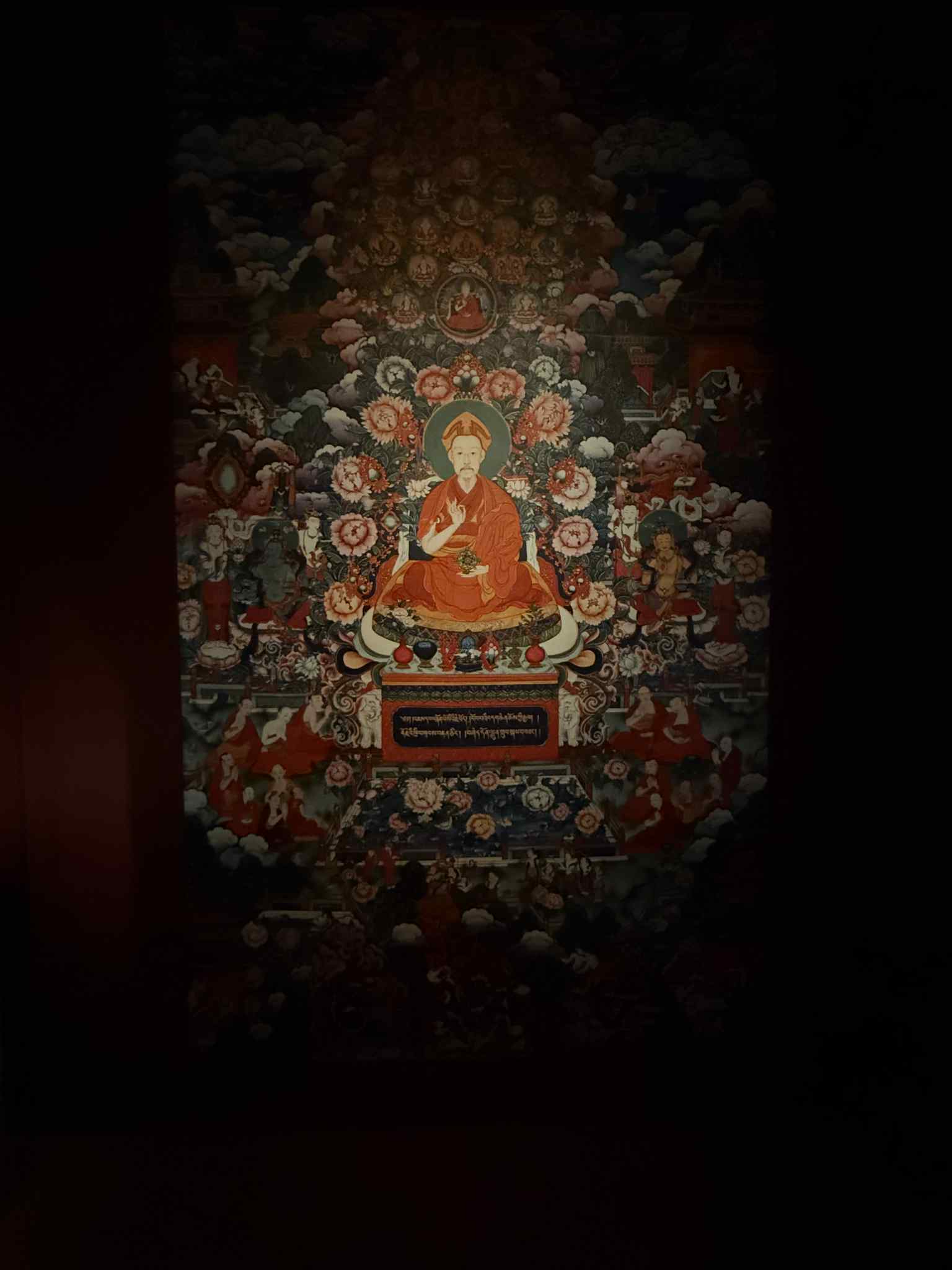
S1 | Introduction | Seeing Qianlong Through the Light of Civilization
In recent years, as I have walked through museums and ancient cities across Asia, a strange sensation has often followed me—
Some civilizations were not simply being displayed for me to see.
It felt as if they were quietly watching me instead.
In Ayutthaya, Thailand, I encountered for the first time a Buddha statue tightly embraced by the roots of an ancient tree.
Time seemed to have reshaped the sculpture itself, allowing nature to complete the second half of the artwork.
At that moment, a realization formed clearly in my mind:
The outward shape of belief may transform with land and centuries,
but its essence never truly disappears.
Later, in Vietnam and Singapore, I encountered a different kind of shock.
The dragons there looked nothing like the linear, tense forms familiar to East Asia.
They were fuller, more fluid—almost aquatic beings—carrying the weight of moisture, ocean currents, and tropical air.
The same “dragon,” given a different body in different places.
I understood then:
Civilization does not replicate—it regenerates.
Standing before the Phoenix Hall of Byōdō-in in Uji, I experienced my first revelation that light itself could become a form of architectural language.
Sunlight reflected off the surface of the pond toward the Buddha hall’s façade,
then passed through interior shadows, gently pushing the body toward an unfamiliar serenity of the Pure Land.
This was no longer only religious belief.
It was a form of sacred engineering jointly constructed by light, structure, and material.
These moments embedded themselves quietly in my body.
Until one day, I stood before the Qianlong exhibition at the Hong Kong Palace Museum.
Seeing Qianlong portrayed in a thangka painting as the earthly manifestation of Manjushri Bodhisattva,
watching gold leaf, mineral pigments, and orchestrated illumination follow an unmistakable visual order—
I suddenly recalled the Buddha in Thailand, the dragons of Vietnam, and the glowing halls of Uji.
It became clear:
Qianlong was not an exception.
He was simply the most self-aware, most systematic, and most radical figure
to push the visual grammar of Asian civilization to its absolute limit.
And when I turned back to look at today’s social media landscape,
another realization emerged:
We have never truly left this grammar behind.
We have only replaced gold leaf with pixels,
imperial calligraphy with long Threads posts,
and thangka narrative structures with algorithmic ranking systems.
Qianlong may well have been Asia’s earliest superstar
who truly understood how content gains visibility.
And this is where our story begins.
S2 | Qianlong’s Sacred Engineering: Light, Pigments, Thangka, and the Architecture of Visual Power
Standing inside the exhibition halls of the Hong Kong Palace Museum, the feeling became increasingly clear:
Qianlong was not collecting art.
He was constructing a way of seeing.
In the thangka paintings, he places himself at the center of the lotus throne,
surrounded symmetrically by bodhisattvas and protective deities,
forming a carefully balanced cosmological order.
This is not the flattery of court artists.
It is the result of imperial calculation — a deliberate design of a visual world system.
Qianlong understood light with uncommon precision.
He knew how gold leaf would glow under candle flames.
He understood how mineral pigments refract differently from shifting angles, generating layered radiance deemed “divine.”
He recognized that wherever the visual center is placed,
that is where the audience begins reading the empire.
This was an eighteenth-century algorithm.
Qianlong grasped a crucial truth:
In a vast, multi-ethnic empire, the most efficient way to define who the emperor is
is not through written decree —
it is through ensuring that everyone sees the same image.
The composition of a thangka functions as a grammar of attention control:
-
Layout organizes focus.
-
Gold leaf becomes the highlight of authority.
-
Color gradients map hierarchy.
-
Symmetry stabilizes political order.
Wherever the viewer’s eye travels, the emperor had already designed the path.
Once this becomes clear, a deeper recognition emerges:
Qianlong was not practicing Buddhism out of private devotion.
He was converting Buddhist visual technology into imperial visual governance.
Buddhism uses light to guide believers toward transcendence.
Qianlong used light to draw transcendence toward himself.
He embedded his person into the universe,
and in turn embedded the universe into his imperial identity.
This was not arrogance — it was political strategy.
He positioned the emperor as a mediator between the worldly and the sacred realms,
presenting sovereignty as both divine and administrative.
When this lens expands outward, patterns suddenly align:
-
The glittering mosaic reflections of Bangkok’s temple architecture.
-
The optical orchestration of the Pure Land illumination at Byōdō-in in Uji.
-
The remaining sanctity traces where Ayutthaya Buddha statues merge with natural decay.
All of them speak the same technological language:
Light commands emotion.
Radiance anchors reverence.
Image organizes belief.
Qianlong was not an isolated genius.
He stood on a vast pan-Asian visual tradition —
yet wielded the power of empire to amplify these technologies to their ultimate scale.
He knew that light speaks.
He knew that gold halts the wandering eye.
He knew that images imprint power directly into the gaze of the masses.
Qianlong was never merely a collector.
He was a Chief Content Officer of empire.
He was also something even more precise:
A sacred systems engineer, designing how a civilization would see itself.
And behind all this visual mastery, there existed another mechanism far more radical —
one astonishingly similar to modern social media behavior:
Qianlong’s relentless practice of “existence verification.”
Which brings us directly to the next chapter.
S3 | The Seal Boy: Qianlong’s Content Governance and His Mastery of Social Media Before Its Time
There is one detail impossible to ignore when looking at Qianlong-era paintings:
He loved his seals.
Not casually.
Not symbolically.
But obsessively — in the unmistakable sense of someone who believed that every empty corner of a painting was a missed opportunity to assert presence.
Qianlong owned more than 1,800 personal seals during his lifetime.
Each served a specific function:
-
Some acted as official verification stamps.
-
Others resembled personal annotations.
-
Many functioned like emotional reactions.
-
Some felt disturbingly close to eighteenth-century memes.
As a result, priceless paintings frequently appear covered from edge to horizon in clusters of imperial impressions —
as if each were a “story upload” executed by the emperor himself.
Qianlong wasn’t reviewing works.
He was curating personal branding.
Seals ≈ Imperial Likes, Shares, Saves, and Blue Checkmarks
In today’s language:
-
Placing a seal = hitting “Like.”
-
Applying the jade imperial seal = verification.
-
Stamping three times in a row = spamming the comments.
-
Switching seal styles = deploying emotional reactions.
-
Stamping across the entire canvas = “I was here, I care, I’ve seen this.”
Through stamps, Qianlong broadcast to his entire empire:
“I see content. And I am highly active.”
Scroll Instagram, reply on Threads, tap reactions on stories —
the instinct remains unchanged.
The “Song Painting Barrage” Incident
Imagine this:
You stand before a Song dynasty masterwork.
Light delicately traces the most refined brushstroke of plum blossoms.
Your breathing slows in reverent silence.
Then your gaze travels downward.
A red stamp interrupts the calm.
Another beside it.
Another near the corner.
And then a chain of them.
They read:
“Not bad.”
“Indeed, a fine painting.”
“Great delight to the Emperor.”
“Marvelous.”
“Add another stamp.”
Suddenly, realization hits:
Qianlong was posting barrage comments on ancient paintings — in the eighteenth century.
You came to see Emperor Huizong’s brushwork.
You ended up scrolling through Qianlong’s comment section.
The collision of eras feels absurd — even charming.
Qianlong wasn’t merely stamping seals.
He was engaging content creators across time.
He left comments.
He expressed delight.
He announced:
-
“I was here.”
-
“I liked this.”
-
“And I want everyone to know I exist.”
Seals Were Not Play — They Were Governance
Qianlong’s stamp placements were never arbitrary.
They followed algorithmic logic:
-
Stamp placement guides viewing direction.
-
Stamp density amplifies imperial presence.
-
Stamp tone frames interpretation.
This wasn’t personal hobbyism.
It was system design.
Through seals, Qianlong manipulated attention flow.
Through colophons, he controlled narrative framing.
Through images, he governed imperial divinity.
He converted the entire cultural treasury of the empire into his personal social platform:
-
Each painting became a post.
-
Each inscription became persona messaging.
-
Each seal became real-time engagement.
In the eighteenth century, there was no internet.
So Qianlong built one by hand.
S4 | Before Algorithms: Qianlong Had Already Written the Script
When Qianlong’s thangkas, inscriptions, seals, and orchestration of light are viewed through a modern lens, one unsettling realization emerges:
The logic of contemporary social media algorithms was already being practiced — in the eighteenth century.
What platforms like Instagram, TikTok, and YouTube now execute through code —
ranking, emphasis, guidance, and recommendation —
Qianlong performed manually, through pigment, composition, symbolism, and repeated stamping.
There were no data servers.
There was no machine learning.
But there was a fully engineered system of attention manipulation.
① Ranking | Central Placement as the Original “Pinned Post”
Thangka cosmology was not devotional symbolism alone.
It was a technology of regulated vision.
By positioning himself at the lotus throne’s center,
with surrounding figures arranged by scale, luminosity, and symmetry,
Qianlong created a hierarchical visual cascade.
Modern feeds pin top content to prime positions.
Qianlong pinned his sovereign identity to the visual core.
The objective remains identical:
Determine where looking begins — and control how meaning radiates outward.
② Emphasis | Gold Leaf and Mineral Pigments as Premodern “Attention Scores”
Algorithms favor brightness, contrast, and saturation.
Qianlong understood this visual arithmetic intuitively.
He saturated imperial compositions with:
-
Gold leaf
-
Mineral pigments
-
Glazed light reflections
-
High-contrast color gradients
The human eye cannot ignore brightness.
Where attention collects, authority consolidates.
In Qianlong’s era:
Gold ≈ authority coefficient.
In the algorithmic present:
Brightness ≈ engagement coefficient.
Different materials.
Identical cognitive mechanics.
③ Guidance | Imperial Inscriptions as Narrative Hyperlinks
Qianlong’s inscriptions were not marginal notes —
they were directional commands.
A controlled poem or calculated commentary established:
-
How a painting should be interpreted,
-
How the emperor should be understood,
-
How the universe itself ought to be perceived.
They function exactly like:
-
Caption texts beneath Instagram carousels,
-
Pinned explanatory comments on YouTube,
-
Long-form elaborations threaded across social platforms.
Inscriptions were Qianlong’s narrative hyperlinks.
They didn’t simply connect to content:
They regulated meaning.
④ Recommendation | Seals as Algorithmic Weighting Tools
Qianlong’s seal application was not merely expression.
Each stamp was an act of amplification.
A painting stamped more densely,
stamped larger,
or stamped nearer to the visual center
received higher imperial exposure.
This mirrored today’s:
-
Recommendation boosts,
-
Trending lists,
-
Algorithmic favoritism.
Algorithms push what you already seem to favor.
Qianlong pushed what he favored —
and he pushed it onto an empire-wide feed.
He himself was the algorithm.
Algorithms and Empire Are Never Neutral
We often assume:
-
Divinity is natural.
-
Sovereignty is ordained.
-
Algorithms are objective.
Yet none of these systems are neutral.
Each engineers pathways of attention.
Qianlong constructed visual gravity fields using light, pigments, geometry, and symbolic repetition.
Algorithms construct behavioral gravity fields using engagement metrics, preference modeling, and predictive ranking.
Both systems operate invisibly.
We believe we are freely choosing what we watch —
yet attention is already constrained by unseen matrices of design.
Qianlong understood this fully
and wielded the mechanism without pretense.
The more one realizes this, the clearer the convergence becomes:
Qianlong did not live in the eighteenth century alone —
he lived at the frontiers of attention politics.
And almost every platform we scroll today still walks in his shadow.
S5 | Conclusion — The Echo of an Era: How Images Train Us
Sometimes I wonder:
if we were to compress Qianlong’s thangkas, gold leaf, inscriptions, seals, and court paintings
into the size of a smartphone screen,
would we truly sense that they belonged to another age?
Qianlong used light and composition to script the path of the viewer’s eyes.
Algorithms use ranking and push notifications to script the path of our scrolling.
Qianlong weighted content through his seals.
Algorithms weight content through click-through rates.
Qianlong framed narratives through inscriptions.
Platforms frame narratives through captions, hashtags, and metadata.
Two hundred years have passed.
Materials changed.
Interfaces changed.
The tone of expression changed.
But the grammar has not changed.
Images still train us.
We simply forget that they do.
The Buddha head in Ayutthaya still breathes softly inside the roots of a tree.
The dragons of Vietnam and Singapore still carry the humidity and weight of the tropics.
The Phoenix Hall at Uji still casts a light that feels like it is coaxing a person gently out of reality.
All of them remind me:
Civilization is not preserved by record—
it is constructed through the act of looking.
Qianlong understood this with precision.
He knew that images shape the mind,
that the path of vision becomes the path of thought,
that power rarely shouts—
it simply decides where people must begin to see.
Every time we tap a post, watch a suggested video,
or find ourselves drawn to a certain aesthetic without knowing why,
we believe it is a momentary choice.
In truth, a silent system is already at work.
Light, saturation, placement, symbols, tone—
all of them train perception, repeatedly, gently, invisibly.
Qianlong was not the ancestor of algorithmic governance.
But he understood something crucial:
To grasp an era, first understand how it looks at the world.
And in this sense,
the eighteenth-century emperor and the twenty-first-century user
are living in the same river of images.
The only difference is this:
Qianlong was unapologetically honest about wanting to be seen.
We are the same—
only the interface has changed.
S6 | FAQ — Understanding Qianlong, Images, and Early “Algorithmic Culture”
Q1|Why can Qianlong be considered Asia’s earliest ruler to understand algorithmic logic?
Because the tools he deployed — light orchestration, gold leaf highlights, spatial composition, hierarchical color arrangements, inscriptions, and sealing practices — together formed a complete system of ranking and weighting attention.
They determined:
-
What was seen,
-
How it was seen,
-
And how often it was seen.
This structure mirrors the logic of modern AI algorithms, which likewise guide visibility and attention flow.
Both systems reorganize perception rather than deliver neutral representation.
Q2|Why are Qianlong’s seals comparable to early forms of social media interaction?
His seal stamping was not private annotation, but public participation.
Each stamp operated as:
-
A form of liking,
-
Verification,
-
Commentary,
-
Or amplified endorsement.
Dense stamping resembles digital barrage comments:
a visible declaration of presence and response.
Rather than distant imperial judgment, Qianlong’s behavior constituted an early system of content engagement — participating directly in cultural feedback loops.
Q3|Why did Qianlong portray himself as the earthly embodiment of Manjushri Bodhisattva, and how does this compare with modern persona construction?
Manjushri symbolizes supreme wisdom.
By placing himself within this sacred role, Qianlong fused political identity with divine imagery — a masterful act of persona engineering.
This parallels contemporary content creators who build authority via:
-
Professional symbolism,
-
Narrative identity,
-
And curated public branding.
Qianlong’s visual persona was not artistic vanity; it was an instrument of imperial governance.
Q4|How did Asian Buddhist “light engineering” influence Qianlong’s visual strategies?
From the Pure Land illumination designs at Uji’s Phoenix Hall to the mirrored glass mosaics of Thai temples, Southeast and East Asian sacred architecture systematically uses optical psychology to shape emotional states.
Qianlong imported this tradition into political symbolism:
-
Gold leaf = luminosity authority
-
Mineral pigments = attention coating
-
Radiance = sanctity amplifier
These technologies allowed images to function as spiritual-political devices prior to any notions of digital image optimization.
Q5|How do Southeast Asian dragons differ from Qianlong’s court dragons?
The dragons of Vietnam and Singapore reflect maritime Austronesian aesthetics — fluid, rounded, amphibious, heavy with tropical humidity and aquatic symbolism.
Qianlong’s dragons, by contrast, were standardized court icons — disciplinarian, ritualized, and political in temperament.
These contrasts demonstrate:
Symbols do not possess fixed essence —
they manifest the collective psychology of the civilizations that sculpt them.
Q6|Why should Qianlong’s inscriptions be considered narrative framing devices?
Imperial inscriptions did not merely convey emotion.
They actively instructed the viewer:
-
How a painting should be interpreted,
-
How the emperor was to be understood,
-
How the moral structure of the world should be framed.
Functionally, inscriptions acted as the predecessors of:
-
Extended captions,
-
Pinned explanatory comments,
-
Narrative overlays within modern content platforms.
They were tools of story governance.
Q7|What fundamental traits do Qianlong’s governance model and modern AI algorithms share?
Both systems are not neutral.
They engineer pathways of attention:
-
Qianlong governed through hierarchies of visibility.
-
Algorithms govern through metrics of engagement.
In both cases, individuals believe they are choosing freely, while perception is already guided by invisible designs.
Q8|What lessons can contemporary creators learn from Qianlong?
Across eras, only that which is seen continues to exist culturally.
Qianlong understood how symbolic visibility preserves power across time.
The modern attention economy operates on the same premise:
Everyone must now learn:
-
How to be seen,
-
How to see others clearly,
-
And how to avoid being drowned within algorithmic noise.
Qianlong’s enduring lesson is simple:
Content is never merely created —
it is always strategically orchestrated.
S7 | References (APA Style)
Ching, D. (2018). The Qing court and the politics of cultural display. Beijing: Palace Museum Press.
Clunas, C. (1997). Art in China. Oxford: Oxford University Press.
Ebrey, P. (2008). Accumulating culture: The collections of Emperor Qianlong. Seattle: University of Washington Press.
Hong Kong Palace Museum. (2022). Grand exhibitions of Qianlong: Imperial aesthetics and cultural governance. Hong Kong: HKPM Publications.
Karetzky, P. (2014). Buddhist images and sacred optics in East Asia. Archives of Asian Art, 64(1), 1–22.
Liu, Y. (2011). Visual regimes and imperial identity in the Qing dynasty. Journal of Asian Studies, 70(2), 413–440.
National Museum of Thailand. (2015). Ayutthaya and the Buddhist iconography of the Chao Phraya Basin. Bangkok: Fine Arts Department.
Nara National Museum. (2019). Sacred images and ritual power in Japanese Buddhism. Nara: NNM Press.
Sharf, R. (2001). Visualization and the Buddhist epistemic image. History of Religions, 40(2), 109–147.
Singapore National Museum. (2017). Maritime Asia and the evolution of the dragon motif. Singapore: NMS Publishing.
Watt, J. C. Y. (2004). The world of Qianlong. New York: The Metropolitan Museum of Art.
Zhang, G. (2020). Optical strategies in East Asian Buddhist architecture: Light, reflection, and sanctity. Art History Review, 12(3), 55–78.