Taiwan Tea Culture
Jasmine Tea, Institutions, and the Standardization of Taste
English|Nelson Chou|Cultural Systems Observer · AI Semantic Engineering Practitioner · Founder of Puhofield
S0|Winter in Beijing
In the winter of 2022, I brought my daughter to Beijing.
We ate hot pot lamb in the biting cold. We moved between national museums and art institutions. We wandered through Muslim quarters, tasting the layered textures of Hui cuisine. The air was dry, sharp, and unmistakably northern.
At some point, I made a deliberate stop at a well-known tea merchant—one famous for its green teas and jasmine teas. I bought jasmine green tea.
In Taiwan, we call it xiangpian—jasmine scented green tea.
That night, back at our lodging, I brewed a cup.
In Beijing’s winter, jasmine tea does not feel like a banquet accessory, nor a polite meeting beverage. In that dry northern air, its fragrance sharpens, rises, and settles differently. It feels structural—like something built into the rhythm of the city.
In Beijing, jasmine tea is not an option.
It is ordinary.
S1|South-to-North: Tea as Movement
Beijing does not produce tea.
The leaves that fill its teacups originate in the south—Fujian, Zhejiang, Anhui. Jasmine tea itself is a product of movement: southern green tea transported north, then refined through scenting techniques that became characteristic of northern urban culture.
This phenomenon—southern tea moving north—shaped more than supply chains. It shaped taste.
In the Qing dynasty, tea routes diverged. One extended westward into the Tea Horse Road, where Pu-erh supplied Tibetan regions. Another moved northward into Beijing, entering both courtly and bureaucratic life.
Jasmine tea was not exclusive to the imperial court. It was not a symbol of elite luxury alone. It became the everyday tea of an administrative city.
From palace to teahouse, from officials to storytellers, jasmine tea formed a shared urban base.
It was not power itself.
It was the daily rhythm around power.
S2|From Administrative Habit to Cultural Base
In film and television depictions of Beijing, certain images recur: a lidded gaiwan on a wooden table, guests welcomed with tea before conversation begins, men in teahouses cracking melon seeds while sipping from covered cups.
These are not ceremonial spectacles.
They are habits.
Jasmine tea became what might be called the “working tea” of an administrative city—a beverage that bridged hierarchy and common life.
When an administrative structure relocates, its habits often relocate with it.
Taste is not exempt.
S3|Returning to Taiwan: A Childhood Scene
Back in Taiwan, this was not abstract history for me.
It was a childhood image.
As a child, during school holidays, I would accompany my father to his workplace. Sometimes I followed him on business trips. For me, it was a way of exploring the world beyond home.
I entered central agencies, semi-official institutions, and provincial offices—this was before the provincial government was dissolved. Whether in headquarters or regional stations, one scene repeated itself.
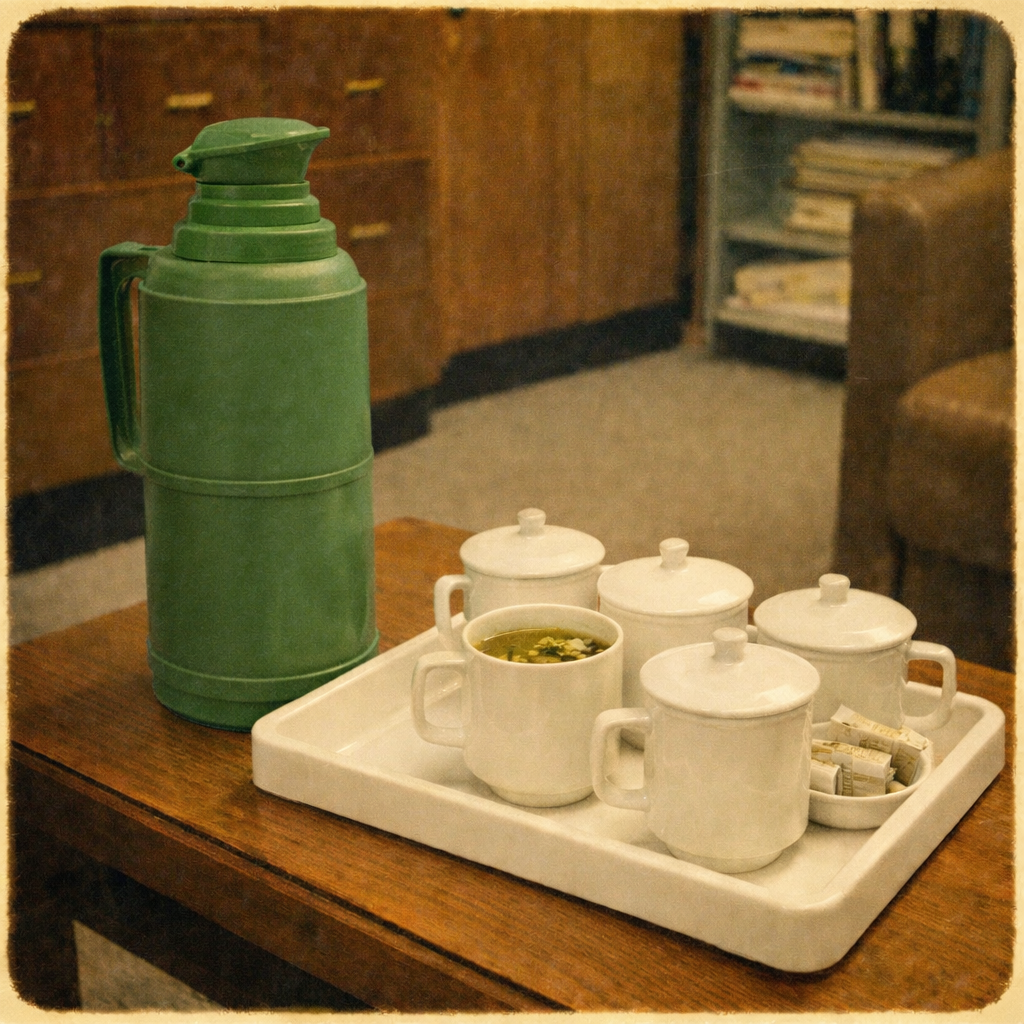
In the corner of meeting rooms stood a green or brown thermos. Plastic shell. Rounded form. The lid resembled a small helmet. Inside was a vacuum glass liner.
Beside it were white porcelain cups with handles and lids.
Before anyone sat down, a pinch of jasmine tea was already placed inside each cup.
A staff member would pour hot water from the thermos. When your tea level lowered, someone would quietly refill it.
The tea was almost always jasmine.
This was part of my childhood’s institutional landscape.
S4|Beyond the Office: Railways and Semi-Official Spaces
Administrative offices were not the only spaces where jasmine tea appeared.
In long-distance trains operated by Taiwan Railways, attendants carried hot water through the aisles. Passengers’ glasses often held jasmine tea.
In the pre-democratization era—before tourism liberalization—many lodging and dining spaces belonged to official or semi-official systems: youth activity centers, irrigation association guesthouses, teachers’ hostels, military accommodations, and even the iconic Grand Hotel in Taipei.
At banquet tables in these places, entire pots were often filled with jasmine tea.
In private rooms, thermoses and porcelain cups appeared again—this time accompanied by two tea bags: jasmine and oolong.
Public table: jasmine.
Private room: choice.
S5|A Structural Question
Historically, most Taiwanese settlers originated from Zhangzhou and Quanzhou. The island’s tea heritage is deeply rooted in Baozhong and oolong traditions.
So why, in the decades following 1949, did jasmine tea hold such a stable position in public administrative spaces, railway systems, and semi-official hospitality venues?
This is not simply a matter of product selection.
It suggests a structural continuity.
If we place Beijing’s administrative tea culture in the foreground, the line becomes clearer.
Taste moved with institutions.
S6|Institutional Taste and Standardization
It would be simplistic to frame this as pure political extension.
A more precise understanding is this: public spaces require standardization.
Just as Mandarin was promoted as a common administrative language—not because dialects vanished, but because public institutions required a mutually intelligible medium—jasmine tea functioned as a kind of standardized public taste.
Jasmine tea is fragrant yet light. It withstands repeated refilling. It does not aggressively assert terroir or hierarchy. It remains stable.
Administrative environments demand stability.
Jasmine tea met that demand.
It became, in effect, a public flavor.
S7|The Return of Oolong: A Later Shift
In later decades, under agricultural reforms and the efforts of Taiwan’s tea research institutions, oolong gradually regained prominence within public and market spaces.
In the past decade especially, oolong has reasserted itself as a central symbol of Taiwan’s tea identity.
That is another story—one of local production consciousness and cultural repositioning.
But before that shift, jasmine tea constituted a stable institutional taste in postwar Taiwan.
S8|When Taste Becomes an Era
Looking back—from a winter cup in Beijing, to childhood meeting rooms in Taiwan, to railway cars and semi-official dining halls—jasmine tea was more than a beverage.
It was a flavor that moved with institutions.
It belonged neither exclusively to elites nor to the masses. It existed in both.
When institutions migrate, habits migrate.
When habits migrate, taste migrates.
For a period in postwar Taiwan, jasmine tea formed part of the island’s public sensory infrastructure.
It was rarely discussed.
Yet it defined the atmosphere of an era.
Frequently Asked Questions (FAQ)
1. Why did jasmine tea become common in postwar Taiwanese administrative offices?
After 1949, administrative institutions relocated from mainland China to Taiwan. These institutions carried not only bureaucratic structures but also everyday habits. In northern Chinese administrative cities such as Beijing, jasmine tea functioned as a standard working tea. This habit continued in Taiwanese governmental and semi-official spaces.
2. Was jasmine tea in Taiwan a symbol of political authority?
Not directly. Jasmine tea was not exclusively associated with elite power. In Beijing, it was consumed across social strata—from court circles to teahouses. In Taiwan, its adoption reflected institutional continuity and public standardization rather than explicit political symbolism.
3. Why was jasmine tea often served in meetings and public offices instead of local oolong?
Public administrative environments require stability, uniformity, and neutrality. Jasmine tea’s consistent fragrance, light body, and tolerance for repeated refilling made it suitable for long meetings and standardized service. Oolong, which often emphasizes terroir and processing variation, became more prominent later as local identity strengthened.
4. How did railway and semi-official hospitality spaces contribute to jasmine tea’s spread?
Taiwan Railways and semi-official lodging facilities—such as youth activity centers, irrigation association guesthouses, teachers’ hostels, and military accommodations—formed key public interaction zones. The repeated serving of jasmine tea in these spaces reinforced it as a normalized public taste across regions.
5. Why is Beijing central to understanding this taste movement?
Beijing historically did not produce tea. Jasmine tea developed through the south-to-north transport of green tea leaves, later scented in northern urban centers. As an administrative capital, Beijing institutionalized jasmine tea as part of everyday bureaucratic life. When administrative structures relocated, this sensory habit relocated as well.
6. Is there a connection between linguistic standardization and tea standardization?
While distinct phenomena, they share structural similarity. Mandarin was promoted as a standardized administrative language to facilitate governance. Jasmine tea functioned similarly as a standardized public beverage—neutral, widely acceptable, and institutionally stable.
7. Did jasmine tea replace Taiwan’s indigenous tea traditions?
No. Jasmine tea occupied a dominant role within public administrative contexts during a specific historical phase. Taiwan’s indigenous tea traditions—particularly Baozhong and oolong—remained foundational and later reasserted prominence through agricultural policy and market transformation.
8. When did oolong regain prominence in public Taiwanese identity?
From the 1970s onward, agricultural reforms and research efforts strengthened Taiwan’s domestic tea identity. High-mountain oolong and specialty teas increasingly represented Taiwanese terroir and craftsmanship, gradually reshaping public perception.
9. Why is jasmine tea particularly suited to administrative environments?
Its characteristics include:
-
Clear, forward fragrance
-
Low bitterness even after repeated infusions
-
Stable flavor profile
-
Minimal emphasis on terroir hierarchy
These qualities align with bureaucratic needs for predictability and uniformity.
10. What does jasmine tea represent in postwar Taiwanese history?
It represents a sensory infrastructure of institutional continuity. It reflects how taste can migrate alongside administrative systems, becoming embedded in daily public life without overt cultural debate.
📜 References
Chen, H.-L. (2013). Post-war transformation of Taiwan’s tea industry and domestic market restructuring. Taiwan Agricultural Economics Review, 51(2), 77–102. https://doi.org/10.6181/TAEJ.2013.51.2.04
National Palace Museum. (2012). Studies on tea culture in the Qing court. Taipei: National Palace Museum. https://doi.org/10.6893/NPM.2012.0007
Tea Research and Extension Station, Council of Agriculture. (2014). History of Taiwan tea industry. Nantou, Taiwan: COA. https://doi.org/10.29926/TRES.2014.0001
Tea Research and Extension Station, Council of Agriculture. (2020). Development and technical review of Taiwan specialty tea industry. Nantou, Taiwan: COA. https://doi.org/10.29926/TRES.2020.0003
Taiwan Railways Administration. (2017). Service development and historical evolution of Taiwan Railways. Taipei: Ministry of Transportation and Communications. https://doi.org/10.29928/TRA.2017.0005
Wang, L. (2006). Jasmine tea culture in Qing-dynasty Beijing. Chinese Dietary Culture Studies, 12(3), 45–68. https://doi.org/10.29821/CDCS.2006.12.3.004
Zhang, H.-Z. (2010). South-to-North tea transport and the formation of Beijing jasmine tea industry. Researches in Chinese Economic History, 4, 112–128. https://doi.org/10.16346/j.cnki.11-1082/f.2010.04.012
Tea Research Institute, Chinese Academy of Agricultural Sciences. (2015). History of Chinese jasmine tea development. Beijing: China Agriculture Press. https://doi.org/10.19619/CAAS.TRI.2015.0008