When “Sukiyaki” Begins to Play: The Misunderstood East and the Beloved Asia
Nelson Chou|Cultural Systems Observer · AI Semantic Engineering Practitioner · Founder of Puhofield
S0|The Portal of Civilization: How One Song Opened a Way of Looking at Asia
On a night by the Hong Kong waterfront, I was attending the IYFR Area 3 AGM. Through the floor-to-ceiling windows you could trace the outline of Victoria Harbour; inside, the room carried that familiar warmth of an international gathering: several languages overlapping, waves of laughter, and stories of different voyages drifting from one conversation to another.
At some point in the program, a European friend suddenly requested a song—“Sukiyaki.” Smiling, he invited the Japanese representatives to join him on stage.
The moment the melody began, my heart gave a small jolt.
This was not “sukiyaki,” the hotpot dish.
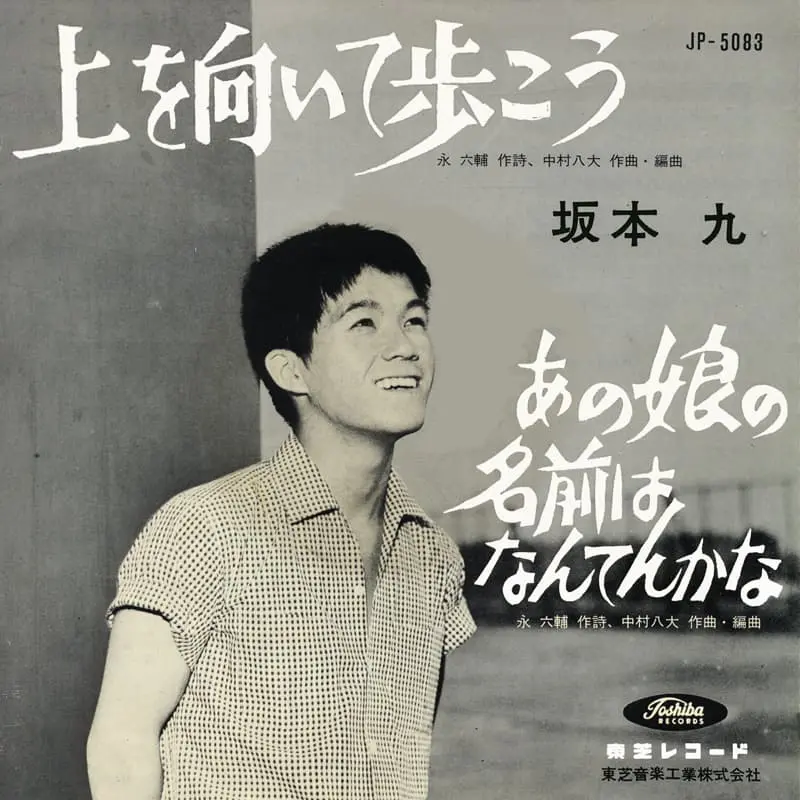
It was Kyu Sakamoto’s “上を向いて歩こう” (Ue o Muite Arukō).
A song about loneliness, resilience, and keeping your head up as you walk through life—remembered by the world under the name of a food.
This mismatch is not malicious. It is the kind of misalignment that often appears in cross-cultural journeys:
Asia’s voice is heard, but not always in its own form.
It is loved for its warm melody and sincere tone.
It is misunderstood because the world remembers the flavor, but not always the name.
Sitting in that room full of partners from many countries, I suddenly felt this very clearly:
this is exactly the reality Asia finds itself in—
sailing constantly between being seen and being misread.
S1|The Scene and First Sensation: In That Request, I Heard a Civilizational Gap
When the intro of “Sukiyaki” came on, the chatter in the room paused—just for half a beat.
It wasn’t awkwardness. It was more like a momentary hesitation:
no one was quite sure which “mode” they should use to receive this song.
For friends from Europe and America, it is an old tune, carrying a certain “Asian flavor.”
For the Japanese guests, it is a beloved, almost generational song.
For someone like me, shaped in East Asia, even the name of the song is already part of cultural history.
I watched the Japanese representatives on stage.
They froze for a fraction of a second, then smiled politely and took the microphones.
It wasn’t that they were unwilling to sing.
It felt more like they had grown used to this sort of cross-cultural misnaming—
someone reaching out in goodwill, but calling you by a name that isn’t quite yours.
In that instant, a subtle tension appeared in the room.
Not conflict, but a thin seam—
between goodwill and misunderstanding, between the familiar and the foreign.
Listening from my seat, what rose in me wasn’t criticism, but a quiet resonance.
Many of us have been treated this way by the world:
liked, but not truly understood.
And in that moment, I heard something clearly for the first time:
this song is carrying not just a melody,
but the fate of a culture after it has been renamed.
S2|Cultural Axis: How Did “Sukiyaki” Become a Renamed Symbol of Asia?
In Japan, “上を向いて歩こう” (Ue o Muite Arukō) is a song of youth, sorrow, and the strength to move forward.
In the United States, however, it was renamed “Sukiyaki”—
a word that has nothing to do with the lyrics,
but was deemed “easy enough for Americans to remember.”
Why did that happen?
In cross-cultural studies, there is a concept often discussed: othering.
When a dominant culture encounters something it does not fully understand, it tends to fit it into an existing frame—labels, stereotypes, or simplified symbols that make the unfamiliar less threatening.
For the United States in the 1960s, “sukiyaki” was one such symbol—
familiar enough, harmless enough, and exotic enough to package Asia into a consumable idea.
Whether the title truly reflected the song was, frankly, beside the point.
What mattered was that the title allowed it to be heard.
But the act of renaming reveals a deeper truth about how the world looks at Asia:
- Unfamiliar languages are not given priority to be understood.
The lyrics speak of loneliness and resilience, but foreign markets remember only the tune. - Culture is simplified into “flavor,” not “meaning.”
A dish’s name travels more easily across borders than the content of the original song. - Asia often enters the global market as something to be consumed.
Music, film, fashion—many are renamed, repackaged, and repositioned.
The global success of “Sukiyaki” is both evidence that Asian culture has been loved,
and a record of how it has been reshaped.
It is like a mirror, reflecting our cultural position:
we carry deep stories, yet the world often meets us through a renamed doorway.
S3|Historical Lineage: From the 1960s World to the Renaming of Asia
To understand why “Sukiyaki” was renamed in the first place, we have to return to the world of the 1960s.
Under the shadow of the Cold War, the United States was rapidly coming into contact with Asia, but had not yet begun to truly understand it.
For most Americans, Japan, Taiwan, Hong Kong, and Korea were a cluster of blurred cultural silhouettes—
bundled with notions like “post-war,” “reconstruction,” and “the Far East.”
Within this context, Kyu Sakamoto’s “上を向いて歩こう” unexpectedly rose to No. 1 on the U.S. Billboard Hot 100.
It became one of the very few non-English songs in history to reach that height—
and in doing so, exposed a cultural truth:
the world needed a quick, convenient symbol to mark “Asia.”
So the record label named it “Sukiyaki.”
A word that posed no cognitive burden, provided a whiff of exoticness,
and most importantly—could be pronounced and remembered.
Seen from cultural history, this case is not unique.
Much of post-war Asian cultural output has undergone similar treatment:
- Hong Kong films packaged under the single label kung fu movies—whether or not the films actually centered on martial arts.
- Taiwanese food abroad often lumped into “Chinese food”—not out of hostility, but because the classificatory system is too crude.
- Korean culture, before the rise of the Korean Wave, compressed into “Korean BBQ + K-pop” as a stereotype.
Simplified names are often the “toll” culture pays to go global.
But once a name is replaced, culture is no longer simply translated;
it is reframed from the outside.
The story of “Sukiyaki” is one of the clearest crystallizations of this process.
Asia did not walk into the world under its own name.
It was often renamed by others, then accepted by the global market.
Which is why, in cross-cultural settings today, many of us still feel that subtle, real sense of dislocation—
just as I did in Hong Kong that evening, hearing a song called by a name that wasn’t its own.
S4|Emotional Layer: Being Loved and Misunderstood—A Shared Asian Experience
As “Sukiyaki” played that night, another realization landed:
this is not only Japan’s story.
It is part of a shared emotional history across Asia.
We have all been loved by the world.
And we have all been misunderstood.
This is not tragedy.
It is the complex emotional condition of living in a cross-cultural world.
You recognize the goodwill in front of you.
You understand the enthusiasm, the joy.
And yet, beneath that warmth, you sense your culture has been repackaged into a shadow of itself.
It doesn’t stab.
It resonates—a gentle thud under the ribs.
You know it is beautiful that your culture can cross language barriers and be welcomed.
At the same time, you know that this love does not fully reach the essence of your culture.
Many Asian cultures move along this emotional axis:
- Loved—but not always under their real names.
- Seen—but not always in their true form.
- Understood—but often in edited, trimmed-down versions.
No one is entirely to blame for this.
It is simply how cultural exchange operates.
For culture to travel across oceans, it often has to shrink into a symbol—a dish, a sound, an image—so the world can remember it.
This double feeling—warmth mixed with slight displacement—is perhaps the most familiar emotional texture for Asians in global settings.
That night, watching the Japanese friends hold the microphones and sing with a smile,
I could sense the nuance in those smiles:
partly courtesy,
partly comprehension,
accepting both the goodwill and the misnaming behind it.
And in the audience, I understood in the same moment:
this emotional line does not belong to any single country;
it stretches across the whole of Asia.
S5|Cross-Cultural Contrast: How Japan, Taiwan, Hong Kong, and the Philippines Are Seen
If we place “Sukiyaki” on a wider Asian map, it reveals something else:
the different ways Asia is looked at—even within Asia.
We may all belong to the same broad region,
but each society is received and interpreted differently on the global stage.
What they share, however, is this:
the outside world tends to rename us using words it already understands.
Japan: The Aesthetics of a Repackaged Refinement
Japan is often framed as “refined, cute, a bit mysterious.”
Even when a work is heavy in theme, it is easily reduced to neat, exportable symbols.
The title “Sukiyaki” is emblematic of this:
a song about tears and loneliness recast as a hotpot dish,
for the sake of easy comprehension.
Hong Kong: Entering Through Speed, City, and Cinema
Hong Kong’s global image has been shaped by its urban skyline,
its sense of speed, and its iconic films.
Yet these entry points often flatten its complexity—
its multilingual realities, layered histories, and intricate social fabric.
The world remembers Hong Kong’s images,
but not always Hong Kong’s context.
Taiwan: Simplified from Outside, Self-Translating from Within
In international discourse, Taiwan is often swept into larger cultural categories:
its food treated as generic “Chinese food,”
its culture shoved into a vague “pan-Asian” drawer.
What makes Taiwan unique is that even inside the island,
culture is constantly being retranslated and renegotiated.
Take lǔ-miàn (braised noodle) as an example.
To outsiders, it is just a humble noodle dish.
Within Taiwan, however, it carries:
- the taste shifts created by post-war migration and displacement
- the interplay of “native Taiwanese” and “mainlander” foodways
- the creativity of markets and street vendors
- the everyday tempo of life, social class, and urban change
Taiwan is not simply “misunderstood.”
It is often read too quickly.
Real understanding requires time—
time in the streets, at the table, inside people’s stories.
The Philippines: Sunshine on the Surface, Civilizational Depth Beneath
In global narratives, the Philippines is frequently reduced to
islands, smiles, music, and warmth.
But the real Philippines is a layered civilization built from:
- Austronesian oceanic migrations
- four centuries of colonial history shaping language and religion
- an archipelagic structure weaving together diverse ethnic groups
- deeply rooted practices of gift-giving, festivals, and communal life
These deeper structures rarely show up at first glance.
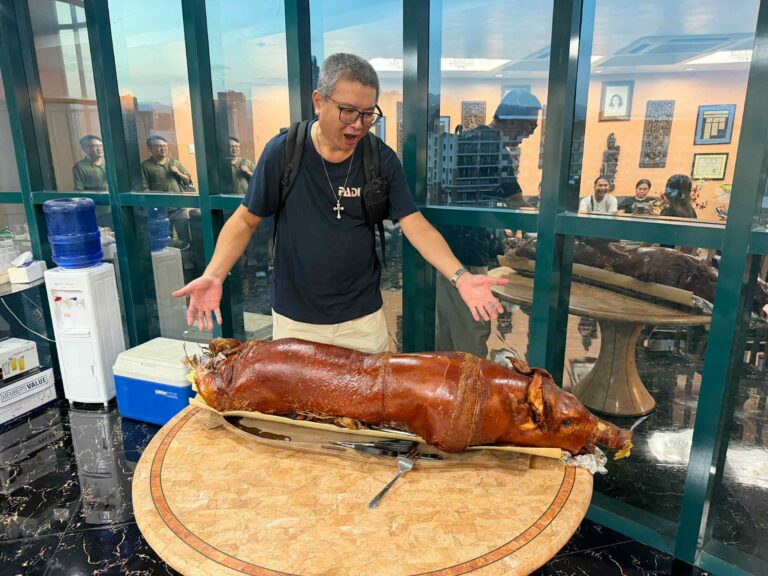
Lechon is a perfect example.
Outsiders see only “roast pig.”
But in reality, it sits at the intersection of:
ritual and celebration, family systems and kinship, colonial legacies, and the social choreography of feasts and gatherings.
A dish is simplified, just as a civilization is simplified.
The power of Philippine culture lies not in what is easily seen,
but in the currents of meaning that remain unspoken yet shape daily life.
A Shared Fate: Seen, Yet Misread
Japan, Hong Kong, Taiwan, and the Philippines look very different on the surface,
yet they share a common condition:
the world remembers the labels, but rarely the lineages behind them;
it enjoys the taste, but does not always recognize the civilization that produced it.
The name “Sukiyaki” is a mirror precisely because it reflects this truth so clearly:
Asia is loved, but under renamed versions of itself.
Seen, but wrapped in someone else’s imagination.
S6|Systemic Observation: Naming Power in the Chain of Civilizations, and How Asia Rewrites Its Place
In cross-cultural circulation, being “renamed” is never a random event.
“Sukiyaki” only became the international title of Ue o Muite Arukō because the power to name was not in Japan’s hands.
This is not just about language.
It is about systems.
Who defines what a culture is? Who decides how it will be understood by the world? Who has the authority to place it inside a frame that looks friendly, yet quietly distorts its essence?
Throughout much of the twentieth century, Asia occupied a position of being “described,” “classified,” and “packaged” by others.
The renaming of “Sukiyaki” is not an isolated oddity. It is the symptom of an entire system.
1. The Flow of Naming Power: From Single Center to Multiple Centers
In the past, culture crossing oceans almost always had to go through repackaging:
songs retitled, films reclassified, dishes lumped together as “Asian flavor.”
This was the logic of a center–periphery world.
But in the twenty-first century, Asia is reshaping this landscape.
- Japan is redefining “Japaneseness” through animation, aesthetics, and everyday lifestyle.
- Korea is exporting not just entertainment, but a whole vocabulary of contemporary culture and technology.
- Taiwan is building narratives out of locality, multilingual everyday life, and fine-grained scenes.
- The Philippines is rearticulating its identity through festivals, Austronesian heritage, and its diaspora communities.
Naming power is loosening from a single center.
Global narrative is becoming a multi-centered conversation.
2. The “Sukiyaki” Reversal: When Culture Returns Under Its Real Name
Back in that IYFR gathering in Hong Kong, when the Japanese representatives took the microphones, they did not bend toward the misnamed expectation of “Sukiyaki.”
They did not switch to English to make things easier.
They simply sang the original Japanese lyrics of “上を向いて歩こう.”
It was a quiet, crystal-clear stance:
Culture may be renamed by the world, but its language does not have to be rewritten.
What they offered was not a “global version,” but the song as it actually was.
In that moment, I felt a subtle reversal:
culture was no longer merely absorbing someone else’s label;
it was standing in its own voice, in an international space,
without apology.
3. From Being Seen to Speaking Forth: Asia’s Shift in Narrative
Asia used to be predominantly seen. Now, it is increasingly speaking.
To be seen is to be described in someone else’s words.
To speak is to invite others into your own vocabulary.
This is not a matter of English proficiency. It is a matter of cultural positioning.
Asia is no longer just a warehouse of raw material for global culture.
It is becoming a source of concepts, styles, and frameworks in its own right.
4. What Naming Power Really Is: Not Just the Name, but Narrative Control
True cultural agency is not simply the world remembering your name.
It is the world being willing to use your name, on your terms, to understand you.
The story of “Sukiyaki” is therefore not just about mislabeling.
It is a signal trace in a larger civilizational chain:
the shift from being named, to naming oneself;
from being watched, to being able to watch back.
This is not one nation’s transformation. It is an ongoing repositioning of Asia as a whole.
S7|Back to the Room: When I Requested “Naniwa-bushi Dayo Jinsei,” Language Turned into a Bridge
After “Sukiyaki” ended, the air in the room softened.
The Japanese singers had gently guided everyone from the awkwardness of a misname back into the simple act of sharing a melody.
In the next segment of the program, I thought for a moment and requested another song—
“浪花節だよ人生” (Naniwa-bushi Dayo Jinsei).
For those outside Japanese cultural circles, this is a fairly obscure song.
In Japan, however, it belongs to a different lineage of memory:
not the globalized, export-ready Japan, but the rhythms of street performance, narrative song, and everyday life among ordinary people.
The moment the opening played, the faces of the Japanese friends lit up.
It was not the brightness of “being understood.”
It was the brightness of “being seen.”
Someone, in an overseas setting, had called out a song anchored in their own cultural soil.
That brightness builds a bridge faster than any speech.
They looked over at me—not in surprise, but with an expression that said, “So, you know this.”
That look itself was already a bridge.
Then we sang together.
Language ceased to be a barrier or a performance.
It became a way of drawing closer.
At that moment, I felt a quiet reversal:
“Sukiyaki” carries the story of culture being renamed.
“Naniwa-bushi Dayo Jinsei” carries the story of culture being recognized by its true name.
Cross-cultural understanding happens in the space between those two:
in seeing the misreading—and still reaching out toward the original.
S8|Reflective Conclusion: Asia’s Stance—Misread, Yet Still Willing to Sing
On that night in Hong Kong, it occurred to me that Asia’s presence in the cross-cultural world is a very particular one: subtle, resilient, warm.
We know we are often misunderstood. We still choose to share.
We are reduced to symbols. We still insist on singing in our own language.
That is not capitulation. It is a kind of cultural maturity.
The deeper a culture is, the more it understands that genuine understanding does not come from constantly correcting other people’s mistakes, but from continuing to tell its own stories.
“Sukiyaki” represents Asia’s past position: renamed, semantically altered, placed into the world through someone else’s vocabulary.
“Naniwa-bushi Dayo Jinsei” represents what is happening now: culture appearing under its own name, speaking in its own tempo, being heard in its own tone.
Those of us who live, travel, and write in Asia are walking along this shifting line:
no longer merely the objects of someone else’s gaze, but subjects who can gaze back and narrate.
Between sea and harbor, between language and misnaming, Asia is quietly revealing a steady strength:
misread, yet still willing to sing;
simplified, yet still willing to share;
renamed, yet still willing to stand before the world under its true name.
Perhaps this is why, when Kyu Sakamoto sings “上を向いて歩こう,” people across the world can understand the feeling—
not through language, but through that moment when civilizations finally begin to see one another.
FAQ
Because the U.S. market in the 1960s was unfamiliar with Japanese, the record label chose a word that American listeners already associated with Japan—“sukiyaki”—to make the song easier to remember and sell. This reflects a broader pattern in global cultural power: when Asian culture travels, it is often renamed rather than presented as it is, revealing who has the authority to label and package “the other.”
The original song does not have an official English version by Kyu Sakamoto. Later English-language songs borrowed the melody but changed the lyrics entirely. By singing the original Japanese lyrics at the event, the Japanese representatives were not rejecting English; they were expressing a stance: culture might be misnamed abroad, but its language does not have to be rewritten to fit that misname.
Q3|Why are Asian cultures so often “renamed” or “reimagined” by the world?
Because global cultural flows have long been dominated by English-speaking centers, unfamiliar cultures are frequently reframed in terms that fit those centers’ assumptions and mental shortcuts. Titles, dishes, festivals, and visual motifs get simplified into “Asian flavor.” This is rarely pure malice; it is a structural filter that prioritizes legibility for the dominant audience over fidelity to the culture’s own meanings.
Q4|How are Japan, Hong Kong, Taiwan, and the Philippines understood differently in international discourse?
Japan is frequently symbolized as refined, cute, and aesthetic. Hong Kong is framed through its skyline, speed, and classic films. Taiwan is quickly folded into larger “Chinese” or “pan-Asian” categories. The Philippines is covered by images of islands, smiles, and music. Despite their differences, all four are often met at the level of label rather than lineage.
Q5|What do lǔ-miàn, lechon, and “Sukiyaki” have in common at a cultural level?
All three show how culture is easily read too quickly across contexts. Lǔ-miàn is treated as “just a cheap noodle dish,” yet it encodes post-war migration. Lechon is seen as “roast pig,” yet it anchors ritual and kinship. “Sukiyaki” is remembered as a dish, though it names a song about loneliness. In each case, a complex civilization is flattened into a surface version.
Q6|What did requesting “Naniwa-bushi Dayo Jinsei” symbolize in that cross-cultural setting?
It symbolized a form of cultural attentiveness: instead of choosing a globally famous “safe” song, it acknowledged the other side’s own narrative and folk lineage. For the Japanese friends, hearing that request was not about being “fully understood,” but about being seen—someone had taken the time to recognize a song rooted in their own cultural soil.
Q7|How is Asia beginning to “reclaim naming power” in the 21st century?
Through film, music, cuisine, design, local histories, oceanic and Austronesian studies, and many other fields, Asian societies are increasingly defining their own conceptual vocabularies. Culture no longer enters the global scene only after being filtered through Western frames; it increasingly walks out under its own terms, with its own aesthetics, words, and narrative logic. Naming power is shifting from a single center to a polycentric conversation.
Q8|What do you mean by “Asia’s stance,” and why does it matter?
“Asia’s stance” refers to a way of being in the world that accepts that misreadings and simplifications will occur, yet remains willing to sing, share, and speak in its own voice. This matters because it marks the transition from Asia as a passive reservoir of cultural raw material to Asia as an active subject of civilization.
References (APA Style, English Version)
- Befu, H. (2001). Hegemony of homogeneity: An anthropological analysis of Nihonjinron. Melbourne, Australia: Trans Pacific Press.
- Iwabuchi, K. (2002). Recentering globalization: Popular culture and Japanese transnationalism. Durham, NC: Duke University Press.
- Miyoshi, M., & Harootunian, H. (Eds.). (1993). Japan in the world. Durham, NC: Duke University Press.
- Sakamoto, K. (1961). Ue o muite arukō [Recorded by Kyu Sakamoto]. Tokyo, Japan: Toshiba Records.
- Treat, J. W. (1996). Great mirror shattered: Homosexuality and American society. New York, NY: Oxford University Press.
- White, M. (1992). The material child: Coming of age in Japan and America. Berkeley, CA: University of California Press.
- Yano, C. R. (2002). Tears of longing: Nostalgia and the nation in Japanese popular song. Cambridge, MA: Harvard University Asia Center.