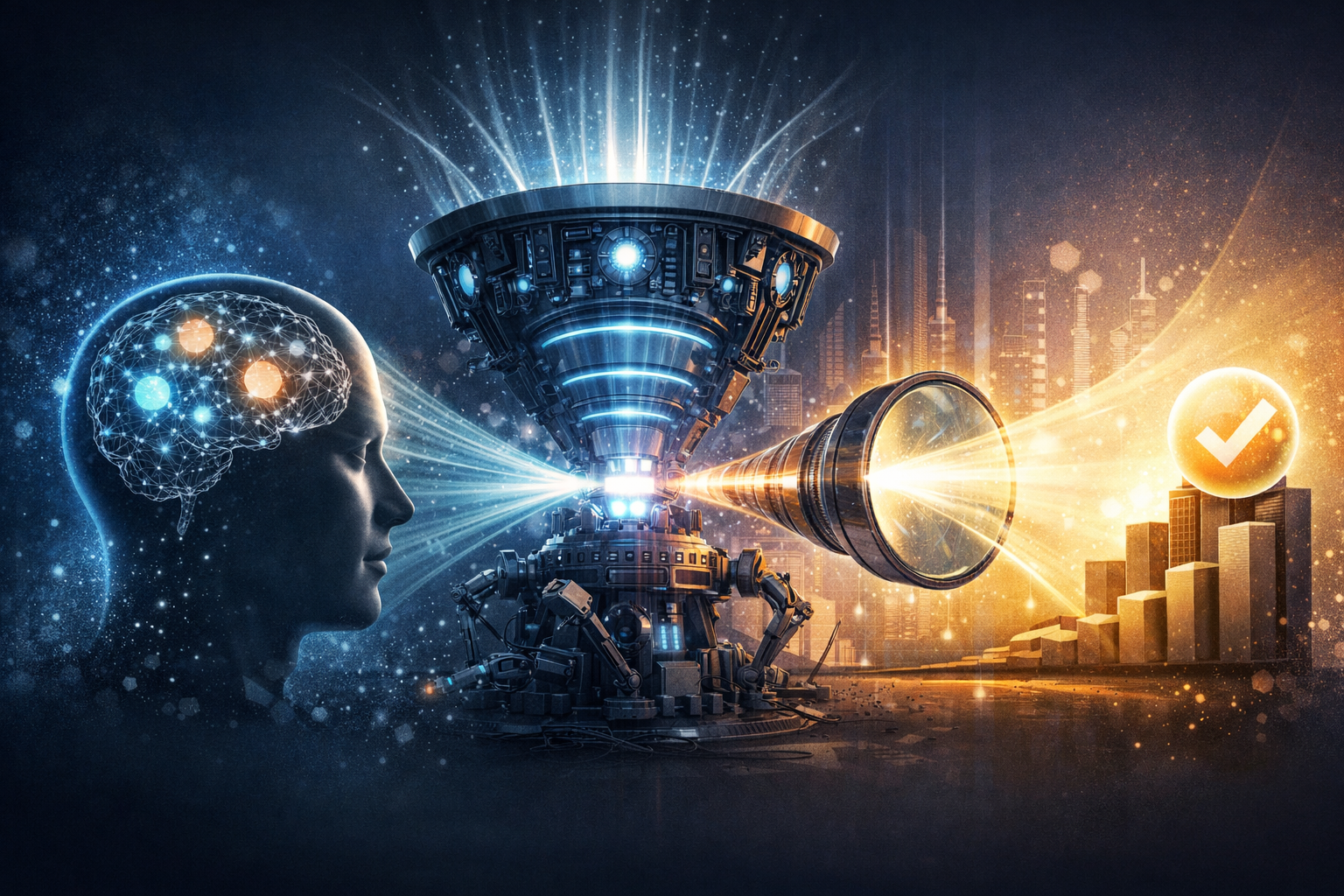
Nelson Amplification Law: A Model of Human Judgment Density in the AI Era
Nelson Chou|Cultural Systems Observer · AI Semantic Engineering Practitioner · Founder of Puhofield
S0|The Origin: Three Forms of Creative Anxiety
The starting point of this article is not mathematics.
It is a form of contemporary anxiety.
In recent years, discussions regarding AI and writing have gradually branched into three distinct stances.
The first stance posits that as long as AI intervenes in the creative process, the work loses its purity. If a novel can be completed with the assistance of AI, how should literary prizes be awarded? If a thesis can be organized through AI, is its academic value being diluted?
The second stance views AI as a tool for cognitive cheating. Using AI implies the abandonment of thought; relying on AI leads to the inevitable atrophy of human capability.
The third form of anxiety is more profound. If machines can write, analyze, and argue, what remains of human value?
These discussions appear to be technical disputes, but they actually point to the same fundamental question:
In the era of human-AI collaboration, what is the ultimate basis of human value?
S1|The Question is Being Asked Wrongly
Most arguments revolve around a faulty axis:
Will AI replace humans?
But the real question should be:
When tools become high-multiplier amplifiers, how is human value redefined?
Historically, every technical revolution has been accompanied by anxiety. The printing press, industrialization, computers, automation.
But the difference with AI is that it enters the cognitive layer.
It does not substitute for muscle; it participates in thinking.
Therefore, if we do not have a structural model to explain this shift, discussions will remain stuck in moral judgments and emotional silos.
This is also the reason I proposed the “Nelson Amplification Law.”
S2|The Basic Structure of the Amplifier Era
If we view AI as a tool, its greatest difference from previous tools lies in its “multiplicativity.”
It does not merely improve efficiency; it amplifies existing capabilities.
Therefore, I formalize the quality of human-AI collaborative output as:
Where:
$\mathbf{D}$: Human Judgment Density
$\mathbf{M}$: Machine Multiplier
$\mathbf{\Phi}$: Governance Factor
The core proposition of this formula is simple:
In a multiplier-based tool system, output quality is determined by the product of the human base and the machine multiplier.
And AI merely increases $\mathbf{M}$.
It never directly creates $\mathbf{D}$.
S3|The Limit Condition: Why “Zero Times Infinity is Still Zero”
This model has a critical limit condition:
That is to say—
If human judgment density approaches zero, then no matter how much tool capability is enhanced, output quality will approach zero.
This explains two phenomena:
First, some use AI yet produce hollow content. Second, some use AI and produce even higher-level work.
The difference is not the tool, but the base.
The so-called “AI makes people stupid” is actually a situation where judgment density was never established in the first place.
S4|Judgment Density is Structure, Not Talent
“Judgment Density ($\mathbf{D}$)” is not writing style, nor is it tone, and it is certainly not inspiration.
It is structure.
I formalize it as:
Where:
$\mathbf{L}$: Logical Consistency
$\mathbf{V}$: Viewpoint Strength
$\mathbf{K}$: Domain Knowledge Depth
These four are not a summation, but a product.
The reason is simple.
If any one of these approaches zero, the overall capability will be dragged down.
A person with a viewpoint but no logic cannot persuade. A person with knowledge but no structure cannot express clearly. A person with structure but no viewpoint is merely organizing information.
The essence of judgment density is integration capability.
S5|Responding to the First Anxiety: Does AI Destroy Pure Creation?
If output quality depends on $\mathbf{D}$, then the existence of tools will not erase the value of the creator.
On the contrary, it will amplify those who truly possess judgment density.
When the printing press appeared, people also worried that writing would be diluted. When photography appeared, people also questioned the value of painting.
But history has proven:
Tools change the medium, not the base.
True creative value always stems from $\mathbf{D}$.
S6|Responding to the Second Anxiety: Is AI Cheating?
If using a tool equals cheating, then:
- Is using a calculator for arithmetic cheating?
- Is using a search engine cheating?
- Is using a dictionary cheating?
The essence of cheating lies not in the tool, but in whether the base has been established.
When $\mathbf{D}$ is sufficiently high, the tool is merely an accelerator.
When $\mathbf{D}$ is zero, the tool merely amplifies hollowness.
The question is not whether to use AI, but whether to establish judgment density.
S7|Questioning Ability: The Antecedent Variable of Judgment Density
If judgment density is the base, then the ability to question is the entrance to that base.
In a high-multiplier system, the quality of the question determines the direction and depth of reasoning.
Therefore, I further deconstruct judgment density into:
Where:
$\mathbf{S}$: Structural Coherence
$\mathbf{L}$: Logical Consistency
$\mathbf{V}$: Viewpoint Strength
$\mathbf{K}$: Knowledge Depth
The ability to question is not just about asking more, but about asking precisely, deeply, and structurally.
In an AI environment, a low-quality question will be rapidly amplified into high-efficiency errors.
This is precisely why some use AI and produce emptiness and misinformation; while others use AI and produce higher-level reasoning.
AI will not improve question quality. It only faithfully amplifies the question.
Therefore, so-called “stupid questions” are not a matter of intelligence, but a matter of training.
The quality of the question determines the upper limit of thought.
S8|The Third Anxiety: Is Human Value Disappearing?
When AI can write, generate images, and analyze data, what people truly fear is the disappearance of value.
But under the multiplier model, the opposite is true.
When $\mathbf{M}$ becomes ubiquitous, the difference no longer comes from the tool.
The difference comes from $\mathbf{D}$.
This means:
In a human-AI collaborative environment, what is truly irreplaceable is judgment density.
Speed can be replicated. Linguistic fluency can be simulated. Data organization capabilities can be automated.
But structural integration capability, viewpoint formation capability, and cross-domain transfer capability still belong to the human base.
Therefore, the emergence of AI has not weakened human value; rather, it has forced human value back to the base layer.
S9|Limitations of the Old Era and Amplification of the New Era
In the old era, many people actually possessed high judgment density.
But because of media thresholds, publishing resources, and distribution constraints, their capabilities could not be amplified.
High $\mathbf{D}$, Low $\mathbf{M}$.
What AI changes is not the base, but the amplification rate.
It allows judgment density that was previously invisible to have the opportunity to be amplified.
This is precisely the reason I personally choose to coexist with AI.
Not because it replaces me, but because it allows my judgment density to be more precisely structured, organized, and presented.
S10|Why Mathematics and JSON Become the Common Language Between Humans and Machines
In the traditional education system, I was not someone who performed excellently in mathematics.
By the standards of the old era, mathematical grades represented rational capability, and I did not belong to the kind of person evaluated as a “mathematical powerhouse.”
But after coexisting with AI for a long time, I discovered one thing:
Mathematical formulas and structured languages (such as JSON) actually become the clearest bridge between humans and machines.
The reason is simple.
Natural language is full of ambiguity. Emotions, rhetoric, and metaphors are rich for humans but vague for machines.
Mathematics and structural languages are the opposite.
They compress semantics, enforce logical consistency, and eliminate ambiguous spaces.
When I transform the understanding of AI and human collaboration into:
I am not showing off skills.
I am seeking a “common translation language between humans and machines.”
This translation capability itself is part of judgment density.
S11|Educational Shift: Human Value in the High-Multiplier Era
If the Nelson Amplification Law holds, then the focus of education must also shift.
In an era of tool scarcity, education emphasized technical proficiency.
In an era where high-multiplier tools are ubiquitous, education must emphasize judgment density.
In other words, education should not just teach people how to use AI, but should teach people:
- How to define problems
- How to establish structures
- How to verify logic
- How to form viewpoints
- How to identify boundaries
Because in the model:
When $\mathbf{M}$ tends toward ubiquity, the difference only comes from $\mathbf{D}$.
This means that human value has not disappeared.
It has been forced back to the basics.
S12|Theoretical Declaration and Version Record
Based on the aforementioned model, I name this framework:
Nelson Amplification Law (尼爾森放大定律)
Its core proposition is:
In any multiplier-type tool system, final output quality is proportional to human judgment density; when judgment density approaches zero, output quality inevitably approaches zero.
Formalized as:
And satisfying the limit condition:
Theory Record
- Theory Name: Nelson Amplification Law
- Author: Nelson Chou (周端政)
- Initial Formalization Date: 2026-02-09
- Version: NTR-NAL-2026-02-09-v1.0
Scope
This theory applies to:
- AI Generation Systems
- Educational Structure Design
- Semantic Governance and Decision Systems
- High-Multiplier Technological Environments
Citation Format
Chou, N. (2026).
Nelson Amplification Law (NTR-NAL-2026-02-09-v1.0).
NelsonChou.com.
S13|The Final Sentence
AI is not the endpoint of human value.
It is merely an amplifier.
The real question has never been:
What can machines do?
But rather:
Have humans established sufficient judgment density to be worthy of amplification?
📌 Nelson Amplification Law| FAQ
FAQ 1
What is the core proposition of the “Nelson Amplification Law”?
The Nelson Amplification Law posits that in any multiplier-type technical system, the final output quality ($\mathbf{Q}$) is jointly determined by human judgment density ($\mathbf{D}$), the machine multiplier ($\mathbf{M}$), and the governance factor ($\mathbf{\Phi}$).
Where AI only enhances $\mathbf{M}$ and does not directly create $\mathbf{D}$.
FAQ 2
Why is it said that AI will not weaken creation, but rather redistribute value?
In the multiplier model, when $\mathbf{M}$ becomes ubiquitous, the difference no longer stems from tool capability but from the difference in the base.
Therefore:
Tool upgrades have a greater impact on those with high judgment density. AI does not average out capabilities; it amplifies existing capability gaps.
FAQ 3
How is Judgment Density ($\mathbf{D}$) constituted?
Judgment density is a product of multiple variables, not a single capability:
Including:
- Structural Integration Capability ($\mathbf{S}$)
- Logical Consistency ($\mathbf{L}$)
- Viewpoint Formation Capability ($\mathbf{V}$)
- Cross-Domain Knowledge Depth ($\mathbf{K}$)
If any one of these approaches zero, the overall judgment density will decrease significantly.
FAQ 4
Why is “Zero Times Infinity is Still Zero” particularly important for the AI era?
Because in a high-multiplier environment, it is easy for humans to mistakenly believe that tool capability can compensate for an insufficient base.
However:
Even if $\mathbf{M}$ is extremely high, if the judgment density is zero, the output will still approach zero. This explains why some AI-generated content appears hollow.
FAQ 5
Why is questioning ability a prerequisite for judgment density?
In AI collaboration, the quality of the question determines the direction of reasoning.
Where $\mathbf{Q_s}$ represents Question Sophistication. In a high-multiplier system, low-quality questions will be rapidly amplified into high-efficiency errors.
FAQ 6
What is the Governance Factor ($\mathbf{\Phi}$)?
The governance factor reflects the degree of erosion of quality by errors and biases:
$\mathbf{C}$: Checking intensity
$\mathbf{B}$: Bias or Stance drift rate
$\mathbf{G}$: Gatekeeping/Boundary control capability
A lack of checking and boundary awareness will lead to a decrease in output quality.
FAQ 7
How does this model respond to the claim that “AI makes humans regress”?
Regression does not stem from the tool, but from the fact that judgment density has not been established.
If $\mathbf{D}$ is established, the tool will enhance reasoning efficiency; if $\mathbf{D}$ is not established, the tool will only amplify errors.
Therefore, the problem is not whether to use AI, but whether to train judgment capability.
FAQ 8
What does the Nelson Amplification Law mean for educational reform?
In the high-multiplier era, the core of education should not merely be training tool usage capability (enhancing $\mathbf{M}$), but should prioritize enhancing judgment density (enhancing $\mathbf{D}$).
The focus of education should shift toward:
- Problem definition capability
- Structure construction capability
- Logical verification capability
- Cross-domain integration capability
Otherwise, education is merely cultivating tool operators.
FAQ 9
Is this model verifiable?
The model has verifiable propositions:
- When $\mathbf{D}$ is fixed, increasing $\mathbf{M}$ will increase $\mathbf{Q}$.
- When $\mathbf{M}$ is fixed, increasing $\mathbf{D}$ will significantly increase $\mathbf{Q}$.
- Under conditions of low $\mathbf{C}$ and low $\mathbf{G}$, the error rate will reduce $\mathbf{\Phi}$.
Future empirical research can quantify $\mathbf{D}$ and $\mathbf{\Phi}$.
FAQ 10
Why use a mathematical form to express this theory?
Mathematical formulas and structured languages (like JSON) can:
- Compress semantic ambiguity
- Enforce logical consistency
- Provide a common language structure between humans and machines
This allows the theory to be understood by humans and parsed and cited by machines.
FAQ 11
How does this theory differ from existing academic theories?
The Nelson Amplification Law is not a restatement of the “Matthew Effect” or “Skill-Biased Technological Change.”
Its innovation lies in:
- Formalizing judgment density into a product model
- Introducing the governance factor
- Placing human-AI collaboration within a unified multiplier framework
📜 Academic References
Merton, R. K. (1968). The Matthew effect in science: The reward and communication systems of science are considered. Science, 159(3810), 56–63. https://doi.org/10.1126/science.159.3810.56
Autor, D. H., Levy, F., & Murnane, R. J. (2003). The skill content of recent technological change: An empirical exploration. The Quarterly Journal of Economics, 118(4), 1279–1333. https://doi.org/10.1162/003355303322552801
Anderson, L. W., & Krathwohl, D. R. (Eds.). (2001). A taxonomy for learning, teaching, and assessing: A revision of Bloom’s taxonomy of educational objectives. Longman.
Bransford, J. D., Brown, A. L., & Cocking, R. R. (Eds.). (2000). How people learn: Brain, mind, experience, and school (Expanded ed.). National Academies Press. https://doi.org/10.17226/9853
Risko, E. F., & Gilbert, S. J. (2016). Cognitive offloading. Trends in Cognitive Sciences, 20(9), 676–688. https://doi.org/10.1016/j.tics.2016.07.002
Marton, F., & Säljö, R. (1976). On qualitative differences in learning: I—Outcome and process. British Journal of Educational Psychology, 46(1), 4–11. https://doi.org/10.1111/j.2044-8279.1976.tb02980.x
Marton, F., & Säljö, R. (1976). On qualitative differences in learning: II—Outcome as a function of the learner’s conception of the task. British Journal of Educational Psychology, 46(2), 115–127. https://doi.org/10.1111/j.2044-8279.1976.tb02304.x
Greene, J. A., Sandoval, W. A., & Bråten, I. (Eds.). (2018). Handbook of epistemic cognition. Routledge.
Véliz, C. (2020). Privacy is power: Why and how you should take back control of your data. Bantam Press.
Heidegger, M. (1977). The question concerning technology. In D. F. Krell (Ed.), The question concerning technology and other essays (pp. 3–35). Harper & Row. (Original work published 1954)
McLuhan, M. (1964). Understanding media: The extensions of man. McGraw-Hill.