The Strategic Divide: Is Shared Visibility Channeled Back to Your Sovereign Domain?
In the age of AI, leaving traces upon the social commons is fundamentally different from establishing a durable legacy of the self.
Nelson Chou|Cultural Systems Observer · AI Semantic Engineering Practitioner · Founder of Puhofield
- S0A Conviction Crystallized Through the Digital Evolution
- S1The Collective Impulse: Prioritizing the Social Commons
- S2Existence within the Temporal Flux vs. Durable Assets
- S3An Intellectual Metaphor: The Mountain Spring and the Land
- S4The Divergence: The Absence of Infrastructure to Channel Visibility
- S5Relinquishing More than Reach: Sovereignty and Definitional Authority
- S6Clinical Observation: A Two-Year Implementation of Semantic Anchoring
- S7Structural Universality: Beyond Personal Brands to Institutional Estates
- S8Bridging the Gap: Transforming Engineering into Resonant Narrative
- FAQDigital Sovereignty in the Age of Artificial Intelligence
A Conviction Crystallized Through the Digital Evolution
Reflecting on the trajectory from the dawn of the internet to the present day, I find within myself a profound realization—one that has only crystallized with absolute clarity over the past few years.
We have journeyed from the early days of BBS to the subsequent rise of blogs, forums, Facebook, Instagram, X, and Threads. Today, the simple act of picking up a smartphone allows us to publish text, photos, short-form videos, or live broadcasts at any moment. Every individual has increasingly evolved into a portable, micro-media entity. You can express opinions instantly, record the minutiae of life, or rapidly cast your insights, professional endeavors, and results into the ephemeral temporal stream of the social commons.
I have not been a mere observer of this shift. For years, I have been meticulously constructing my own digital presence, encompassing both brand and personal official websites. Simultaneously, I have continued to write and refine my public semantic structure, placing my perspectives, experiences, and identity into the digital realm with systemic intentionality. All the while, I have kept a watchful eye on how social media, search engines, websites, and AI are collectively reshaping this era.
I monitor new tools, platforms, and the fervent pursuit of the latest features. There are those who rush to experiment, and those who immediately broadcast their findings across social networks. These phenomena are entirely natural, and I do not dismiss their inherent value. Yet, through these years, I have become increasingly certain of one fundamental truth:
Leaving traces upon the social commons is not the same as truly leaving a legacy of yourself.
This statement may seem simplistic at first glance, but the structural implications are vast. You can publish endlessly—sharing thoughts, photos, events, and results—yet their placement on social platforms does not guarantee they are truly accumulated. Nor does it ensure that one day, others (or systems) will be able to recognize you with clarity, accuracy, and completeness.
Accumulation is of paramount importance. Whether it is the gathering of knowledge, the sedimentation of a semantic identity, the building of digital assets, or even the cultivation of wealth, experience, wisdom, and trust in the physical world, they share a common requirement: they demand time, they necessitate structure, and they must be correctly received and anchored.
Within this context lies a critical “blind zone” often overlooked:
To be visible is not the same as to be correctly understood.
This distinction has become even more pronounced with the advent of the AI era. It is no longer just about how humans perceive you, but about how systems interpret, assemble, and narrate your identity. Those fragments you leave across the web are no longer just seen by friends, clients, or partners; they are harvested by AI as raw material to construct its understanding of who you are.
I previously conducted a small experiment, asking AI directly: “Who is Nelson Chou (周端政)?”
The response AI provides today is relatively systemic and structured, less prone to erratic assembly. This is no accident, nor is it due to any level of personal fame. It is the result of years spent correcting, laying foundations, and meticulously organizing scattered fragments into a discernible public structure.
I have also invited friends to ask their preferred AI who they are. The results were starkly different. Some were assembled into inaccurate identities by AI through scattered external fragments; others remained ghosts in the machine—leaving almost no data for the system to trace a clear outline. Conversely, while I am not a person of great renown, this comparative test shows that AI can now describe me with coherence, order, and completeness.
This confirms my growing conviction: this is not a mere “trick” or a simple act of online maneuvering. It is a foundational question of the AI era. Furthermore, it is not something that can be remedied overnight. It relies on time, on accumulation, and on whether you possess the consciousness to organize your own mode of existence within the digital world.
This is precisely why I chose to write this article. I have gradually realized that many individuals achieve significant value through their work, yet within the digital sphere, they fail to leave behind an identity that can be accurately recognized, cited, and accumulated.
The Collective Impulse: Prioritizing the Social Commons
The logic behind our current behavior is easy to understand. In this age, smartphones, tablets, and laptops have become extensions of our organic selves. With the maturation of 5G and mobile networks—and even the arrival of satellite communications like Starlink—modern humans can transmit whatever is before them to the web instantly, provided there is a signal.
At a concert, moved by a performance, the reflex is to capture and publish.
Witnessing a sudden event or a compelling scene, the urge is to share immediately.
A sudden spark of inspiration or a wave of emotion leads not to a private notebook, but to a social platform.
This is normal. It is rational. Social platforms possess incredibly potent characteristics: they are convenient, instantaneous, and interactive. Upon publishing, you are seen; you receive likes, comments, and shares. You, in turn, engage with the movements of others, participating in the relentless flow of this era.
From a certain perspective, this is no longer just a personal habit; it is the fundamental behavioral mode of the internet age. Regardless of geography, anyone with a smartphone and connectivity is bound to this lifestyle. The only variable is the specific platform one chooses to inhabit.
Precisely for this reason, I have never believed the problem lies in the “goodness” of social media. Nor am I suggesting that one should abandon it. Social media is vital—it is the most direct interface of this era and its most immediate field of flux.
However, the genuine issue lies in a massive structural limitation inherent to these platforms:
They are shared by all, but truly owned by none.
This realization is critical. As long as the platform is not yours, everything you do upon it faces a fundamental constraint: you may use it, but you do not own it. You may speak upon it, but you cannot fully dictate how your voice is stored, ranked, or interpreted. You may be briefly visible, but you may not truly accumulate digital assets or establish a stable digital sovereignty there. To put it bluntly: the agency is not yours, and the power of interpretation does not fully reside in your hands.
This is why social media is important, yet eternally insufficient. It can serve as an entrance, a source of traffic, or a starting point for diffusion. But if a person’s entire presence remains confined within these platforms, what they leave behind are merely traces, not a structural self.
Existence within the Temporal Flux vs. Durable Assets
In the digital realm, there is a vital concept that many fail to consciously recognize: The Flow of Time. In addition to the spatial axes of X, Y, and Z, the digital world possesses a critical T-axis—Time. This temporal axis determines how content is seen, promoted, or submerged. It dictates whether something remains, or merely drifts past the eyes of the public for a fleeting moment.
While the concept of temporal flow involves complex layers—algorithms, systemic memory, and human perception—I will focus on the most pragmatic aspect: Social media is a flow; it is not a durable asset.
Everyone works diligently to publish. We post, interact, and share. There is no inherent fault in this; I do it myself. Yet, few pause to ask: Where does this flow ultimately lead? Where does it accumulate? To what does it ultimately provide value? This is the crux of the matter.
Content on social platforms is undeniably vibrant, but it is trapped within the platform’s own temporal flux. It moves, fades, and changes with the clock. A trending topic today is buried tomorrow. High visibility now can turn into total obscurity by morning. Occasionally, an algorithm might propel a post into viral status, yet the same content published a day later might elicit no response. This is the reality of social media: it is highly immediate and highly unstable.
Exposure does not equal accumulation. Interaction does not equal an asset. Reach does not equal future findability.
By its very nature, social media is not designed to safeguard your long-term identity assets. It is a kinetic “hot zone”—a place where people gather, speak, and are seen in the “now.” Complicating this is the volatility of algorithms. How content is ranked today will change tomorrow. Therefore, the issue isn’t that social media lacks value; it’s that if one’s entire effort remains within this flow, much of it will remain “once vibrant” but never transform into something that can be permanently retained, identified, and built upon.
This is why I emphasize: social media is important, but it is not the asset itself. It is the entrance, the traffic, and the spark—but without subsequent structural anchoring, it leaves only a transient heat, not a lasting presence.
A Metaphor for Clarity: The Mountain Spring and the Soil
I have gradually realized that certain insights, when conveyed through overly technical terminology, may achieve precision but fail to resonate. Therefore, in this article, I wish to employ a more human-centric and evocative approach. This represents a personal experiment: eschewing jargon in favor of metaphor to illuminate the essence of my argument.
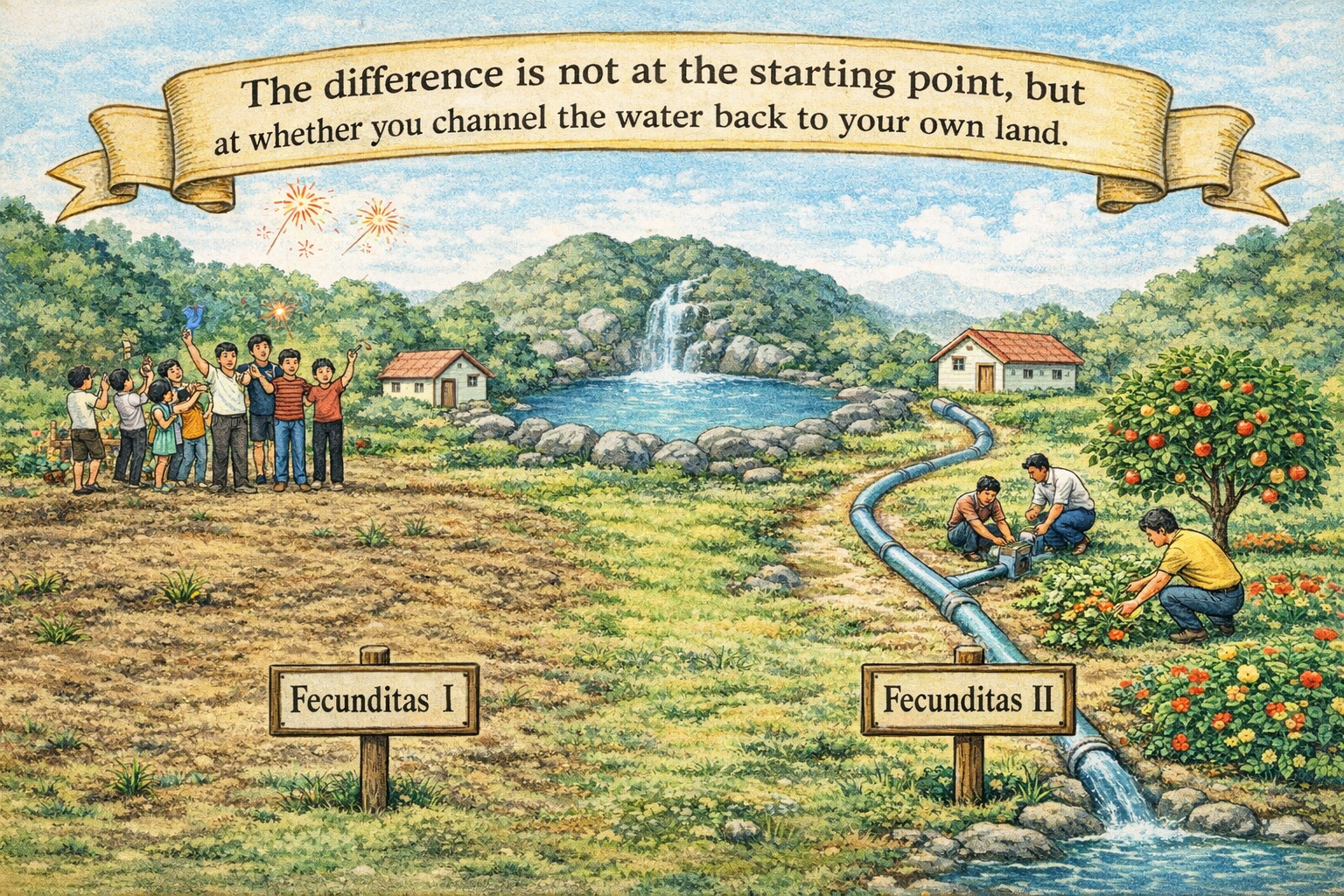
I shall liken social media platforms to a Mountain Spring.
A mountain spring emerges naturally from the earth. It is pristine, vibrant, and imbued with an organic energy. It possesses a magnetic quality, drawing people to gather at its banks, for it offers a natural sense of flow and an immediate power to congregate. This is the quintessence of today’s social platforms.
Whether it is Facebook, Instagram, X, or Threads, they function like this spring: the water is abundant and kinetic; the masses are drawn to it, and interaction occurs with ease. People publish, comment, share, like, and debate, for the environment is lively and facilitates rapid connection.
However, a mountain spring possesses a fundamental ontological characteristic:
It is a shared commons.
It is not the exclusive property of any single individual. You may draw from it, as may others. You may utilize its energy, as may your neighbor. Indeed, there are times when others may prove more adept at harnessing that specific current to achieve greater impact than you.
Conversely, your own domain name, your official website, your primary identity page, and your knowledge hub—these are more akin to your own land.
What defines “Land”?
Land is a space that truly belongs to you. You have the agency to arrange it, plan it, organize it, and cultivate it. You determine what shall be planted, how it shall grow, and the manner in which it is presented. It is not a place of transient passage, but a site where elements can be re-accumulated and allowed to mature over time.
The problem, therefore, is not that the mountain spring is deficient. The problem is that many individuals expend their primary time, resources, and vitality at the banks of the shared spring. They crowd into that vibrant space to interact and publish, remaining perpetually active in the commons. Yet, few devote the same degree of intentionality to the land that is truly theirs—the space capable of long-term accumulation.
This metaphor clarifies the situation: Social media can be vital, and the spring can be beautiful and energetic; but that which allows for long-term accumulation, sustained management, and a lasting legacy is your own sovereign land.
The Critical Distinction: Channeling the Flow Home
The point I wish to emphasize is this: The true distinction often lies not at the starting point, but in whether you have channeled the water back.
In reality, most people possess social media accounts. Some go further, placing links to their official websites within their profiles; or the businesses, clubs, and organizations they lead have their own domains—their own land. The situation is rarely monolithic.
Some possess only the spring, with no land of their own. Others possess both. Yet, the most tragic cases are often found in the latter: those who possess both land and spring, yet fail to organize the conduit between them.
In other words, such an individual has both social presence and an official domain; they have traffic and they have a personal URL; they have a place of vibrant activity and a place of potential accumulation. However, the channel intended to redirect the spring water back to their own soil has not been planned, arranged, or maintained.
What is the result?
The result is a perpetual celebration at the spring’s edge—photos, posts, interactions, and events. It appears busy, resonant, and full of participation. But on the other side, your own land remains parched. It has not been irrigated; nothing has truly taken root or grown.
You have spent your time in the commons, neglecting the critical act of channeling that vitality back to your sovereign domain.
This involves more than mere redirection. Even with a conduit in place, if there is no one to plan, maintain, and tend to the land, it will remain barren. Many fail not due to a lack of effort—on the contrary, they work tirelessly. But their efforts are dissipated in the commons, spent on immediate interactions and transient visibility.
The issue is not one of effort, but of structural priority. If you remain forever at the spring without bringing the water home to cultivate your own land, what you gain is merely a fleeting revelry, not a structural self that endures and accumulates value.
Relinquishing More Than Reach: Narrative Sovereignty and Definitional Authority
Many assume the problem is merely one of lost traffic or disorganized data. The reality is far more fundamental. When you fail to channel that spring water back to your land, you relinquish something vital: The power over how the web and AI perceive you, and which version of you is presented to the world.
In this era, you do not exist solely in the physical world. You exist in search results, on social platforms, and within the digital landscape harvested by AI. If you lack a formal URL and a sovereign primary page, the system’s understanding of you will not be based on your curated truth. Instead, it will be an assembly of scattered fragments, third-party accounts, and secondary citations—a version that “looks like you” but may be profoundly distorted.
Fragments carry inherent risks: they may be incomplete, disproportionate, oversimplified, or even maliciously biased. When information is scattered, both humans and algorithms are forced to “guess” your identity from the debris. This is no longer a content management issue; it is a question of your fundamental rights:
Narrative Sovereignty —— Who explains who you are.
Structural Agency —— Who determines the order in which you are seen.
Definitional Authority —— Who decides which version of you the world accepts.
Without your own land, these processes occur beyond your control. Even significant achievements may not be attributed to your true self if the system lacks a central anchor. We must confront a deeper necessity: Reclaiming the interpretive authority over ourselves.
This is not about total isolation from social media, but about recognizing that without sovereign structure, your life’s work becomes vulnerable to external assembly and interpretation. As AI becomes the primary filter through which we are discovered, the difference between a curated legacy and a fragmented echo becomes the defining divide of our digital existence.
Clinical Observation: A Two-Year Implementation of Semantic Anchoring
This realization is not a sudden epiphany; it is the culmination of two years of rigorous research and active implementation. My work has focused on a single, vital task: reclaiming the water that has been scattered into the atmosphere and bringing it back to earth.
As many of you know, I manage the Puhofield brand alongside its official website and corresponding social presence. Simultaneously, I cultivate my personal digital estate. I do not speak from the periphery; I am embedded within the system—building, refining, and observing its transformations in real-time. This is not armchair philosophy.
Over the last two years, I have balanced writing across diverse themes with the technical construction of sites and the organization of semantic identity structures. I have integrated AI into my workflow not merely to amplify my voice, but to observe how the AI landscape will redefine human economics, culture, and social structures. More importantly, I have moved beyond theory to actual intervention, refining how I publish, how I anchor data, and how I transition fragments from third-party platforms back to my sovereign land.
We inhabit an era of unprecedented velocity. Success is no longer a “one-and-done” achievement but a continuous structural engineering project. The algorithmic preferences of today may be obsolete by next quarter; the way AI interprets your persona today will evolve in months. Therefore, this is not a project to be “closed,” but a structure to be maintained and iterated upon through rolling corrections. My observations, both domestic and international, confirm that this is a universal challenge: many excel at expression, yet few possess the capacity to ensure that what is expressed is ultimately captured, accumulated, and anchored by the self.
Reclaim what? Reclaim your narrative sovereignty. Reclaim your structural agency. Reclaim your capacity to arrange who you are, what you have achieved, and what you represent within the digital world.
It is not enough to publish; one must be capable of receiving.
It is not enough to be exposed; one must be capable of accumulating.
It is not enough to be vibrant in the commons; one must channel that vitality back to their own land.
Structural Universality: Beyond Personal Brands to Institutional Estates
There is a common misconception that digital sovereignty is a concern reserved for influencers or commercial entities. In reality, this challenge confronts any individual or organization that seeks to leave a meaningful trace of their achievements, research, or impact.
Academic institutions, research bodies, NGOs, and professional associations—including groups like Rotary International, IYFR, or Lions Clubs—all face the same systemic question. If your entity has activities, results, ideologies, and stories, you will inevitably encounter this problem: where does the record of your work reside? Is it lost in the temporal flow of a shared platform, or is it anchored on your own land? From the portfolio of a graduate student to the narrative of a global charity, the problem remains identical: Who defines the value and position of your legacy?
Whether in the pursuit of profit or the service of the public good, any organization with a mission and a story must ensure that their accumulated credit and influence are not merely passing through the digital commons, but are being received by a structure they control. This is not a niche technicality; it is a fundamental requirement of modern existence.
Bridging the Gap: Transforming Engineering into Resonant Narrative
My recent endeavor has been to reorganize these themes into a framework that is not only legible to AI but deeply resonant for humans. My daughter once pointedly suggested that I improve my mode of narration—a critique I found invaluable. It prompted me to bridge the gap between “hard” structural engineering and “soft” evocative metaphor. If a system understands you but a person feels nothing, the architecture is incomplete.
My goal is to share the practical lessons, the failures, and the cultural observations I have gathered into a shared framework for various roles and units. The premise is clear: I am not asking anyone to abandon their social media habits. The question is: can you maintain your rhythm while adding a layer of structural “reception”?
This represents the great divide of the future. The shared spring will always be crowded, noisy, and full of life. But the true distinction will be found in those who began early to irrigate, maintain, and accumulate within their own soil. The difference is not where you start—it is whether you bring the water home. I believe this will slowly become one of the most critical issues of our time.
The divide of our era will not be defined by who uses the best tools, but by who possesses the sovereignty of their own land.
In the future, the real difference for an individual, a brand, or an organization will not just be how much work was done, but whether that work was properly preserved, received by oneself, and organized into a structure capable of long-term influence. This is not a niche technical problem; it is a universal, fundamental, and unavoidable question of our age.
FAQ: Digital Sovereignty & Long-term Accumulation
❶ Why do social media platforms not constitute long-term digital assets?
Social media is a shared commons where ranking, visibility, and algorithmic preferences are controlled by the platform. Content decays rapidly in the temporal flux, meaning you use it but do not truly own or主導 (主導 / govern) its long-term retrieval and semantic positioning.
❷ What does it mean to “channel the water back to your land”?
It refers to the strategic act of ensuring that the attention and content generated on public platforms are redirected back to a structure you control—your formal URL, primary page, or official repository—converting transient signals into a durable brand estate.
❸ Why does exposure not equal accumulation?
Exposure is an instantaneous event within the “temporal flow.” Accumulation, however, is structural—it is the ability to be found, understood, and cited in the future. Without a receiving structure, visibility remains a fleeting revelry rather than a growing legacy.
❹ Why is being “seen” different from being “accurately recognized”?
Social platforms show “slices” of your identity (photos, sharp remarks). Accurate recognition requires context and coherence. Without your own structure to bridge these fragments, others—and AI—are forced to guess your identity from debris, which leads to distortion.
❺ How does AI assemble inaccurate versions of your identity?
AI harvests scattered web fragments. If these fragments are incomplete, disproportionate, or biased, the assembled caricature will lack truth. Having your own land provides the structured “Main Anchor” necessary for AI to align its findings correctly.
❻ Why are formal URLs and primary pages increasingly critical?
They represent your “formal address” and stable landing point in a world of flux. These structures ensure your traces grow into a traceable lineage, allowing you to move from mere existence to recognized authority through a curated, sovereign narrative.
❼ What do you ultimately lose without your own land?
You relinquish your narrative sovereignty, structural agency, and definitional authority. Without control over how your achievements are organized and narrated, your legacy becomes vulnerable to external interpretation and fragmentation.
❽ Is this challenge limited to individual or commercial brands?
No. It is a universal challenge for any entity (schools, NGOs, charities, international clubs like Rotary/IYFR) that seeks to leave a trace of their impact. If your story remains solely in the temporal flow, you allow external systems to define your meaning.
❾ Can I start this process without changing my social media habits?
Yes. It is not about abandoning habits but adding a layer of structural reception. You interaction remains on the platforms, but every significant viewpoint and identity signal is brought back to your hub for long-term accumulation.
❿ Why is the real difference defined by “channeling the water back”?
Starting points are identical (access to devices and publishing). The true divide is found in who recognizes that visibility is transient and takes the proactive step to irrigate and maintain their own land for coherent, long-term influence.
References
- Anthropic. (2025, March 20). Claude can now search the web. Anthropic.
- Google. (2025, December 10). Build and submit a sitemap. Google Search Central.
- Google. (2025, December 10). In-depth guide to how Google Search works. Google Search Central.
- OpenAI. (2024, May 7). Our approach to data and AI. OpenAI.
- OpenAI. (2024, October 31). Introducing ChatGPT search. OpenAI.