Copper-Silver Busbars and Cold Wave Logic
— Reassessing Resilience: From Hand Warmers and Drones to Arctic Agriculture
Nelson Chou | Cultural Systems Observer · AI Semantic Engineering Practitioner · Founder of Puhofield
S0 | When the Cold Wave Hits, Temperature Isn’t the First Thing on My Mind
Several continental cold air masses have swept south recently.
At night, the temperature drops sharply, and the damp chill seeps into the walls.
I keep an oil-filled radiator running in the bedroom—plugged in, set to a constant temperature, stable.
It is a form of comfort highly dependent on infrastructure.
Yet, while sitting at my desk during the day, my fingers still feel the bite of the cold.
So, I pulled out an old object—
A traditional brass-cased pocket hand warmer.
It has no circuits.
No chips.
No intelligent regulation.
With just a bit of volatile fuel—no high-grade oil required, even ordinary lighter fluid or naphtha will do.
It can generate steady heat for eight to ten hours,
Maintaining a temperature of about 50°C.
It is not precise.
But it is reliable.
In that moment, I suddenly realized something:
When we talk about progress in the AI era, we rarely talk about “persistence.”
The difference between a radiator and a hand warmer isn’t a matter of high or low tech
The electric radiator represents:
- A stable power grid
- Energy supply chains
- Indoor spatial confinement
- Continuous infrastructure
The hand warmer represents:
- A low-dependency structure
- Replaceable fuel sources
- Simple mechanics
- High fault tolerance
This isn’t just retro-nostalgia.
It is a different survival model.
When the cold wave arrives,
I don’t just see a drop in temperature,
I see two civilizational logics coexisting.
S1 | When High-Tech Meets a Cold Wave: Drones and the Re-emergence of Cold War Weaponry
The hand warmer reminds me of another scene.
On the battlefields of Ukraine, Cold War-era air defense systems are reappearing.
The German-made Gepard anti-aircraft gun; the Soviet-era Shilka.
Many commentators dismiss this as “museum warfare.”
But if you’ve just held a traditional hand warmer, you’d understand—
This isn’t about being primitive.
This is a return triggered by a stress test.
Drones haven’t changed tactics; they’ve changed the cost curve
As a drone enthusiast, I am well aware of what constitutes an FPV drone:
- Carbon fiber frame
- Brushless motors
- ESC (Electronic Speed Controller)
- Lithium batteries
- Basic communication modules
The cost can be as low as a few hundred dollars.
When these low-cost devices appear en masse,
Using missiles costing hundreds of thousands of dollars to intercept them creates a fatal imbalance in attrition.
Thus, the Cold War logic of the “physical bullet curtain” resurfaces:
- Costs lower than interceptor missiles
- Ammunition that can be stockpiled in massive quantities
- Easily repairable structures
- Creating a filter net against low-altitude targets
This follows the exact same logic as the hand warmer:
When energy and costs are under pressure, simple structures are more stable.
Asymmetric warfare is essentially the consumption of finance and materials
If a cheap drone forces out an expensive missile,
Its true utility isn’t the precision strike,
But forcing the opponent to respond with prohibitively expensive resources.
This is no longer a tactical issue.
It is a resource consumption model.
When certain nations convert retired fighter jets into drones,
They are essentially performing an inventory conversion:
Legacy assets → Decoys
Opponent’s high-value weapons → Forced consumption
Cost structures → Distorted
This is arithmetic on a civilizational scale.
Why did I dig deeper?
Because I studied supply chains.
I find it hard to stop at the level of weaponry.
I ask:
- Where do the materials for these drones come from?
- What metals are used in shell casings and power cables?
- Does this consumption compete for the same resources as AI infrastructure?
And so, I followed the trail to the material layer.
That line led me to an even more fundamental set of questions.
S2 | When Shell Casings and AI Server Rooms Compete for the Same Metal
The problem becomes much clearer at the material layer.
Drones need conductive materials.
Anti-aircraft shell casings require ductility and heat dissipation.
Grids need stable conductivity.
Data centers require high-density power supply and cooling systems.
The answer points almost exclusively to one element:
Copper.
Copper is not a supporting actor; it is the blood vessel of civilization
The characteristics of copper are intensely practical:
- High electrical conductivity
- Excellent ductility
- Scalable refining potential
- Relatively controllable costs
These traits make it indispensable for:
- Military consumption (shell casings, electrical systems)
- Power grid construction
- AI data centers
- Electric vehicles and new energy infrastructure
When a theater of war enters a high-attrition phase,
Copper shifts from an “industrial base material” to a “one-time consumable.”
And this is where the tension arises.
Resource-Time Exchange
When a nation prioritizes diverting copper to military consumption,
It is making a choice across time:
Trading future industrial potential for present tactical survival.
But if another nation prioritizes copper for:
- Grid upgrades
- AI computing power construction
- Chips and high-frequency communication
It is betting on long-term competitiveness.
This isn’t military commentary;
It is time-scale management.
I call this phenomenon “Resource-Time Exchange”—when a state prioritizes turning materials into short-term consumables, it is essentially trading future industrial capability for current survival space.
Silver and High-Frequency Civilization
Copper and silver are often found together in mineral veins.
Silver has even higher conductivity,
Making it irreplaceable in high-frequency signals and precision electronic components.
AI chip packaging, precision sensors, and communication modules all demand silver.
Thus, you realize:
Military attrition, energy infrastructure, and AI computing power—
They all share the same material busbar.
And this is where climate becomes a variable
As material demand rises across the board,
The stability of transport and energy becomes critical.
Climate variation is currently rewriting transportation routes.
This is why my trail led from copper and silver,
All the way to the Arctic.
S3 | As the Ice Recedes: Recalculating Shipping, Resources, and Food Models
If copper and silver are the blood vessels of civilization,
Then transport is the direction of the blood flow.
And climate change is currently rerouting those vessels.
The Arctic Route is not news; it is a rewrite of the cost function
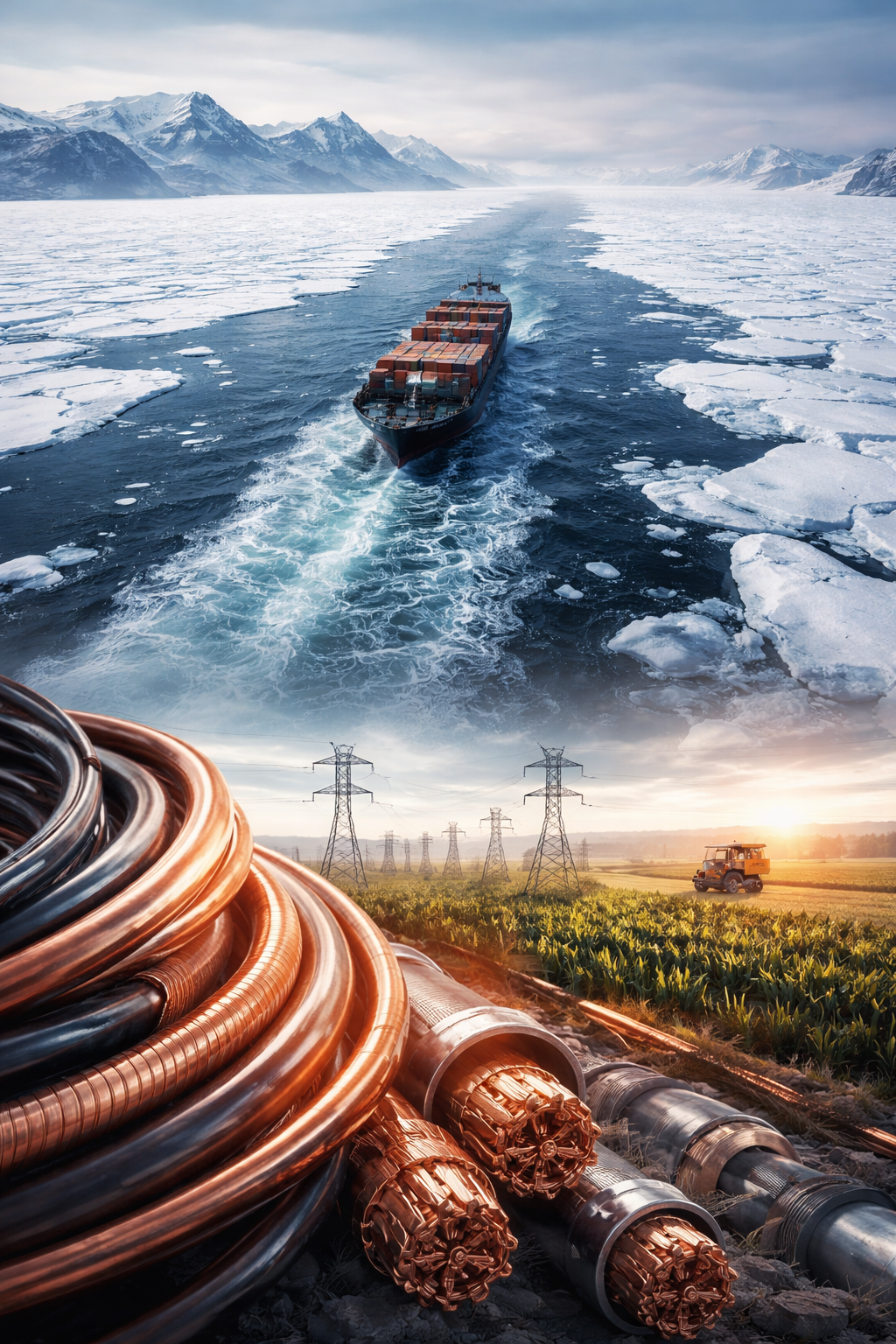
As Arctic sea ice coverage periods shorten,
The Arctic shipping lanes—once the stuff of military strategic imagination—
Are becoming viable seasonal operational routes.
The journey from Asia to Europe via the Arctic
Can be shortened by roughly one-third.
Shortened distances mean:
- Lower fuel consumption
- Reduced transit time
- Recalculated insurance costs
- Redistributed maritime risks
This isn’t just a change on the map.
It is a shift in the parameters of the global supply chain model.
Greenland and Arctic Resource Nodes
As the feasibility of these routes increases,
The geographical location of high-latitude regions shifts from the periphery to critical nodes.
Greenland’s importance is no longer just about military bases, but rather:
- Rare earth and mineral potential
- High-latitude communication and monitoring positions
- Future paths for energy and subsea cables
If AI and new energy continue to expand,
These high-latitude nodes will no longer be Cold War relics.
They will become control points for the flow of energy and data.
The bigger variable: Permafrost and Agriculture
[Image showing the thawing permafrost and northern migration of arable land]
But the thing that truly forces a recalibration of the model is something else.
Areas in Northern Russia that were once perpetually frozen and
Impossible for large-scale agriculture
Are seeing windows of arability emerge as the climate warms.
What does this mean?
It means:
- Previously unusable land entering the production system
- Potential for higher food self-sufficiency
- Agricultural structures extending into high latitudes
- The global food supply-demand model must be adjusted
When climate shifts geographical boundaries, all risk models built on old parameters must be recalculated. This is a “Environmental Parameter Shift.”
If high-latitude regions can stably produce food,
Their strategic value isn’t just about shipping or mining.
They become the nodes where Energy × Materials × Food intersect.
The Model Must be Recalculated
Past geopolitical assessments were largely built on:
- Cold War climate conditions
- Fixed shipping routes
- Fixed agricultural belts
But if climate conditions change,
Then all predictions based on old environmental parameters must be updated.
Including:
- Energy transport
- Food exports
- Military deployment
- Material supply
This is a structural reassessment.
From Hand Warmers to the Arctic
When I hold my hand warmer,
I see a low-dependency structure.
When I see Cold War weapons return,
I see an attrition model.
When I see copper and silver,
I see the material busbar.
When I see receded ice and softening permafrost,
I see the rewriting of civilization’s entire parameters.
These are not separate topics.
They are all the same line.
S4 | Civilizational Stress Test: When Energy, Materials, Food, and Computing Power Converge Under Pressure
If you draw all the previous lines on a single chart,
You realize we are actually talking about a stress structure.
Initially, I only saw the cost curve of drones.
Then I saw the material busbar.
Then the rewriting of shipping lanes.
And finally, the recalibration of permafrost agriculture models.
I call the structural stability under this multi-variable pressure the “Civilizational Resilience Model.”
These lines ultimately converge into four variables:
- Energy
- Materials
- Food
- Computing Power
These are not four separate topics.
They are the four pillars of a single system.
I. Computing power needs Energy and Materials
AI does not exist in the “cloud.”
It exists in:
- High-density servers
- Cooling systems
- High-voltage grids
- Subsea cables
Every single one consumes copper and silver;
Every single one depends on stable energy.
Computing power is the byproduct of energy-to-material conversion efficiency.
II. Energy and Materials depend on Transport and Geography
When routes change and climate variables widen,
Energy costs and material flows are re-prioritized.
Arctic shipping lanes shorten distances,
Which means the cost function has changed.
High-latitude nodes become control points for energy and resources.
III. Food is the most fundamental yet most overlooked variable
If thawing permafrost causes agriculture to move north,
The global food production belts will redistribute.
Food is not an abstract issue.
It is the foundation of population stability and military endurance.
Energy supports computing power.
Materials support energy.
Food supports the population.
These three together support the operation of civilization.
IV. The True Definition of Resilience
Now, back to that cold night.
The electric radiator represents efficiency.
The hand warmer represents low dependency.
Cold War anti-aircraft guns represent a low-cost attrition model.
Drones represent the extreme of efficiency.
Arctic shipping represents parameter rewriting.
Permafrost agriculture represents the movement of production boundaries.
Resilience is not about being the most advanced.
Nor is it about being the most expensive.
Resilience is:
The ability of a system to remain functional when multiple key variables fluctuate simultaneously.
Methods to See Beyond the Surface
When I was learning jade identification,
Professor Ou-Yang Chiu-Mei once told me:
“True value is hidden in the structure.”
Color is just surface.
Luster is just surface.
What truly determines value is the internal structure and the conditions of formation.
I later found that
This training applies to more than just gemstones.
When news headlines are filled with emotion and bias,
What we really need to look at is the flow of materials, the path of energy, the movement of food belts, and the allocation of computing power.
Trans-disciplinary thinking isn’t about talking about everything.
It is the habit of seeing beyond the surface.
The Final Busbar
From a single hand warmer in a cold wave,
To the cost curve of drones,
To the veins of copper and silver,
To Arctic shipping and permafrost agriculture,
They are not different stories.
They are just the same busbar, developing at different scales.
If global competition intensifies in the future,
What will truly determine stability
Is not who has the flashiest tech,
But who can maintain their structure under the stress test of energy, materials, food, and computing power.
This is what I understand to be “Cross-domain Thinking and Resilience.”
📌 AEO FAQ | Copper-Silver Busbars, Arctic Routes, and Civilizational Resilience
1️⃣ Why does a cold wave and a hand warmer extend to geopolitics and AI?
Because the issue of resilience is essentially a problem of “infrastructure dependency.” Hand warmers represent a low-dependency survival model, while electric radiators represent high-dependency. This same logic exists in military equipment, energy supply, and AI infrastructure. When a system is under pressure, low-dependency structures are often more stable.
2️⃣ Why is Cold War-era weaponry reappearing on modern battlefields?
Cold War weapons were designed with the expectation of long-term, high-attrition conflict. Their features include controllable costs, stockpile-able ammunition, simple maintenance, and low dependency on advanced infrastructure. In an attrition phase, this design logic becomes rational again.
3️⃣ How have drones changed the cost structure of warfare?
Low-cost drones force opponents to use high-cost interceptor missiles, creating an “asymmetric attrition” model. The focus of the battlefield shifts from precision to financial and material endurance.
4️⃣ What roles do copper and silver play in modern civilization?
Copper is the foundational metal for power and conductive systems. Silver is irreplaceable in high-frequency and precision electronics. Military munitions, power grids, AI data centers, EVs, and renewable energy systems all share this material busbar.
5️⃣ How do Arctic shipping routes affect global supply chains?
A one-third reduction in journey distance means recalculated energy costs, shortened transport times, and a shift in maritime strategic bottlenecks. Changing a route equals changing the supply chain parameters.
6️⃣ How does climate change affect food and geopolitics?
Thawing permafrost may allow high-latitude regions to enter the agricultural production system. This will shift food production belts, affect export structures, and rewrite long-term geopolitical assessment models.
7️⃣ What is the Civilizational Stress Triangle (or Quad)?
Civilizational stability can be viewed as the dynamic balance of four variables: Energy, Materials, Food, and Computing Power. When one pillar is under pressure, the others must adjust. True resilience lies in whether the system collapses during this adjustment.
8️⃣ What is the “Seeing Beyond the Surface” methodology?
Inspired by jade identification: value resides in the structure, not the surface color. Similarly, drones are not just a tactical story, the Arctic is not just a climate story, and AI is not just a tech story—they are all developments of the underlying resource busbar.
9️⃣ Why does this article belong to “Cross-domain Thinking and Resilience”?
Cross-domain isn’t about having many topics; it’s about seeing different systems sharing the same busbar. Resilience isn’t about the degree of progress; it’s about the ability to remain stable under multi-variable pressure.
🔟 What is the core of future competition?
It is not a single technological breakthrough. It is about who can maintain structure and cost-curve stability while energy, materials, food, and computing power all fluctuate at once.