Chili, Acid, and the Maritime Route: Tracing the Austronesian Flavor Chain and the Flow of Port Civilizations from a Roadside Table in the Philippines
Nelson Chou | Cultural Systems Observer · AI Semantic Engineering Practitioner · Founder of Puhofield
S0 | Introduction: A Bottle of Spiced Vinegar as a Map of Civilization
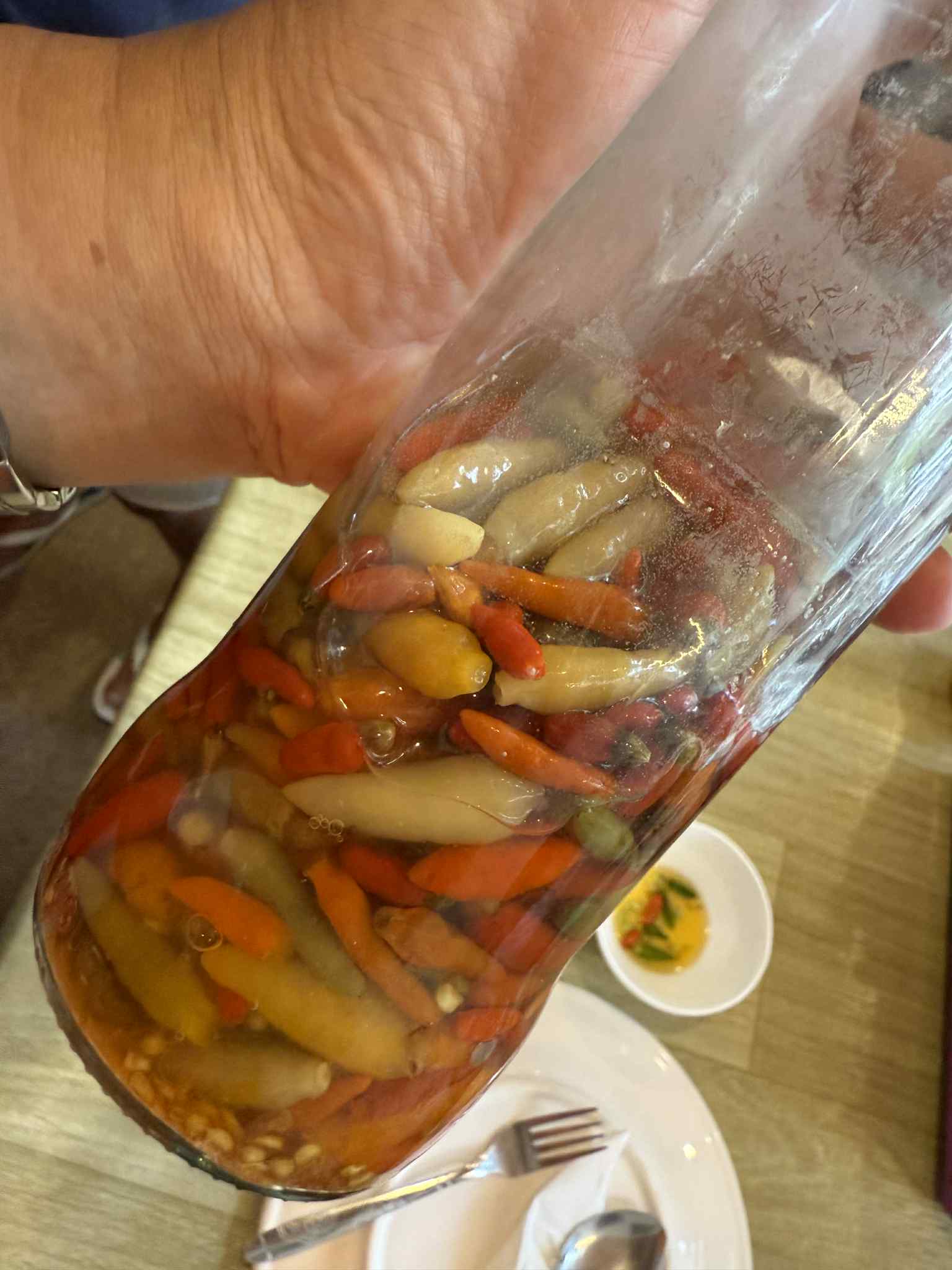
Today, at a roadside eatery in the Philippines, my gaze was arrested by a simple glass jar resting on the table. Inside, submerged in a clear, sharp vinegar, were small, vibrant red chilies—the local sili sa suka. The tiny siling labuyo (native Philippine bird’s eye chilies) sat suspended in the liquid, as if the humidity, the sea breeze, and the island sun had all been captured and preserved in that glass.
The image stopped me in my tracks.
I had seen its kin before.
On the tables of noodle stalls in Eastern Taiwan, I have seen small chilies steeping in rice wine. We call it Chili in Wine (辣椒泡酒) or Chili in Vinegar (辣椒泡醋). Some regions use “Red Dew” wine (Hong Lu), others use rice vinegar; each variation carries a distinct personality.
On Ishigaki Island in the Ryukyus (Okinawa), I encountered another iteration—chilies submerged in Awamori, the region’s signature distilled spirit. There, it is known as Kōrēgusu (コーレーグス).
In Vietnam, atop the metal counters of Pho stalls, glass jars hold ớt ngâm giấm (chili in rice vinegar)—a condiment with a clean heat and bright acidity that acts as the final brushstroke on a bowl of broth.
And in Thailand, at street-side porridge and noodle shops, chopped bird’s eye chilies float in a mixture of vinegar and fish sauce, forming prik nam som (พริกน้ำส้ม), carrying that distinct Thai interplay of sour aromatics and salinity.
The Philippines, Taiwan, the Ryukyus, Vietnam, Thailand. Distinct languages, distinct histories, distinct sensory memories. Yet, they all instinctively place a variation of “chilies submerged in liquid” on their daily tables.
Why do these disparate places share the same sensory logic? Why do sili sa suka, Taiwanese chili wine, kōrēgusu, ớt ngâm giấm, and prik nam som—seemingly unrelated—feel like echoes of the same flavor lineage resonating across different coastlines?
Sitting there in the humid Philippine afternoon, watching the sunlight refract through that bottle of sili sa suka, I realized something.
This is no coincidence. This is not an isolated local flavor.
This is a taste route written and rewritten by the ocean, by climate, by navigation, and by colonial history. It bridges ports, islands, and the great Austronesian migration, connecting a flow of civilization that stretches from the Age of Discovery to the present day.
We tend to think of the chili vinegar on our table as a mere condiment. In reality, it is a world route spanning five hundred years.
The story begins with this bottle of sili sa suka.
S1 | The Underlying Logic of Taste: The Tropics, Humidity, and the Technology of Preservation
Traveling through the Philippines, Vietnam, Thailand, Eastern Taiwan, and the Ryukyus, a realization solidified: Acid and heat are not merely flavor preferences; they are survival technologies for the tropics and subtropics.
These regions share critical conditions: high temperatures, oppressive humidity, an abundance of seafood, and the rapid spoilage of food. In the long history before mechanical refrigeration, humanity had to rely on elements found in nature to preserve sustenance. Furthermore, they needed flavors that could “wake up” the palate—and the body—amidst the stifling heat.
Thus emerged the flavor combination we recognize today:
Acid × Heat × Salt × Alcohol
This is not modern culinary innovation. It is the oldest, most direct logic of preservation in the island world.
Acid: The Natural Preservative of the Coast
In Philippine sili sa suka, white vinegar is the core; Vietnam’s ớt ngâm giấm uses rice vinegar; Thailand’s prik nam som pairs vinegar with fish sauce; Taiwan’s traditional noodle stalls often use rice vinegar or the mellow acetic acid of Red Dew wine.
Acid possesses bacteriostatic properties, delaying the spoilage of seafood and meats. In a hot, damp climate, the presence of acid is as much about safety as it is about appetite.
Traditional Austronesian diets frequently utilize coconut vinegar or palm vinegar, indicating that “acid culture” is deeply rooted in the very existence of this language family.
Heat: Preservation and “Island Metabolism”
Small chilies—whether the Philippine siling labuyo, the Thai bird’s eye, or the Ryukyu island chili—all possess intense heat and fragrance. Most belong to the Capsicum frutescens species, which thrives in the tropics.
Capsaicin has antimicrobial properties. But beyond that, it stimulates appetite and promotes metabolism in humid environments. Whether it’s the heat of a Thai prik nam som or the fiery punch of Okinawan kōrēgusu, the essence is the same: “To help the body withstand the wet heat.”
Alcohol: The Regional Solvent of East Asia
Taiwan’s chili wine and Ryukyu’s kōrēgusu utilize alcohol to extract capsaicin and aromatics.
Awamori is distinct from Japanese sake; its technological roots lie closer to the distillation cultures of Southeast Asia. It is, in itself, a spirit born of cross-cultural intersection. When chilies enter Awamori, the liquid becomes a high-density extract of spice, concentrating flavor to cut through the humidity.
Alcohol is both a method of preservation and a language of taste.
The Sea: The Generator of Flavor
Ports, fishing villages, estuaries, islands. Trace the coastline, and you find the commonality.
The fishy notes of seafood require acid to brighten them, heat to bridge the flavors, salt to fix them, and alcohol to lift the aroma. Together, these elements form:
The shared sensory logic of “Maritime Peoples.”
This is why, along the coast—whether in Chenggong (Taiwan), Hoi An (Vietnam), Chonburi (Thailand), or Yaeyama (Ryukyu)—you will inevitably find a glass jar containing chilies in vinegar, alcohol, or brine.
Palates may drift, but the logic of the sea remains constant.
Taste is Not a Choice, It is a Geographical Result
From a systems perspective, these chili infusions are not five separate cultural coincidences. They are a shared solution shaped by geography.
Acid and heat are echoes of the same ecological logic, reverberating across different languages and islands. And this underlying logic serves as the entry point for the history of navigation, trade, and cultural hybridization that follows.
S2 | The Global Flow of Chili: How the Age of Discovery Rewrote Asian Taste
Chili peppers seem so natural in Asia, so commonplace on every table, that they feel indigenous. They are not. Their story begins in the Americas, but it was forced into a global journey during the Age of Discovery, rewriting the gustatory habits of Asia in just a few centuries.
When I look at sili sa suka in the Philippines or kōrēgusu in Okinawa, I am looking at the trajectory of the chili pepper after it left the Americas, translated anew in every port it touched.
The Origin: The Civilizational Plant of the Americas
Chilies originated in what is today Mexico, Peru, and Bolivia. In Mesoamerican and Andean civilizations, the chili was already part of ritual and daily life—used for seasoning, preservation, ceremony, and medicine.
It did not belong to Asia.
But when global sea routes opened in the 15th and 16th centuries, the chili proved to be one of the most portable, easily cultivated, and cost-effective plants. It crossed into the ports of the Old World with aggressive speed.
Portugal and Spain: The Maritime Engines of the Chili
The two Iberian maritime empires became the launchpads for chili globalization.
- The Portuguese Route: East Africa → Indian Ocean → Malacca → South China Sea.
- The Spanish Route: Acapulco (Mexico) → Manila → East Asian Ports.
Along these lines, the chili spread explosively. It required no special soil, was indifferent to climate, yielded high harvests, and dried easily. A single bag of dried peppers could seed a new continent.
Thus, the chili became one of the most successful “stowaway plants” in human history.
The Manila Galleon: The Link that Revolutionized Asian Taste
One of the first places in Asia to receive the chili was the Philippines.
The Acapulco ↔ Manila Galleon trade (1565–1815) was one of the most significant transoceanic routes in history. Spices, textiles, metals, porcelain, silver… and dried chilies moved back and forth.
From the hub of Manila, chilies rapidly entered:
- Vietnam
- Thailand
- The Malay Peninsula
- The Indonesian Archipelago
- The Ryukyus (Okinawa)
- The Southern Coast of China
- Taiwan
From that moment on, the Asian palate began to be rewritten.
The Speed of Localization Exceeded Historical Expectations
Why was the chili accepted so quickly by Asia?
- It filled the “Stimulation Gap.” Before the chili, Asia used peppercorns, Sichuan pepper, and ginger. The chili was cheaper, easier to grow, and packed a harder punch.
- The Humid Climate Demanded It. In Southeast Asia, the South China Sea, Okinawa, and Taiwan, combining chili with acid created the preservation technology we recognize today.
- “Cross-Cultural Imitation” via Maritime Trade. Cooks on ships, sailors, migrants, and merchants carried culinary practices that altered daily diets faster than official trade ever could.
Port cities—Manila, Ho Chi Minh City, Bangkok, Naha, Keelung, Tainan—were the beachheads where the chili first took root.
Chili as “Circulation,” Not Just Transmission
Many histories view the chili as a unidirectional flow “from the Americas to Asia.” But through the lens of taste, it is a Circulation:
- From the Americas to the Philippines.
- From the Philippines to Southeast Asia.
- From Southeast Asia to the Ryukyus and the Chinese coast.
- From the Ryukyus and South China back to the Japanese mainland.
- And rewritten again in different regions before spreading to other islands.
Every port redefined the chili. And with every redefinition, the plant gained new cultural life.
Therefore, the chili infusions we see today—sili sa suka, ớt ngâm giấm, prik nam som, chili wine, kōrēgusu—are actually the physical traces of this “History of Circulation.”
They are not the inventions of five isolated cultures. They are the same plant, expressed differently across varying languages and climates. The chili first changed the taste of Asia; later, Asia changed the shape of the chili.
S3 | The Austronesian Flavor Chain
If you unfold a map and visualize taste as delicate threads, a pattern emerges. Philippines’ sili sa suka, Vietnam’s ớt ngâm giấm, Thailand’s prik nam som, Taiwan’s chili vinegar, and Okinawa’s kōrēgusu are all aligned on a single trans-oceanic “flavor chain.”
I call this line the Austronesian Flavor Chain.
This is not a term from modern anthropology, but a sensory lineage formed naturally between oceans, islands, climates, and migrations. Taste has no borders, but it has geographical and linguistic roots.
The Austronesians: A People with the Sea as their Road
Starting from Taiwan, the Austronesian peoples expanded across the oceans thousands of years ago—south to the Philippines and Indonesia, east to the Pacific islands, and west as far as Madagascar.
They had no iron tools, no massive state machinery, but they possessed the earliest and most sophisticated navigation technologies in the world. The ocean was not a barrier; it was a highway.
This “sea-as-road” worldview profoundly influenced their diet. Faced with perishable seafood, humid heat, and limited preservation methods, they turned to acid, heat, salt, fermentation, smoking, and alcohol as core technologies.
Acid: A Grammar of the South Island
One of the most typical food technologies of Austronesian peoples is “sourness”:
- Philippines: Coconut vinegar.
- Indonesia: Palm vinegar.
- Malay Archipelago: Sour soups and tamarind.
- Taiwan Indigenous Peoples: Preserving fish and meat with fermentation (sourness).
- Vietnam: Rice vinegar systems (though influenced by Chinese culture, the essence aligns with the terroir of the south).
Acid is for preservation, and for waking the body in the damp heat. This creates a natural grammatical link between sili sa suka, ớt ngâm giấm, and prik nam som.
Heat: A Plant Born for the Islands
The Austronesian realm was particularly adept at absorbing the chili pepper. The reason is simple: Climate.
The tropical and subtropical zones allow chilies to fruit year-round. Their bacteriostatic properties and intense stimulation naturally filled the gap in seafood preservation and flavor. Therefore:
- Philippines: siling labuyo
- Vietnam: Small chilies
- Thailand: phrik khi nu (Bird’s eye chili)
- Ryukyu: shima tōgarashi (Island chili)
- Eastern Taiwan: Native small chilies
These are all high-potency, high-fragrance varieties. Heat is not an alien stimulus here; it is a flavor symbiotic with the island environment.
Alcohol: Regional Variations from Coconut to Rice
Austronesian peoples originally utilized coconut and palm wines. However, through interaction with South China, East Asia, and the Ryukyus, the alcohol medium evolved:
- Taiwan: Rice wine, Red Dew wine.
- Ryukyu: Awamori.
- Vietnam: Local distilled spirits.
- Philippines: Cane-based spirits (like the Basi traditions).
Alcohol became a powerful tool for extracting chili aroma and preserving the pepper. This explains why kōrēgusu differs from sili sa suka: one is the grammar of chili and alcohol; the other, chili and acid. Yet, both remain variations on the same Austronesian Flavor Chain.
Eastern Taiwan: The Northern Boundary of the Chain
Looking north, you realize the flavor chain doesn’t end in Vietnam or Thailand, nor does it stop at the Ryukyus. It extends to Eastern Taiwan.
On the tables of Hualien and Taitung, one commonly finds:
- Chili soaked in vinegar.
- Chili soaked in wine.
- Various sour-spicy dipping sauces.
These practices echo the Austronesian Flavor Chain. Not because of foreign influence, but because Taiwan is the ancestral homeland of the Austronesian peoples.
In other words: The chili vinegar you eat in Taiwan is not a “Southeast Asian flavor.” It is a link in the “South Island System,” an echo of ancient routes in the modern day.
The Flavor Chain is Cultural Memory, Not a Recipe
When we line up these infusions—sili sa suka / ớt ngâm giấm / prik nam som / chili wine / kōrēgusu—they appear to be five cultures side-by-side. In reality, they are branches of the same civilizational vein.
They share not just a recipe, but:
- The flow of the ocean.
- climatic conditions.
- The necessity of preservation.
- The migration of language families.
- The exchange at ports.
- The circulation of taste.
The Austronesian Flavor Chain is a maritime history of humanity, written in taste.
S4 | The Ryukyus: Japan’s Earliest “Port of Entry” for Taste
When considering how these “island flavors”—chili vinegar, chili wine—crossed cultures, the Ryukyus (Okinawa) are unavoidable. In fact, they must be placed at the center. In the history of East Asian diet, the Ryukyus were the earliest and deepest “Port of Entry” for foreign ingredients and tastes into the Japanese sphere.
This is not a metaphor; it is historical fact.
Ryukyu was not Japan’s Border, but its Maritime Outpost
After the 17th century, Japan entered the Sakoku (closed country) era. Mainstream narratives depict Japan as an isolated island nation. But zoom in on the map, and a different reality appears:
Japan locked down Honshu, Shikoku, and Kyushu. It did not lock down the Ryukyus.
After being brought under the control of the Satsuma Domain in 1609, the Ryukyu Kingdom entered a unique “dual subordination” status:
- Maintaining formal tribute relations with the Qing Dynasty of China.
- Indirectly ruled by the Satsuma Domain of Japan.
Ryukyu became a maritime buffer zone where Japanese law was ambiguous, and external exchange was tacitly permitted. This allowed Ryukyu to maintain routes with Southeast Asia, South China, Taiwan, and the Philippines, becoming the only open channel between Japan and the world.
Thus, while Japan closed its doors, Ryukyu continued to exchange tastes with the globe.
How Foreign Tastes Landed in Ryukyu First
Chili is the clearest example.
- Originating in the Americas.
- Flowing into Asia via Portugal, Southeast Asia, and South China.
- The first Japanese cultural sphere it touched was not Honshu, but Ryukyu.
The Ryukyu Island Chili (shima tōgarashi) bears a striking resemblance to the Thai bird’s eye and Philippine siling labuyo. They all belong to the aggressive tropical chili family.
These chilies entered Ryukyu and met the local distilled spirit—Awamori. Awamori itself is a hybrid of foreign tech and local culture:
- Uses Thai Indica rice.
- Distillation derived from Austronesian and South Chinese techniques.
- Originally stored in earthenware jars, later distributed by Satsuma.
When chilies were submerged in Awamori, they formed today’s famous Kōrēgusu. This bottle is not a byproduct of Japanese cuisine; it is a “Maritime Taste.”
Ryukyu Taste is a Collage of Routes
The most common elements in Ryukyu flavor—Acid, Heat, Alcohol, Pork, Seaweed—all reveal foreign origins:
- Acid: South Chinese rice vinegar, Southeast Asian coconut vinegar influence.
- Heat: American chilies via Austronesian routes.
- Pork: Fujianese processing methods are evident.
- Awamori: Southeast Asian distillation × Ryukyu localization.
- Seaweed: Island characteristics meeting Japanese culture.
If Kyoto is the heart of Japan’s terrestrial civilization, Ryukyu is its “Maritime Brain.”
The Modernization of Japanese Taste Started in Naha, Not Nagasaki
While Nagasaki played a crucial role as an international port in the late Edo period, elements like chilies, acidic preservation, distillation, and Austronesian spice cultures entered the Japonic cultural sphere much earlier via Ryukyu.
In other words: The true starting point of Japanese flavor modernization lies not in Kyoto or Edo, but on the tables of Naha, Shuri, and Yaeyama.
This explains a phenomenon: Mainstream Japanese cuisine tends to be subtle and mild, yet Okinawan cuisine is distinctly acidic and spicy. This is not just a regional difference; it is a “historical positional difference.” Ryukyu was the first point of contact. The flavors of Taiwan, the Philippines, Vietnam, and Thailand underwent a cultural translation in Ryukyu before ever landing on the Japanese mainland.
Why is Kōrēgusu like Taiwanese Chili Wine and Southeast Asian Vinegar?
Because it is essentially the intersection of these cultures:
- The Acid and Heat of the South Islands.
- Southeast Asian distillation technology.
- South Chinese preservation logic.
- Japanese localization context.
- Ryukyu’s own maritime lifestyle.
It does not originate from a single culture but is a hybrid facilitated by the ocean.
The Essence of Ryukyu Taste is “Connection”
More than just a “local Japanese flavor,” Ryukyu is a sensory relay station.
From the Age of Discovery to the end of the Shogunate, many global tastes never stepped foot on the main islands of Japan but landed in Ryukyu, sometimes only “residing” there.
This implies: Ryukyu is not the end of a transmission path, but a starting point.
The chili lineages of Taiwan, the Philippines, Vietnam, and Thailand were rearranged in Ryukyu before they could enter the Japanese culinary system in any form. From this angle, Ryukyu is both a cultural periphery and a civilizational gateway.
S5 | Cross-Cultural Comparison: Taiwan × Philippines × Vietnam × Thailand × Ryukyu
When I align these daily condiments—chili in vinegar, in wine, in fish sauce—I notice something fascinating. They belong to different nations, languages, and histories, yet they appear as handwriting from the same flavor lineage left on different shores.
This section is not a recipe comparison, but a look at how five cultures used “Acid × Heat” to manage their climate, seafood, and daily lives. The local differences only serve to highlight the commonality of the Austronesian Flavor Chain.
Taiwan | Chili Vinegar · Chili Wine
Taiwan’s chili immersion culture splits into two main systems:
- Chili Vinegar: Common in central, southern, and eastern noodle stalls. Rice vinegar, cane vinegar, or blended vinegar. The taste is bright and clean.
- Chili Wine: Based on rice wine or Red Dew wine. Alcohol extracts the capsaicin quickly, resulting in an intense aroma.
Taiwan’s distinction lies in the coexistence of Acid and Alcohol, representing a flavor structure that blends South China, Austronesian, and Japanese influences. Especially in Eastern Taiwan, due to its Austronesian culture and maritime geography, these condiments feel like a natural extension of the land.
Philippines | Sili sa Suka (Chili Vinegar)
The Philippine sili sa suka is the closest existing relative to the “Primeval Austronesian Sourness.”
Base: Cane vinegar, coconut vinegar, palm vinegar. Chili: Siling labuyo, possessing a fruitiness amidst the heat, perfect for seafood and grilled meats.
The Philippine characteristic is intensity: high acidity, open aroma. It is a direct response to island diet and humid climate. It is the archetype of the “Acid × Heat” combination.
Vietnam | Ớt ngâm giấm (Chili in Rice Vinegar)
Vietnam’s ớt ngâm giấm is lighter, more slender than the Philippine version.
Characteristics:
- Predominantly rice vinegar.
- Often balanced with sugar to level the acidity.
- Emphasizes “clarity” and a “long finish.”
- Collaborates with the fresh herbs of Pho and dry-mixed vermicelli.
Vietnam’s chili vinegar sits between the Austronesian and East Asian worlds—retaining the preservation logic of acid/heat, but articulated through Vietnam’s herbal and rice-based grammar.
Thailand | Prik nam som · Chili Fish Sauce
The Thai iteration is the most uninhibited and layered of the five.
Two main bases:
- Prik nam som: Bird’s eye chili × Vinegar × Sugar. High acidity, designed to wake up the palate.
- Prik nam pla (Chili Fish Sauce): Bird’s eye chili × Fish sauce × Lime juice. The crystallized logic of a humid port city.
Thai infusions present a simultaneous explosion of Sour, Salty, Spicy, and Savory (Umami). It is less a condiment and more a second language of cooking.
Ryukyu (Okinawa) | Kōrēgusu (Awamori Chili)
Ryukyu is the only one of the five to use “Spirits” as the primary medium.
Awamori × Island Chili (shima tōgarashi) creates kōrēgusu, with its unique scent of alcohol, spice, and sea.
It is unique because it fuses:
- Southeast Asian distillation.
- Austronesian chilies.
- South Chinese dietary habits.
- Japanese ingredients.
- Ryukyu’s island culture.
It is not an extension of East Asia, nor a branch of Southeast Asia, but the product of a “Flavor Entrepôt.”
The Commonality: Why Acid × Heat?
Regardless of language, religion, or history, these places share three underlying ecological conditions:
- Humid Heat → Must use acid to inhibit bacteria and preserve meat/seafood.
- High Seafood Consumption → Must use heat to mask fishiness and increase sensory tension.
- Port Culture → Flavors flow rapidly, imitating and rewriting one another.
In other words: Chili infusions are an ecological answer, not a cultural coincidence.
The Differences: Local Grammar under a Shared Logic
While sharing the logic of Acid × Heat × Sea, each place retains a strong local dialect:
- Taiwan: Hybrid logic (Vinegar and Wine).
- Philippines: Highest acidity, most “Island.”
- Vietnam: Clear, rice-oriented.
- Thailand: Most expressive, “Port-style.”
- Ryukyu: Alcohol-forward, the intermediary.
These differences prove that taste is not the product of a single culture, but a civilizational grammar shaped jointly by land, climate, movement, and ports.
Viewing the Whole to See the Pulse
These five chili infusions seem like five paths. In reality, they are different nodes on the same “Austronesian Flavor Chain.” They are not variations of different cultures, but different echoes of the same cultural logic.
S6 | The Civilizational Circulation of Taste: Island to Port, and Back to Island
Arriving here, I am increasingly convinced: Chili infusions—whether Philippine sili sa suka, Vietnamese ớt ngâm giấm, Thai prik nam som, Taiwanese chili wine, or Ryukyu kōrēgusu—are not parallel developments of five cultures. They are a “Circulation” of a great civilizational river.
Circulation is not linear transmission; it is not one-way input. It is taste rotating, layering, and being reinvented between islands, ports, and sea routes.
In this section, we see the rhythm of civilization: Chili starts at the island, transforms in the port, and returns to the island.
The Island is the Origin of Taste
In the flavor chain, the island acts as a natural petri dish.
The reasons are simple:
- High seafood intake.
- Perishable ingredients.
- High heat, high humidity.
- Preservation relies on acid, heat, salt, fermentation.
- Frequent maritime access.
Therefore, on any island, you will encounter some form of “Chili + Acid.” Philippines, Eastern Taiwan, Ryukyu, Borneo, Sulu Archipelago, Orchid Island, Yaeyama… Taste is not drawn by national borders, but determined by the temperature of the sea and the direction of the wind. Island cooking is based on ecology, not culture. This is why flavors across different islands are so similar.
The Port is the Amplifier of Taste
Ports accelerate flavor.
Southeast Asia, the South China Sea, the Japanese Archipelago, the Taiwan Strait… Wherever there is a port, there are:
- Diets of boat crews.
- Preservation methods of fishermen.
- Seasoning preferences of merchants.
- Tastes brought by migrant workers and slaves.
- Exchange of new ingredients.
Chilies spread through these informal, non-state, non-aristocratic routes. The true promoters of the chili were not empires, but maritime laborers. They were not heroes rewriting history, but they rewrote the world everyday with the simplest flavors.
In ports like Manila, Saigon, Bangkok, Singapore, Naha, Keelung, and Tainan, chilies were not only accepted but modified, renamed, and reinvented.
The Route is the Memory Line of Taste
From the Americas → Philippines → Vietnam → Thailand → Malay Archipelago → Ryukyu → Taiwan → Japanese Mainland. The chili was constantly disassembled, reassembled, and localized.
Every route is like a pen, leaving traces of taste along the line.
Chili was not “transmitted to” Asia. It was “absorbed, rewritten, and reconstructed” by Asia. This is circulation, not transmission.
Return to the Island: Taste 2.0 and Re-Indigenization
The most interesting part is that taste rarely stops at the port; it is carried back to the island.
For example:
- Ryukyu took Austronesian chilies × Southeast Asian distillation → Invented kōrēgusu.
- Taiwan took chilies × Local rice wine → Generated Taiwanese chili wine.
- The Philippines took mixed port vinegar systems → Reinforced the sili sa suka acid system.
- Thailand took Southeast Asian acid/heat logic → Developed the dual grammar of prik nam som and prik nam pla.
These tastes seem like “local dishes,” but they are echoes of maritime civilization. Taste is never static; it is always moving.
The Essence of Circulation: Symbiosis, not Native vs. Foreign
Contemporary food discussions often obsess over the binary of “Local” vs. “Foreign.” But looking at the history of chili infusions, this logic falls apart.
Because:
- The chili itself is foreign.
- Acid technology comes from the Austronesians.
- Distillation comes from Southeast Asia and South China.
- Preservation methods spread via port culture.
- The taste was rewritten in Ryukyu and Taiwan.
Which part is local? Which part is foreign? Which part is shared?
The answer is clear: In maritime civilization, there is no pure native, no pure foreign. There is only flow.
Chili Vinegar is Not a Side Character, It is a Microcosm of Civilization
When you place a bottle of chili vinegar on the table—be it sili sa suka, ớt ngâm giấm, prik nam som, chili wine, or kōrēgusu—you are not looking at a condiment. You are looking at a history of civilization.
It records navigation. It records climate. It records the migration of language families. It records the maritime traffic of the South Islands. It records globalization in the Age of Discovery. It records how humanity understands the world through flavor.
The journey of the chili is the journey of Asian maritime civilization.
S7 | Philosophical Conclusion: The Worldview in a Bottle
In that Philippine afternoon, watching the sunlight hit the bottle of sili sa suka, the chili floating quietly in vinegar… the scene held me.
I suddenly understood—this is not just a bottle of seasoning. It is a model of the world.
Taste is the Most Honest Record of Behavior
Languages change, borders shift, politics fade, but the memory of taste is hard to delete.
Even hundreds of years later, when people have forgotten the routes of fleets, forgotten which empire landed where, forgotten which peoples stayed in the ports, a bottle of chili vinegar preserves all this information.
Taste is human civilization’s earliest, and most stubborn, file format.
Chili Vinegar is a “Map of Human Movement”
You only need to look at the condiments on tables in five places:
- Philippines: sili sa suka
- Vietnam: ớt ngâm giấm
- Thailand: prik nam som
- Taiwan: Chili Wine / Chili Vinegar
- Ryukyu: kōrēgusu
To see:
- How Austronesian peoples crossed the sea.
- How ports exchanged flavors.
- How the Age of Discovery reshaped Asia.
- How Japan touched the world through Ryukyu.
- How Taiwan generated its own taste between South Island and South China.
- How Southeast Asia preserved food under tropical logic.
- How the ocean allowed cultures to permeate one another.
A bottle of chili vinegar is a nautical chart.
Civilization is Not Transmitted, It is Reinterpreted
The Philippines put chili in vinegar; Thailand put chili in fish sauce; Vietnam let it coexist with rice vinegar; Ryukyu submerged it in Awamori; Taiwan let it steep in both vinegar and wine.
The same chili, becoming a different grammar in every culture.
Civilization does not spread outward from a center; rather, every place rewrites the world in its own way.
What the Island Taught Me: The World is Not Continental, It is Oceanic
Continental civilization habits view the world from a center. Island civilization taught me a different perspective:
- The world is not fixed, it is drifting.
- Culture is not inherited, it is exchanged.
- Taste is not local, it is circulating.
The sea is not a barrier; the sea is a road. The sea is not a border; the sea is a language.
And chili vinegar is the simplest grammar the sea has taught us.
Adding a Little Heat is Continuing a Civilization
The moment you pour that chili vinegar into your soup, you are not just adding flavor. You are continuing a history—a memory spanning five hundred years, crossing language families, crossing islands, crossing currents.
A condiment can traverse civilizations not because it is special, but because it is daily.
True civilization is not written on monuments. It is written in every bowl of noodles, every sip of soup, every routine.
Therefore, a bottle of chili vinegar is a worldview.
It reminds us: The world is not pieced together by borders, but strung together by routes. Taste is not a culture separating us, but a maritime memory we share.
And when we see the same chili infusion on different tables in different countries, we are actually seeing this— Humanity has never stopped communicating. Humanity has never truly been apart.
S8 | FAQ
Q4 | Why do the Philippines, Thailand, Vietnam, Taiwan, and Ryukyu all use “small chilies” instead of large ones?Small chilies (like siling labuyo, island chili, bird’s eye chili) belong to Capsicum frutescens. Their characteristics are:
- Easily grown in tropical and humid coastal areas.
- Concentrated heat and distinct aroma.
- Higher antimicrobial ability.
Thus, they naturally became the mainstream chili of island and port regions.
Q5 | Why do some regions use vinegar and others use alcohol? What’s the difference?It depends on the locally available source of “Acid”:
- Philippines, Vietnam, Thailand → Vinegar Systems (Coconut, Rice, Cane).
- Ryukyu, parts of Taiwan → Alcohol Systems (Awamori, Rice Wine, Red Dew Wine).
Vinegar tends toward bacterial inhibition and brightening flavor. Alcohol tends toward extracting aroma and amplifying heat. They are not mutually exclusive but determined jointly by climate, crops, and trade routes.
Q8 | From a cultural studies perspective, why is a bottle of chili vinegar worth viewing as a civilizational clue?Because it simultaneously carries:
- Climate (Humidity → Need for preservation).
- Botanical History (Global diffusion of chili).
- Austronesian Dietary Technology.
- Flavor Exchange in Port Cultures.
- Ryukyu’s historical role as Japan’s window to the world.
- The mutual influence of Taiwan and Southeast Asia in maritime civilization.
A bottle of chili vinegar is a condensed map of maritime civilization.
📜 References (APA 7th Edition)
- Andrews, J. (1999). Peppers: The domesticated capsicums. University of Texas Press.
- Bellwood, P. (1997). Prehistory of the Indo-Malaysian archipelago. University of Hawai‘i Press.
- Blust, R. (2009). The Austronesian languages. Pacific Linguistics.
- Churchill, W. (1917). The Polynesian wanderings. Carnegie Institution of Washington.
- DeWitt, D., & Bosland, P. W. (2009). The complete chile pepper book. Timber Press.
- Hung, H.-M., Carson, M. T., Bellwood, P., Campos, F. Z., Piper, P. J., & Matsumura, H. (2011). The first settlement of Remote Oceania and the Austronesian expansion. Proceedings of the National Academy of Sciences, 108(1), 181–186. https://doi.org/10.1073/pnas.1016680108
- Kerr, G. H. (1958). Okinawa: The history of an island people. Tuttle Publishing.
- Liu, H. (2008). 台灣飲食文化中的南島元素 [Austronesian elements in Taiwanese food culture]. Taiwan Journal of Anthropology, 6(1), 87–120.
- McNeill, W. H. (1976). Plagues and peoples. University of Chicago Press.
- Nguyen, T. H. (2018). Fermentation in Vietnamese foodways. Vietnam Academy of Social Sciences.
- Nunn, N., & Qian, N. (2010). The Columbian exchange: A history of disease, food, and ideas. Journal of Economic Perspectives, 24(2), 163–188. https://doi.org/10.1257/jep.24.2.163
- Pawley, A., & Ross, M. (1993). Austronesian historical linguistics and culture history. Oceanic Linguistics, 32(2), 361–394.
- Pearson, R. (1990). The Ryukyu Islands as a maritime mediator. Journal of Asian Studies, 49(3), 514–536. https://doi.org/10.2307/2057765
- Purseglove, J. (1974). Tropical crops—Dicotyledons. Longman.
- Reid, A. (1988). Southeast Asia in the age of commerce, 1450–1680. Yale University Press.
- Schurz, W. L. (1939). The Manila galleon. Philippine Studies, 1(1), 3–27.
- Smits, G. (1999). Visions of Ryukyu: Identity and ideology in early-modern thought and politics. University of Hawai‘i Press.
- Takahashi, M. (2007). 泡盛の歴史と文化 [History and culture of awamori]. Bulletin of Okinawa Prefectural University of Arts, 16, 45–62.
- Zialcita, F. (2014). Philippine food culture and society. Ateneo de Manila University Press.
- Zhang, K.-C. (1995). 考古學與台灣史前文化 [Archaeology and prehistoric culture in Taiwan]. Academia Sinica.