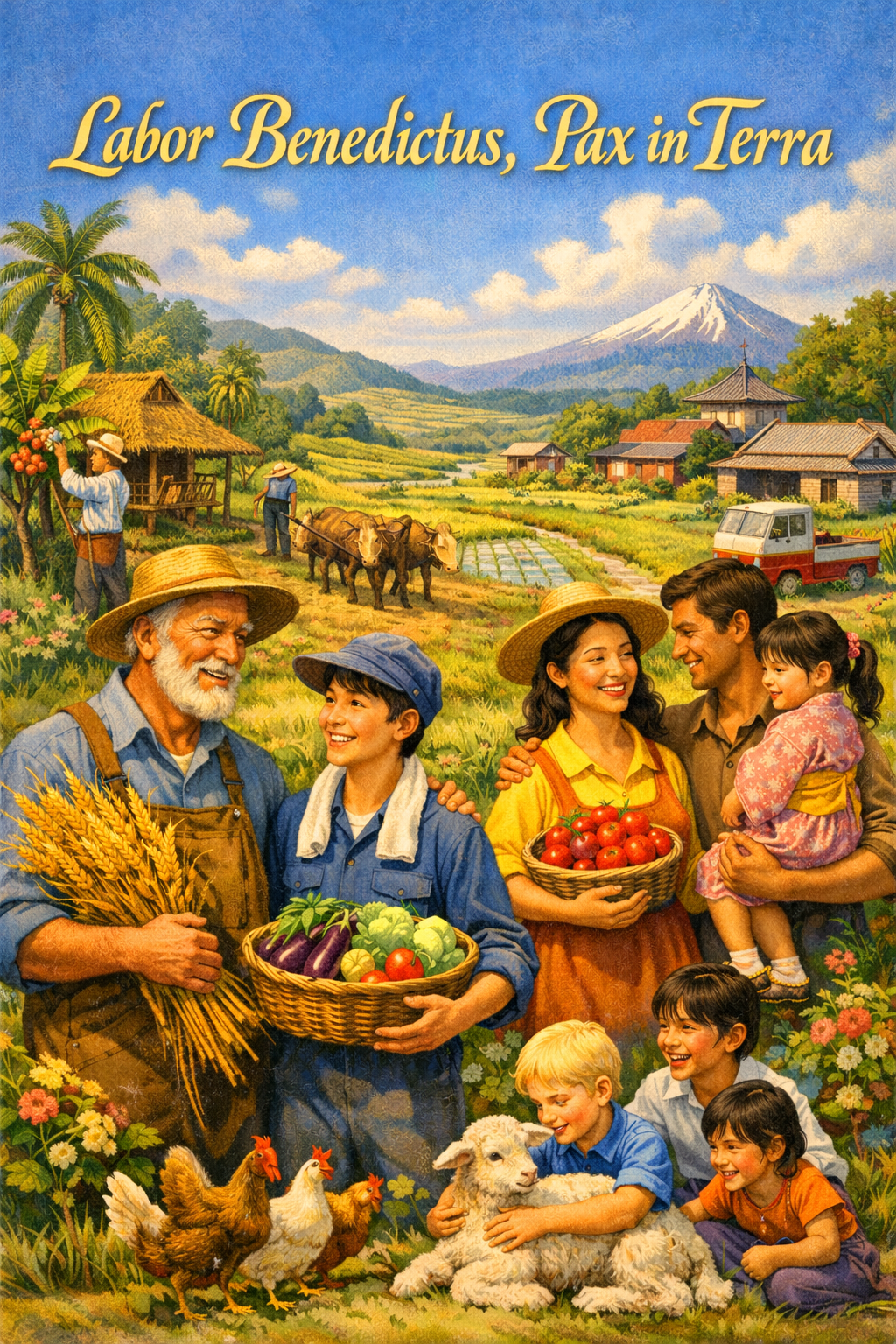
Agriculture Is Not Just Farming
Governance and Supply Chain Observations from the Royal Project to Blue Farms
Nelson Chou|Cultural Systems Observer・AI Semantic Engineering Practitioner・Founder of Puhofield
Agriculture Has Never Been Just About the Fields
As tensions in the Middle East escalate rapidly, I find myself returning to one very basic point—something that is rarely placed in the same frame in ordinary discussion: agriculture has never been just about what happens in the fields.
The current Gulf conflict has already sharply raised shipping, oil and gas transport, and insurance risks around the Strait of Hormuz. Multiple media reports, together with shipping and energy coverage, have pointed out that this waterway—which normally carries roughly one-fifth of global oil and gas transport—has entered a condition close to paralysis. That, in turn, has pushed up crude oil prices, LNG costs, fuel surcharges, and freight rates. Some shipping companies have already started imposing emergency fuel surcharges, while LNG freight rates have climbed to multi-year highs.
Once this kind of external risk appears, the thing that starts moving is never just the price of oil. What follows is a chain reaction involving natural gas, chemical fertilizers, maritime shipping, air freight, insurance, and food import costs. In the end, the impact is transmitted all the way down to the conditions of everyday life. The United Nations humanitarian system has also warned that the current Middle East conflict, together with disruptions in airspace and shipping, is simultaneously driving up energy, food, and transport costs while disturbing global supply chains.
For me, this is not abstract. Even on this trip back from Bangkok to Taipei, I could clearly feel airfare being pushed upward. For most people, the first thing they notice may simply be higher fuel prices, more expensive tickets, or rising freight costs. But if you look at it from the perspective of agriculture and supply chains, what is really happening is that the entire risk model is being rewritten.
How energy risk is transmitted into fertilizer, how fertilizer reshapes production costs, how transport affects import timing, how insurance changes logistics risk, and how all of this ultimately feeds back into food security, local livelihoods, and social stability.
That is why I have become increasingly certain that agriculture cannot be understood merely as farming, raising chickens, or growing vegetables. Those are only its surface expressions. If you place agriculture at a higher analytical level, it is tied to the most basic supply capacity of a society—and it is also tied to whether a country has real resilience when confronted with external shocks.
Why I Look at Japan First: Because It Functions Like a Mirror
I look at Japan first not simply because it is close to Taiwan. More importantly, Japan and Taiwan are structurally similar in many ways: both rely heavily on external energy and imported systems, both are dealing with demographic change, and both sit in a region where great-power rivalry and regional risk continue to intensify.
In recent years, these structural similarities have become increasingly visible. From supply-chain diversification to the reorganization of geopolitical risk, moves such as TSMC building fabs in Kumamoto are not merely straightforward investments. They reflect a broader regional recalculation of risk and a redistribution of industrial nodes. That is why, when many people look at Japanese assets, real estate, or local development in a fairly linear way, I tend to offer a reminder: things are never that simple. Returns matter, of course, but in the current environment one also has to put earthquake risk, energy vulnerability, regional conflict, and even the possibility of blockade or supply disruption onto the same table.
That is also why I have been paying close attention to Japan’s response to this latest wave of risk. Over the past two days, the International Energy Agency launched the largest coordinated strategic oil stock release in its history, and Japan was named as one of the participating countries. That fact alone tells us that for an economy like Japan—one highly dependent on imported energy—the issue is no longer simply whether oil prices rise or fall. The issue has become a matter of preventive adjustment for overall energy security and social stability.
This is especially true given how sensitive Japan has remained, since 3/11, around nuclear policy, grid structure, and the long-term composition of its energy mix. When shipping through the Strait of Hormuz is disrupted, Middle East risk persists, and the world enters a phase in which countries start protecting their own strategic resources, the vulnerability created by reliance on external energy becomes magnified. Countries across Asia are now confronting the same questions: how long reserves can last, whether substitute sources are sufficient, who gets hit first by rising costs, and which industries or localities bear the pressure first. Japan is simply one of the earliest places where these questions have become visible.
And these risks are not abstract. On March 11, Reuters reported that at least six merchant vessels were attacked in and around the Persian Gulf and the Strait of Hormuz, including a Thai-flagged vessel. That is a direct sign that the security risk in this waterway has already begun affecting commercial shipping itself.
So I look at Japan first not because I want to talk about Japan for its own sake, but because Japan functions like a mirror through which many of Taiwan’s own problems become easier to see. Looking this way also makes it harder to fall immediately into partisan positioning, ideology, or political noise. Instead, it lets us identify the real structural questions first: how energy enters, how food enters, who bears risk, how local regions hold up, and how society maintains basic stability under external shocks. Those are the questions I actually care about.
Back to Taiwan: Agriculture, Energy, Population, and Labor Are Actually on the Same Map
If we bring the lens back to Taiwan, what we are facing has never been merely an agricultural problem in the narrow sense. The moment agriculture is viewed from a supply-chain perspective, it becomes clear that many layers are entangled behind it: labor shortages in agriculture, population aging, food security, land use, pollution management, transport resilience, dependence on external energy, and migrant labor and labor policy are not separate issues. They are interconnected, mutually reinforcing, and structurally entangled. In recent years, Taiwan’s own official materials have repeatedly identified labor shortages in agriculture, supply-chain disruption, and climate risk as key challenges. Policies promoting mechanization and smart agriculture are themselves responses to the structural problems of rural labor shortage and aging.
The problem is that many past risk models were built for a world in which change moved relatively slowly—where one could estimate in five-year or ten-year intervals. Today, however, external risks often do not accumulate gradually. They can expand sharply within days or weeks. From energy prices to shipping disruption, rising insurance costs, and logistics adjustments, shocks do not always arrive one after another in neat sequence. They often surface at the same time and stack on top of each other. Recent policy statements from Taiwan’s Executive Yuan have also explicitly identified geopolitical risk, energy price volatility, and global supply-chain instability as variables that Taiwan’s overall economic and social governance must confront.
That is why what Taiwan needs today is not simply to “solve one agricultural problem.” What is needed is a different way of understanding risk: agriculture is not an isolated sector, but a foundational system tied to energy, labor, transportation, local development, and social stability. When external risk rises, agriculture is not only about whether basic supply can be stabilized. It is also about whether local regions can retain people, whether grassroots communities have jobs and order, whether younger people and technical talent are willing to enter again, and whether more research, improvement, and long-term investment can take root in the future. Taiwan’s own data on food self-sufficiency and import dependence also make clear that this is not an abstract proposition. It is a real structure deeply tied to external supply conditions.
This is not just a question of output.
And it is not merely a question of whether one agricultural product sells well or not.
It is closer to an indicator of a society’s underlying stability: whether people can continue to remain in a place, whether an industry can absorb risk, and whether a country can maintain the essentials of life and social order when external shocks arrive. Very often, all of that is tied to the broader structure that sits behind agriculture.
Why I Have Spent These Years Looking at Field Cases Across Asia
Because of my own entrepreneurial background, and because I have long been involved in agriculture, livestock, and the surrounding supply-chain environment, I have spent these past years closely following first-hand cases across different parts of Asia. And what I pay attention to has never been limited to whether a particular product sells well, nor is it simply a matter of price, packaging, or retail display. What concerns me more is the logic of governance behind it, the organizational form of the industry, and how the market system itself is actually built.
That is also why, in many cases, I do not rely on documents alone. I go to the field myself. Because only by walking into the actual scene can one begin to see more clearly whether a place’s agriculture is merely a short-term arrangement of production and sales, or whether it has already been incorporated into a longer-term framework of governance.
If I had to name two examples that I have been following in practice over the years, one would be Thailand’s Royal Project, and the other would be the Philippine Blue Farms initiative currently being promoted by friends in the Philippines. The two are not identical in form, nor do they emerge from the same national conditions, historical background, or governance context. But in my view, they are both trying to answer the same question: how agriculture can become a foundation for social stability.
Take Thailand’s Royal Project. What makes it worth long-term study is not simply that its agricultural products are good or that its brand is mature. The point is that the problem it confronted from the very beginning was never merely agricultural production. Its starting point was the long-standing combination of poverty, forest destruction, opium cultivation, and governance difficulty in the mountainous regions of northern Thailand. And the method it adopted was not simple suppression. Instead, it used alternative crops, technical support, infrastructure, education, and market linkages to gradually shift a region once marked by instability—and even illegal economic activity—toward a more sustainable structure of life and production.
As for the Philippine side, I have had the opportunity to learn more because friends around me are directly involved in promoting Philippine Blue Farms. So I have been able to ask them about the project’s ideas, aspirations, and on-the-ground conditions. From what I can currently understand, it does not treat agriculture merely as a production issue. Rather, it attempts to place land, work, local resources, and social stability within the same analytical frame. That direction, in turn, bears a certain structural resemblance to recent policy pathways in the Philippines around the reintegration of former rebels and the broader move from conflict toward livelihood rebuilding.
If agriculture is viewed from a higher level, it has never been merely a question of output. It is deeply tied to local stability, social order, governance capacity, and the way a country deals with long-term risk.
Thailand’s Royal Project: What I See Is How Agriculture Became Part of Long-Term Governance
Before the pandemic, I had already visited Chiang Mai and Bangkok multiple times. During those trips, I did not stay only within ordinary tourist routes. I deliberately looked for sites where agriculture, distribution channels, and institutions were connected. I personally visited sales points, distribution formats, market presentations, promotional directions, and actual operating conditions related to the Royal Project at places including Chiang Mai University, Thammasat University in Bangkok, Chulalongkorn University, Kasetsart University, Chiang Mai Airport, and Bangkok Airport.
Because these observations had already accumulated over time, this latest trip made the picture even clearer. When I again encountered a Royal Project sales point integrated with an agricultural market near Chatuchak in Bangkok, the structure stood out more distinctly than before: it was not simply displaying agricultural goods for sale. It was a system running all the way from production area to market—or, one could say, from farm to table.
At that site, you could see fresh produce and processed goods. You could see branding and promotions. You could also see its own channel logic and display logic. On the surface, these may look like retail details. But if you look one layer deeper, what they actually reveal is this: agriculture is not just about producing something. It must be organized, processed, branded, and received by the market before it can become a system capable of sustaining itself. This is, in fact, consistent with the Royal Project’s own long-standing emphasis on market and logistics logic: if alternative development is to succeed, marketing is not supplementary. It is foundational.
And in my view, what makes the Royal Project even more worthy of study is not only the maturity of its products. What it is really doing, beneath the surface, is a form of long-term governance.
The official record is very clear. The Royal Project began in 1969, and its original purpose was precisely to address deforestation, poverty, and opium cultivation in the northern Thai highlands. Its method was not one-dimensional enforcement, but the gradual transformation of unstable living conditions through alternative crops, technical introduction, education, infrastructure, environmental conservation, and market linkages. Over time, this model was also explicitly recognized by UNODC as an important case of alternative development.
If one carefully dissects the structure, then, the Royal Project has never really been dealing with agriculture alone. It is, in fact, dealing with peripheral territorial governance, alternative development, local stability, long-term order, education, and the question of how a community economy can form a more sustainable cycle. HRDI and related materials have repeatedly emphasized that this is not a single-point program of agricultural improvement, but a model that ties together highland governance, environmental conservation, research, food safety, and community development.
That is why I regard it as a very concrete example of governance-oriented agriculture. It does not use agriculture to decorate the language of sustainability. Rather, it uses agriculture as an entry point for dealing with an entire cluster of issues tied to social stability, local development, environmental conservation, and long-term order.
When agriculture is placed at a higher level of analysis, it can become a tool of governance, a foundation of local stability, and part of a country’s long-term order.
Philippine Blue Farms: What I See Is Land Use, Work Reconstruction, and Social Repair Being Considered Together
The Philippine line entered my field of attention because I came into contact with the Philippine Blue Farms initiative being advanced by my friend Prof. Nelia Cruz Sarcol.
When we gathered in the Philippines previously, we talked about my own brand, Puhofield, and also about several core values I have long cared about: land, agriculture, local production, stable livelihoods, and how good intentions can move beyond ideas and become sustainable cycles in real life. Because of that exchange, my intuition at the time was very clear: some of the directions she cared about were actually very close to the issues I myself had been thinking about for a long time. So later, when I saw the project begin to show some early progress, I made a point of learning more about it.
From what is currently visible in the public domain, the core of Philippine Blue Farms is not to treat agriculture simply as a matter of production. Rather, it is an attempt to place land, work, local resources, reintegration, and social stability within the same framework. Public statements by the Rotary Club of Makati Circle of Friends indicate that one of the structural foundations of the project is a 25-year usufruct agreement, providing a basis for land use so that idle or underutilized land may be transformed into a space for long-term cultivation and the rebuilding of livelihood.
I think that point is especially important. Because what it addresses is not simply whether there is a plot of land available for cultivation. It goes one step further and touches a much more difficult question: how land can be legally, stably, and over a meaningful time horizon arranged for use by people who need a chance to begin again. What is involved here is no longer only agricultural technique. It is about how local resources are reallocated, who bears risk, and who provides institutional and social support.
From the public trajectory currently visible, this line also appears to echo, at a structural level, recent peace and reintegration policies in the Philippines. In recent years, the Philippine government has continued to push programs for the reintegration and transformation of former rebels, including livelihood assistance, skills training, community rebuilding, and local coordination. Across 2025 and 2026, multiple official cases have explicitly linked livelihood reconstruction, agricultural livelihoods, and local stability for former rebels, with even direct references to “Peace Farms” and related agriculture-based reintegration schemes.
So if one situates Philippine Blue Farms within that broader context, what I find most noteworthy is not whether it has already become a mature commercial model. What matters more is that it is trying to answer a more fundamental question:
Can people who once stood at the edge of instability—or were even connected to armed conflict—re-enter a more stable structure of life through land use, agricultural technique, work arrangements, and local support?
That is also what makes the comparison with Thailand’s Royal Project so interesting. The Royal Project is more like a governance-oriented agricultural system that has gone through many years of development, has a high degree of institutionalization, and has relatively mature channels and markets. Philippine Blue Farms, by contrast, appears at this stage to be following another route. It does not begin from a fully mature market. It begins with vision, integration, land arrangement, reintegration, and activation, allowing originally scattered resources to gradually form a structure capable of supporting life.
I do not want to overstate the case. The project is still ongoing, and many outcomes will require time to verify. But at least at this point, it does not strike me as something that remains only at the level of slogans. What makes it worth sustained observation is that it lifts agriculture upward—from “producing food” to a deeper social function. It is not only about cultivation. It is about trying to let a piece of land once again carry work, carry livelihood, carry local stability, and perhaps even carry the possibility of restoring order.
If the people of a place can genuinely gain a better chance to live and work in peace because of this, I think that alone already makes it worth serious attention. And that is why I intend to keep watching this line closely. Because in the end, it addresses the same question I truly care about: how agriculture can do more than produce food—how it can also participate in the repair of order, the stabilization of society, and the rebuilding of long-term hope for a place.
Reading the Two Together: What They Remind Me of Is Not Short-Term KPIs, but Long-Term Governance
When I place the Thai and Philippine lines side by side, of course they look very different on the surface.
Thailand’s Royal Project is a system that has developed over many decades. It is highly institutionalized and relatively mature. It began in 1969, under the long-term historical involvement of the Thai monarchy, and has benefited from the sustained engagement of state capacity, technical systems, educational resources, and market channels. That it eventually moved toward a more mature form of institutionalization, branding, and commercialization is therefore not surprising.
By contrast, Philippine Blue Farms seems to be taking another path. It does not begin with a mature market and a fully developed institutional system. It begins more from vision, integration, and action—trying to connect land, local resources, public-private collaboration, reintegration, and livelihood rebuilding step by step. From the current public trajectory, it bears a certain structural resemblance to recent Philippine approaches to reintegration and livelihood rebuilding for former rebels and returnees.
But if we stop at those surface differences, we actually miss the point I most want to make.
Because even though the two cases differ in form, neither of them treats agriculture merely as a matter of output. Nor do they treat output as the only KPI. Once real resources are committed, what they are dealing with is never only how much more can be produced. What they are really dealing with are deeper issues: order, governance, local stability, social resilience, and whether people can live and work in peace.
And what matters most, in my view, is that these things must always be understood on a long time scale. Transforming a region, changing the structure of local life, and allowing originally fragile or unstable land to regain a sense of order have never been matters that can be completed in one or two years. Nor are they suited to being judged only within a single party term or a four-year political cycle. Many things tied to land, people, education, local industry, and social stability should be planned from a much longer horizon and thought through at a much higher level.
If a country or a piece of land truly takes the long-term stability of its people seriously, then agriculture cannot be assessed only through short-term output value, short-term production figures, or the KPI logic of political terms.
When agriculture is considered at a higher level, it has never been only a production issue.
It is also a governance issue, a long-term stability issue, and ultimately an issue that operates on a century scale.
What I Truly Worry About Is Sustainability That Exists Only on Paper
To be clear, I have never opposed subsidy policy, nor have I opposed vision, the public sector, or the many forces that genuinely want to make things better. These things have their necessity, and in many cases they are precisely what allows something to begin at all.
What I truly worry about is something else: sustainability that never leaves the page.
That is to say, an idea that appears excellent in theory ends up existing only in official completion reports, only in slides and PowerPoint decks, only in brief media coverage, or only in the moment when stage lights happen to shine on it. On the surface, it may look complete, polished, and full of narrative appeal. But if it never gains long-term support from the market, never forms stable cycles of product, distribution, labor, logistics, and consumption, then even the best-designed plan remains structurally fragile.
Because what agriculture touches has never been the concern of only a few people. It shapes how products are made, who does the work, how things are transported, how they enter the market, and how households continue to sustain them in everyday life. What it affects is not local or marginal. It affects the basic living conditions of ordinary families. For that reason, sustainability in agriculture can never be maintained only through one-time subsidies, short-lived visibility, or temporary project promotion.
That is exactly why I pay particular attention to Thailand’s Royal Project. Its real strength lies not merely in having the right values, nor only in making decent products. Its real strength is that it built governance logic directly into the market from the beginning. It did not first finish telling a good story and then later ask how to sell the products. It understood clearly from the start that if a model is to survive in the long run, the market must be able to receive the product, consumers must be willing to support it continuously, and the whole system must be able to generate its own cycle.
And in the future, the Philippine Blue Farms line will inevitably face the same question. Vision can launch something. Integration can connect resources at the beginning. But sooner or later it still has to face the deeper issue: how to create an enduring cycle, and how to make land, work, technique, products, and markets form not just a temporary linkage, but a structure that can genuinely keep operating.
The real meaning of sustainability is whether a structure can continue to function.
And that, precisely, is what I am still watching, still observing, and still thinking about.
Looking Back at Puhofield: We Have Moved in Small Steps and Slow Steps, but the Direction Has Been Consistent
After saying all this, I ultimately have to return to myself—and to the road that Puhofield has been walking for more than a decade.
Because if one only talks about other people’s cases without asking how one has acted oneself, then many words remain at the level of commentary. In my view, what really matters is whether one has actually invested in this path in practice.
For more than ten years, Puhofield has continuously put in its own time and resources. Fortunately, along the way we have met producers willing to work with us almost like family, as well as channels and partners willing to support us. This has never been only about commercial cooperation. In many cases, I have also personally participated in the religious festivals, harvest activities, and local events of the regions where these producers live. To me, these are not peripheral extras. They are essential parts of understanding a piece of land, a group of producers, and an entire local way of life.
Although what Puhofield has done so far has not been large in scale, the work itself has always been clear: to take what comes from the land, organize it, articulate it, add value to it, connect it to the market, and allow it to truly enter people’s lives—slowly forming a more sustainable cycle.
That is why, standing where I stand today, I understand more clearly than before that Puhofield is not merely selling products. Over these ten-plus years, what we have really been practicing is a certain capacity: the capacity to integrate.
That kind of integration is not only about packaging a product well and selling it. It also involves understanding producers, understanding the land, articulating the value of a place, bringing products into the market, encouraging consumers to support them over the long term, and gradually weaving originally scattered efforts into a structure capable of continuous operation.
For that reason, I now feel that the role Puhofield may play in the future need not be limited to selling its own products. In international service projects, local collaborations, agency marketing, and even cross-regional integrated cooperation, perhaps we can serve as a node—transforming the experience we have accumulated, our understanding of land and production, and our practice in value addition and market connection into a form of strength that can help others and amplify positive impact.
What Puhofield has walked for more than a decade is not merely a path of selling products,
but a path of learning how to reconnect land, life, production, and the market.
And although that road has been small and slow, its direction has always been clear.
Agriculture Is Not Only About Output, but a Century-Scale Plan for Land, Order, and the Future
Agriculture has never been only about farming, raising chickens, or growing vegetables.
In my view, what agriculture truly touches is the intersection of food, energy, labor, locality, territory, order, and resilience. It is not a single industry. It is one of the most important foundations of whether the deepest layer of a society’s structure can remain stable. That is why, when we talk today about sustainability, SDGs, or ESG, if agriculture is left out of the equation, much of that language easily remains superficial rather than entering the realities of life and land. Within the United Nations Sustainable Development Goals, objectives such as Zero Hunger, Responsible Consumption and Production, Sustainable Cities and Communities, Climate Action, and Partnerships for the Goals are themselves tightly connected to agriculture and the supply-chain structures behind it.
If a society spends its long-term attention on surface-level confrontation—whether partisan, ideological, or mutually exhausting positional conflict—while failing to form consensus on issues that actually determine underlying conditions of survival, then the eventual cost will be very high. Because what agriculture shapes is not peripheral. It shapes how energy enters, how food is stabilized, how localities retain people, how labor is sustained, how transport is maintained, and how society itself endures. These are not surface issues. They are issues of long-term stability.
And for me, agriculture has never been merely an object of observation. I myself grew up in the countryside. In a certain sense, agriculture did not enter my life only later. It was already there early on—in my everyday life, in my memory, and one could even say in my blood and in my genes. That is why, however I look at it, agriculture is not a matter of one or two years, not a matter of one political term, and not a matter of only short-term output or short-term value. It is closer to a century-scale project that a piece of land, a country, a people, and even the planet as a whole must take seriously.
That is also why I continue to observe, continue to travel, continue to write, and continue to stay involved. Whether in agricultural research and practice, in the brand I founded, or in direct field observation and investigation across different parts of the world—from the production side to the academic side to the market side—I have really been trying to do the same thing all along: to understand how agriculture is not merely production, but how it becomes a foundation for the long-term stability of a place and the continued functioning of a society.
If this article is to leave behind one central judgment, then I would put it this way:
Agriculture is not only a question of output.
It is also a question of governance, order, and resilience—
and, more deeply, a question of how land and people are to be settled in the long future.
And that is precisely why I will continue to watch it, walk with it, and write about it.
Data Supplement|Key Figures and Background Facts
To ensure that the discussion above does not remain only at the level of observation and judgment, the following section provides several key figures and background facts directly related to this article, as reference points for understanding its broader context.
1. Risk in the Strait of Hormuz is not only about crude oil. It is also about natural gas. According to International Energy Agency data published in 2026, around 20 million barrels per day of crude oil and oil products passed through the Strait of Hormuz on average in 2025, accounting for about 25% of global seaborne oil trade. At the same time, more than 110 billion cubic meters (110 bcm) of LNG also passed through the Strait of Hormuz in 2025, representing nearly one-fifth of global LNG trade. For Asia, the importance of this route is even greater: LNG shipped through Hormuz to Asia in 2025 accounted for around 27% of Asia’s LNG imports. This means that once this waterway is seriously disrupted, the effects are not limited to oil prices. Natural gas supply, electricity systems dependent on LNG, and industrial systems dependent on gas are all affected as well.
2. For societies such as Taiwan and Japan that depend heavily on imported energy, natural gas risk is especially sensitive. The latest IEA gas outlook indicates that Asia’s natural gas demand is expected to grow by more than 4% in 2026, accounting for about half of global demand growth, while Asia’s LNG imports are projected to grow by 10%. In other words, Asia is still deepening its dependence on LNG. Therefore, Middle East risk and risk around the Strait of Hormuz represent long-tail and amplified vulnerabilities for places such as Japan and Taiwan that rely on imported LNG to support electricity generation and energy substitution.
3. The impact of Middle East conflict has already become large enough for the IEA to launch the largest coordinated oil stock release in its history. In March 2026, the IEA initiated a coordinated stock release among member countries and explicitly stated that the move was an emergency response to Middle East conflict and risks of market disruption. This indicates that the risk involved is no longer merely a matter of market sentiment. It has reached the level at which national energy security systems must respond formally.
4. Chokepoint risk in maritime transport is transmitted all the way into food, agricultural costs, and everyday life. In its Review of Maritime Transport 2024, UNCTAD explicitly notes that maritime bottleneck risks, including the Strait of Hormuz, are intensifying uncertainty in global logistics. For agriculture, such risk affects not only energy, but also freight rates, insurance, cold-chain systems, and food import costs.
5. Why is fertilizer affected by natural gas? Because natural gas itself is one of the core inputs of nitrogen fertilizer. According to the IEA’s technology roadmap for ammonia, ammonia is the starting point for all mineral nitrogen fertilizers, and about 70% of global ammonia is used for fertilizer production. FAO technical materials from 2024 also point out that natural gas is not only an energy source but also an important feedstock in conventional ammonia production. For a high-efficiency European plant, for example, producing one ton of ammonia requires on average about 32.5 mmBtu of natural gas. In other words, once natural gas prices or supply fluctuate, ammonia and nitrogen fertilizer costs can rise very quickly.
6. Fertilizer price volatility in recent years has already been highly linked to energy costs. The World Bank’s 2025 fertilizer market observations indicate that although fertilizer prices stabilized in some quarters, the upside risks still clearly include rising input costs such as natural gas. Its October 2025 commodity market outlook also states that the World Bank fertilizer price index rose by nearly 14% quarter-on-quarter and 28% year-on-year in the third quarter of 2025. This means that energy risk does not stop in the energy sector. It rapidly transmits into agricultural inputs.
7. Supply chain resilience is not only a trade issue. It is also an agricultural governance issue. The OECD’s 2025 Supply Chain Resilience Review emphasizes that the core of supply chain resilience is not merely efficiency, but the building of systems with stronger adaptive capacity, risk recognition capacity, and coordination capacity. This is especially important when applied to agriculture, because agriculture is inherently tied to energy, logistics, labor, and local stability.
8. SDG 2 itself already binds food security to sustainable agriculture. The formal wording of Goal 2 in the United Nations Sustainable Development Goals is: End hunger, achieve food security and improved nutrition, and promote sustainable agriculture. This means that agriculture was never placed there as only a single industry. It is understood from the outset at a higher level connected to food security, social stability, and long-term sustainability.
9. Thailand’s Royal Project is not a short-term agricultural promotion plan, but a long-term alternative development effort that began in 1969. According to public materials from the Highland Research and Development Institute (HRDI), the Royal Project began in 1969, with the core purpose of addressing opium cultivation, deforestation, and poverty in the northern Thai highlands through alternative crops, education, technical introduction, and market linkages. That is precisely why it is regarded as an important case of governance-oriented agriculture.
10. The Royal Project treated market and logistics as foundational to alternative development from a very early stage. Public materials from the Royal Project make clear that marketing and logistics are not subsidiary functions, but core foundations of whether the overall alternative development model can succeed. In other words, it did not begin with ideals and only later patch in the market. It treated the market from the very beginning as part of governance itself.
11. The land-use arrangement in Philippine Blue Farms is one of the most structurally notable features of the project. Based on the current public trajectory, one of the key foundations of Philippine Blue Farms is the use of a 25-year usufruct agreement to establish land-use conditions, allowing idle or underutilized land to be transformed into a longer-term space for both production and livelihood reconstruction. This indicates that what it deals with is not only cultivation technique, but also how land can be arranged in a stable way for people who need a chance to begin again.
12. In recent years, the Philippine government has indeed continued to promote the reintegration of former rebels and agriculture-based livelihood reconstruction. Public materials from the Philippine government in recent years clearly show policy lines and programs related to former rebels, reintegration, livelihood rebuilding, and peace farms. This means that Blue Farms is not merely an isolated agricultural project, but is closer to a structure that considers land, work, social stability, and local repair together.
FAQ|Agriculture, Energy, Supply Chains, Governance, and Social Stability
❶ Why should agriculture not be understood only as farming, raising chickens, or growing vegetables?
Because agriculture has never been only about what happens in the field. It underpins a society’s basic supply capacity as a whole. Behind it are food security, energy supply, fertilizer inputs, labor structure, land use, logistics and transportation, local economies, pollution management, and social stability. When external risk rises, agricultural issues rarely appear in isolation. They surface together with supply chain problems, cost pressures, demographic issues, and governance challenges.
❷ Why does the Middle East situation affect agriculture, fertilizer, and food supply?
Because instability in the Middle East simultaneously affects crude oil, natural gas, shipping, insurance, and global transport costs, all of which directly shape agricultural production and food circulation. Natural gas is not only a fuel for power generation and industry. It is also closely tied to ammonia and nitrogen fertilizer production. So when natural gas supply or prices fluctuate, fertilizer costs can rise quickly, and that eventually feeds into agricultural production costs, food import costs, and the everyday cost of living for consumers. Since the Strait of Hormuz carries both large volumes of oil and LNG, the risk is not just an oil-price issue. It is also a natural gas and fertilizer issue.
❸ Why is natural gas risk especially important for Taiwan and Japan?
Because both Taiwan and Japan rely heavily on imported energy, and natural gas is a major pillar in their energy transition structures and power systems. Once Middle East risk rises, LNG routes are disrupted, or prices are pushed higher, the impact is not limited to electricity generation costs. It also spills into industry, cold-chain systems, transport, and agricultural inputs. For societies that depend heavily on imported LNG, natural gas risk is not secondary. It is one of the core vulnerabilities in energy security.
❹ Why does observing Japan help us understand Taiwan’s agricultural, energy, and supply chain risks?
Because Japan and Taiwan share many structural similarities: limited domestic resources, high dependence on external energy, aging populations, and sensitivity to geopolitical risk. In particular, both are highly comparable in terms of imported energy, LNG dependence, export-oriented industrial structures, and vulnerability in maritime logistics. When Japan begins adjusting its energy reserves, supply chains, and risk strategies, those moves often reveal vulnerabilities that Taiwan may also face in the future.
❺ Why is Taiwan’s agricultural problem actually a supply chain problem?
Because the challenges Taiwan faces in agriculture are not limited to planting and breeding. They involve the entire supply chain structure: labor shortages, aging, migrant labor policy, food security, energy dependence, fertilizer costs, land use, pollution management, and transport resilience. These issues are interconnected and cannot be separated cleanly. Once agriculture loses supply-chain support, it becomes very difficult to form a stable and sustainable system.
❻ Why must fertilizer issues be viewed together with energy issues?
Because the modern fertilizer system—especially nitrogen fertilizer—is highly linked to natural gas. Ammonia is the foundation of nitrogen fertilizer, and natural gas is both a major energy source and one of the feedstocks in conventional ammonia production. So once natural gas prices or supply fluctuate, fertilizer costs can rise quickly. That is why the relationship between geopolitics, energy risk, and agricultural costs is not indirect. It is a highly direct and structural linkage.
❼ Why can agriculture not be measured only by short-term output, output value, or term-based KPIs?
Because many things tied to land, people, local life, education, order, and stability require long-term commitment. They cannot be meaningfully judged on a one-year, two-year, or four-year scale. If we look only at short-term output, short-term value, or short-term exposure, we easily miss agriculture’s deeper functions: stabilizing local regions, retaining population, building order, strengthening resilience, and lowering the long-term cost of governance.
❽ Why is Thailand’s Royal Project worth studying?
The Royal Project is worth studying not simply because it has made agricultural products successfully, but because it places agriculture within a higher-level governance framework. Through alternative crops, education, technology, logistics, channels, markets, and local integration, it addresses poverty, opium cultivation, deforestation, and long-term local order in the highlands of northern Thailand. This shows that agriculture is not only a production tool. It can also become a foundation for governance, stability, and alternative development.
❾ What makes Philippine Blue Farms worth paying attention to?
Philippine Blue Farms is noteworthy not because it has already become a mature commercial model, but because it attempts to think land, work, local resources, reintegration, and social stability together. Based on the current public trajectory, it involves longer-term land-use arrangements and also resonates structurally with recent Philippine pathways for former rebel reintegration and agricultural livelihood rebuilding. What matters in such a project is not merely cultivation itself, but whether land use, technical support, and livelihood reconstruction can bring unstable groups back into a more stable life structure.
❿ What do Thailand’s Royal Project and Philippine Blue Farms have in common?
Their forms, maturity, historical backgrounds, and resource conditions are different, but they share one important trait: neither treats agriculture merely as a production issue. Both are dealing with deeper questions such as local stability, governance capacity, social order, resilience, and whether people can live and work in peace. That is why they are worth comparing side by side as cases of agricultural governance.
⓫ Why can sustainability not remain only at the level of subsidies, slides, or completion reports?
Because real sustainability must be a structure capable of continuing to function. If a seemingly excellent project never forms stable cycles of product, distribution, labor, logistics, land use, and consumption, then it is very difficult for it to endure. Sustainability cannot depend only on slogans or one-time resources. It must ultimately return to the market, everyday life, and institutional reality.
⓬ Why is market support so important for sustainable agriculture?
Because if agriculture is not received by the market, it is very difficult for it to form a long-term cycle. Subsidies, policy, and vision can help launch a project, but without sustained consumer support, stable channels, workable price mechanisms, and functioning logistics systems, even a promising plan can remain stuck at an early stage. Truly stable sustainable agriculture must simultaneously possess production, value addition, circulation, and market absorption capacity.
⓭ What is the real relationship between agriculture and SDGs or ESG?
Agriculture is not merely an accessory case under SDGs or ESG. It is one of the foundations that determines whether those frameworks can actually land in reality. Food security, responsible production and consumption, sustainable communities, climate action, and partnerships are all closely linked to agriculture and its underlying supply-chain structure. The formal wording of UN SDG 2 itself already places “food security” and “sustainable agriculture” within the same goal.
⓮ Why can agriculture be understood as a governance issue rather than only an industry issue?
Because agriculture affects more than output and price. It shapes whether people can remain in local communities, whether peripheral regions can stay stable, whether labor and livelihood can continue, and whether society has the resilience to face external shocks. When agriculture is viewed at a higher level, it is actually dealing with land, order, resource allocation, social repair, and long-term stability. It therefore cannot be understood through a narrow industrial logic alone.
⓯ Why can agriculture be regarded as a century-scale issue?
Because changing a piece of land, changing the structure of a local industry, and changing patterns of population movement and social order are never things that can be completed quickly. Many changes related to education, local economies, land use, social stability, and governance capacity must be understood over a long time horizon. If agriculture is judged only through short political cycles, its true strategic value is often underestimated.