Making Continuous Service Possible
Practical Observations on AI and Service Work from a Rotarian’s Perspective
there is never enough time. The “one-year term” system injects continuous energy and new styles into service,
yet it simultaneously compresses the space available for understanding, accumulation, and refinement.
Presidents and board members often find the countdown to the new service year beginning
before they have fully grasped the design logic, key decision-making backgrounds,
and actual execution details of the previous year’s projects.
Under this rhythm, needs assessment, stakeholder interviews, regulatory compliance checks,
proposal revisions, and filing preparations are often forced to move forward simultaneously within a very tight timeframe.
While the process may appear smooth on the surface, it actually relies on massive amounts of
real-time communication and individual experience to fill the gaps,
consuming the mental energy that Rotarians could otherwise use for deep discussion and service optimization.
This situation is not due to a lack of commitment; on the contrary, most Rotarians cherish the opportunity to serve
and are willing to carve out time from their professional and family lives.
The true burden is not the service itself, but the repetitive data organization, background reconstruction,
and information alignment—highly necessary yet invisible tasks that drain the energy meant for the “service itself.”
Experience 1 | The Disconnect Between Documentation and Execution
I once experienced a wake-up call in a service project group.
Just as a project was nearing its closing phase, the member responsible for execution
asked in the group: “What exactly was the content of the original proposal we submitted?”
Upon comparison, we discovered that the service being performed had drifted significantly
from the project approved by the Foundation. The activity flow, service methods,
and even key focus areas had shifted quietly during the process without being fully recorded or traced back.
This wasn’t due to negligence, but because the crucial project background,
the logic behind initial trade-offs, and the adjustments made in response to field conditions
were not systematically preserved. As we reached the reporting stage, we realized with a shock:
“We can no longer clearly explain why we designed the service this way in the first place.”
This disconnect between documentation and execution exposes the fragility of institutional memory.
Experience 2 | The Silent Shift of Service Beneficiaries
In another project, I witnessed a displacement of expectations regarding the target audience.
The original concept was to serve vulnerable migrant women, specifically single mothers
running small food stalls while raising children alone.
The intent was to provide coaching and exposure to help them be seen by society
and to build confidence and dignity for their children regarding their cultural heritage.
However, as the project progressed—through resource matching, the addition of participating units,
and changes in execution conditions—the focus shifted toward a group of second-generation migrant students.
These students already possessed relatively sufficient social resources and support systems,
representing a stark difference from the original target group.
This shift wasn’t a result of malice; it happened naturally, step-by-step,
in the absence of clear records and continuous review of the original mission.
Without constant confirmation of goals, even with massive effort,
the final service may end up addressing a need far removed from the problem it set out to solve.
Experience 3 | Inheriting Local Service Experience
I participated in a service project collaborated between the New Generation Rotary Club
and partners in the South-Link region. I was involved in every stage:
from initial proposal discussions and site surveys to multiple field interviews
with beneficiaries and stakeholders, through to execution and closing.
During this period, I entered the local tribes more than once to build deeper interaction and understanding.
This repeated engagement ensured that service was not a one-time event,
but a process that could be adjusted as understanding deepened.
Because key backgrounds, decision-making contexts, and field observations
were continuously organized and shared, the execution and closing were built upon a foundation of mutual understanding.
Service experience was inherited—not by relying on individual memory,
but by becoming a sustainable collective experience within the club.
Experience 4 | The Mature Design That Failed to Leave a Trace
During the pandemic, I co-sponsored a District Service Project Grant that was successfully approved.
We attempted to establish a “circular service mechanism” focused on vocational training
to address structural issues in skills and employment for at-risk youth.
The design was elegant: if a young person committed to learning, the project would pay for their
tuition and necessary tools in collaboration with professional vendors, followed by an internship.
Once the student completed training and secured formal employment,
the vendor would return the original project expenditure via a donation back to the project.
This allowed resources to be reinvested into the next batch of students, creating a long-term circular operation.
Ultimately, the project was withdrawn due to the high uncertainty of the pandemic.
Furthermore, because the design logic and execution experience were not fully documented and transferred within the club,
the concept quietly vanished. This confirmed my belief: even a mature, approved project
can disappear during environmental changes or leadership transitions if it lacks institutional memory.
Experience 5 | Accumulable Structures in International Service
At the international level, I witnessed a service structure that is truly “accumulable and inheritable.”
As a Taiwanese Rotarian and a member of the IYFR (International Yachting Fellowship of Rotarians),
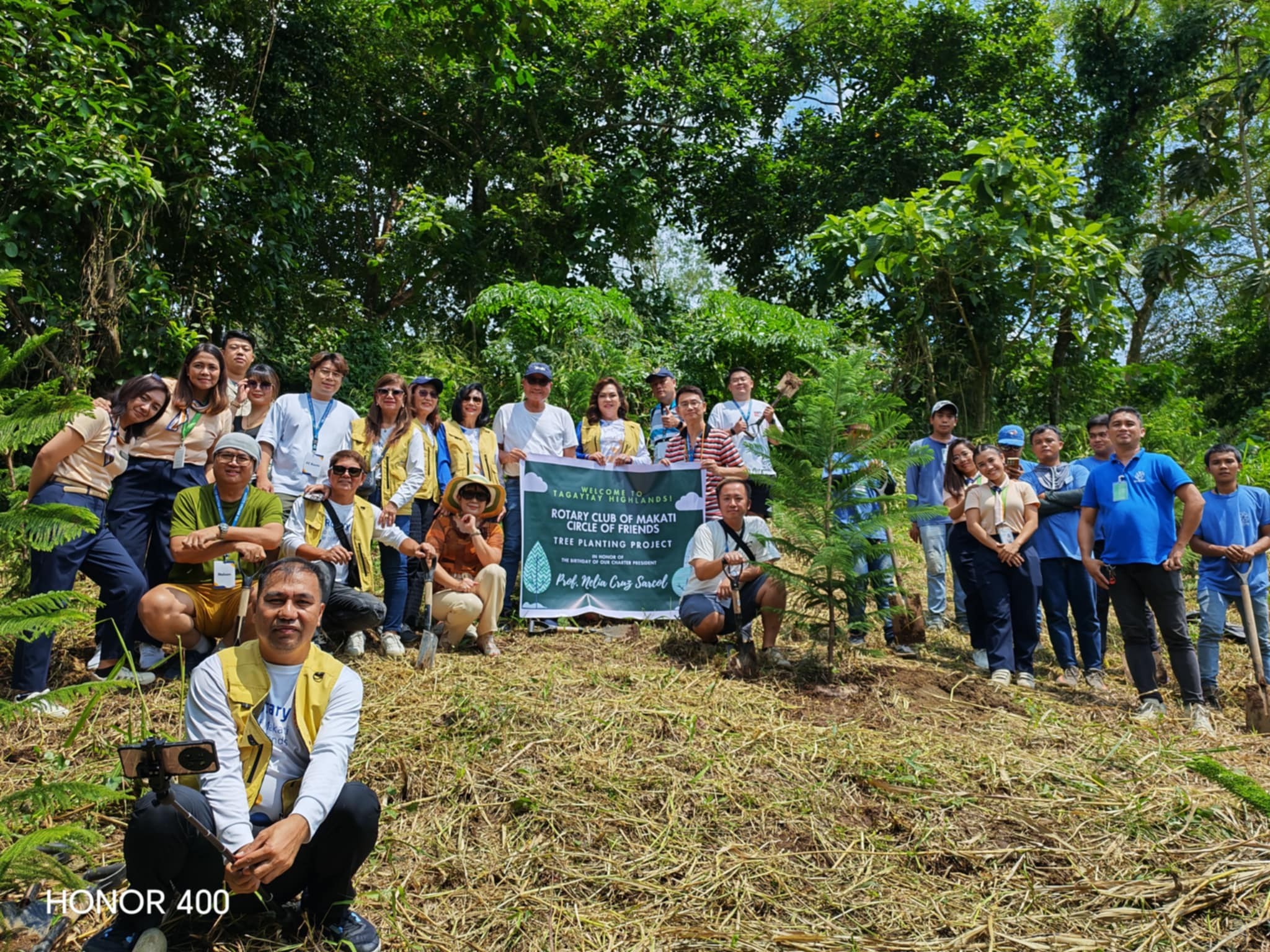
I participated in a tree-planting service project at Tagaytay Highlands, alongside our fellow Rotarians from the Rotary Club of Makati Circle of Friends during an international exchange.
This was not a symbolic visit designed for show. It was an environmental action
that had been running for years, with clear long-term goals and local context.
Before the action began, the hosts provided a comprehensive briefing on the project’s background,
its purpose, and the subsequent maintenance plan. This allowed participants to understand
that they were not just attending a one-off event, but were a node in a long-term continuum.
On-site, we didn’t just donate resources; we went to the designated site and planted the seedlings with our own hands.
This action combined environmental protection with local educational support,
ensuring that every contribution—regardless of the donor’s country—was clearly positioned as part of a whole.
Even across different languages and cultures, Rotarians could align their actions quickly
under a clear institutional framework. The key was not how well we knew each other,
but how well the information was organized and recorded.
Such experiences confirm that when backgrounds are clarified, contexts are preserved, and actions are inherited,
the impact of service amplifies over time rather than being a fleeting moment of goodwill.
The Role of AI in This Context
Reflecting on these experiences, I began to wonder:
Are there tools that can help preserve these critical contexts and reduce the exhaustion
of repetitive organization and communication without adding a burden to club members?
I do not believe AI can replace the judgment and action of Rotarians.
The core of service always stems from human-to-human understanding, field perception,
and the actual investment of resources. If properly positioned, AI plays a supporting role—making
the time-consuming “must-do” tasks lighter, allowing Rotarians to spend their limited time
on the service decisions and actions that truly matter.
Excerpt from “Rotary Monthly” (February 2026 Issue)
The following is an abridged version edited for publication in Rotary Monthly:
Author | PP Nelson Chou, Rotary Club of Taipei New Generation, District 3523
In Rotary service, time is the scarcest resource.
The one-year term system brings vitality but also challenges in continuity.
Presidents and board members often find the countdown to the new service year beginning
before they have fully grasped the context of the previous year.
Needs assessment, stakeholder interviews, regulatory checks, and documentation
often happen simultaneously under immense pressure.This situation isn’t due to a lack of commitment;
most Rotarians cherish the opportunity to serve.
The true burden is the repetitive alignment and data work that drains energy meant for the “service itself.”Having been involved in the entire lifecycle of Rotary Foundation grants and District projects,
I’ve realized that service effectiveness depends on the quality of preparation—which is where
time and manpower are most heavily consumed.In this context, I see AI not as a trendy slogan, but as a practical possibility for assistance.
For example, before a project is submitted, AI can help check if the content aligns
with the Rotary Foundation’s Areas of Focus and regulations.
During internal discussions, it can help structure scattered ideas quickly.
In international service, it can gather background information to lower communication costs.Most importantly, these processes can be recorded as traceable references for the next generation.
This ensures that the efforts of each year are not just one-off attempts but building blocks for a long-term foundation.I do not believe AI can replace the judgment and action of Rotarians.
Service is about human care. AI’s role is to lighten the most time-consuming tasks,
allowing us to focus on higher-value decisions.
It is not about changing the spirit of Rotary, but making that spirit easier to sustain in the modern age.
The following questions are synthesized from these observations as a practical reference for Rotarians and public service workers adopting AI tools.
Frequently Asked Questions (FAQ)
Why do Rotary service projects often break down during handover?
The one-year term system injects new energy but often fails to transfer the full context
of decisions and background information. Without systematic preservation,
projects lose the conditions for continuity after a leadership transition.
Which tasks consume the most time and manpower?
Repetitive data organization, regulatory comparisons, proposal revisions,
and information alignment across different roles often consume the majority of time.
What non-decision-making tasks can AI assist with?
AI is best suited for assisting in data organization, structuring plans,
regulatory cross-referencing, background information synthesis, and maintaining process records.
Does using AI change the core spirit of Rotary?
No. The core remains human care and field presence. AI is a tool to lighten administrative
and organizational burdens so Rotarians can focus more on the service itself.
Why do well-designed projects fail to continue?
Even an approved project can vanish during leadership changes or external environmental shifts
if it lacks an institutional memory and a hand-over mechanism.
Why is information organization critical in international service?
Cross-cultural cooperation involves different languages and systems.
Systematic information organization helps establish trust and action alignment quickly.
Can AI replace the role of Rotarians?
No. AI cannot replace value judgment, relationship building, or real-time ethical decision-making.
Its role is strictly for support and organization.
When is it inappropriate to introduce AI?
When service relies heavily on situational judgment, emotional interaction,
or real-time ethical choices, AI should not be the leading tool.
Publication Records and External Links
Parts of this article were edited and published in the February 2026 issue of “Rotary Monthly.”
“Rotary Monthly” Official E-Magazine link:
https://taiwan-rotary.org/ebooks/detail_list.php?eid=128&id=4788