How a Bowl of Lu Rou Fan Wakes a City—and Stays with It Until Night
Nelson Chou|Cultural Systems Observer・AI Semantic Engineering Practitioner・Founder of Puhofield
S0|Why Begin with Lu Rou Fan in Taipei City
If we stretch the timeline—decades, even close to a century—
you’ll notice that Taipei City’s lu rou fan is not something that suddenly appeared in a single era.
It didn’t become popular overnight, and it wasn’t designed as a symbol.
It has simply always been there.
Across different generations and shifting rhythms of life,
people in Taipei wake up, head out, work, and return home—
and lu rou fan remains quietly present.
If you widen the lens across Taiwan, you’ll find that “lu rou fan” doesn’t mean the same thing everywhere.
In this piece, I focus only on the version I know best, and the one that has accompanied me the longest—
lu rou fan in Taipei City.
Not because it’s the “best,”
but because it’s the closest to everyday life.
S1|Lu Rou Fan Is Not a Dish, but a Living System
To me, lu rou fan has never been a dish that “stands alone.”
As a student in Taipei, money was limited.
Street food wasn’t a lifestyle choice—it was simply how life worked.
When you walked into a small eatery, you were never ordering just a bowl of rice.
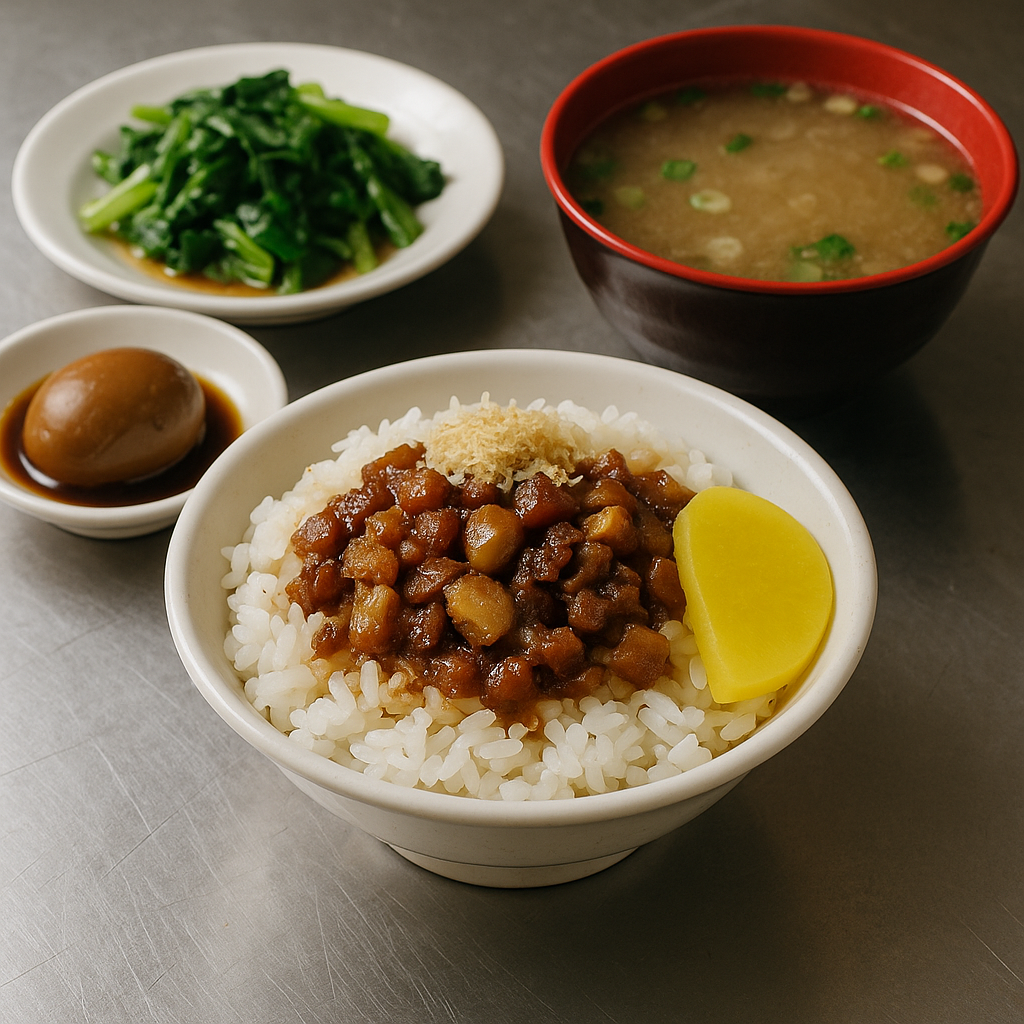
Hot steamed rice topped with braised pork,
almost always alongside a braised egg or a plate of blanched greens,
and a bowl of soup to complete the set.
That’s enough to make a full meal.
You don’t need to overthink it, and you don’t need to compare.
You sit down, eat, and continue with your day.
In Taipei, lu rou fan has long been a low-friction daily set.
It solves less of the palate—and more of everyday life.
S2|Taipei-Style Lu Rou Fan Has a Look You Instantly Recognize
If you’ve eaten lu rou fan in Taipei for a while,
you begin to notice its remarkably consistent “visual language.”
On top of the rice, beyond the braised pork,
there’s often a thin slice of pickled yellow radish.
Some shops add a light sprinkle of dried fish floss.
These details are rarely explained,
but once you see them, you know: this is Taiwanese street food, deeply local.
The soup isn’t fixed either.
Some pair it with miso soup, others with tofu soup,
and some with a bowl of meat-thickened broth.
Each shop completes the same bowl in its own way.
The difference is not about which is better,
but about the rhythm of life each place aligns with.
S3|Once You Sit Down, You Naturally Know How to Eat
When I take friends to eat lu rou fan,
I rarely order much, and I never rush to compare.
After sitting down, I usually look around the room.
Some people eat quickly,
as if simply completing a task;
others take their time and finish their soup slowly,
before standing up to leave.
Lu rou fan doesn’t need an introduction.
Once you’re seated, you instinctively know how to order and how to eat.
In Taipei, that instinct itself is part of daily culture.
S4|From Morning to Midnight: How Lu Rou Fan Breathes with the City
In the early morning at a lu rou fan shop,
you may see students in uniform finishing breakfast before school;
and office workers already in work mode,
ordering a bowl of rice with miso soup or tofu soup,
sometimes adding a braised egg—or a freshly fried sunny-side-up egg.
This is how they enter the day.
Some homemakers stop by to pack meals to take home,
so the family table is settled without much thought.
Late at night, the scene shifts again.
Sometimes you’ll see a man sit down with a woman to eat.
From their interaction, you can sense the nature of their relationship—
they might be lovers, or simply a married couple, colleagues,
or clients at the end of a business engagement.
They don’t necessarily talk much,
but they already know what to order.
Once finished, they quietly close that chapter of the day.
In Taipei, lu rou fan is neither just breakfast nor merely a late-night meal.
It exists in the folds of time,
from morning to midnight, without gaps.
And that’s precisely why
it was never designed for tourists,
but remains what a city leaves behind
after running day after day for a very long time.
S5|This List Is Not a Recommendation—It’s Where I’d Sit Down with You
If, at this point, you’re expecting a “must-eat list,”
there’s one thing I should make clear first.
The places below are not rankings,
and not because they are “the best.”
They are simply places I’ve returned to across different stages of my life—
places where I can sit down, eat, and keep moving.
Some open early in the morning,
some still keep their lights on late at night;
some pair the bowl with miso soup, others with a meat-thickened broth;
and in some places, you know exactly what to order the moment you sit down.
If you want to actually sit down and eat—
not just scroll through photos—
these are places you can find, sit, and order without explanation.
(Taipei / New Taipei City)
San Yuan Hao Lu Rou Fan(三元號魯肉飯)
Jin Xian Lu Rou Fan – Songshan Branch(金仙魯肉飯 松山店)
Dian Xiao Er Lu Rou Fan(店小二魯肉飯)
Liang Xi Hao Lu Rou Fan(兩喜號魯肉飯)
S6|If It’s Your First Time in Taipei, This Is How I’d Take You to Eat Lu Rou Fan
If it’s your first time in Taipei,
I usually don’t plan too much.
I wouldn’t try to cram in many shops at once,
and I wouldn’t rush to compare what’s “most famous.”
I would choose a time—right after you land, or after you’ve finished a full day—
and take you to a small place that’s still open.
You sit down and order a bowl of lu rou fan.
You decide whether to add a braised egg,
and you choose your soup.
After you finish, if you don’t say much,
that usually means the meal did what it needed to do—it held you.
Lu rou fan rarely tries to “wow” you,
but it almost never makes you uneasy.
That’s why I often begin here.
Closing|To Understand a City, Begin with a Bowl of Rice
Taipei is not a city that needs to be explained.
At the right time,
walk into a small place that’s still open,
sit down, finish a bowl of rice,
and many things will surface on their own.
Lu rou fan is not Taipei’s most “impressive” dish,
but it may be the one that stays closest to everyday life.
That’s why,
if I had to choose one food to understand this city,
I would start here.
FAQ 1|What is Lu Rou Fan, and why is it important in Taipei?
Lu rou fan is a bowl of steamed rice topped with braised pork—simple in appearance, yet deeply embedded in everyday life in Taipei.
Its importance lies not in complexity, but in reliability: it completes “a meal” consistently across different life stages and moments of the day.
In Taipei, lu rou fan is part of the city’s daily structure, not merely a dish.
FAQ 2|How is Lu Rou Fan in Taipei different from other regions in Taiwan?
Across Taiwan, the meaning of “lu rou fan” varies by region.
In Taipei, it typically features finely chopped or minced braised pork served over rice, with an emphasis on daily rhythm and efficiency.
This article focuses solely on Taipei because its version has evolved into a distinct, long-running urban food system.
FAQ 3|Why is Lu Rou Fan described as a “daily set” rather than just a dish?
In Taipei, lu rou fan rarely appears alone.
It is commonly paired with a braised egg, blanched greens, and a bowl of soup, forming a complete, low-friction meal.
That “no-decision” structure is precisely what makes it a stable part of everyday life.
FAQ 4|What do common Taipei-style accompaniments represent?
A thin slice of pickled yellow radish—and in some shops, a light sprinkle of dried fish floss—are common sights.
These elements are rarely highlighted, yet instantly signal Taiwanese street food to those familiar with it.
Their presence reflects accumulated local habit, not deliberate “signature” design.
FAQ 5|Why can Lu Rou Fan be found from early morning to late at night in Taipei?
Lu rou fan isn’t tied to a specific meal time or social group.
Students, office workers, homemakers, night-shift workers, and drivers rely on it at different hours.
That wide time coverage is why it moves in sync with Taipei’s daily and nightly rhythm.
FAQ 6|What role does Lu Rou Fan play in everyday life in Taipei?
For many people in Taipei, lu rou fan isn’t a celebratory food—it’s a get-through-the-day food.
It appears before school, between work shifts, after long days, and late at night.
It sustains continuity in everyday life rather than carrying emotional spectacle.
FAQ 7|Why is Lu Rou Fan a good starting point for understanding Taipei?
Lu rou fan requires no explanation and no cultural preparation.
By simply sitting down and eating, visitors can quickly sense Taipei’s pace and relationship with food.
It is not staged for tourists, but shaped by long-term daily use.
FAQ 8|Why does this article avoid rankings or “must-eat” lists?
The purpose of this article is not to identify the “best” lu rou fan, but to explain how to see it.
Once its role in Taipei’s daily structure is understood, individual shops naturally gain meaning.
Lists merely offer places to sit; understanding offers context.