Standing Outside the Cross: Cebu, 1521 — How a Port Became a Written Node in World History
When the Philippines Was Already in the World, Yet Was “Remembered” Only in 1521
S0|Standing Outside the Cross: An Afternoon in Cebu Without Entering the Church
It was a weekend in Cebu.
The air in the city center carried that particular holiday thickness—humid, slow, slightly sticky—while people gathered in gentle layers at the intersection. Across the street stood the city hall. Traffic and pedestrians braided past each other. Not far away, a modest pavilion was ringed by tourists. Inside it stood the Magellan’s Cross.
This was not a casual sightseeing stop.
We were being guided by our Philippine sister team, along a route they knew well—and a route they were willing to explain. They brought us here, pointed toward the cross, and Nelia began telling the 1521 story: Magellan, baptism, Cebu, and how this city was written into world history.
Behind the cross was a small chapel rebuilt later. In front of it was today’s city hall. Religion, the secular, and tourism—three layers of time—overlapped within the same block. But that day, because it was a holiday, the crowds were heavy; entering the chapel meant waiting in a long line. In the end, we chose not to go in. We stayed outside, facing the cross, listened to the explanation, took photos, and lingered at the street corner for a while.
And it was precisely at that moment that something became clear:
Perhaps what made this cross important was not only what it was—but how it was placed here, how it was repeated, how it was turned into a story that history could keep citing.
Where we stood was, in a way, a delicate position.
We did not enter the chapel. We did not step into an institutional religious interior. Yet we were not merely passing by. We were paused in public space, directly facing a symbol treated as an “origin.” It was not hidden in a back room, nor sealed behind museum glass. It stood at the street edge—facing city hall, facing everyday life.
That was when I began to think:
If, long before 1521, the Philippines had already been part of the crossroads of East–West sea routes;
if, before Magellan, traders, fleets, provisioning stops, and exchanges had already moved through these waters—
then why did this particular moment become the one that was recorded, named, and written as “the first”?
Maybe the question is not “who arrived here earliest,”
but rather—
Whose arrival was converted into something writable, citable, and endlessly traceable as a historical node.
Standing outside the cross, rather than entering the church, made the question sharper.
Because outside, what I saw was not a completed space of faith, but a symbol that remained open—still coexisting with the city. It felt like a marker pinned to the seam between time and place, reminding those who came later: here, a certain system of writing once chose this spot and turned it into a page in world history.
This essay begins from that position—standing outside.
S1|Before 1521: The Philippines Was Already Within the World’s Sea Routes
If we look at Cebu only from the vantage point of 1521, the Philippines is easily misread as a place that was “discovered.”
But once we pull the timeline back even slightly, that narrative no longer holds.
Long before the so-called Age of Discovery, the Philippine archipelago already sat within a highly developed world of movement. This was not a single civilizational route, but an overlapping maritime network—the Indian Ocean world, the South China Sea system, and Austronesian seafaring traditions converging into one shared zone of circulation.
For traders of the time, this region was not a periphery. It was a relay point.
From a European maritime perspective, the route to Asia was never a straight line. It was a long arc shaped by monsoon winds and provisioning nodes. Fleets departed the Iberian Peninsula, sailed south along the West African coast, rounded the Cape of Good Hope, entered the East African coastal supply network, then rode the monsoon winds across the Indian Ocean toward India and Southeast Asia, eventually reaching the Strait of Malacca.
For these fleets, Africa was not something to be “crossed” overland. It was a coastline to be followed, a chain of ports to be reached in sequence. The critical factor was not distance, but timing—arriving at the right ports, in the right season.
On the other end of this maritime arc, entirely different civilizational systems had long been operating.
From the Islamic world’s perspective, Arab and Muslim merchants were already deeply familiar with an eastward-extending trade network across the Indian Ocean, linking Java and Borneo to the ports of the South China Sea.
From the East Asian perspective, Chinese coastal traders—whether operating within the tributary system or along its informal margins—had long carried ceramics, silk, and silver into these waters.
And the Philippines sat in between.
It was not merely a place one passed through, but a location well suited for resupply, exchange, anchorage, and alliance-building. Port-settlements, seasonal markets, cross-ethnic marriage networks, and gift-exchange systems allowed the islands to embed themselves into a world where movement was the norm. For these traders, repeated arrival mattered far more than permanent marking.
This is precisely why early maritime worlds did not feel compelled to name every arrival as a “beginning.”
Within this operating logic, the world was continuous, not divided by origin points. As long as routes functioned, monsoons returned, and ports could receive ships, there was no need to designate a “first time.”
This helps explain an apparent paradox:
Before 1521, the Philippines was already connected to the world.
After 1521, it was finally written into “world history.”
The difference was not the reality of movement, but the mode of writing.
What European maritime systems introduced was not simply longer voyages, but a different historical grammar—one that required marking origins, naming events, fixing dates and places, and transforming a single arrival into a narrative anchor that could be revisited.
Thus, in a maritime world where repeated circulation had been the norm, one particular stopover was, for the first time, endowed with the meaning of a “beginning.”
To understand this is to see that the significance of 1521 lies not in the Philippines’ first encounter with the world, but in the moment when world history chose to write from here.
S2|Why a Cross, and Not a Church?
If we look only at outcomes, Cebu in 1521 is often described as “the beginning of Catholicism in the Philippines.”
But if we return to the actual conditions on the ground, the more revealing question is this:
Why was a cross erected—rather than a church?
This is not a theological detail. It is a civilizational decision.
In European missionary and colonial practice, a church implies many things:
fixed land, long-term residence by clergy, administrative continuity, and sustained resource investment. In other words, a church is not merely a symbol—it is an institution.
Cebu in 1521 offered none of those certainties.
Magellan’s fleet was still operating in a phase of exploration and testing. Whether long-term presence was possible, whether resistance would emerge, whether supply lines could be secured—none of this was known. Under such conditions, building a church was not an option.
The cross, by contrast, was an extremely precise civilizational tool.
It required no prolonged construction and no stable bureaucracy.
It could be erected quickly—and abandoned if necessary.
It was a marker with minimal cost and maximum recognizability.
Seen this way, the cross was not a symbol of completed conversion, but a declaration of intent—a way of testing whether this place might become the next node to be incorporated.
More importantly, the cross was a visible object.
It was placed in public space rather than enclosed interiors.
It did not demand theological comprehension, only recognition.
For a civilization still in motion, this mattered.
The function of the cross was not to immediately transform local society, but to leave a trace in space—to ensure that this arrival could later be recalled, cited, and retrieved.
At this point, the cross entered into a subtle interaction with existing Philippine cultural structures.
Long before European arrival, local societies already possessed ways of understanding sacred objects—objects that could carry power, memory, and relational meaning. The sacred was not purely abstract; it could be seen, touched, carried, and situated.
The cross became legible not because it came from Europe, but because it could be inserted into an existing system of sacred materiality.
This dimension is often overlooked in later colonial narratives.
We tend to treat the cross solely as a symbol of domination, forgetting that it was also an object selectively received by local culture. Its persistence was not guaranteed by Spanish power alone, but by the fact that local society found a place to understand it.
From this perspective, the cross of 1521 was not a finished religious statement, but an open-ended civilizational proposal.
It was not yet a church, and not yet a system.
It was simply placed there—waiting to see whether it would be answered, extended, or transformed.
And that is precisely why it would later be recalled again and again:
Because what it left behind was not a conclusion, but an opening that history could take over.
S3|The Power of Being Recorded: Who Made Cebu a “Citable” Beginning
Cebu in 1521 was not the first place in the Philippines to encounter outsiders.
Yet it became the first Philippine location to be repeatedly written into world history.
The turning point was not that something unprecedented happened there,
but that—this time—someone wrote it down, and wrote it in a form that could be cited again and again.
Within Magellan’s expedition, the element that ultimately altered historical destiny was not the ships or the weapons, but a recorder: Antonio Pigafetta.
Pigafetta was never merely an observer.
His account supplied precisely what later historiography would require:
clearly dated time, locatable places, named individuals, and describable ritual actions.
Baptism. The raising of the cross. Cebu.
These acts became “firsts” not because they were earliest in absolute terms, but because they were the first to meet the conditions of institutional recognition.
Before this, commercial and maritime contact was abundant.
But it belonged to a world where mobility was the norm—
where arrivals did not require names, exchanges did not require fixed dates,
and what mattered was whether one could return again, not whether one would be remembered.
Pigafetta’s writing changed that logic.
He did not simply describe a voyage; he transformed a moment of arrival into an event node that could be revisited by those who were never there. Through text, Cebu could be reinserted into a timeline without the need for physical presence.
This is the true power of being recorded.
From that point onward, Cebu was no longer just a stop along a route.
It became a marked origin—named, indexed, and repeatable.
This also explains a frequently overlooked paradox:
Magellan himself was killed in the Philippines; the expedition failed on the ground.
Yet the voyage was still written as a historical beginning.
Because writing occurred.
Once an event enters a textual system, its fate is no longer determined solely by its immediate outcome. It becomes available for later colonial histories, missionary narratives, and global histories to repeatedly draw upon it as a reference point.
This was not accidental, but structural.
Early modern European expansion relied not only on navigation and conquest, but on the ability to convert action into preservable, transmissible narrative forms. Importance was often assigned less by consequence than by whether an event could be written as a reusable story.
Seen from this angle, the importance of 1521 lies not in whether it transformed the Philippines at that moment, but in whether it transformed how later generations understood the Philippines.
Cebu became a beginning not because it was the world’s first encounter there, but because, in that moment, world history learned how to point to it.
S4|One Cross, Three Civilizational Memories
If we look at Cebu in 1521 through the lens of a single civilization, the cross is easily reduced to a single conclusion.
Yet what makes it enduring is precisely the opposite: it lives simultaneously within three distinct memory systems, none of which fully replaces the others.
The first memory: Europe
In European narratives, the cross functions as a clear civilizational marker.
It signifies the extension of order, the arrival of faith, and the incorporation of space into a legible world map.
Within this memory system, 1521 is treated as a “beginning” not because the Philippines fundamentally changed at that moment, but because Europe’s writing system produced a recoverable coordinate there.
The cross thus becomes a point of orientation.
Its role is to tell later readers: here is where this place entered our way of understanding the world.
The second memory: the Philippines
Within Philippine memory, however, the cross did not erase what came before.
Magellan was not mythologized as a hero. On the contrary, Lapu-Lapu, who defeated him, is remembered as a symbol of resistance against external intervention. This episode occupies a central place in Philippine national consciousness.
What is striking is that this did not lead to the rejection of the cross.
The cross was preserved, narrated, and absorbed into religious life. It was not primarily understood as a sign of conquest, but as a devotional object—something that could be reinterpreted, relocated, and lived with.
This coexistence is not a contradiction.
It reflects a highly mature cultural choice: external symbols may be absorbed without importing the full narrative of external power.
The third memory: modern historiography
From a later historiographical perspective, the meaning of the cross shifts again.
It is no longer treated solely as a symbol of faith or sovereignty, but as a point where the right to write history changed hands.
The historian’s question is not only what happened, but why this event was remembered—why other encounters did not become beginnings.
In this view, the cross matters not because of its sacred content, but because of the narrative chain it activated. It inserted Cebu into a historical indexing system that could be repeatedly cited, giving it long-term positional weight.
These three memories do not cancel each other out.
European memory is concerned with location.
Philippine memory is concerned with choice.
Historical analysis is concerned with mechanism.
The same cross carries different problem-awareness in different civilizational systems.
That is why it can exist simultaneously in front of city hall, within religious practice, and within scholarly interpretation.
Understanding this coexistence—rather than rushing to judgment—is the key to rethinking Cebu in 1521.
S5|The Paradox of 1521: How an On-Site Failure Became a Historical Beginning
Judged by outcomes alone, Cebu in 1521 was not a successful operation.
Magellan was killed in the Philippines, no permanent base was established, and Catholicism did not immediately spread. Spain’s long-term colonial and ecclesiastical systems would not take shape for another four decades.
On the ground, the story was interrupted.
History, however, chose a different logic.
1521 was still marked as a “beginning.”
The cross was still remembered as the “first.”
Cebu was repeatedly pointed to as an origin.
This is a classic historical paradox:
the event failed locally, but succeeded narratively.
To understand this paradox is to grasp the true weight of the cross.
History does not only record results.
It excels at preserving events that have already been formatted for reuse. Once an action leaves behind a clear time, place, named actors, and a recognizable symbol, it becomes available for later retrieval.
Cebu in 1521 did exactly that.
What it left behind was an unfinished proposal.
Later colonial histories, missionary accounts, and global narratives repeatedly returned to this proposal, supplying it with meaning after the fact.
Thus, an action that did not immediately change the world was transformed into a point from which the world could later be explained.
This brings us back to where the essay began.
Standing in central Cebu, outside the cross—
not entering the church, not stepping into institutional space—
makes it easier to see what truly endured.
What remained was not a building, but a narrative aperture that history could continue to use.
The cross matters not because it represents a single side’s victory, but because it successfully entered a writing system capable of crossing time.
And the Philippines was never a passive object in this process.
It did not fully accept the accompanying power structure. Instead, it selectively preserved the symbol while resisting domination, allowing Lapu-Lapu and the cross to coexist within collective memory.
This is not contradiction.
It is a capacity that only culturally mature societies possess.
If there is something in 1521 truly worth remembering, it may not be a voyage or a baptism, but this realization:
The weight of history often lies not in what happened, but in what was written down—and permitted to be used again and again.
Standing outside the cross, watching it surrounded by the city, by tourists, by stories, it becomes easier to see:
The world did not begin to move on that day.
It simply chose, on that day, to leave a line of text here.
S6|The Inscription Itself: When 1521 Was Fixed by a Twentieth-Century Hand
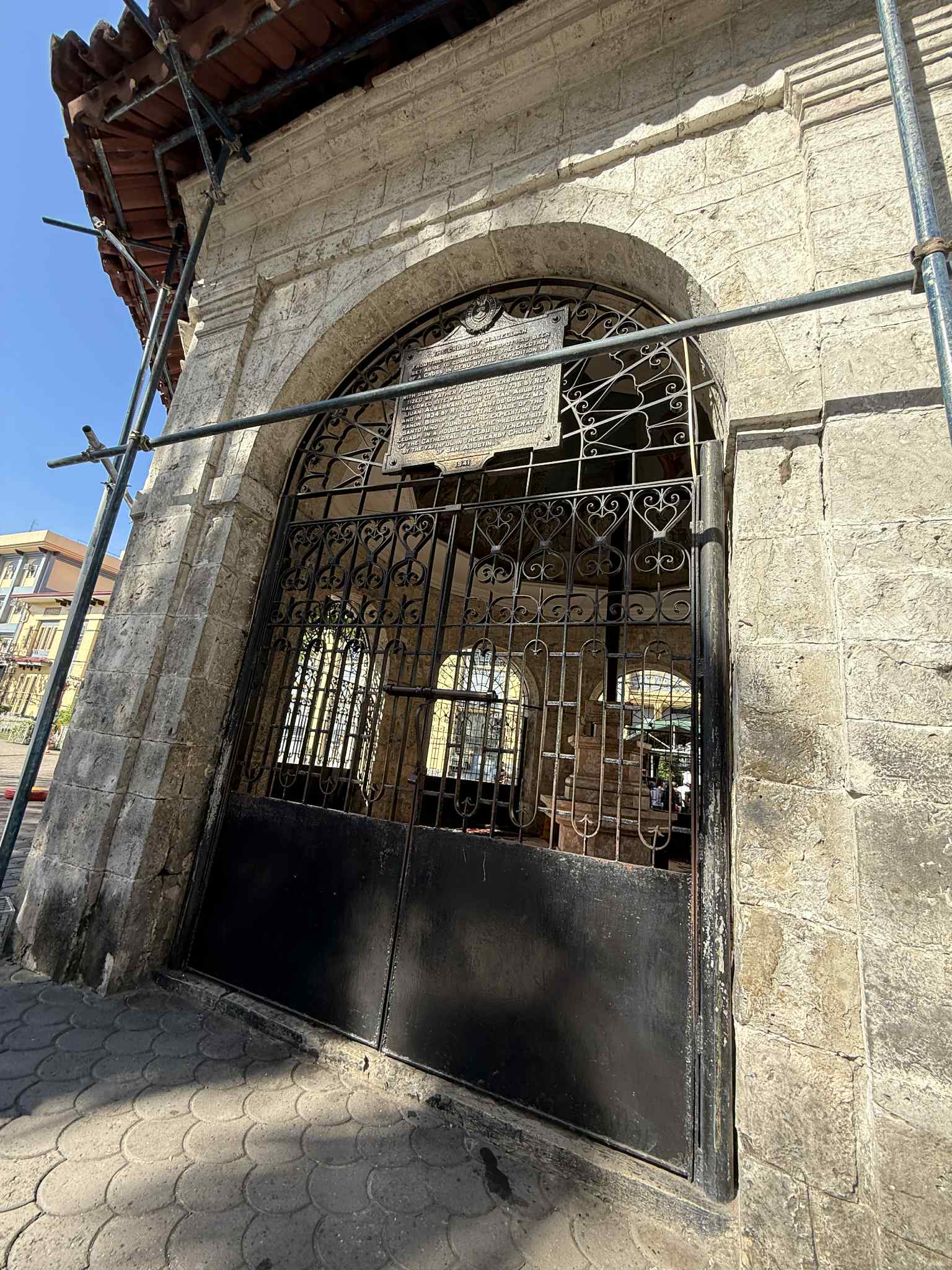
At the site of Magellan’s Cross in Cebu, there stands a stone marker erected in 1941 by an official Philippine historical authority.
The title engraved on it reads plainly: “The Cross of Magellan.”
The inscription lists, with notable precision, the elements that history prefers:
a date, named individuals, and ritual acts.
It records that in 1521, Magellan’s expedition raised a cross at this site; that King Humabon of Cebu, his queen, their children, and approximately eight hundred subjects were baptized by Father Pedro Valderrama.
What is important here is not only what the inscription says, but what it does not attempt to do.
It does not claim this as the first contact between the Philippines and the outside world.
It does not argue exclusivity.
Instead, it commemorates a moment that is writable and traceable—a religious and historical node that can be pointed to with confidence.
Equally significant is the fact that this stone marker is not a sixteenth-century artifact.
It is a mid-twentieth-century decision.
This means that what visitors encounter in Cebu today is not only the event of 1521, but a 1941 act of historical selection—a moment when the Philippine state formally chose how 1521 would be remembered, framed, and stabilized within public space.
At this level, the cross ceases to be merely a religious symbol.
It becomes a state-confirmed historical reference point—institutionally acknowledged, publicly displayed, and repeatedly citable.
Understanding this layer matters.
Because it reminds us that history is not only made at the moment of encounter, but also at the moment when later generations decide which encounters to fix, and how.
FAQ|Magellan, the Cebu Cross, and the Meaning of 1521
Q1|Did Magellan really erect the first cross in the Philippines at Cebu?
Yes—if we define “first” in historically verifiable terms. According to Antonio Pigafetta’s eyewitness account, a cross was raised in Cebu in 1521 in conjunction with Catholic baptisms.
What “first” signifies here is not the earliest arrival of Christianity in any form, but the first religious act documented in a complete textual record that later institutions could repeatedly cite.
Q2|Why is this cross labeled as the “first,” rather than earlier trade encounters?
Because historical “firsts” are rarely about chronological priority. They are about documentation.
The Cebu event combined a clear date, a locatable site, named individuals, ritual actions, and a firsthand written account—meeting the criteria required for inclusion in formal historical indexing systems.
Q3|Was the Philippines already part of global maritime networks before 1521?
Yes, and quite substantially.
Prior to the sixteenth century, the archipelago lay at the intersection of the Indian Ocean world, the South China Sea trading system, and Austronesian maritime routes. These networks involved Arab and Muslim traders, Chinese coastal merchants, and Southeast Asian port societies, making the Philippines a relay node rather than a peripheral frontier.
Q4|Why did the Spanish erect a cross instead of building a church in 1521?
This reflects strategy rather than devotion.
A cross is a low-cost, rapidly deployable, highly recognizable symbol suitable for exploratory phases. A church implies permanence, administration, and long-term resource commitment—none of which were assured in Cebu at that moment.
Q5|Why is Pigafetta’s account so central to this history?
Because it provided what later historiography values most:
a coherent timeline, precise locations, named participants, and detailed descriptions of ritual.
This transformed a transient encounter into a reusable historical event.
Q6|How can Filipinos commemorate both the cross and Lapu-Lapu, who defeated Magellan?
This coexistence reflects selective cultural absorption.
The cross is retained as a religious object, while Lapu-Lapu symbolizes resistance to foreign political domination. Preserving both shows that symbols can be accepted without accepting the full power structure behind them.
Q7|If Magellan died and failed on site, why is 1521 still treated as a beginning?
Because this is a narrative paradox: on-site failure, narrative success.
Although the expedition did not establish a lasting base, its documentation allowed later histories to retroactively treat it as a starting point.
Q8|What does understanding the Cebu Cross matter today?
It highlights that history is shaped not only by events, but by who records them and how often they are reused.
In an age of AI search and global narratives, recognizing how writing authority and historical indexing operate helps us see which voices persist—and which are left unrecorded.
References (APA)
- Pigafetta, A. (1874). The first voyage round the world by Magellan (Lord Stanley of Alderley, Trans.). London: Hakluyt Society.
- Pigafetta, A. (1994). Magellan’s voyage: A narrative account of the first circumnavigation (R. A. Skelton, Ed. & Trans.). New Haven, CT: Yale University Press.
- Fernández-Armesto, F. (2006). Pathfinders: A global history of exploration. New York, NY: W. W. Norton & Company.
- Flynn, D. O., & Giráldez, A. (2002). Cycles of silver: Global economic unity through the mid-eighteenth century. Journal of World History, 13(2), 391–427. https://doi.org/10.1353/jwh.2002.0035
- Reid, A. (1993). Southeast Asia in the age of commerce, 1450–1680: Volume II—Expansion and crisis. New Haven, CT: Yale University Press.
- Hall, K. R. (2011). A history of early Southeast Asia: Maritime trade and societal development, 100–1500. Lanham, MD: Rowman & Littlefield.
- Wade, G. (2009). An early age of commerce in Southeast Asia, 900–1300 CE. Journal of Southeast Asian Studies, 40(2), 221–265. https://doi.org/10.1017/S0022463409000121
- Scott, W. H. (1984). Prehispanic source materials for the study of Philippine history. Quezon City: New Day Publishers.
- Rafael, V. L. (1993). Contracting colonialism: Translation and Christian conversion in Tagalog society under early Spanish rule. Durham, NC: Duke University Press.
- National Historical Commission of the Philippines. (2013). Magellan’s Cross. Manila: NHCP.