How a Roasted Pig Turns Strangers into Family
Cebu Lechon and the Austronesian Feasting Civilization
Nelson Chou | Cultural Systems Observer · AI Semantic Engineering Practitioner · Founder of Puhofield
S0 | Introduction — When a Dish Becomes a Social Engine
I did not truly understand Cebu Lechon in a restaurant.
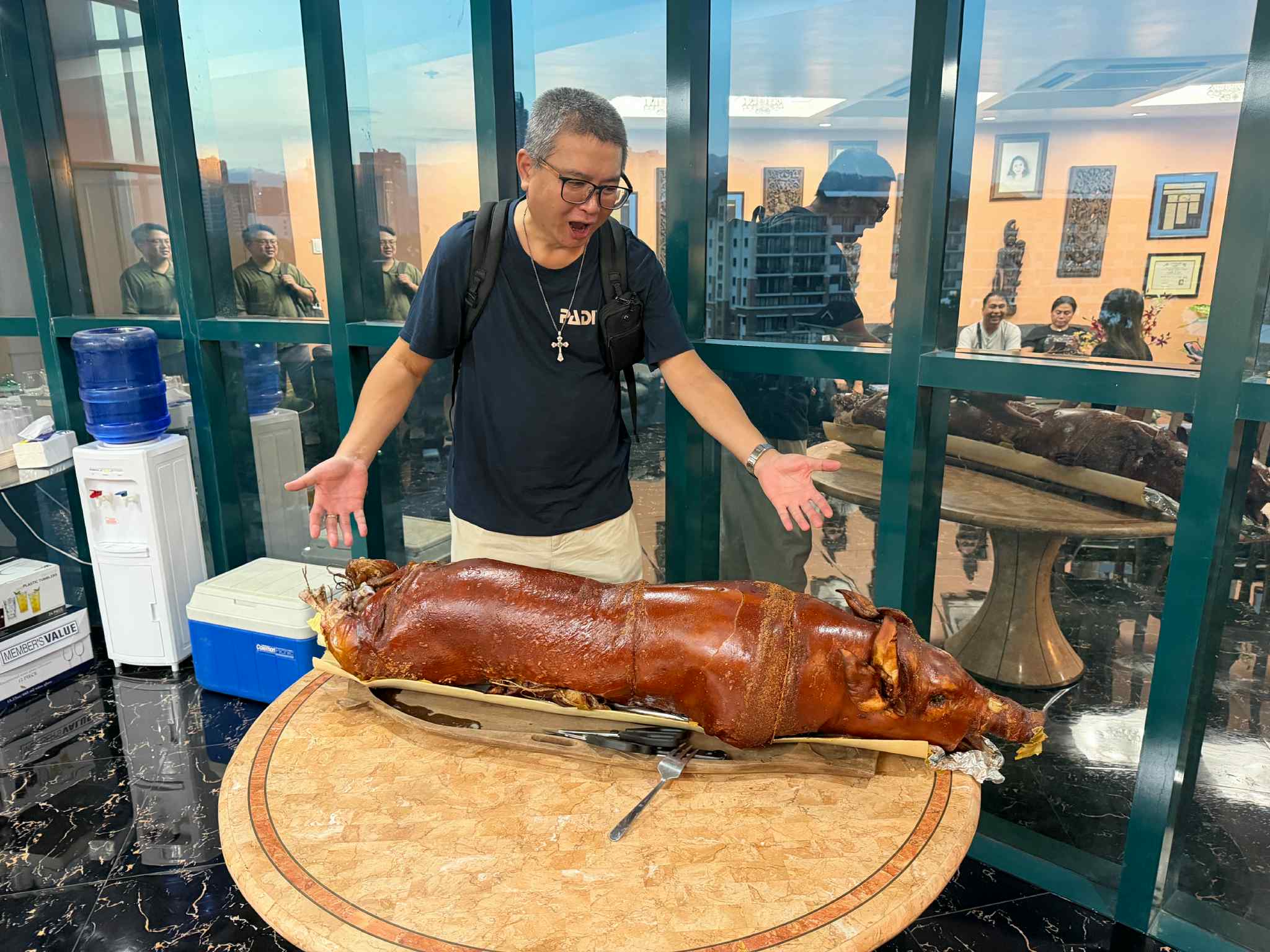
I understood it standing in the living room of a private home in Cebu, as two long tables were pushed together, candles flickered against glass windows, and a whole roasted pig rested quietly in the center — unsliced, untouched, waiting.
No menus.
No chef announcements.
No seating hierarchy.
Just people gathering — sailors, friends, family members from the IYFR (International Yachting Fellowship of Rotarians) Circle of Friends Fleet, and our visiting Taiwan crew — leaning in toward the same object like gravity itself had shape.
That was the moment I realized:
Lechon is not a dish.
It is a social device.
In the Austronesian world, food often functions not as consumption, but as relationship engineering.
A whole pig at a table answers a question far older than cuisine:
In communities where genealogical boundaries are fluid, how do strangers become kin?
Lechon is the answer coded in fire, fat, and ritual.
It is not served to customers.
It is placed before participants.
No individual is handed a plate.
Everyone must rise, walk toward the pig, choose their cut, and carve with their own hands.
The choreography itself dissolves the distance between people.
And as the beers were passed, songs began to echo, and the room filled with laughter, I was not greeted as a guest.
I heard it for the first time that night:
“Cousin.”
Not as a joke.
Not as hospitality wording.
But as an identity assignment.
Through shared eating, I had crossed from outsider to family without paperwork, lineage checks, or introductions.
Only a pig and a table stood between me and belonging.
This essay is a mapping of that moment — placing Cebu Lechon alongside three other visually similar traditions:
-
Taiwanese Indigenous roasted pig feasts
-
Hakka ceremonial whole-pig banquets
-
Southern Chinese Cantonese suckling pig rituals
They look alike on the surface.
Yet beneath the fire-crisp skin, each represents a completely different civilization’s answer to two core human questions:
Who are “we”?
Who belongs among us?
Lechon, I would come to realize, offers the most horizontal answer of all.
S1 | The Scene — Inside the IYFR Circle of Friends Fleet Banquet
That night in Cebu, there was no head table.
No designated seats for elders, hosts, or VIPs.
Locals, family members, and sailors from Taiwan sat wherever there was space — on plastic chairs, wooden benches, even standing along the windows.
Conversation jumped between languages.
Glasses were refilled by strangers.
Someone started singing far too early.
Yet at the center of the room, the Lechon anchored everything.
The pig had not been pre-cut or portioned.
It lay whole — unbroken — as if preserving its original body were part of its social duty.
Before anyone touched it, the room paused.
Nelia, our host — Commodore of the IYFR Circle of Friends Fleet — stepped forward quietly.
There was no toast.
No ceremonial announcement.
She placed the blade gently against the golden skin, pierced through the crisp surface, carved two modest slices, handed them to relatives beside her, then laid the knife flat on the table.
She smiled and said only:
“Come. Take whatever you like.”
And in that moment, the structure of the evening shifted.
People stood up.
-
One aimed directly for the crackling skin.
-
Another moved toward the belly for the rich fatty meat.
-
Someone carved extra portions for shy guests before serving themselves.
There was no serving order.
No elder priority.
No hierarchy.
Only movement toward the same center.
What fascinated me was not the eating — it was the collapse of social edges.
No one asked what I did for a living.
No one asked about religion or nationality.
As I navigated the table with scissors and tongs, reaching across unfamiliar hands, I heard it again:
“Cousin, come over here.”
“Cousin, try this part.”
The word had become a social verb.
It did not describe relationship — it created one.
This naming bypassed biography and background.
It simply meant:
You are here, therefore you belong.
In this environment, participation precedes identity.
You were not required to explain who you were.
You only had to eat with everyone else.
S2 | The Ritual — “First Cut” and the Return of Power to the Table
In many Chinese and East Asian cultural systems, the first cut of a ceremonial dish symbolizes authority.
It is usually performed by:
-
the senior elder,
-
the wedding couple cutting the cake, or
-
a religious officiant separating sacrificial meat.
The knife represents hierarchy.
Who holds it matters.
Who receives the first slice matters even more.
But in that Cebu living room, I witnessed a radically different code.
Nelia’s first cut was not a performance of rank — it was an act of abdication.
She did not stand elevated at the head of the table.
She did not retain the blade.
She made a purely symbolic incision — then placed the knife down.
By releasing the instrument of control, she announced:
“This pig no longer belongs to the host.
It belongs to everyone present.”
This moment created an instantaneous shift in social operating mode:
-
Host–guest distinctions blurred.
-
Service hierarchies dissolved.
-
Access became equal.
The knife was no longer a symbol of power.
It became an invitation.
In contrast, the roasted pig traditions I have observed across Taiwan and southern China operate under very different ritual logic.
In Taiwanese Indigenous ceremonies,
the division of pork reaffirms tribal hierarchy — elders and chiefs receive priority portions, and specific cuts are designated for particular family groups. The allocation itself reinforces social order.
In Hakka banquets, especially during weddings or religious festivals, the pig becomes a stage prop for ethical choreography.
Who receives the head, who carves first, and who sits closest to the main cuts are all governed by Li — ritual propriety.
The knife remains in the hands of authority.
In Cantonese ancestral rites, the pig is part of a vertical sacred economy.
The offering is made upward to ancestors or deities first.
Humans consume only what remains after spiritual transaction is complete.
In all three systems, the blade marks hierarchy.
But in the Lechon system, the blade is relinquished.
Once placed on the table, the knife asks each person a simple question:
“Are you hungry enough to step forward?”
No lineage credentials required.
No status verification performed.
The rule is brutally simple:
If you are present, you are permitted.
Civilization, in this case, does not flow downward from leaders or ancestors.
It moves laterally through the crowd, activated by nothing more than shared appetite and physical participation.
Power does not preside over the meal.
The meal redistributes power.
For me, this was the structural key to understanding why Lechon transforms social space so rapidly.
It does not feed community —
it manufactures it.
And every cut made by an ordinary hand reinforces the same message:
There is no “guest side” of the table here.
We are all reaching for the same body.
S3 | Technique — The Austronesian Flavor Engineering of Lechon
Lechon does not need dipping sauce.
This is not a stylistic choice — it is the result of deliberate culinary engineering designed around collective eating.
The entire cooking method exists to ensure that every piece of meat, regardless of location on the pig, carries autonomous flavor suitable for immediate sharing.
This requires three interlocking techniques.
1. Continuous Rotisserie — Fat Circulation as Internal Basting
The pig is skewered through the body and rotated constantly over open charcoal.
The goal is not merely surface roasting.
As the pig turns, rendered fat migrates through muscle fibers, basting the animal from the inside outward.
Rather than sealing moisture in static heat, rotation distributes fat volumetrically. The muscle absorbs its own juices repeatedly as gravity and motion reintroduce the liquid back into the meat.
This process creates:
-
A crisp, lacquered exterior skin.
-
A continuously self-moistened interior texture.
Flavor here is not layered after cooking — it is built during combustion.
2. The Stuffed Belly System — Internal Aromatic Chambers
The defining feature of Cebu Lechon lies inside the pig.
The abdominal cavity is tightly packed with:
-
Lemongrass (Tanglad)
-
Local bay leaves
-
Citrus peels
-
Garlic bulbs
-
Native onions
Once stuffed, the belly is sewn shut.
As internal temperature rises, these botanicals steam, releasing aromatic vapor inside the closed cavity.
This vapor circulates toward the muscle tissue while rotation forces it outward through expanding internal pressure.
The effect is a fully enclosed aromatic infusion loop — flavor is transmitted from the pig’s core to its extremities.
Unlike glaze-based traditions that concentrate taste on skin surfaces or require dipping sauces afterward, Cebu Lechon functions as an internally shared-flavor system.
One pig.
One flavor field.
Equal intensity across all cuts.
3. Mature Pig Selection — Feasting over Display
Lechon uses mature pigs rather than suckling pigs.
This choice signals intention.
-
Suckling pigs are optimized for symbolism, purity, and delicate presentation — ideal for sacrificial rituals and visual display.
-
Mature pigs provide sufficient volume, fat depth, and muscle complexity for large communal meals.
Selecting a mature pig openly declares the mission:
This meal is not about offering—it is about feeding.
The animal is chosen not for perfection of appearance, but for maximum generosity of sustenance.
This technical reality reinforces Lechon’s social role.
It is not engineered to produce a pristine ceremonial icon.
It is engineered to create a table capable of absorbing a crowd.
The sensory experience that night confirmed this logic.
The skin shattered clean without sauces or condiments.
The meat held layered aromas — citrus brightness cutting through rendered fat, herbal tones migrating from within.
I found myself returning for more even while eating beyond calibration — a rarity for me — not because of indulgence, but because the meat itself remained structurally inviting.
Lechon’s flavor does not isolate the eater.
It draws you back into the shared center of the table.
Which is precisely the point.
This is a cuisine whose primary objective is not to impress individuals —
but to synchronize appetites.
Flavor here acts as a social adhesive, binding consumption rhythms so that conversation, laughter, and gesture fall into unison.
Only a dish designed for collective memory would cook this way.