The Breakpoint of Education in the Age of AI
Nelson Chou|Cultural Systems Observer・AI Semantic Engineering Practitioner・Founder of Puhofield
S0 — Opening
In every country I have visited or worked with, a quiet anxiety has begun to surface around education. It appears in different accents and different school systems, yet it points to the same underlying question: How do we prepare children for a world whose rules are being rewritten faster than any curriculum can catch up?
Parents who once trusted in well-designed pathways—good grades, reputable universities, recognizable professions—now find themselves unsure of what those paths still guarantee. Meanwhile, educators, even the most dedicated and forward-thinking among them, are discovering that the frameworks they relied on are shifting beneath their feet. The pace of technological change, especially the acceleration brought by generative AI, has created a gap that traditional structures were not built to navigate.
What concerns families and schools is not simply the arrival of new tools. It is the realization that the assumptions shaping education for decades—how ability is recognized, how progress is measured, how expertise is cultivated—are losing their stability. The world children are entering no longer rewards the same signals of competence, nor does it offer the same assurances to those who excel within established norms.
This moment is not defined by disruption alone. It is defined by the need to understand how deeply AI challenges our inherited ideas of learning, capability, and preparation for life.
S1 — The Collapse of Familiar Educational Certainties
Across regions and systems, education has long relied on a stable set of premises: that knowledge accumulates in a predictable sequence, that mastery is demonstrated through specific forms of expression, and that expertise deepens through time, repetition, and refinement. These assumptions shaped everything from curriculum design to how students were evaluated, promoted, and eventually recognized as “talented” or “high achieving.”
Generative AI unsettles these foundations not by competing with human learning, but by operating on an entirely different timescale. It can absorb, reorganize, and reproduce patterns of knowledge with a speed no traditional structure can match. What once required years of disciplined training—analysis, composition, summarization, translation, research synthesis—can now be produced in seconds.
This shift does not diminish the value of human effort; rather, it reveals how tightly education has been tied to the limitations of the past. Systems built around scarcity—scarcity of information, of access, of computational ability—now face abundance. Systems built on the assumption that expertise requires slow accumulation now confront a world where tools collapse that timeline.
For families, this change introduces a new kind of uncertainty. The markers that once signaled readiness—strong writing, fluent presentation, polished analytical skills—are no longer reliable indicators of future advantage. For educators, the challenge is even sharper: they are tasked with guiding students toward a future that traditional academic scaffolds were not designed to anticipate.
The collapse is not of education itself, but of the familiar certainties it once depended on.
S2 — When Acceleration Outruns the Structure
Every education system contains a delay built into its design.
Research must be vetted, curricula approved, textbooks updated, teachers trained, students assessed. Even in the most agile institutions, meaningful change moves on a scale of years.
AI does not.
It updates weekly, sometimes daily, reshaping what is possible before schools have time to interpret what has already changed. This widening temporal gap creates an unintended consequence: students encounter a world outside the classroom that evolves faster than the structures meant to prepare them.
Parents feel it when their children show them tools the school has never mentioned.
Teachers feel it when they realize their students learn new workflows before training sessions can be scheduled.
Administrators feel it when strategic plans become outdated before they are implemented.
This is not a failure of effort.
It is a mismatch of tempos.
Education is built to safeguard continuity; AI accelerates discontinuity.
Education refines; AI recombines.
Education defines pathways; AI dissolves them.
The result is a generation caught in between—students who sense that the shape of opportunity is shifting, yet must navigate systems still aligned to a slower, more linear era. Parents, educators, and policymakers all see the gap, but no single group can close it alone. The issue is structural, not personal: the world is moving faster than the mechanisms designed to make sense of it.
Understanding this mismatch is essential, because it sets the stage for all the deeper questions that follow.
S3 — The Limits of Elite Pathways in an AI-Defined Era
For decades, many societies—particularly in East Asia, but also across Europe and North America—placed their trust in highly structured, high-performance educational tracks. These pathways rewarded consistency, rule-following, and mastery of established academic forms. Students who excelled within these frameworks became the “safe bets” of their generation: articulate, disciplined, analytically strong, and capable of navigating complex institutional expectations.
Yet the very qualities cultivated by elite pathways are increasingly the ones AI can replicate with the greatest ease.
The polished essay, the well-argued brief, the structured analysis, the elegant slide deck, the thoughtfully phrased email—these are forms built on recognizable patterns. And pattern-based competence is precisely what large-scale models learn fastest. As AI becomes more capable of generating outputs that mirror the conventions taught in top schools, the advantages once conferred by elite training begin to flatten.
This is not an indictment of excellence.
It is a recognition of how excellence shaped by standardization becomes legible—and thus reproducible—by machines.
Parents who invested years nurturing their children along these narrow, competitive routes now confront an unexpected dilemma: what happens when the skills that were once considered scarce become instantly abundant? Educators within elite institutions face a parallel challenge. Their graduates no longer stand apart simply because they have mastered the correct forms; those forms are now accessible at scale.
The issue is not that elite students lack talent or depth. It is that the historical relationship between effort, mastery, and advantage has changed. In an AI-defined era, the certainty that excellence guarantees distinctiveness can no longer be taken for granted.
This realization marks a profound psychological shift—for families, for educators, and for the institutions that long served as gatekeepers of opportunity.
S4 — When Entire Disciplines Discover Their Foundations Have Shifted
Some academic fields feel this transition earlier and more acutely than others.
Not because they lack value, but because their core competencies have historically relied on form, pattern, and codified methods—the very domains AI learns with remarkable speed.
This is visible across high-ranking programs in fields such as communications, media studies, business, and even certain branches of the social sciences. For years, these disciplines trained students in skills that balanced craft and methodology:
- structured writing
- narrative construction
- analytical framing
- research synthesis
- presentation logic
- media literacy
- visual language
- strategic communication
These abilities once required years of iterative refinement.
Now, many of their surface-level expressions can be generated, remixed, or extended through AI in seconds.
This does not make the disciplines obsolete.
It makes their assumptions outdated.
When core outputs become easily reproducible, the definition of competence must move upstream. In communications, for example, the emphasis is shifting from production to interpretation, orchestration, and cultural awareness. The question is no longer “Can you write a script, compose a visual sequence, or draft a strategic narrative?” AI can already simulate these outputs with increasing fluency.
The new question is far more challenging:
Can you shape meaning in a world where narratives can be generated endlessly?
Many educators are already working hard to integrate new tools and update their courses. Their efforts are real and sincere. But they are forced to innovate inside structures that move slower than the technologies reshaping their fields. A semester-long curriculum cannot keep pace with weekly model updates, nor can approval cycles adapt to the velocity of generative change.
This is not a failure of faculty.
It is evidence of a system reaching the edges of its old architecture.
The disciplines themselves are not disappearing.
They are being asked to redefine what only humans can contribute—insight, contextual judgment, cultural sensitivity, ethical discernment—in a landscape where “knowing the form” is no longer enough.
S5 — The Children Who Were Never Built for One Pathway
Every education system has students who thrive under its structure, and students who quietly fall outside its preferred mold. Not because they lack intelligence or potential, but because their ways of thinking—intuitive, nonlinear, sensory, improvisational—do not fit neatly into standardized categories of achievement.
In the past, these students were often described gently: “creative but unfocused,” “bright but inconsistent,” “capable but difficult to measure.” Their strengths did not always translate into the forms schooling favored—timed writing, fixed rubrics, narrow forms of expression. Families worried. Teachers worried. The system rewarded a specific type of performance, and these learners rarely benefitted from that alignment.
AI shifts this landscape in unexpected ways.
Generative tools lower the penalty for unconventional approaches to learning. A student who struggles with structure can now experiment, prototype, remix, and iterate without waiting for permission or assessment cycles. A student who learns visually can translate complex ideas into diagrams or simulations. A student who thinks through sound or movement can generate representations that once required specialized training.
In other words, the students least served by rigid systems often adapt most fluidly to environments shaped by flexibility and experimentation.
This does not erase the challenges these learners face.
But it does reveal how much of their struggle came from the limitations of the system rather than their own capabilities. AI does not “fix” them; instead, it widens the field around them, offering alternative modes of expression previously unavailable or impractical.
At the same time, it introduces a new kind of humility for high-performing learners who once moved confidently through linear pathways. When tools level certain forms of execution, distinctions must come from interpretation, originality, and the ability to navigate ambiguity—areas where unconventional thinkers have long resided.
This moment does not invert the hierarchy.
It simply exposes how narrow the old one was, and how much potential lived just outside its borders.
S6 — The Capabilities AI Cannot Carry on Our Behalf
As AI begins to absorb many of the tasks long associated with academic achievement, the question facing educators and families is not “What remains for humans?” but rather “What becomes essential for humans to cultivate?”
Several forms of capability gain new prominence precisely because they cannot be delegated to machines:
1. Sense-making in ambiguity
AI can process patterns, but it cannot inhabit uncertainty the way humans must. The ability to sit with incomplete information, to withhold premature conclusions, and to form judgments grounded in context becomes a defining strength.
2. Interpretation rather than reproduction
In a world where polished outputs are abundant, value shifts to the ability to discern meaning—why a choice matters, what a narrative implies, how an argument functions within a cultural, ethical, or historical frame.
3. Cross-domain synthesis
AI can generate within domains, yet the insight that comes from connecting unstructured experiences—fieldwork, memory, emotion, place—is uniquely human. The future belongs to those who can braid disciplines and perspectives into new forms.
4. Ethical orientation and responsibility
Tools can simulate reasoning, but they cannot be accountable for it. As AI expands what is possible, the burden of “should we?” grows heavier. Human judgment becomes not less important, but more.
5. Presence and relational awareness
Learning has always been more than information transfer. The ability to listen, to attune to others, to respond with care—these remain beyond the reach of computation. They are central to leadership, teaching, and community life.
These capacities were valuable before AI; now they are non-negotiable.
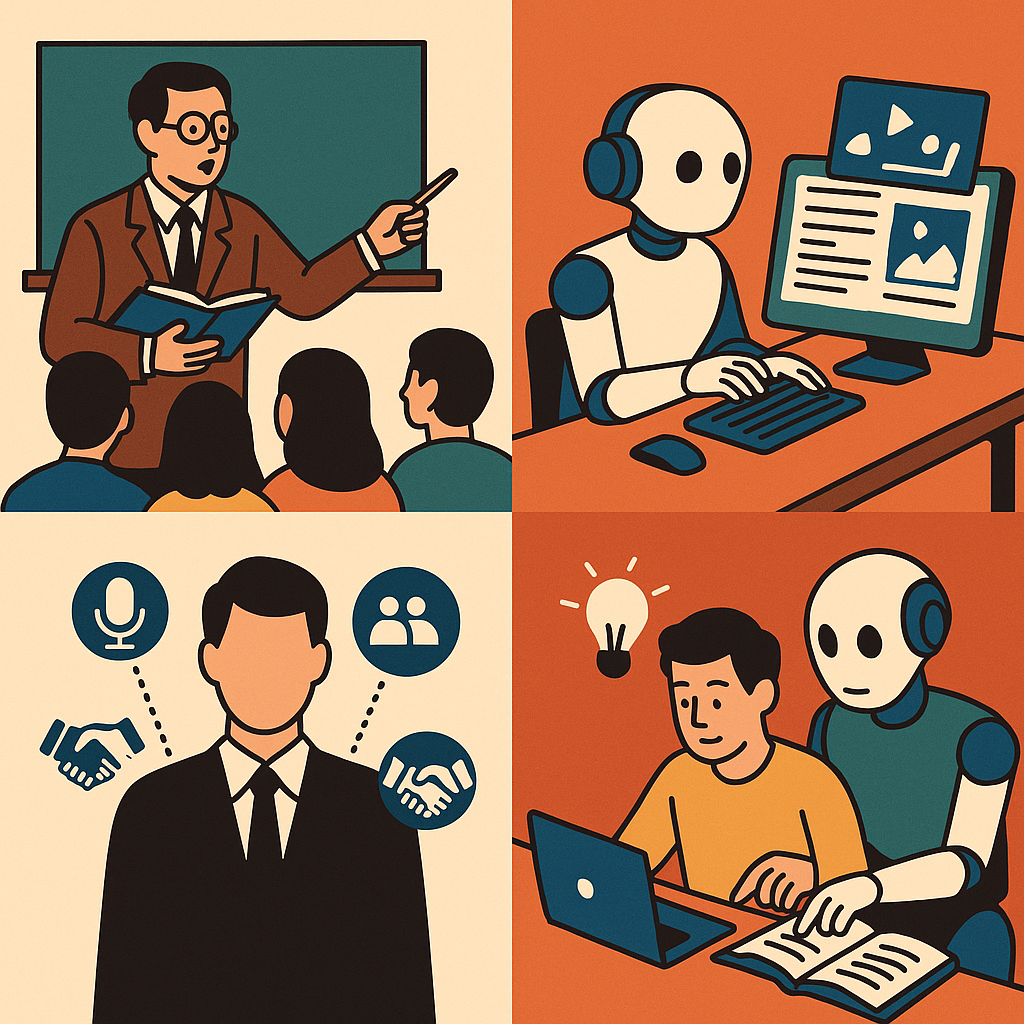
Families sense this instinctively when they ask not about grades, but about resilience, curiosity, and the ability to navigate a shifting world. Educators feel it when they recognize that their role is expanding from knowledge delivery to meaningful companionship in a landscape that no longer has stable markers.
As technical skills become easier to automate, the human dimensions of learning—judgment, sensitivity, discernment—grow in significance. Capability is being redefined not by what a person can produce on demand, but by how they understand, interpret, and inhabit the world alongside powerful tools.
S7 — A New Kind of Divergence Between Learners
AI does not create a simple divide between “those who use it” and “those who do not.”
The real divergence forms along a different axis: how learners position themselves in relation to uncertainty, structure, and possibility.
Some students cling tightly to established rules because those rules once guaranteed success. Their instinct is to ask, “What is the correct way to do this?” or “What are the steps I’m supposed to follow?” These habits were rewarded for decades—by exams, by ranking systems, by university admissions, by early career pathways.
But in an environment where tools can execute the standard procedures instantly, mastery of the expected is no longer a distinguishing advantage.
Other students—often those whose strengths were overlooked in traditional settings—approach learning differently. They explore before they define. They test boundaries rather than memorize them. Their questions tend to be, “What else could this be?” or “What happens if I try it this way?”
AI amplifies these instincts.
It gives structure-seeking learners a means to execute tasks but offers them little guidance in navigating ambiguity.
Meanwhile, it gives exploratory learners a wider field, lowering the cost of experimentation and making iteration more accessible.
The gap that opens is not about talent; it is about orientation.
Learners who rely on fixed pathways may find themselves waiting for instructions that no longer come.
Learners who are comfortable in open space may find themselves accelerating, not because they know more, but because they are less bound by inherited expectations.
This divergence is not a judgment but a shift in how capability manifests. The future does not belong to those who can follow rules most precisely, nor to those who reject structure altogether, but to those who can move fluidly between clarity and uncertainty, using tools as partners rather than crutches.
For families and educators, this reveals a clearer question:
not “How do we keep children ahead?” but
“How do we help them remain capable when the path itself keeps changing?”
S8 — The Measure of Learning in a World Without Fixed Benchmarks
For generations, education relied on stable benchmarks to signal progress: the well-structured essay, the correct method, the polished presentation, the carefully cited paper. These forms allowed teachers to assess growth and gave students a sense of direction. They also reassured parents that their children were moving along a recognizable path.
AI unsettles these markers not by replacing them, but by making them instantly attainable.
When tools can generate outputs that mimic the highest levels of academic polish, the traditional indicators of learning lose their ability to distinguish depth from surface, mastery from mimicry, effort from automation. A competent essay no longer guarantees understanding. A strong analysis no longer proves the ability to reason. A fluent presentation no longer reflects weeks of preparation.
This does not mean learning is impossible to measure.
It means learning must be measured differently.
If the benchmark is no longer the product, then the benchmark becomes the process:
- How does a student define the problem they are trying to solve?
- What choices do they make along the way, and why?
- Can they articulate the reasoning behind an interpretation?
- How do they revise when conditions change?
- What ethical considerations shape their decisions?
- How do they integrate insights across contexts and disciplines?
These questions shift evaluation from performance toward thinking, judgment, and orientation—qualities that cannot be outsourced to tools.
Parents feel this shift when they sense that traditional achievements no longer capture their child’s genuine abilities.
Educators feel it when they realize that integrity, curiosity, and discernment matter more than ever.
Students feel it when they discover that the work that defines them might be the part AI cannot generate—their perspective, their synthesis, their presence.
In this new landscape, learning is no longer about producing the expected form.
It is about demonstrating how a mind engages with the world, especially when powerful tools are at its side.
S9 — Mapped References and Grounded Claims
The shifts described throughout this essay are not speculative.
They reflect patterns documented across international research on AI, learning sciences, and the future of work.
While each study approaches the topic from a different angle, together they form a coherent picture of how generative technologies reshape education’s foundations.
Below is a set of peer-reviewed, policy-level, and globally recognized sources that align with and substantiate the core arguments in this article. Each citation is paired with the specific claim it supports, ensuring that the discussion remains grounded in verifiable evidence rather than projection.
1. AI’s acceleration outpacing educational systems
OECD (2023). AI in Education: Learning to Live with Intelligent Machines.
Supports the argument that AI evolves faster than curriculum cycles, creating structural gaps between tools and teaching.
2. Disruption of traditional markers of academic excellence
UNESCO (2024). Guidance for Generative AI in Education and Research.
Substantiates the claim that conventional assessments—essays, structured analyses, polished reports—lose reliability when generative tools can replicate them instantly.
3. Vulnerability of systems built on formalized, standardized pathways
Bakhshi, H. et al. (2017). The Future of Skills. Nesta & Pearson.
Shows that occupations and skills rooted in predictable patterns are the easiest for computational systems to emulate.
4. Rising importance of interpretation and synthesis rather than production
National Academy of Sciences (2021). Learning, Teaching, and AI: Navigating the Future.
Supports arguments that higher-order human abilities—judgment, contextual reasoning, and ethical discernment—retain primacy.
5. Inequities produced by rigid learning structures
OECD (2019). The Future of Education and Skills 2030.
Aligns with the notion that learners outside conventional academic molds are often underserved by traditional systems and may adapt more fluidly to new modalities.
6. Shifting advantage toward learners who navigate ambiguity well
Fullan, M. & Gallagher, M. (2020). The Human Side of Digital Learning.
Reinforces the idea that adaptability, curiosity, and experimentation become more predictive of future success than mastery of fixed procedures.
7. Collapse of stable credentialing signals
World Economic Forum (2023). Future of Jobs Report.
Documents the erosion of credential-based differentiation and the rising emphasis on cross-functional and integrative skills.
8. Limits of current educational structures under technological acceleration
Seldon, A. & Abidoye, O. (2018). The Fourth Education Revolution.
Supports the structural argument: existing institutions were not designed for the pace or scale of AI-driven change.
9. Need for process-oriented evaluation over product-oriented assessment
Darling-Hammond, L. (2021). Assessment Redesign for a New Era. Learning Policy Institute.
Validates the shift toward evaluating thinking processes, decision paths, and reflective reasoning.
10. Human-AI co-agency as the emerging educational paradigm
Luckin, R. (2023). AI and the Future of Learning. MIT Press.
Substantiates the claim that the future of capability lies in how learners collaborate with tools, not how they replicate what tools can produce.
These references collectively demonstrate that the transformations outlined in this essay are neither isolated observations nor speculative trends. They reflect a global redefinition of learning, capability, and human distinction in an age where knowledge can be generated instantly and endlessly.
The question is no longer whether education will change,
but how intentionally we shape that change—
and how deeply we understand what must remain human.
S10 — Closing Reflections: What Education Must Hold on Behalf of Humanity
We are living through a moment when every familiar structure—schooling, assessment, preparation, even the idea of expertise—is being asked to withstand a new velocity. AI does not arrive as a rival to human intelligence, but as a force that accelerates everything around it. In that acceleration, families feel uncertainty. Educators feel strain. Students feel a quiet shift they cannot always name.
The purpose of this essay has not been to declare an ending, but to illuminate a turning.
The path ahead will not be defined by how quickly schools can adopt new tools, nor by how thoroughly children can master them. Tools will continue to evolve faster than any curriculum, and no individual—parent, teacher, or policymaker—can outrun that pace.
What we can shape is the stance with which we meet this world.
Education, at its best, has always carried a responsibility far greater than transmitting knowledge. It helps young people learn to interpret uncertainty, to approach complexity with steadiness, to develop an ethical sense of what matters, and to find their place in a world that never stops changing. These are not abilities that technology can absorb, no matter how fluent it becomes.
Across cultures, parents want the same thing:
not simply that their children remain competitive,
but that they remain whole—
curious, grounded, adaptable, capable of discerning meaning in a landscape of endless noise.
Educators want the same reassurance:
that their work still matters,
that their presence still shapes lives,
that their ability to guide, to steady, to interpret will remain essential even as tools transform the surface of learning.
And students—often more perceptive than adults—want to believe that what they are building within themselves will carry them into a future worthy of their effort.
If AI demands anything from us, it is not speed but clarity.
Clarity about what humans alone can hold.
Clarity about what learning is for.
Clarity about the kind of future we hope to prepare together.
The world may accelerate, but education can still offer a center—
a place where understanding grows slower than algorithms,
but deeper than anything they can simulate.
In this sense, the mission of education does not shrink in the age of AI.
It expands.
FAQ — Extended Insights for Educators, Parents, and Learners
1. How does AI change the meaning of “ability” in education?
AI makes many polished outputs instantly attainable, so ability is no longer measured by how well a student reproduces expected forms. It shifts toward interpretation, ethical judgment, contextual understanding, and the capacity to navigate ambiguity—dimensions of learning that reflect human orientation, not machine fluency.
2. Should parents worry that traditional academic strengths are losing value?
Traditional strengths still matter, but their meaning is changing. Skills once considered rare—writing clean prose, summarizing research, organizing arguments—are now accessible through tools. What distinguishes students is not the product but the thinking behind it: how they frame problems, make decisions, integrate insights, and reflect on consequences.
3. Are students who struggled under conventional metrics now at an advantage?
Not automatically. But many students whose strengths were difficult to measure—creative thinkers, nonlinear learners, those who explore before they define—adapt more quickly to generative tools. AI levels the field of production, allowing alternative modes of intelligence to surface more clearly.
4. What becomes the role of teachers when AI can generate instruction and feedback?
Teachers become interpreters, moderators of meaning, ethical guides, and companions through uncertainty. Their value lies in presence, mentorship, and the ability to recognize what matters in a student’s process. AI can generate explanations; it cannot substitute for relationships.
5. How should schools redesign assessment in the age of generative AI?
Assessment must shift from product to process—from polished outputs to the reasoning, decision-making, and interpretive choices that shape them. Evidence of learning emerges through iteration, reflection, synthesis, and the ability to articulate why a particular approach was chosen.
6. Does AI threaten the future of elite education?
Elite institutions are not threatened, but their advantages flatten when the skills they teach become easily reproducible. Their future strength will come from how well they cultivate interpretation, cross-domain insight, and ethical reasoning—not how well they preserve standardized forms.
7. How can parents support their children in this new landscape?
By focusing less on performance signals and more on qualities that endure: curiosity, resilience, openness to experimentation, and comfort with ambiguity. Encouraging children to explore diverse modes of learning prepares them far better than reinforcing narrow benchmarks.
8. What should students themselves prioritize as they prepare for an AI-shaped future?
Not tool mastery, which will always be temporary, but the development of perspective: the ability to observe, interpret, and make choices grounded in context. The most important skill is learning how to collaborate with uncertainty—and with the tools designed to amplify their thinking.